Night vision security cameras let you see what happens around your home after dark, even in total darkness. Most home models use infrared light to record clear black-and-white video at night, while color night vision models use a sensitive sensor or a built-in spotlight to keep the picture in color. For most homes, a good night vision camera covers 30 to 100 feet (9 to 30 meters), and the right type depends on where you place it and what you need to identify.
That short answer hides one trap that catches a lot of buyers. The range printed on the box tells you how far the camera can light the scene, not how far it can identify a face. A camera rated for 100 feet of night vision may show you that someone stood at the end of your driveway, yet their face may stay too small and too dark to recognize. This guide shows you how night vision really works, how far each type reaches, what shrinks that range, and how to place your cameras so the night footage is actually useful.
How Night Vision Security Cameras Work
A night vision security camera does not see in the dark the way your eyes do. It cheats, in a clever way. It either brings its own invisible light, or it squeezes far more out of the little light that is already there. Most home cameras do the first one, and the better ones do both.
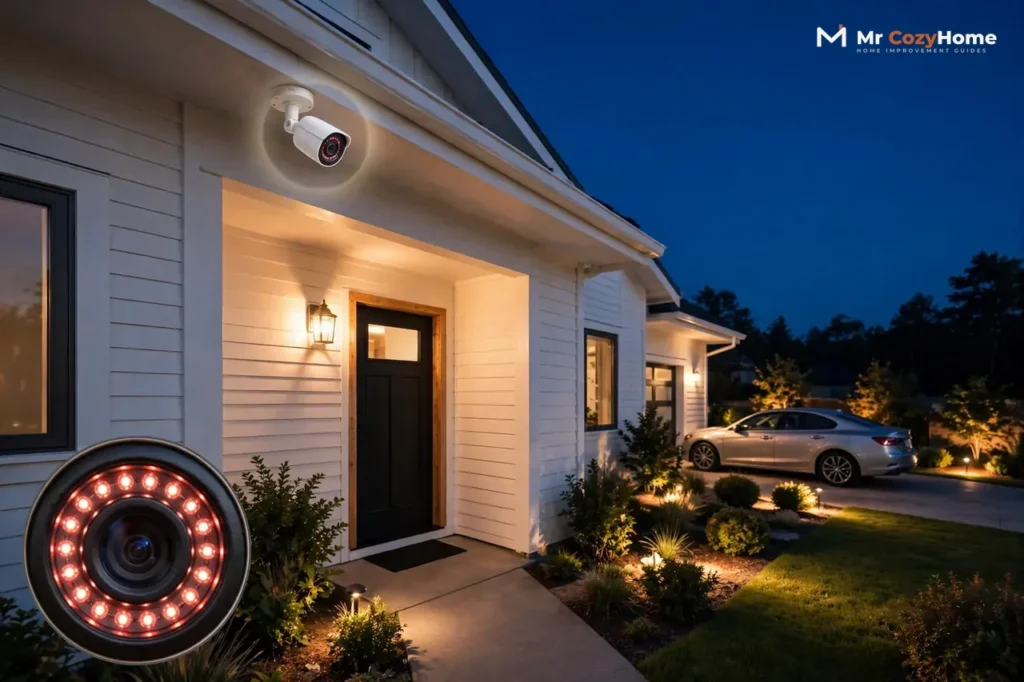
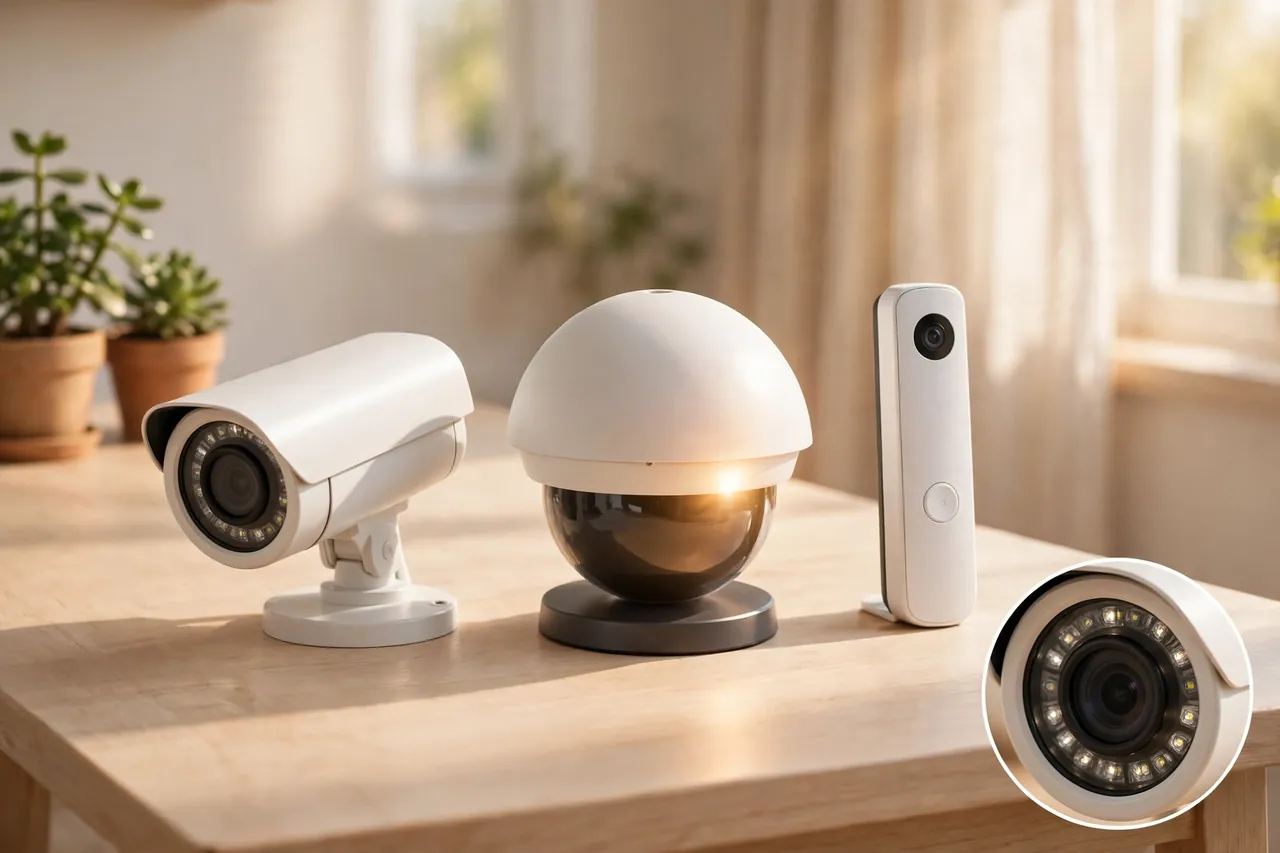
Here is the simple version. When daylight fades, a tiny light sensor in the camera notices the drop and switches the camera into night mode. The camera then turns on a ring of infrared (IR) LEDs around the lens. Those LEDs flood your yard or hallway with infrared light. You cannot see that light, but the camera sensor can, so it builds a picture from the light bouncing back. The result is the crisp black-and-white video you know from security footage.
The IR-Cut Filter Switch
During the day, your camera wears a filter. It is called an IR-cut filter, and it blocks infrared light so colors look natural. Without it, your daytime video would look washed out and strange. When night falls, a small switch slides that filter away from the sensor with a faint click. That click is normal, and it is the sound of your camera changing modes.
Once the filter moves aside, the sensor can drink in the infrared light from its own LEDs. That is why the same camera gives you true color by day and black-and-white video by night. If you ever hear a soft click at dusk and then see the picture turn gray, nothing is broken. Your camera just switched to night mode.
850nm vs 940nm Infrared LEDs
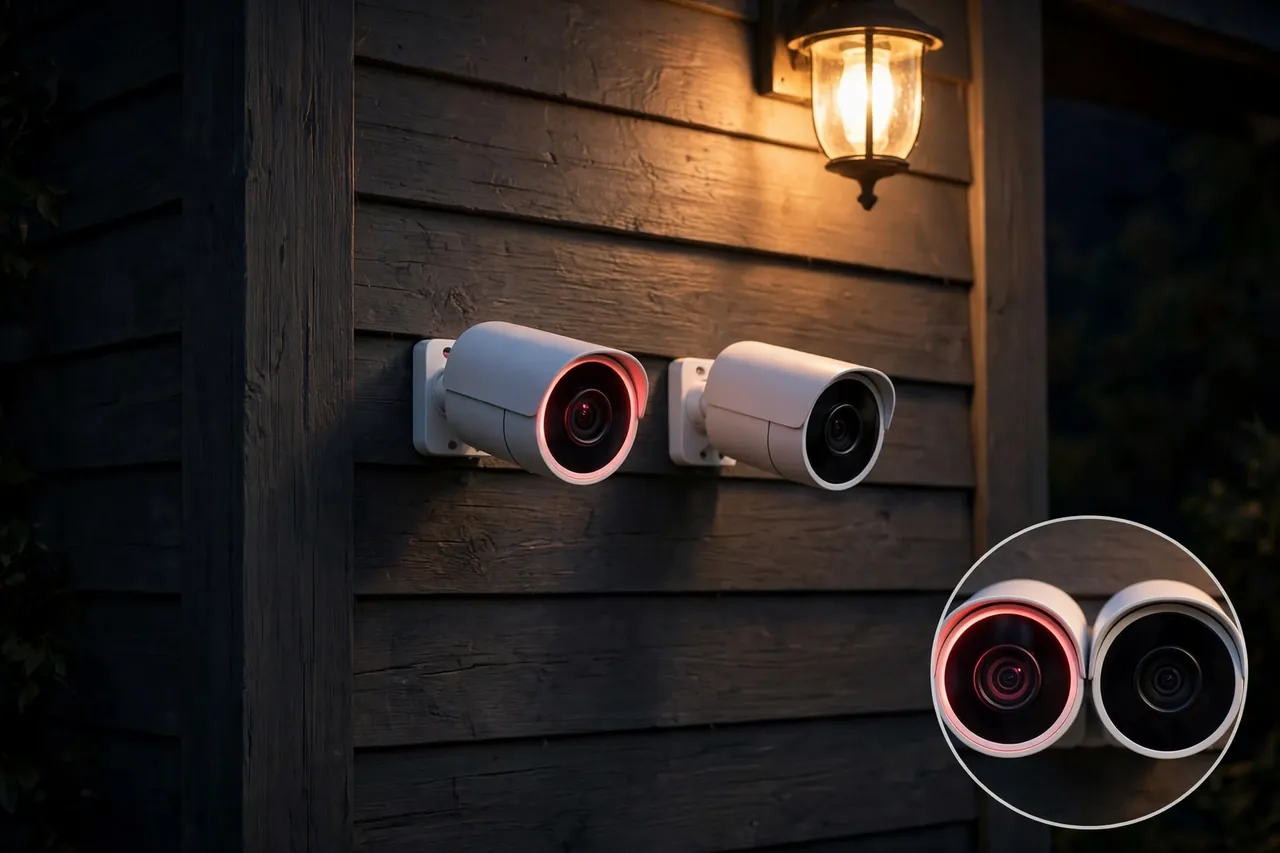
Not all infrared light is the same. Most home cameras use LEDs at one of two wavelengths, 850nm or 940nm, and the choice changes what you get. Cameras with 850nm LEDs throw light farther and brighter, but they give off a faint red glow you can spot up close. Cameras with 940nm LEDs are fully invisible to the human eye, yet they reach a shorter distance and give a dimmer picture.
For an outdoor camera watching a driveway or backyard, 850nm usually wins because reach matters more than stealth. For an indoor camera in a bedroom or a shared hallway, 940nm often wins because nobody wants a red glow in the room at night. Arlo’s own spec sheet for its Essential Security Camera (3rd Gen) lists dual 850nm IR LEDs with a night vision range of up to 25 feet (7.6 meters), which shows how a small battery camera trades reach for size. Check the spec sheet before you buy, because the wavelength and the range sit there in plain numbers.
Infrared vs Color Night Vision: Which One Should You Pick?
Infrared night vision and color night vision solve the same problem in opposite ways. Infrared brings its own light and records in black and white. Color night vision uses the light that is already there, or adds visible light with a spotlight, and records in color. Neither one wins everywhere, so match the type to the spot.
Color footage helps you identify people. You can see a jacket color, a car color, or hair color, and that detail can matter a lot when you describe what happened to the police. Infrared footage helps you watch a dark place quietly. It works in total darkness, uses less power, and never wakes the neighbors with a bright light. eufy puts the choice plainly in its night vision guide: use color night vision where you need to identify people, and infrared night vision where you only need to see movement or there is no light at all.
The table below sums up the choice so you can decide in seconds.
Night vision type at a glance
| Feature | Infrared Night Vision | Color Night Vision |
|---|---|---|
| Picture at night | Black and white | Full color |
| Works in total darkness | Yes | No, needs some light or a spotlight |
| Typical home range | 30 to 100 feet (9 to 30 meters) | 25 to 60 feet (8 to 18 meters) |
| Best for | Dark yards, side gates, quiet rooms | Front doors, porches, driveways |
| Power use | Low | Higher, spotlights drain batteries faster |
| Stealth | Nearly invisible, faint red glow at 850nm | Visible light, also deters intruders |
Many cameras now give you both modes in one body. They record in color while there is enough light, then switch to infrared when the scene goes fully dark. That combo is the easy choice for most homes. If you must pick one mode, ask yourself one question: do I need to identify who this is, or do I only need to know that someone is there? Identification points to color. Simple movement points to infrared.
How Color Night Vision Works
Color night vision leans on a large, sensitive image sensor and a wide-aperture lens. The sensor gathers every bit of light from a porch lamp, a streetlight, or the moon, and the camera’s software cleans up the noise. Starlight sensors, the high end of this type, can produce color video in very dim light, down to about 0.01 to 0.1 lux, which is roughly the brightness of a full moon or a dim streetlight, according to PCWorld’s night vision guide.
Some cameras add a built-in spotlight to the mix. When motion trips the sensor, the white light turns on and the camera records in color, just as it would in daylight. The sudden light also scares off many intruders, which is a real bonus. The trade-off is power. A spotlight eats battery life, and a light that fires all night can annoy your neighbors, so use it where it earns its keep.
How Thermal Imaging Differs
Thermal cameras are a third type, and they work nothing like the other two. They do not use light at all. They read the heat every object gives off and turn temperature differences into a picture. A warm person shows up bright against a cool yard, even behind light fog or thin bushes. That sounds perfect, yet thermal cameras cost far more than normal home cameras, and they show shapes and heat, not faces or license plates. For most homes, thermal is overkill. Infrared and color night vision cover the job at a fair price.
How Far Can Night Vision Security Cameras See?
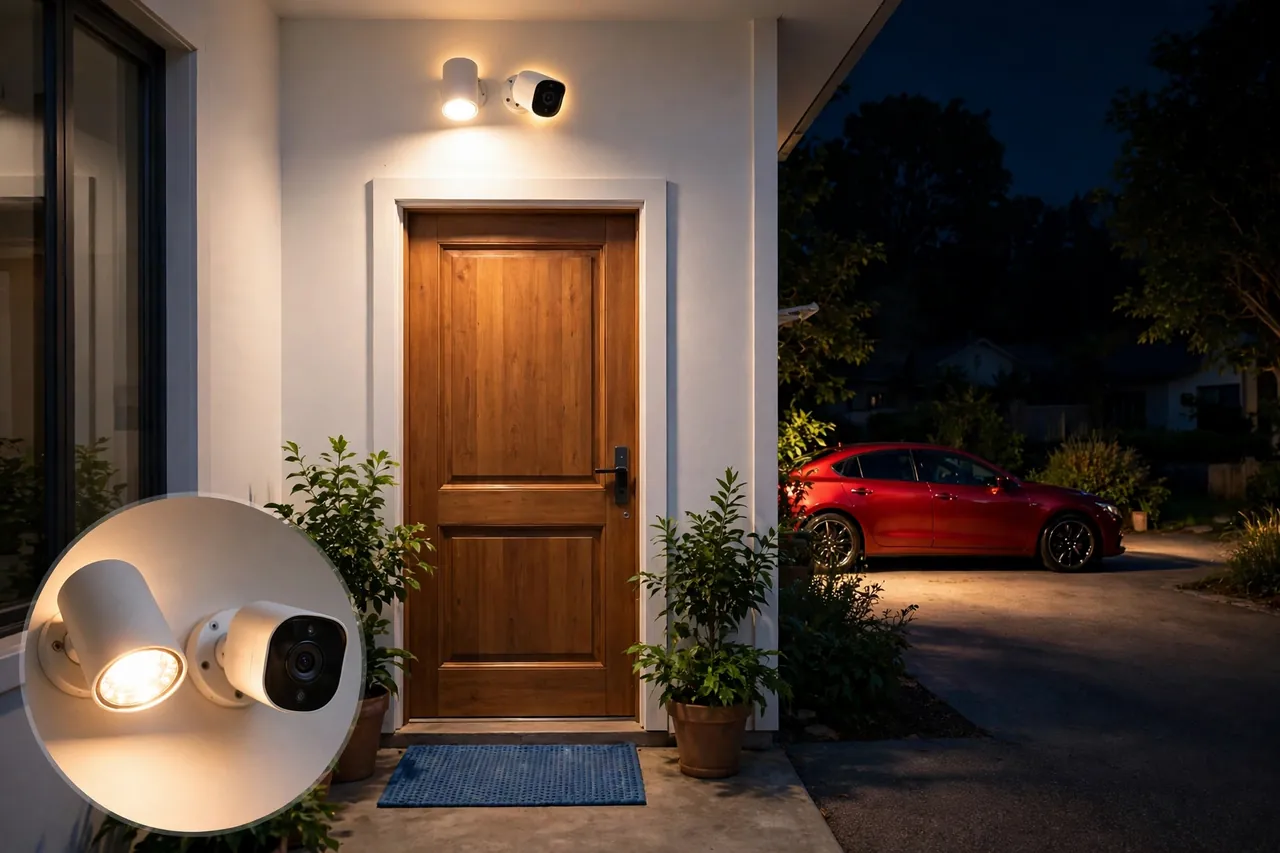
Most home night vision security cameras give you usable night monitoring at 30 to 100 feet (9 to 30 meters). Long-range models with strong infrared LEDs and optical zoom can light a scene 150 to 200 feet (46 to 61 meters) away. Small battery cameras sit at the short end: some Reolink battery models reach about 33 feet (10 meters), while Arlo’s Essential cameras list up to 25 feet (7.6 meters). At the long end, Reolink’s RLC-823S2 lists infrared night vision up to 80 meters (260 feet), and its RLC-810A lists about 100 feet (30 meters) of IR illumination. Reolink’s own range guide states these numbers plainly and warns that they describe illumination, not identification.
That warning matters more than the headline number. Reolink splits range into three levels, and each one means something different for your home.
- Detection: you can tell that a person or a car entered the scene. This works farthest, often at 50 to 100 feet or more.
- Recognition: you can tell it is a familiar person, a certain jacket, or a certain car. This needs a closer distance and more pixels on the subject.
- Identification: you can pick out a face or read a plate well enough to name it. This needs the subject large in the frame, and it is always the shortest range of the three.
So a camera rated for 100 feet of night vision may detect a person at 100 feet yet identify their face only at 15 to 40 feet (5 to 12 meters). That gap is normal, not a defect. When you shop, halve the advertised range in your head to guess the identification distance. If your driveway is 40 feet long and you want to recognize a face at the far end, buy a camera rated for at least 80 feet of night vision.
Night vision range by spot
| Spot Around Your Home | Distance You Need | What Works |
|---|---|---|
| Front door and porch | 15 to 30 feet (5 to 9 meters) | Wide-angle camera or doorbell, color mode |
| Driveway | 30 to 100 feet (9 to 30 meters) | 4K fixed camera, color or IR |
| Backyard | 30 to 80 feet (9 to 24 meters) | Wide-angle camera, IR mode |
| Long driveway or gate | 100 to 200 feet (30 to 61 meters) | Varifocal or zoom camera, strong IR |
What Affects Night Vision Range?
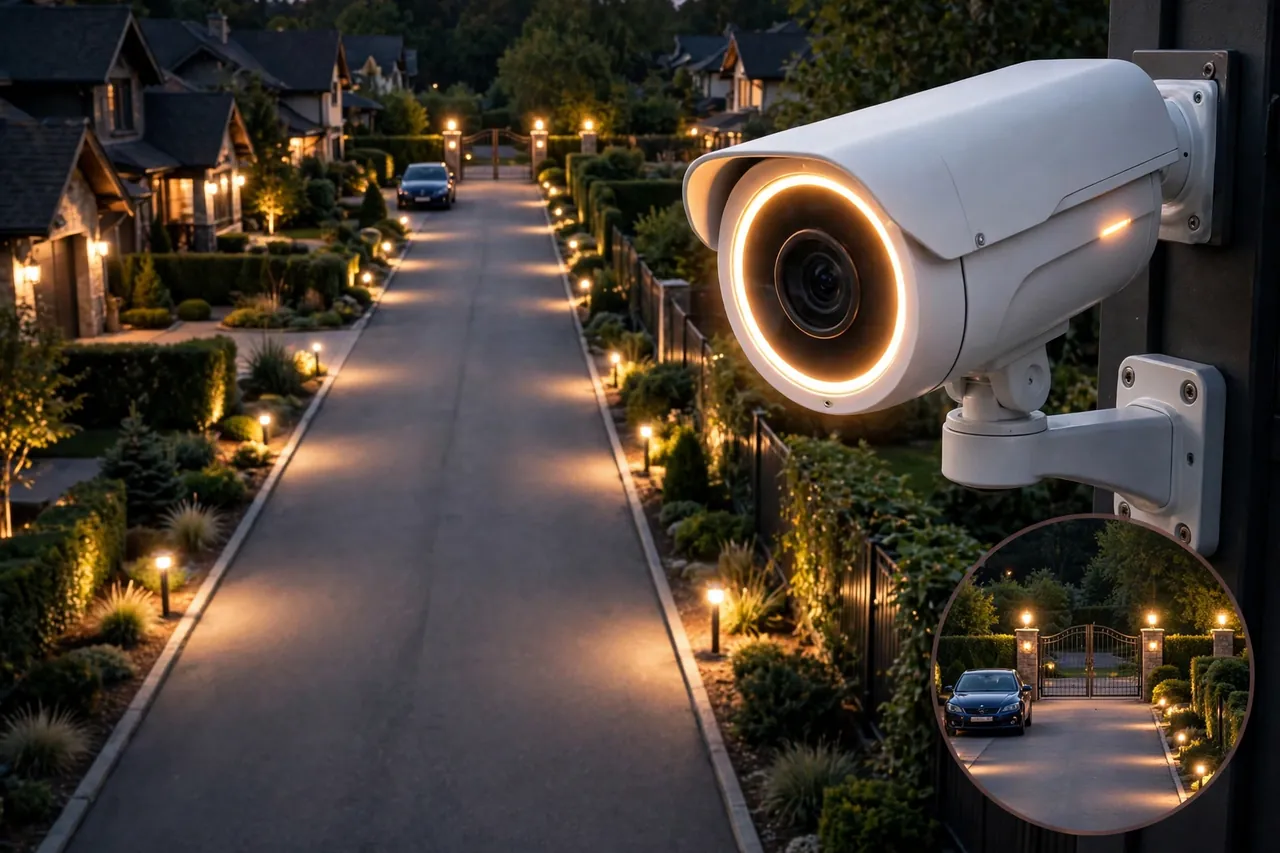
The number on the box is a best-case number, measured in ideal conditions. Real life trims it down. Here are the factors that move the range up or down, and what you can do about each one.
- IR LED power: more LEDs and stronger LEDs light a scene farther. A camera with a big LED array out-reaches a small battery camera every time.
- Lens focal length: a wide lens (2.8mm or 4mm) covers a broad area but throws detail a short way. A longer lens narrows the view and reaches farther, which is why zoom cameras win on long driveways.
- Resolution: a 4K camera packs more pixels onto a distant face than a 1080p camera does, so the face stays readable farther out. Resolution alone cannot fix a weak lens, though.
- Sensor size and aperture: a larger sensor and a wider aperture (a smaller f-number, like f/1.6) gather more light, so the picture stays brighter and cleaner at night.
- Ambient light: a porch light or a streetlight helps color night vision a lot and helps infrared a little. Total darkness leaves infrared as the only worker.
- Weather: rain, fog, and snow scatter infrared light and cut the range. Heavy rain can turn a 100-foot camera into a 40-foot camera for the night.
- Surfaces: light-colored walls and driveways bounce infrared light back and stretch the range. Dark fences, dark siding, and thick bushes swallow the light and shrink it.
- Objects near the lens: a wall, a gutter, or a branch close to the camera reflects infrared light straight back and can wash out the whole picture.
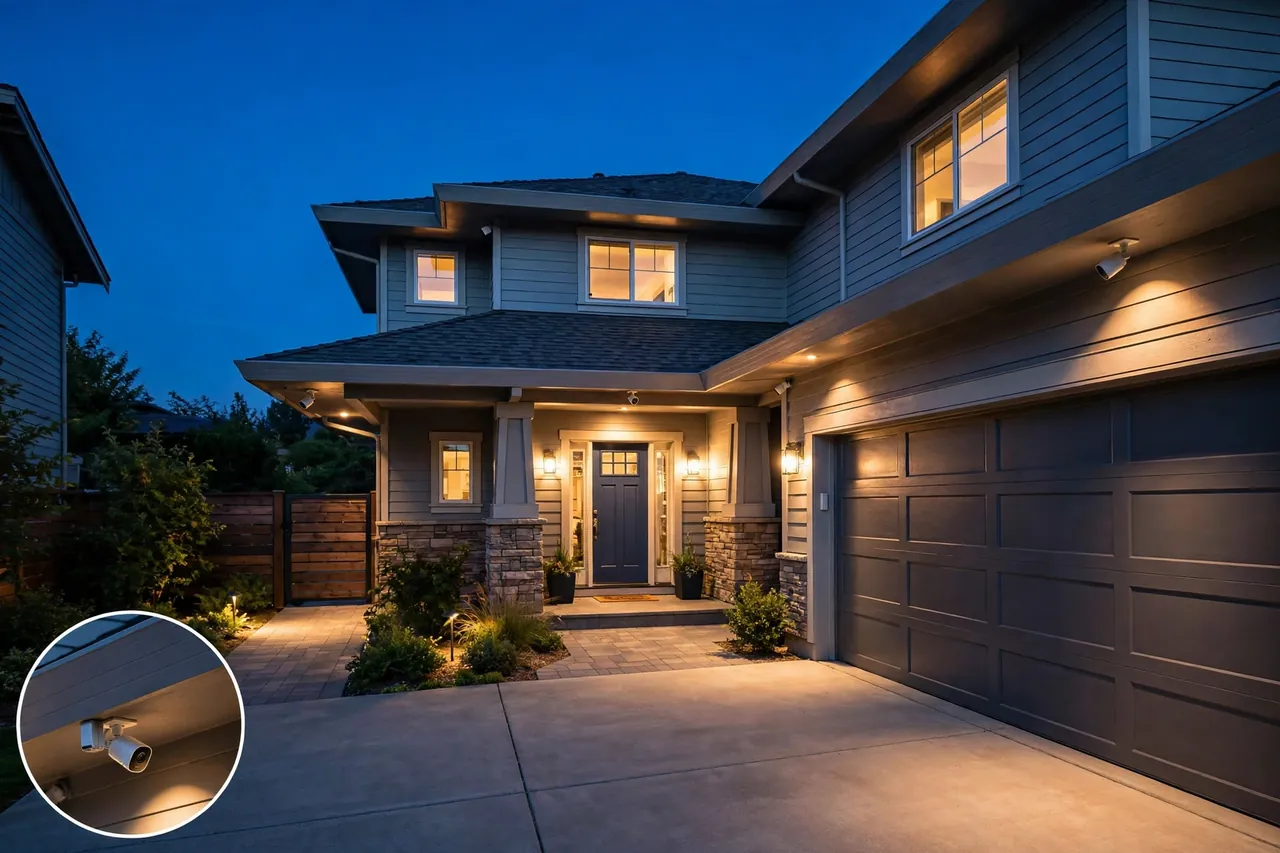
- Camera height and angle: mount too high and faces shrink to dots. Mount too low and the camera covers too little ground. Aim for 7 to 9 feet high, tilted slightly down.
One more factor hides in plain sight: motion detection range is shorter than viewing range. Most standard cameras detect motion within 20 to 30 feet (6 to 10 meters), while advanced models reach 50 to 100 feet (15 to 30 meters). Your camera may see a person at 80 feet, yet never send you an alert about them, because the motion sensor never tripped. If alerts matter to you, check the detection range, not just the night vision range.
How to Place Cameras for the Best Night Coverage
Good placement beats a bigger budget. A well-placed budget camera often out-performs an expensive camera aimed at a wall. Walk your home at night before you mount anything, and follow these steps in order.
- Walk the property after dark. Stand where each camera will go and look at what is actually dark. Note the porch lights, the streetlight, and the pitch-black corners. Those dark corners are where infrared must do the work alone.
- Cover the entry points first. Put cameras at the front door, the back door, and the side gate before you cover the wide yard. Intruders use doors, not open lawns.
- Mount 7 to 9 feet high. This height keeps the camera out of easy reach, yet low enough that faces stay large in the frame. Higher mounts give a wider view but smaller faces.
- Angle the camera slightly down. Aim for the path a person walks, not the sky and not the ground at your feet. A 15 to 30 degree downward tilt usually frames a walkway well.
- Keep the lens clear of walls and branches. Leave at least a foot of clear space around the lens. Anything close reflects infrared light back and fogs the picture.
- Do not point a camera through glass. Infrared light bounces off a window and blinds the lens. Mount the camera outside, or turn its IR LEDs off and rely on outdoor light.
- Overlap the coverage. Let each camera’s view touch the next one’s view, so no dark gap sits between them. Two cameras that overlap beat three cameras with blind spots.
- Test the footage at night. Walk the routes yourself after dark, then watch the clips. Check faces at each distance, and move any camera that gives you a white blur instead of a face.
If your home already has a recorder-based setup, pair this placement plan with a recorder that keeps your night clips safe. Our guide to the NVR security system explains how a network video recorder stores footage around the clock. And if you want your night clips saved off-site as well, read our guide to the cloud camera so you know what cloud storage really costs and covers.
Night Vision Problems and Quick Fixes
Night footage goes wrong in a few predictable ways, and each one has a simple fix. Run through this table before you blame the camera or buy a new one.
Common night vision problems and fixes
| Problem | Likely Cause | Fix |
|---|---|---|
| Face turns glowing white | Person stands a few feet from the IR LEDs | Switch the door camera to color mode with a spotlight |
| Picture is foggy or hazy | IR light reflects off glass, a wall, or rain | Move the camera outside the glass and clear nearby objects |
| Picture is grainy and noisy | Too little light for the sensor | Add a porch light or switch on the spotlight mode |
| Near objects are bright, far objects are black | IR light fades with distance | Move the camera closer or buy a longer-range model |
| Camera misses motion at night | Detection range is shorter than viewing range | Move the camera closer to the path or raise motion sensitivity |
The white-face problem deserves a closer look because it surprises almost everyone. Infrared LEDs sit right around the lens, so a face a few feet away catches far more light than anything else in the scene and reflects it straight back. eufy explains this clearly in its night vision guide: the face turns white while the rest of the image stays dark. At a front door, the fix is not a new angle. The visitor will always stand a few feet from the lens. The fix is color night vision with a spotlight, which lights the face with visible light instead of infrared.
Fog and rain cause a different headache. Tiny water drops in the air scatter infrared light back toward the lens, so the picture fills with a soft haze or bright specks. You cannot stop the weather, but you can mount the camera under an eave so rain does not fall right in front of the lens, and you can wipe the lens clean after a storm. If your yard floods with fog every autumn night, a spotlight camera often cuts through it better than pure infrared, because visible light scatters less in the camera’s view.
How to Choose a Night Vision Security Camera
Buying gets easy once you know your distances and your light. Measure the spots you need to cover, check the light at night, then match the camera to those two facts. Use this checklist before you spend a dollar.
- Measure the distance first. Pace off the driveway, the yard, and the path to the gate. Write the numbers down. Then pick a camera whose rated range is at least double the distance where you need to identify a face.
- Check the light at night. Walk the spots after dark. If a porch light or streetlight reaches the spot, color night vision will work. If the spot is pitch black, you need infrared or a spotlight.
- Pick the mode by the spot. Choose color night vision for the front door and porch, where faces matter. Choose infrared for dark yards and side gates, where quiet coverage matters. Choose a camera with both modes if you want one camera to handle either job.
- Check the real spec, not the headline. Read the spec sheet for the IR range in feet, the wavelength (850nm or 940nm), and the resolution. Arlo, Reolink, and eufy all publish these numbers, and the spec sheet is the only place you can trust them.
- Match power to the mode. Spotlight and color modes drain batteries faster than infrared. If you buy a battery camera, favor infrared for long quiet stretches and save the spotlight for the front door.
- Think about storage before you buy. Night clips pile up fast. A camera with no monthly fee, like the security camera without subscription, or a local recorder setup, keeps your night footage without a bill each month.
- Plan for bad weather. Outdoor cameras need a real weather rating. Look for IP65 or higher on the spec sheet so rain and dust do not kill the camera in its first winter.
For the rest of your setup, keep the night system in good company. A outdoor motion-activated camera pairs well with night vision because it only records when something moves, which saves battery and storage. If you need to follow movement across a wide yard at night, our pan-tilt-zoom security camera guide explains how a zoom camera covers ground a fixed camera cannot. And if you want to hear what happens as well as see it, read our security cameras with audio guide before you buy.
Related Guides
If night vision is one piece of your home security plan, these guides fill in the rest. Our security camera with monitor guide shows how to watch your night feeds on a dedicated screen. Our home security systems self-monitoring guide explains how to watch everything yourself without a monthly monitoring bill. If your cameras will watch the inside of your home too, our wireless indoor security cameras guide covers the indoor side. And if your Wi-Fi is weak at the far corners of your yard, our security cameras without WiFi guide shows cameras that keep recording when the signal drops.
Frequently Asked Questions
How far away can security cameras detect motion?
Most standard cameras detect motion within 20 to 30 feet (6 to 10 meters). More advanced night cameras with infrared or long-range sensors can detect motion up to 50 to 100 feet (15 to 30 meters) or more, especially in low light. Check the detection range on the spec sheet, because it is often shorter than the night vision range.
What is the range of a night vision camera?
Standard night cameras have an infrared range of 30 to 50 feet (10 to 15 meters). Advanced night vision cameras with high-powered infrared LEDs can reach 100 feet (30 meters) or more in complete darkness. Long-range models with optical zoom reach 150 to 200 feet, but identification range is always shorter than the advertised range.
Can night vision work in total darkness?
It depends on the device. Light-amplifying devices cannot work in total darkness because there is no light to boost. Most security cameras can, because they switch to infrared night vision when the scene goes completely dark, using their own infrared LEDs to light the scene.
Is infrared night vision better than color night vision for security?
Neither is better in every case. If you might need to report an incident, color footage shows details like clothing and car colors that help police. If you mainly want to know when something moves in a dark backyard, infrared is enough. Pick color where you identify people, and infrared where you watch dark space.
Can a security camera record color at night without infrared?
Yes, as long as there is some visible light. A built-in spotlight or a porch light lets the camera record in color without infrared. On many cameras you can switch to color night vision in the camera’s night vision settings in the app, and the spotlight will light the scene when motion is detected.
Why does my camera show a glowing white face at night?
The visitor is standing within a few feet of the camera’s infrared LEDs. That close face catches far more infrared light than anything else and reflects it straight back into the lens. If the glow stays when no one is there, a nearby wall or object is reflecting the light instead, so move the object or re-angle the camera.
How far can a camera identify a face?
There is no fixed identification distance. In many home setups, a camera may capture usable facial detail at roughly 15 to 40 feet (5 to 12 meters), while longer focal lengths or optical zoom can extend that range. Resolution, lens, lighting, camera angle, and how large the face appears in the frame all matter.
Night vision is not magic, and it is not a single number on a box. It is a match between a camera, a spot, and the light that is really there after dark. Measure your distances, walk your yard at night, pick infrared for dark corners and color for the front door, and test the footage before you trust it. Do that, and the next time something moves in the dark, your camera will show you what actually happened, not just a shadow.