
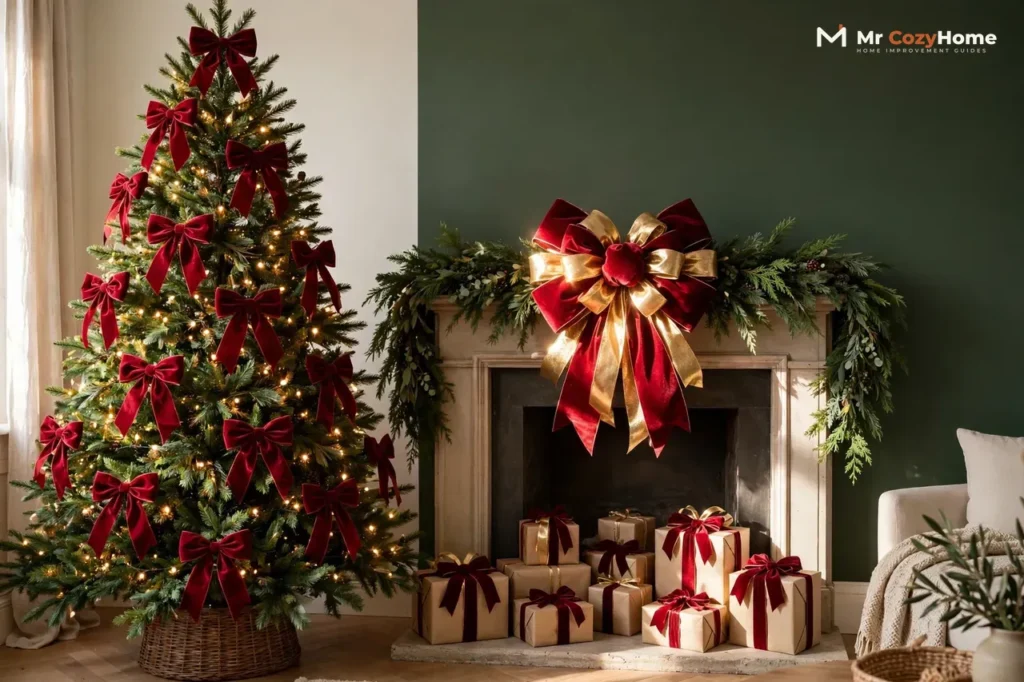
Bow decor Christmas style is simple: you pick ready-made bows in one color scheme, match each bow to the size of its spot, and place a few of them where the eye already lands — the tree, the wreath, the mantel, the gifts, and the stair rail. You do not need craft skills, and you do not need to tie a single bow yourself. Ready-made bows with wire or clips do the work for you, and a handful of well-placed bows can make a whole room feel finished.
Think of bows as the punctuation of your Christmas decorating. Ornaments fill the tree, lights make it glow, and bows tell the eye where to stop and look. One big bow turns a plain wreath into a front-door statement, and a row of small matching bows turns a plain stair rail into a feature.
Choose Your Bow Style First
Start with style, not shopping. When every bow in your home shares one style family, even bows from different stores look like they belong together. Pick one main style, then add one accent style at most. Two styles feel rich. Five styles feel random.
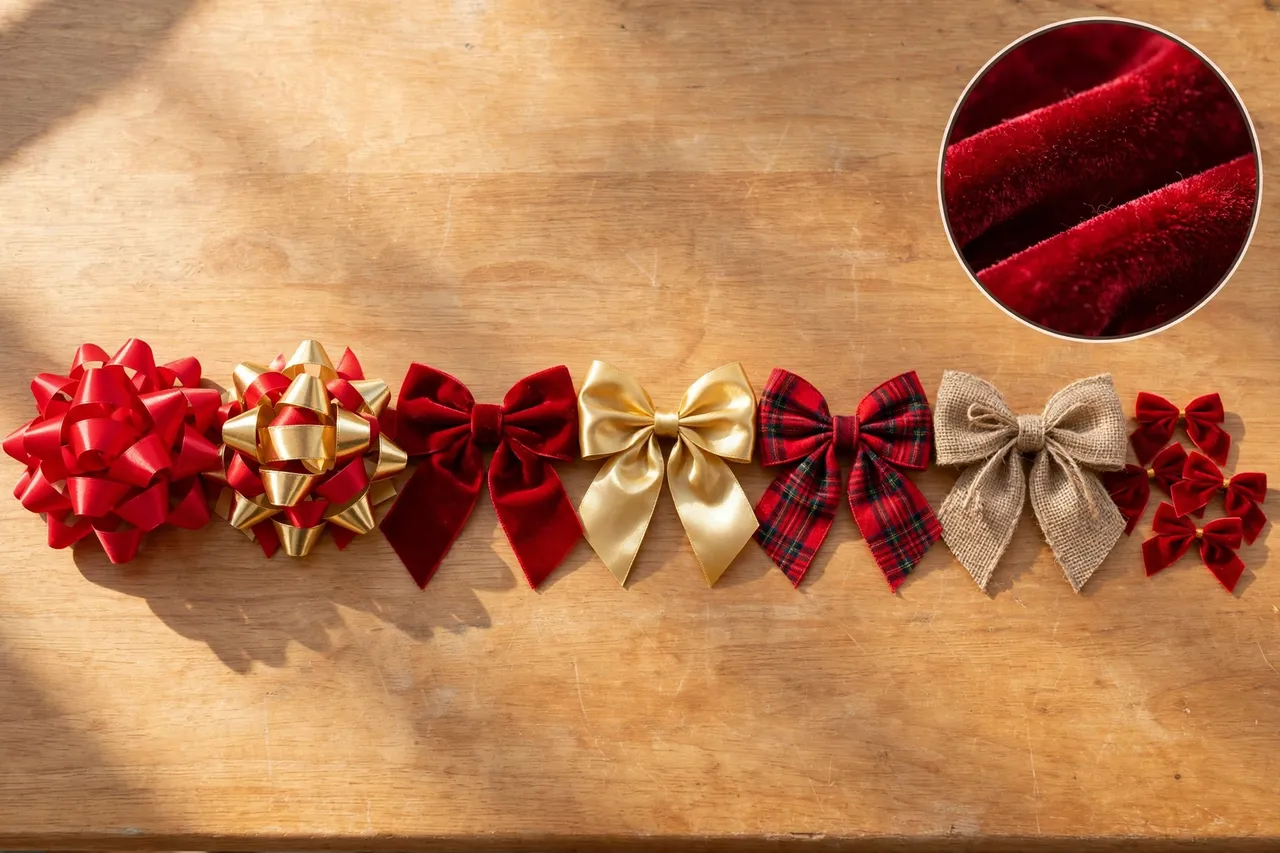
Ready-made bows come in a few clear styles, and each one suits a different kind of home. Classic loop bows, with even loops and two tails, fit almost any room and never look dated. Layered bows stack two or three ribbons, often a wide solid ribbon under a narrow patterned one, and they suit a tree or mantel that needs a real focal point. Velvet bows feel soft and rich under warm lights, satin bows shine in a formal room, plaid and gingham bows suit farmhouse rooms, and burlap and linen bows suit woodland and Scandinavian rooms.
Mini bows play a different role. They do not lead a display. They repeat it. A dozen small velvet bows dotted along garland, or tied to chair backs, pull a whole room together without shouting. Oversized bows do the opposite job: one giant bow above a door or on a mantel can carry a whole entrance by itself.
Table: Bow styles at a glance
| Bow style | Look and feel | Best spots |
|---|---|---|
| Classic loop bow | Even loops, two tails, timeless | Tree, wreath, gifts |
| Layered bow | Two or three ribbons stacked | Tree topper, mantel centerpiece, wreath |
| Velvet bow | Soft, rich, warm under lights | Mantel, stair rail, wreath, gifts |
| Satin bow | Smooth, shiny, formal | Tree, table settings, chair backs |
| Plaid or gingham bow | Warm, traditional, farmhouse | Door, wreath, stair rail, gifts |
| Burlap or linen bow | Natural, rustic, quiet | Wreath, garland, woodland tree |
| Mini bow | Small, repeating accent | Garland, chairs, ornaments, gifts |
| Oversized bow | Bold, single statement | Front door, mantel, large tree top |
When you shop, look for wired ribbon bows first. A thin wire inside each ribbon edge lets the loops hold their shape all season instead of going flat by New Year’s Eve. Soft, unwired bows look lovely on gifts you hand over the same day, but they droop fast on a wreath or stair rail that stays up for weeks, so save unwired bows for the table or a gift you can fluff right before guests arrive.
Pick the Right Size for Each Spot
Size is the one choice that makes or breaks bow decor. A bow that is too small vanishes into the greenery. A bow that is too big swallows the wreath or the mantel whole. The good news is that decorating guides agree on simple size rules, so you can shop with confidence instead of guessing.
For wreaths, a widely shared rule from the Christmas Lights Etc decorating guide says a wreath bow should measure about half the diameter of the wreath, so a 30-inch wreath takes about a 15-inch bow. A few inches either way still looks fine, so do not stress over exact numbers. The same guide recommends 15-inch or 18-inch structural bows for garland, 15-inch, 18-inch, or 24-inch bows for a mantel centerpiece, and 15-inch or 18-inch bows for a stair rail. For a tree, treat bow size like ornament size: small trees under 5 feet suit 6-inch to 8-inch bows, standard 5-foot to 7-foot trees suit 9-inch to 12-inch bows, and large trees over 7 feet can carry 14-inch to 18-inch bows.
Table: Bow size by spot
| Spot | Bow size that works | Why it works |
|---|---|---|
| Wreath | About half the wreath diameter | The bow reads as part of the wreath, not an afterthought |
| Garland or swag | 15 or 18 inches | Big enough to read from across the room, small enough not to crush the greenery |
| Mantel centerpiece | 15, 18, or 24 inches | Matches the wide, flat stage a mantel gives you |
| Stair rail | 15 or 18 inches | Bold at arm’s length without blocking the handrail |
| Tree under 5 feet | 6 to 8 inches | Suits short branches and small ornaments |
| Tree 5 to 7 feet | 9 to 12 inches | Reads from across the room without hiding ornaments |
| Tree over 7 feet | 14 to 18 inches | Big trees need bold bows, or the bows vanish |
| Gifts and chairs | 4 to 8 inches | Pretty at close range without overwhelming the package or chair |
Buy one size up if your room is large or your greenery is very full, and one size down if your space is small or your style is minimal. Always hold the bow up against its spot before you attach it: a bow that looks huge in the store often looks just right against a full wreath or a wide mantel.
Bows on the Christmas Tree
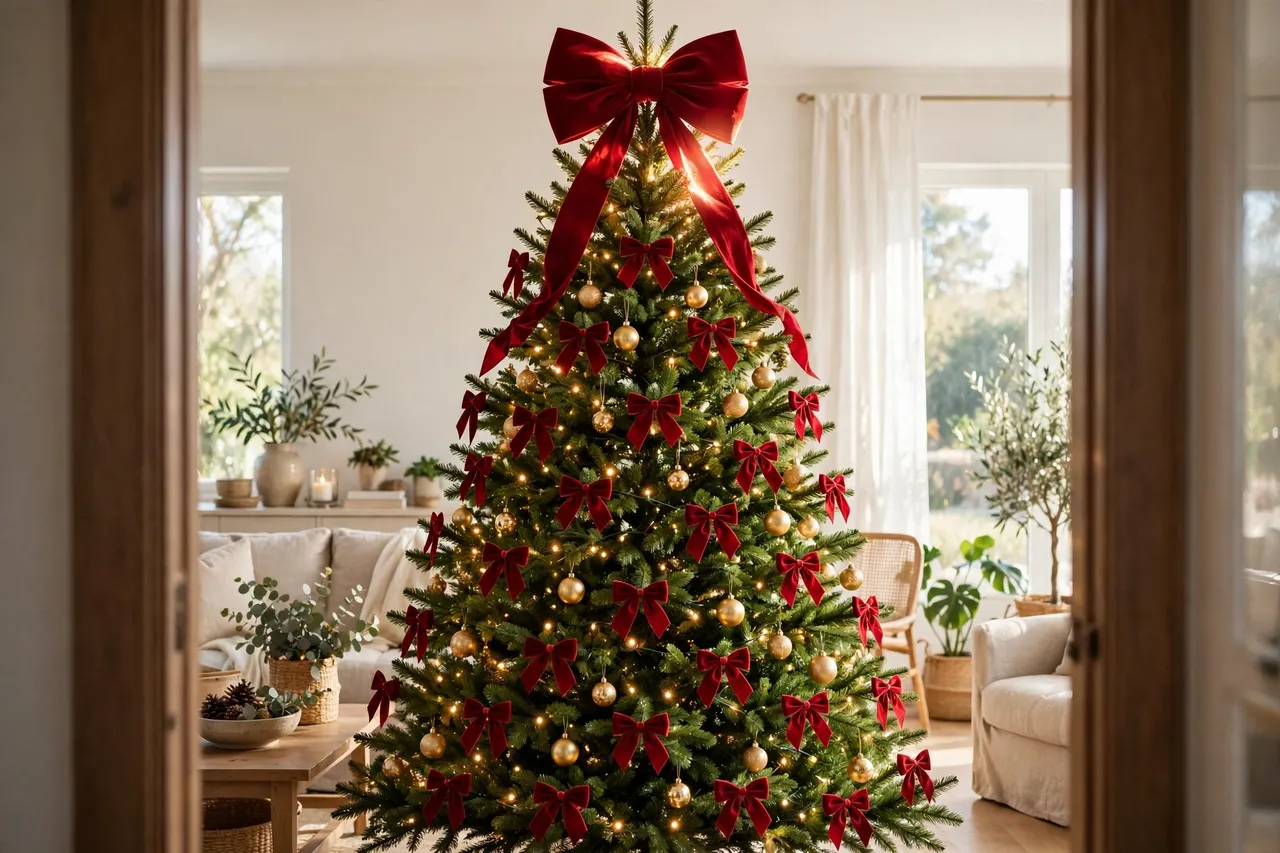
Bows give a tree its rhythm. Ornaments alone can look scattered, but bows placed in a loose pattern pull the whole tree together. You have three good options, and you can mix two of them: a topper bow, scattered bows, or bow clusters. Pick the one that fits how full your tree already is.
A topper bow is the boldest choice. One large, well-shaped bow wired firmly to the top branch crowns the tree and sets its color story in a single glance. If your tree already carries a star or angel, wire a smaller bow just below it, and the bow frames the topper instead of fighting it. On a slim or small tree, use a medium bow with long tails: the tails fall softly over the top branches and give the same finished feeling without the weight.
Scattered bows work best on a tree that already has plenty of ornaments. Space them evenly, like you would space matching ornaments, and keep them all the same size so the tree does not look lopsided. A decorating guide rule of thumb puts 3 to 5 bows on a tree as a light accent, but a bow-forward tree can carry far more — the real rule is even spacing and one consistent size. Step back every few bows and look from the doorway. You will spot a bare side or a clump in seconds from far away, and you will never see it standing six inches from the branches.
Bow clusters give you drama with fewer pieces. Group three bows of the same ribbon at the top, middle, or base of the tree, or tuck a cluster where two branches meet. Clusters add depth without covering the tree, which makes them ideal when you have ornaments you still want to see. For the full decorating order — lights, then ribbon and garland, then ornaments, then the topper — our guide to tree decorating ideas for Christmas walks through the sequence that causes the fewest do-overs. This article covers bows as decor pieces only; draping ribbon itself around the tree is a separate technique, covered in our guide to how to put ribbon on a Christmas tree.
Wreaths, Doors, and Windows
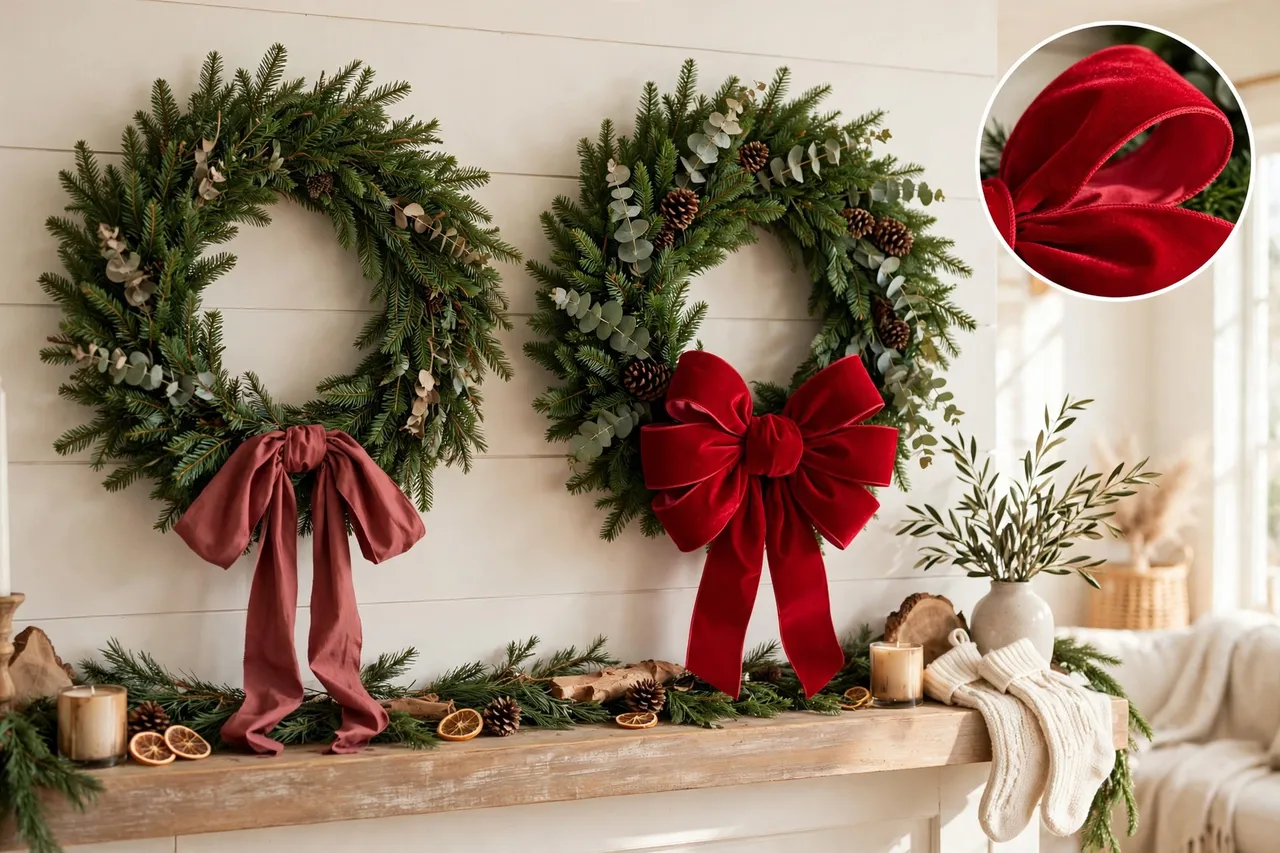
A wreath bow is the easiest win in all of Christmas decorating. A plain evergreen wreath looks unfinished, and one good bow finishes it in ten seconds. Bows also let you restyle a wreath without buying a new one: dot it with small colorful bows, style one side only for a modern look, or pair one big bow with pinecones and berries, as shown in DigsDigs’ bow decor ideas. Place the bow at the bottom of the wreath for the traditional look, which gives the wreath visual balance and lets the tails fall gracefully. Place it at the top if the wreath hangs under a porch light or above a garland swag, where a top bow lines up with the display above it. For a modern feel, place the bow slightly off-center and let the tails fall to one side. All three placements look intentional, so pick the one that suits your door.
On the front door itself, one oversized bow makes the whole house look wrapped like a gift. Hang it above the wreath or above the door, and let long tails run down both sides of the frame. This look works best on a plain door in black, white, navy, or natural wood, where the bow color can pop, so keep the rest of the entrance simple. Outdoors, choose weather-resistant ribbon and check the bow after wind and rain; wired bows bounce back with a quick fluff.
Windows take bows beautifully, and they cost almost nothing to dress. Hang a medium bow at the top center of each window, or hang a small wreath with a bow in each front window for a matched set from the street. Use suction cups or removable hooks rated for outdoor use, and never hang a bow where it presses against a hot bulb or a candle. For more window ideas, see our guide to decorating a Christmas window.
Mantels, Stair Rails, and Garlands
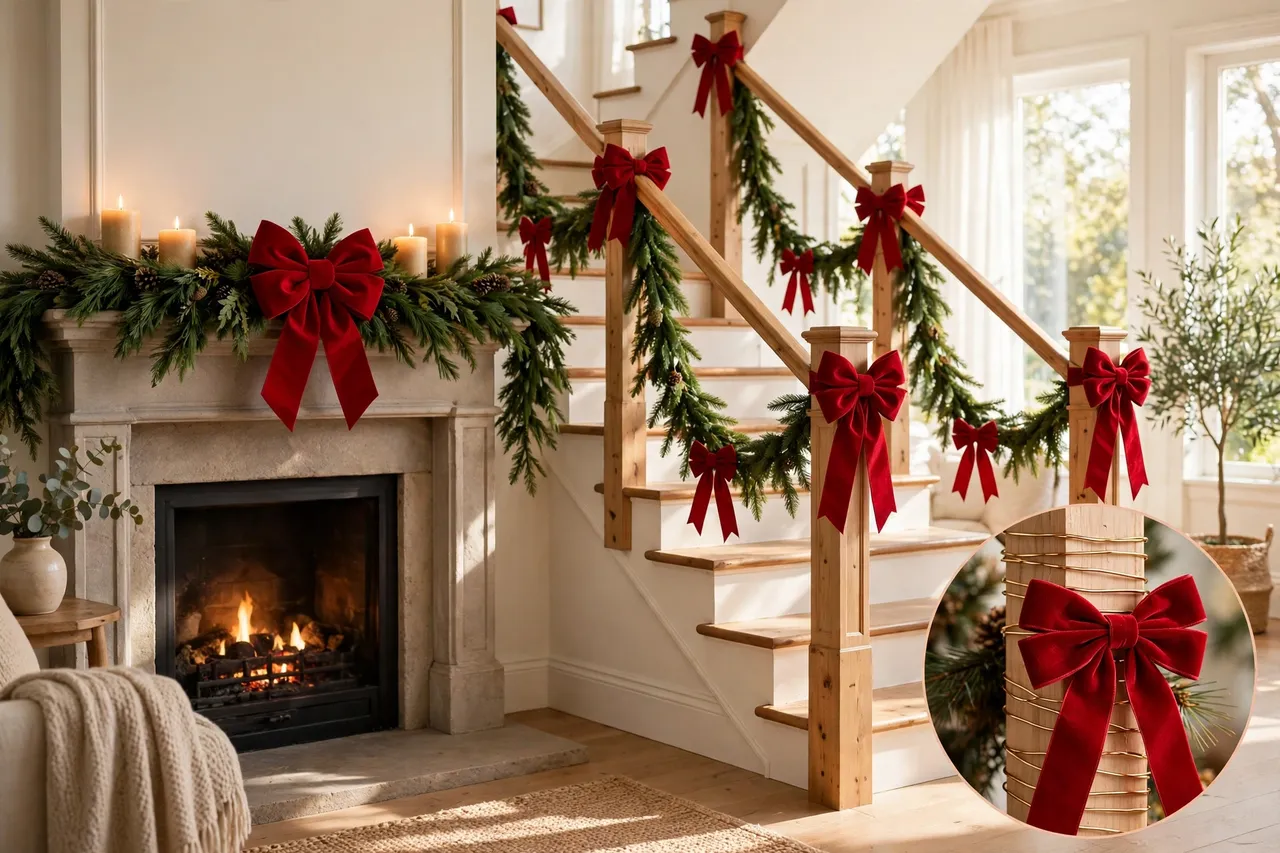
The mantel is a stage, and a bow is its centerpiece. Place one large bow at the center, then build outward with greenery, candles, and small ornaments in the same color family. If your mantel already holds stockings or a mirror, place two medium bows at matching points on either side instead. Symmetry calms a busy mantel, while one bold bow anchors a bare one. Keep bows away from open flames and hot candle glass, and use battery candles near any ribbon.
Stair rails love repetition. Tie matching bows at every newel post, or at regular intervals along the garland, and the whole staircase reads as one display. The Christmas Lights Etc guide recommends wrapping the bow’s attached wire around the stair post for a secure hold, and notes that plastic-coated wire will not scratch wood or paint. If you hang garland along the rail, place a bow at each swag dip and at every joint where two garland pieces meet. Those are the spots the eye naturally pauses, so a bow there looks deliberate instead of random.
Garland itself takes bows in three places: the swag points, the joints, and the ends. A small bow at each swag dip turns a plain garland into a finished one, and miniature velvet bows work beautifully here because they repeat without adding weight. For garland styles and room-by-room ideas, our Christmas garland ideas guide pairs with this one. And if you decorate a staircase, keep the handrail itself clear enough to grip. Bows belong on the posts and the outer edge of the garland, never wrapped around the part of the rail your hand needs.
Gifts, Chairs, and Table Settings
Bows earn their keep at the table and under the tree. A gift with a good bow looks twice as generous as the same gift in plain paper, and matching bows across all your gifts make the pile under the tree look like a set. Use one ribbon for every gift, in one or two widths, and vary only the bow size: big bows on big boxes, small bows on small ones. A single accent, like a tiny pinecone or bell tucked into the bow center, ties the gifts to the tree without extra shopping.
Chair backs are the dining room’s secret weapon. Tie a medium bow to the back of each chair, and the whole table looks dressed even before the food arrives. Keep the bows identical and the tails short, so nobody sits on a tail or knocks a bow into a plate. On the table itself, use mini bows as napkin ties or scatter a few around a centerpiece for color at eye level, without blocking conversation.
Match the gift and table bows to the tree bows, not to each other in a different color. When the same red velvet or gold satin shows up on the tree, the mantel, the chairs, and the gifts, the whole house feels like one home instead of four separate decorating jobs. Our guide to Christmas table decoration shows how bows, greenery, and candles work together on a finished table.
Match Bows to Your Color Scheme
One color scheme saves more decorating mistakes than any other rule. Pick two or three colors, repeat them everywhere, and let one metallic tie them together. Red and gold never fails in a family living room. Champagne and ivory suit a formal room. Blue and silver feel calm and snowy. Deep green with cream and brass suits a rustic room. If your ornaments are a cheerful mix, a simple gold or deep green bow ties them together without competing.
Test your scheme before you buy in bulk. Buy one bow, hold it against your tree, your wreath, and your mantel in daylight, then again with the tree lights on. Velvet looks richer under warm light, satin can glare in a bright room, and plaid reads cozy on a green tree but busy on a flocked white tree. One test bow costs little and saves you from a box of bows that looked perfect in the store and wrong at home.
Keep the bow count calm too. Two colors of bow in a room feel rich. Four colors feel like a craft store exploded. If you love variety, vary the texture instead of the color: red velvet, red satin, and red plaid together look layered and intentional, while red, green, gold, and blue together look scattered. For help choosing a whole-room theme before you buy bows, our guide to themes for Christmas decoration lays out complete looks you can copy.
Christmas Lights With Ribbon Bows
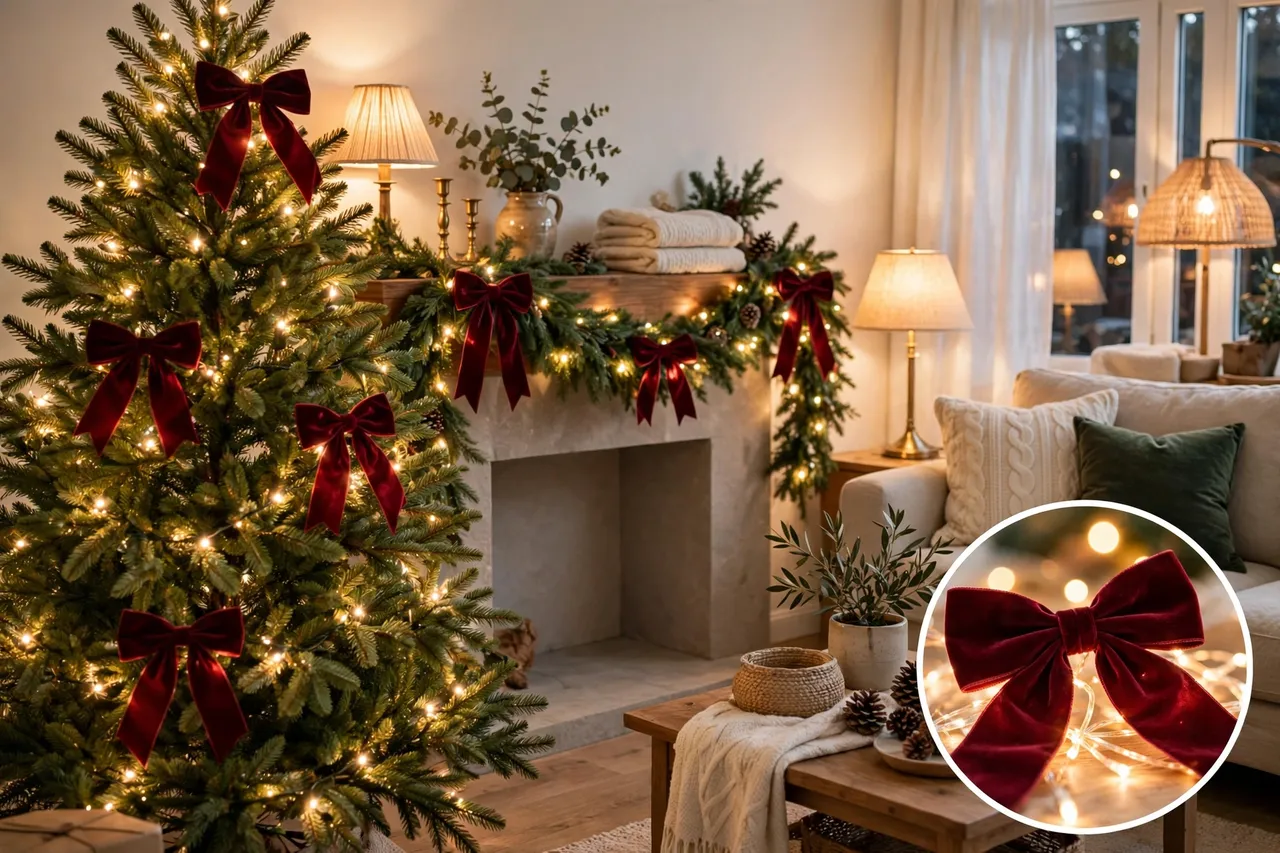
Christmas lights with ribbon bows are a classic pairing because each one makes the other look better. Lights give bows a warm glow, and bows give light strands a place to stop and shine. The trick is order: put the lights on first, then add the bows. Lights woven deep into the branches make the whole display glow from within, and bows placed after the lights sit on top of the glow instead of hiding under it.
Warm white lights flatter almost every bow color, while cool white lights can make red velvet look flat and gold satin look harsh. If your bows are blush pink, champagne, or ivory, warm white is the safer choice, but an icy blue and silver scheme suits cool white. Test one bow under your lights before you commit.
Safety comes first with lights and ribbon together. Use LED lights where you can, because they run cooler than old incandescent strings, and keep every bow clear of hot bulbs, candles, and heaters. Never drape ribbon over a bare bulb, and turn the lights off when you leave the house and before bed. For lighting plans that pair with bows across the whole house, our guide to Christmas light ideas covers warm, layered lighting room by room.
Buy Ready-Made or Reuse Last Year’s Bows
Ready-made bows for Christmas decorations are the beginner’s best friend, and there is no shame in buying every bow you use. Look for bows with wire or clips already attached, because that wire is what fastens the bow to a branch, a wreath frame, or a stair post in seconds. Check that the loops feel full and spring back when you squeeze them, and check that the tails hang evenly. A bow that already looks tired in the store will not improve at home.
Count before you buy. Walk your house with a notepad and count the spots: one wreath bow, one mantel bow, two stair bows, six chair bows, one tree topper, and a dozen gift bows, for example. Buying to a list stops the two classic errors: running out with one bare staircase left, and bringing home bows in a color you already own. Buy one spare bow in your main color too, for the day a bow gets crushed in storage or a pet pulls one off the tree.
Reuse is where Christmas decoration bows really pay off. A well-made wired bow lasts several seasons if you store it well. After Christmas, fluff each bow back into shape, wrap it loosely in tissue paper, and pack it in a box where nothing heavy sits on top. Label the box by color and size, so next December you find your bows in minutes instead of digging through a tangle of ornaments. If you want bows made to your exact colors instead of store-bought ones, our guide to how to tie a Christmas ribbon covers the tying technique in full.
Mistakes That Make Bows Look Messy
Most bow problems come from a few habits, and every one has a quick fix. Check your displays against this list before you call the decorating done.
Table: Common bow mistakes and their fixes
| Mistake | Why it happens | Fix |
|---|---|---|
| Bows look flat and lifeless | Unwired ribbon, or loops never fluffed | Switch to wired bows and fan each loop open by hand |
| One bow dwarfs everything near it | Bow size not matched to its spot | Use the size table above, and hold the bow up before you attach it |
| Tree looks lopsided | Bows clumped on one side or mixed sizes | Space bows evenly, keep one size, step back and check from the doorway |
| Too many colors at once | Buying bows one trip at a time with no scheme | Pick two or three colors first, then buy only inside that scheme |
| Bows slip or droop by New Year | Tape, glue, or loose ties instead of wire | Fasten with the bow’s own wire or floral wire twisted around a branch or post |
| Stair rail cannot be gripped | Bows wrapped around the handrail itself | Move bows to posts and garland edges, and keep the grip clear |
One last check costs nothing: turn the room lights off and the Christmas lights on, then look at each display from the doorway. Bows that looked fine in daylight can show gaps, droops, and clumps in tree light only. Fix what you see, and the display will look good to every guest who walks in.
Related Guides
Tree Decorating Ideas for Christmas · Christmas Garland Ideas · Themes for Christmas Decoration · Christmas Table Decoration · Christmas Light Ideas · How to Put Ribbon on a Christmas Tree · How to Tie a Christmas Ribbon · Christmas Decorating Hallway · Decorating a Christmas Window
Frequently Asked Questions
How big should a Christmas bow be for a wreath?
Make the bow about half the diameter of the wreath. A 30-inch wreath takes about a 15-inch bow, and a 24-inch wreath takes about a 12-inch bow. A few inches either way still looks fine, so shop for the closest size rather than an exact match, and hold the bow against the wreath before you attach it.
Should the bow go on the top or bottom of a wreath?
Traditionally, the bow goes at the bottom of the wreath for visual balance, with the tails falling gracefully below it. A top bow suits a wreath hung under a porch light or above a garland swag. An off-center bow gives a modern feel. All three placements look intentional, so choose the one that fits your door.
How many bows should I put on a Christmas tree?
For a light accent, 3 to 5 evenly spaced bows work well. For a bow-forward tree, use more, but keep every bow the same size and space them evenly around all sides. Step back and check from the doorway after every few bows, because bare patches and clumps show up from far away long before they show up close.
Can I reuse Christmas bows year after year?
Yes, if you store them well. Fluff each wired bow back into shape, wrap it loosely in tissue paper, and pack it in a box where nothing heavy sits on top. Label the box by color and size. A well-made wired bow can last several seasons, while soft unwired bows droop faster and suit single-season use.
What size bow works on a mantel or stair rail?
Use a 15-inch, 18-inch, or 24-inch bow as a mantel centerpiece, and a 15-inch or 18-inch bow on a stair rail. On stairs, fasten bows to the posts and garland edges with their attached wire, and keep the handrail itself clear so everyone can grip it safely going up and down.
Start With One Spot Tonight
You do not need to bow the whole house in one evening. Pick one spot — the wreath, the mantel, or the stair rail — and dress it with matching bows in your scheme. When that spot looks right, the rest of the house gets easier, because you already know your style, your size, and your colors. A few good bows, placed where the eye already lands, turn a decorated house into a finished one. Start with the front door, and let guests see the difference before they even step inside.


