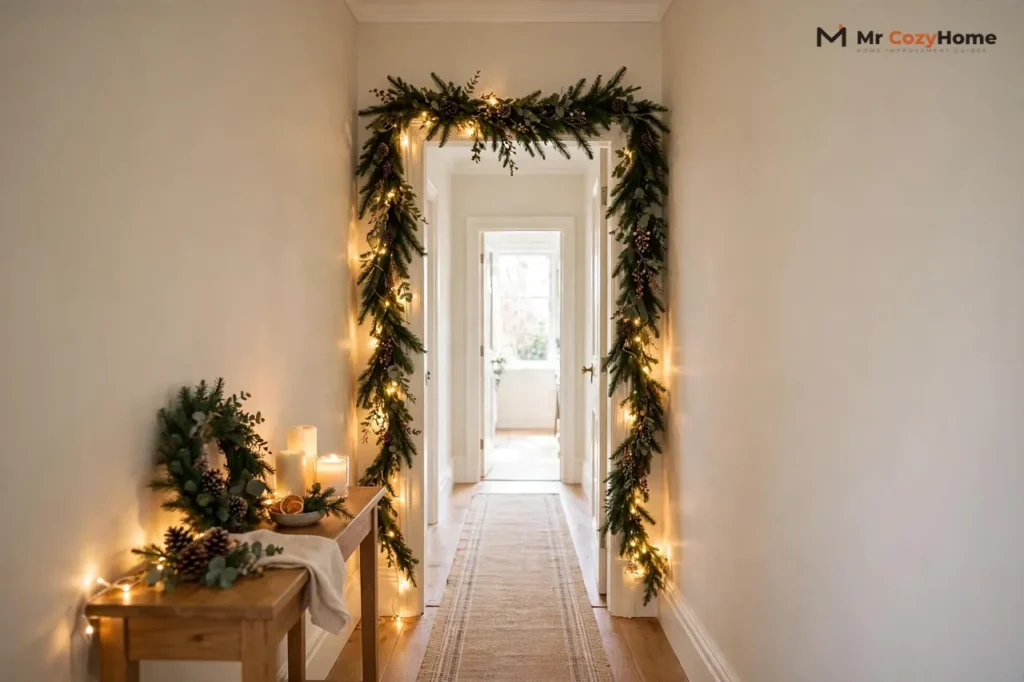
Christmas decorating hallway ideas work best when you decorate the walls, the console, and the air above the floor — and leave the walkway itself alone. Start with a clear path, pick one warm color story, and add slim layers: a garland along a door frame, a low console display, warm LED light on a timer, and a runner that stays put. That is the whole secret, and this guide walks you through it step by step, so your hall feels like Christmas the moment someone steps inside, without anyone tripping over it.
Your hallway does a job no other room does. Guests form their first impression there, coats come off there, bags land there, and everyone in the house passes through it a dozen times a day. So Christmas hallway decorations have to earn their place twice: they must look festive, and they must never get in the way. The ideas below all pass that test, even in a hall so narrow you can touch both walls at once.
Start With the Walkway, Not the Decor
Before you buy a single berry pick, walk your hallway the way a guest would. Carry a laundry basket through it. Open every door that swings into it. Notice where coats pile up and where the dog sleeps. Anything you add must survive that real traffic, not just look good in a photo.
A typical hallway is only about 36 inches wide, which sounds roomy until a console, a basket, and a trailing garland each steal a few inches. So measure first. Keep the full walking width clear from end to end, and treat anything on the floor as guilty until proven innocent. If a decoration forces you to sidestep, it belongs on a wall instead.
Declutter before you decorate, because a tidy hall looks twice as festive with half the stuff. Move out the shoes nobody wears, the bag of bags, and the mail pile. What stays should be things you actually use: hooks for coats, a tray for keys, one bench or console. Then your Christmas layers have room to shine instead of fighting clutter.
Pick One Palette and Repeat It
The fastest way to make a hallway look intentional instead of thrown together is to pick one color story and repeat it down the whole space. Classic red and green with gold feels traditional. White, silver, and soft green feels calm and snowy. Deep blue with gold feels rich against neutral walls. Any of them works, as long as you commit to one.
Repeat one material too, not just one color. If you start with brass, use brass candle holders, brass bells, and a brass-framed mirror. If you start with natural wood, use a wooden tray, wooden bead garland, and pinecones. That single repeated thread is what makes separate pieces feel like one design, and it is the trick stylists use to make a small space feel collected rather than crowded.
Keep the palette to two or three colors at most. A narrow hall shows every color at once, so a fourth or fifth color turns festive into busy. When in doubt, let evergreen be your base, add one accent color, and let warm light do the rest.
Dress the Console Table Without Blocking It
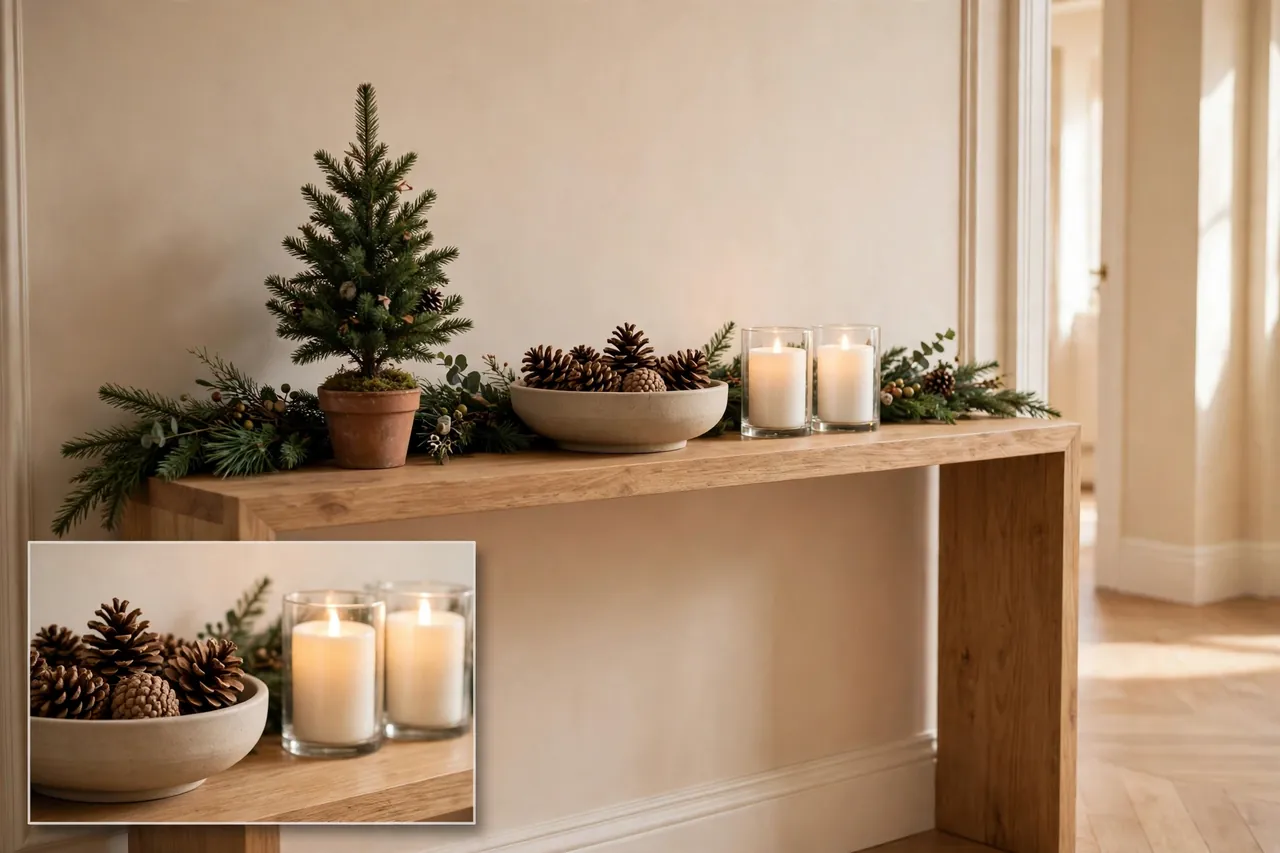
The console table is the hallway’s stage, and it is also the piece most people overload. Most consoles run only 10 to 14 inches deep, so a display that hugs the back edge leaves room for keys and mail and keeps coat sleeves from clipping anything as people pass. Build your display in a single shallow row, and keep the front half of the table empty on purpose.
Start with one low anchor: a tray, a folded runner, or a slim garland laid flat along the back edge. A thin garland about 3 to 4 inches wide gives you the finished look without eating the surface you need every day. Then add height at one end only — a mini potted tree between 18 and 30 inches tall suits a standard 30-inch console and stays in proportion under a mirror or wall art.
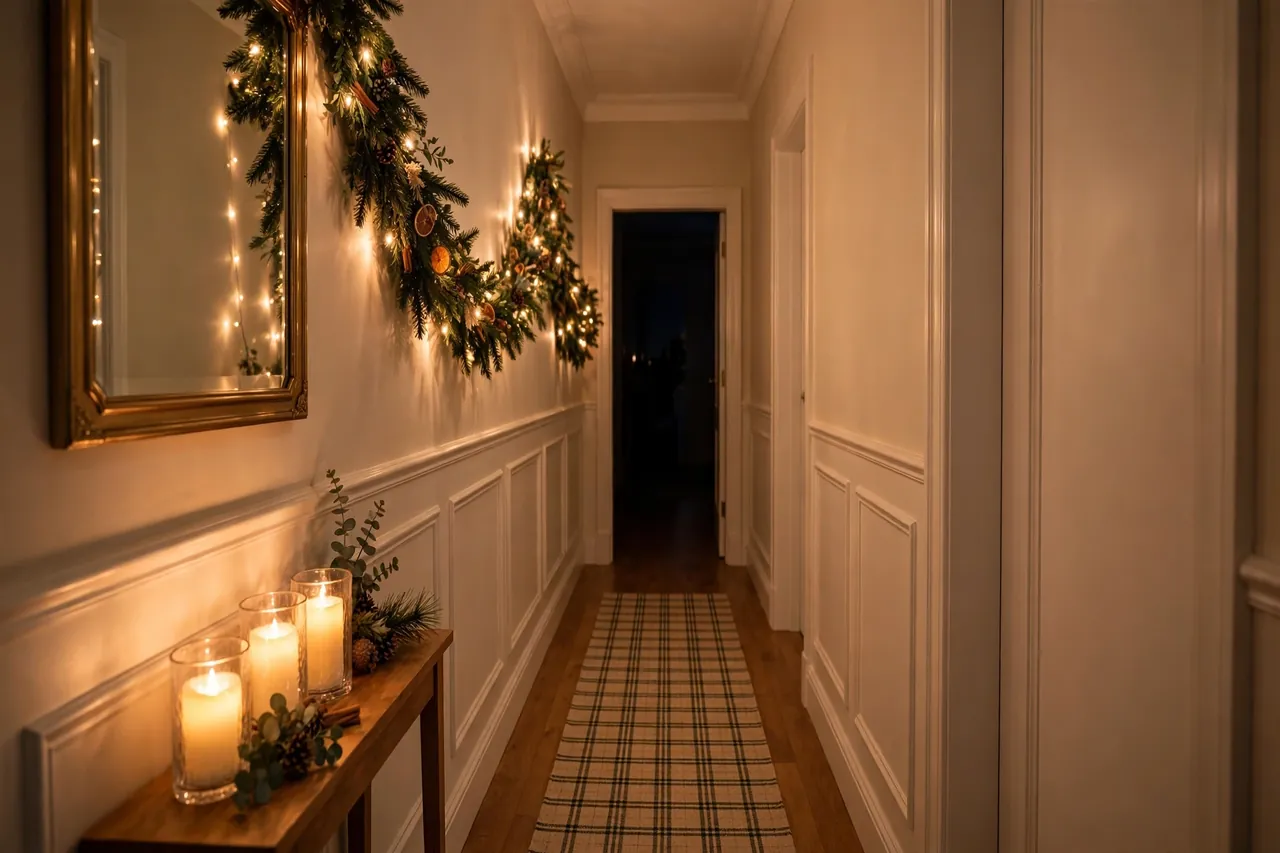
Finish with small, sturdy pieces that will not topple when someone bumps the table. A low bowl of pinecones 8 to 10 inches wide and no taller than 4 inches reads as a centerpiece without blocking a mirror. A pair of flameless pillar candles in glass holders adds glow without a naked flame near coats and scarves. Three pieces, one row, done — and the table still works as a table.
Run Garland Along the Walls, Not the Floor
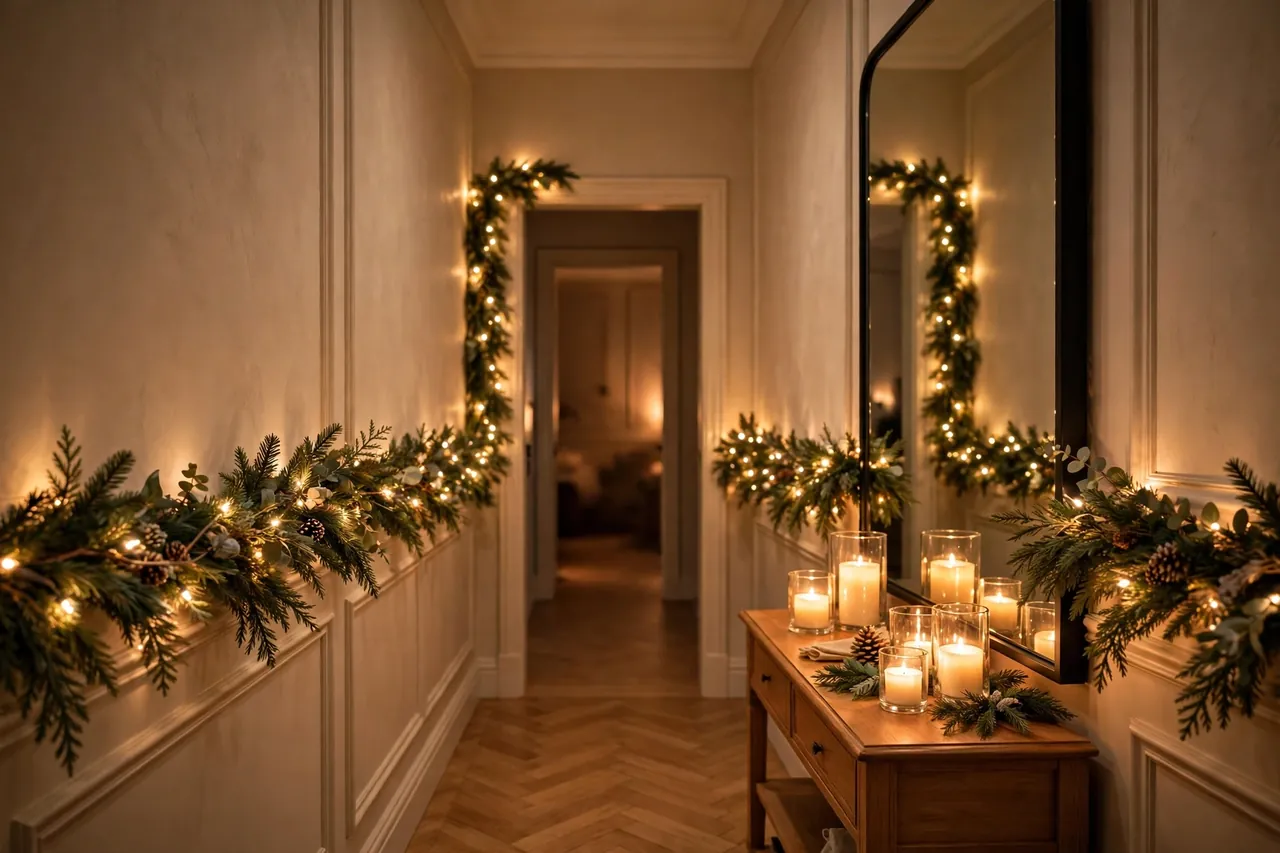
Garland is the hallway’s best friend, because it brings the whole Christmas feeling without taking a single inch of floor. Frame a doorway with it, run it along a picture rail, or drape it around a mirror frame. Every one of those spots adds greenery at eye level, exactly where guests notice it, while the walkway stays wide open.
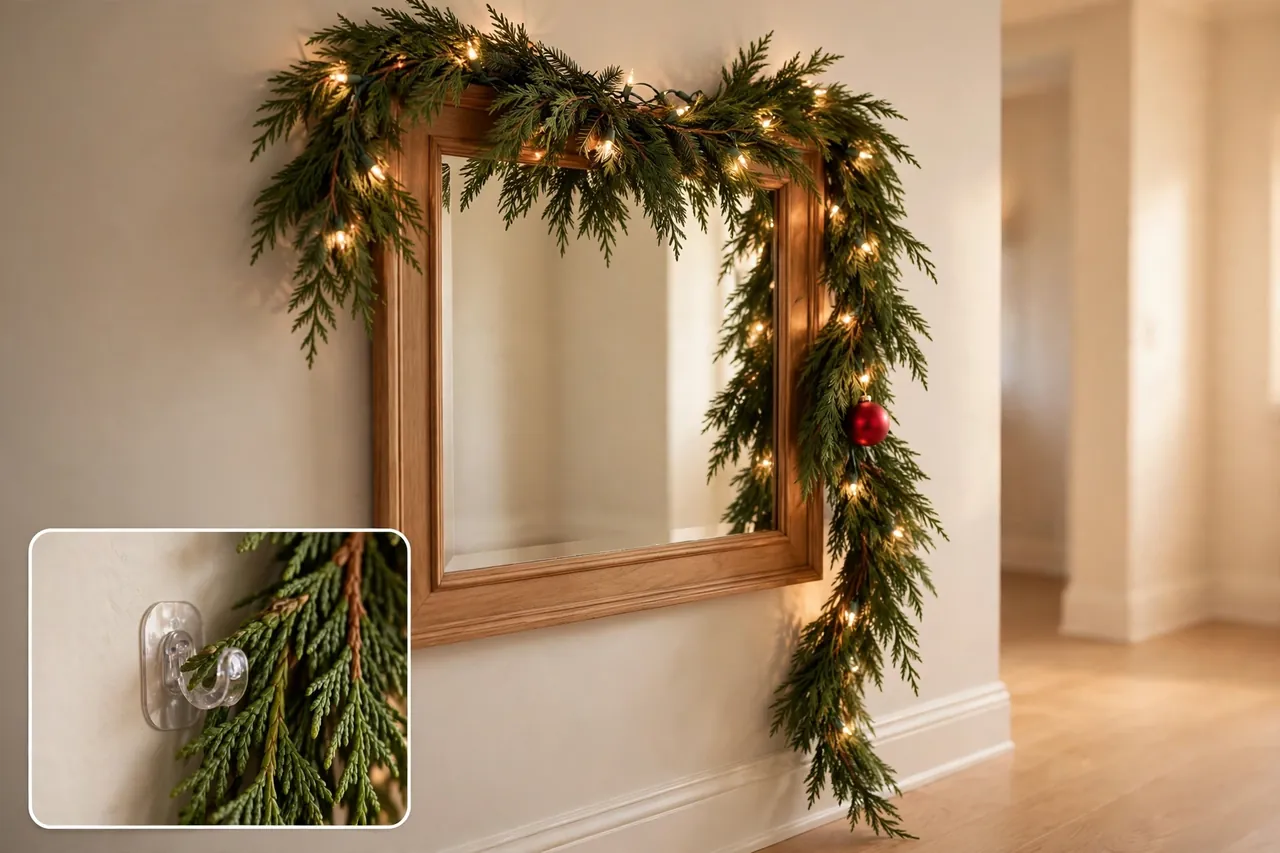
Hang it with removable adhesive hooks, placed about every 12 inches so the garland cannot sag or slide. Dust the surface first so the hooks grip properly, and check the weight limit on the package before you load a heavy garland onto a painted wall. When the season ends, the hooks come off without holes, which makes this one of the most renter-friendly Christmas decorating ideas for hallway spaces.
For a mirror, let the garland trail down one side for a relaxed, asymmetrical look, and add a single ornament for a pop of color. A 6-foot cedar garland suits a standard mirror, and real cedar brings a fresh scent that lasts indoors. If you prefer faux greenery, fluff the branches forward and downward so the garland looks thick from a standing person’s view, not flat from the side.
Weave in a strand of battery-operated LED fairy lights as you hang the garland, so you never run a cord across the floor. Tuck the small battery pack behind the thickest part of the greenery, where it disappears. The result looks like the garland glows on its own, and nobody trips over anything to admire it.
Light It Warm and Safe
Light does most of the emotional work in a Christmas hallway. Warm white fairy lights threaded through garland soften a hard-lined corridor, and a gentle glow overhead makes a dark hall feel welcoming the second the front door opens. The rule is simple: warm light, cool bulbs, no cords on the floor.
Choose LED lights for hallway use, because they stay cool to the touch while old-style incandescent bulbs build up heat. That matters in a narrow space where greenery, ribbon, and passing sleeves all sit close together. Battery-operated strands are the most practical choice where outlets are scarce, and a plug-in timer means the display greets you every evening without a daily climb or switch hunt. If you use a plug-in timer, set it up once and let it run the season — a beginner’s guide to using a timer plug walks through the exact steps for setting a timer plug for holiday lights.
Candles deserve the same caution. Real candles bring a lovely flicker, but they need constant supervision and generous clearance from greenery, paper, ribbon, and passing sleeves. In a busy hallway, flameless candles in glass holders give you the same glow with none of the worry, and remote-controlled ones all switch on at one press. That is the safer choice for homes with kids, pets, or anyone who comes home tired and forgets to blow a candle out.
One more lighting trick costs nothing: put a mirror where it bounces the light around. A large mirror on a side wall makes a narrow hall feel wider, and a mirror on the end wall makes it feel longer. Wrap a little foliage around the frame, feed in micro fairy lights, and the mirror doubles every light you already hung.
Lay a Runner That Stays Put
A runner is the easiest way to make a hallway feel dressed, and it is the one decoration that actually improves the walkway instead of narrowing it. A slim runner brings color and softness underfoot and draws the eye from the entry toward the rest of the house, like a red carpet that happens to match your sofa.
Choose a low-profile weave that lets doors open freely and sits securely underfoot. A thick, plush rug in a hallway is a trip waiting to happen, and it catches every door that swings over it. For a long corridor, one continuous runner creates a sense of flow, while two coordinated shorter runners can mark the entry zone and the far zone as separate moments.
Fix the runner down before you decorate around it. Rug tape or a non-slip pad underneath stops the creeping that turns a pretty runner into a wrinkled hazard by week two. Check it again after the first week of foot traffic, because that is when a loose corner shows up. A runner that stays flat is a decoration; a runner that bunches is an obstacle.
Pick a pattern that hides December honestly. A darker base with a small festive motif — holly, stars, a simple stripe — forgives muddy boots and dropped pine needles far better than a pale solid. And if your hall is dark, choose a runner a shade lighter than your floor, so the path itself catches the light.
Dress the Walls: Gallery, Wreaths, and Flat Decor
Walls are free real estate in a hallway, and they are the answer to the question every narrow-hall owner asks: how do I decorate without losing floor space? The answer is to hang the season instead of standing it up. Wall decor adds charm without cluttering the walkway, and it works in halls too tight for a single basket.
Start with what already hangs there. Swap a few everyday prints for festive ones in the same frames, or tuck small ornaments and sprigs of greenery into your existing gallery wall. A wreath on an interior door works the same way — it claims zero floor space and turns a plain door into a moment. Hang it with a ribbon over the top of the door or a removable hook, and keep it flat enough that the door still opens fully.
If you want a tree but have no floor for one, hang a flat one. A simple triangle of garland or lights on the wall, dressed with a few lightweight ornaments, gives you the tree feeling in about two inches of depth. Hang the larger ornaments higher, where eyes land first, and keep the lower rows small and light, so nothing snags a sleeve.
One wall display per stretch of hall is plenty. A wreath here, a gallery swap there, a flat tree at the far end — each one gets its own moment, and the eye travels down the hall the way you want it to. Three displays competing on one wall just read as clutter, and clutter is the one thing a small hall cannot afford.
Small Entry Halls and Tight Corners
Some halls are barely halls at all — a few feet of wall between the front door and the living room, with no room for a console and no wall long enough for a runner. Those tiny entries still deserve Christmas, and they actually need less than you think. One strong moment beats five small ones fighting for attention.
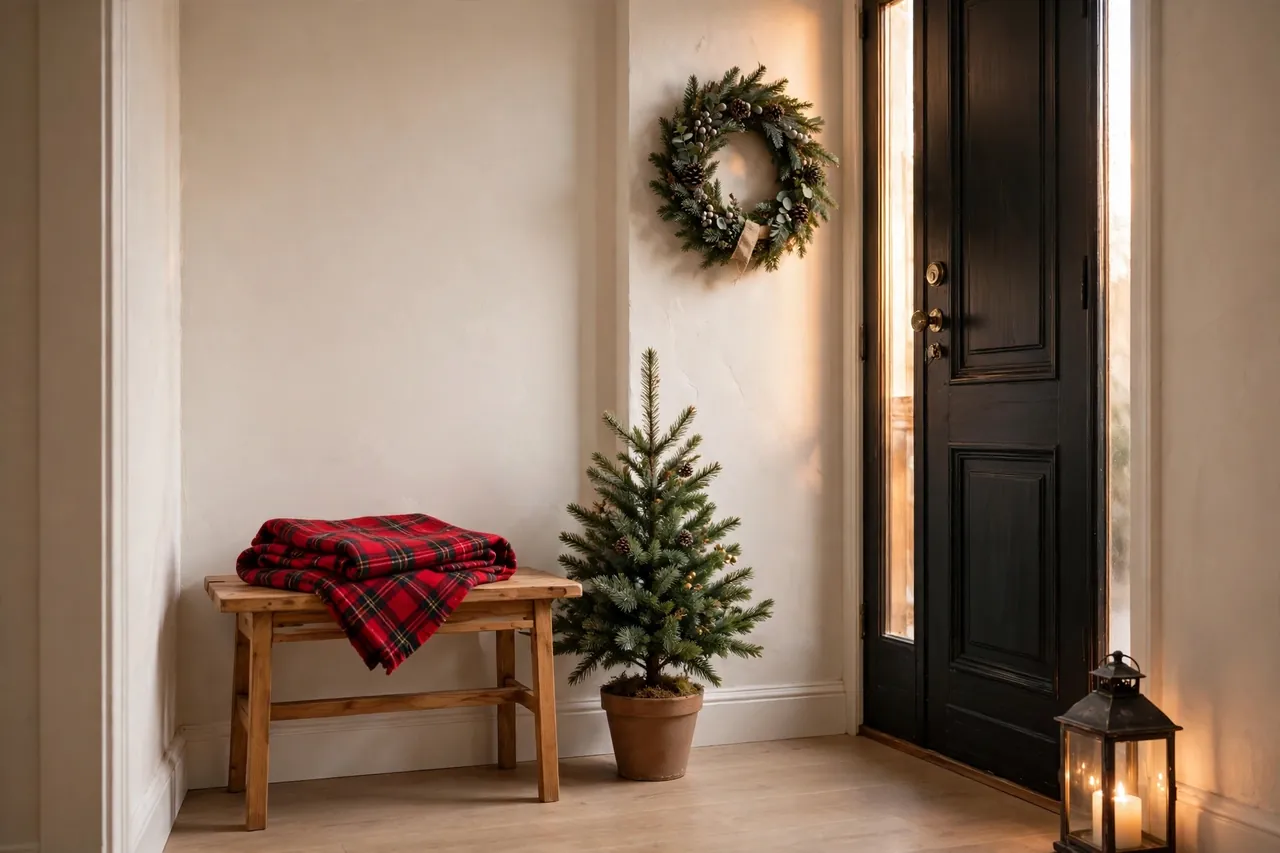
Give that one moment a job. A bench with a folded plaid throw and one small faux tree in a pot gives guests somewhere to perch while they take off shoes, and it looks intentional instead of improvised. A wall-mounted wreath beside the door plus a single lantern on the floor by the wall does the same work in even less space. Pick the moment that fits your entry, then stop.
Use vertical space the way big rooms use floor space. Hooks at different heights hold a wreath, a hanging ornament cluster, and a small stocking without touching the floor. A tall, slim vase of bare branches with a few fairy lights brings height and glow to a corner that could never hold a tree. Everything stays above knee height, so boots, bags, and paws all pass underneath unbothered.
Keep the landing zone honest. An entry hall still has to hold keys, mail, and a pair of shoes, so leave one clear surface — a single hook rail, one small tray — undecorated on purpose. When the practical stuff has a home, the festive stuff looks like a choice instead of a mess, and January you will be grateful you did not have to excavate the keys from under a pile of ornaments.
Keep It Safe All Season
A hallway is an escape route as well as a welcome, so safety is not a footnote here — it is the design. Check your decorations once a week through December, the way you would check a smoke alarm. Most problems announce themselves early if you look: a sagging garland, a warm plug, a runner corner curling up.
Table: Common hallway decoration problems and quick fixes
| Problem | What causes it | Quick fix |
|---|---|---|
| Garland sags mid-season | Hooks too far apart or dusty surface | Add a hook every 12 inches and wipe the surface before re-sticking |
| Cords cross the walkway | Plug-in lights with no nearby outlet | Switch to battery strands or reroute the cord along the wall with clips |
| Runner bunches up | No grip underneath | Add rug tape or a non-slip pad and recheck after week one |
| Candle too close to greenery | Display crowded onto one surface | Move to flameless candles or give real flames a full clear zone |
| Display blocks the path | Floor pieces added one at a time | Move the piece to a wall or remove it — the walkway always wins |
| Hooks peel paint off | Wrong hook for the surface or weight | Match the hook to the weight and surface, and test one spot first |
Walk the hall at night once, with the lights on the way guests will see them. Dark corners hide cords and curling rug edges that daylight forgives. If you find a problem in the dark, fix it in the dark’s terms: more light on that spot, or the hazard moved. Then enjoy the hall instead of worrying about it.
When to Put It Up and Take It Down
Most people begin right after Thanksgiving, and late November is the widely accepted window for hallway decorating. Starting then gives you a full month of evenings to enjoy the glow, and the hall — the first thing guests see — sets the tone for the whole house before anyone reaches the tree.
Take it down within a few weeks after Christmas, while the hooks still come off cleanly and the greenery has not dried onto the paint. Adhesive hooks release more easily when they have not baked in place for months, and fresh greenery left too long can trap moisture against a wall. Pack each piece in a labeled box — garland, hooks, lights, runner — and next December you will decorate in an hour instead of a weekend.
One habit makes next year easier: when you take it all down, note what worked. Which hook held, which garland shed, which corner stayed dark. A three-line note in the box saves you from re-learning the same lessons every November, and your hallway gets a little better every single year.
Related Guides
Decorating a Christmas Window: Ideas That Glow Inside and Out · Decorated Xmas Houses: Ideas for a Whole House That Feels Like Christmas · Christmas Kitchen Decor: A Warm, Workable Holiday Kitchen
Frequently Asked Questions
Can I decorate a narrow hallway for Christmas?
Yes. Stick to slim pieces that live on walls and shallow surfaces: wall-mounted wreaths, garlands along door frames and picture rails, a flat tree on the wall, and one low console display. Keep the full walking width clear, and let vertical space do the work that floor space cannot.
How do I decorate a narrow hallway safely for Christmas?
Focus on vertical space and keep the path clear. Use LED lights along garlands and mirrors, hang wreaths at eye level, and avoid floor decorations that narrow the walk. Keep cords off the floor with battery strands or wall clips, and use flameless candles near greenery, coats, and passing sleeves.
How do you make a hallway look welcoming at Christmas?
Fill it with warmth, light, and one or two interesting features. A clean, uncluttered hall with a wreath, a garland, warm light, and a festive scent feels welcoming the moment the door opens. Add a console vignette or a mirror dressed with greenery, and the hall becomes a stylish sanctuary from the cold.
How can I make my hallway feel cozy for Christmas?
Focus on lighting and texture. Use soft fairy lights, a lantern or two, and flameless candles for a gentle glow. Add a low-profile runner underfoot, a plaid throw on the bench, and greenery along the walls. Small, warm layers beat one big display in a narrow space.
How do I decorate a hallway on a budget?
Use what you already own first. Forage or reuse greenery, pinecones, and old ornaments, make a simple garland from branches you have, and swap prints in frames you already hang. A single strand of fairy lights and a bowl of pinecones can carry a whole hallway, and adhesive hooks cost very little.
Are LED lights necessary for hallway Christmas decorations?
They are the smart choice for a hallway, though not a strict rule. LEDs stay cool, which matters when lights sit close to greenery and ribbon in a narrow space, and battery-operated strands remove cords from the walkway entirely. Add a timer and the hall glows every evening with no daily effort.
Your hallway will never be the biggest room in the house, and that is exactly why it rewards a little thought. One clear path, one color story, a garland on the wall, light that glows without cords, and a runner that stays flat — that is a hallway that welcomes people properly. Start with the walkway, add one layer at a time, and step back at the door the way a guest would. When the hall makes you pause and smile before you even take your coat off, it is done.
One last note: hallway decorating mixes electricity, open flames, and the path everyone uses to leave the house in an emergency. Keep cords off the floor, keep real flames away from greenery and fabric, and never block the walkway or a door. If an outlet feels warm, a cord looks damaged, or a display blocks the way out, fix it before you light anything.