
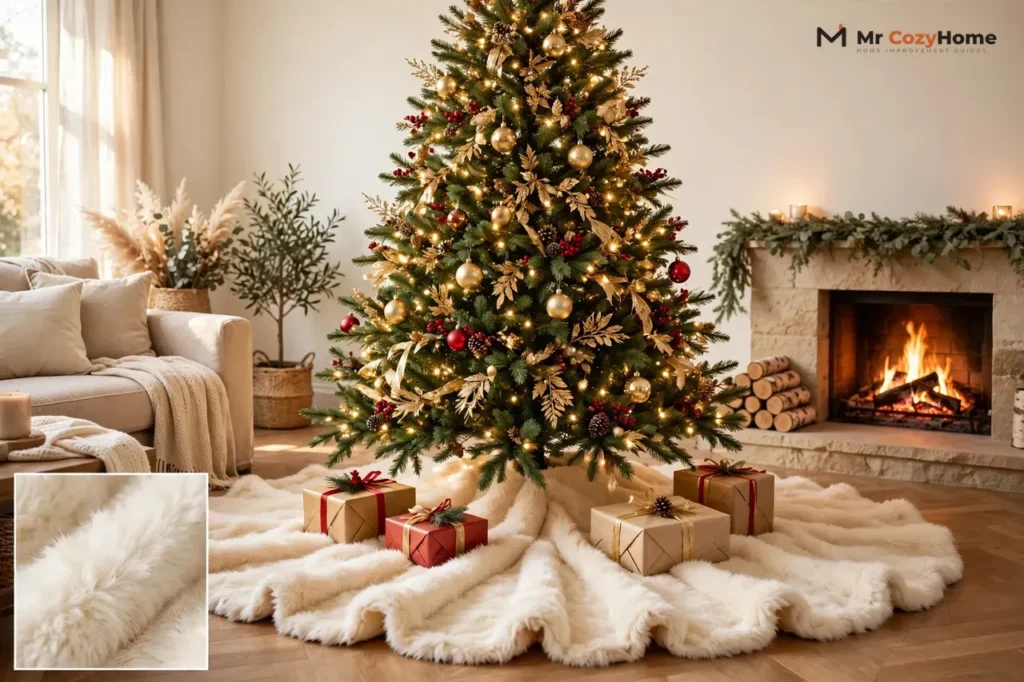
A Christmas tree skirt is a round piece of fabric that sits on the floor around the base of your tree. It hides the stand, catches fallen needles, and gives gifts a soft, finished place to land. The best Christmas tree skirt ideas start with size, then fabric, then color, so the base of your tree looks planned instead of patched together.
Pick a skirt that covers the whole stand and reaches a few inches past the lowest branches. Then choose a fabric that fits your home: soft faux fur for a cozy look, rough burlap for a farmhouse feel, or smooth velvet for a dressier tree. This guide walks you through each choice, step by step, so you can stop second-guessing the base of your tree.
What a Tree Skirt Does at the Base of Your Tree
A tree skirt does three simple jobs. First, it hides the stand, the screws, and the cords that run to the wall. Second, it softens the hard line where the tree meets the floor. Third, it turns the space under the tree into a clear spot for gifts.
A skirt does not hold the tree up, and it does not replace a good stand. If your tree wobbles, fix the stand first. A skirt only covers what sits below the branches, so a loose tree still needs a tight, level stand before you dress the base. The Range’s guide to buying tree skirts and stands describes the same job in plain terms: a skirt hides the stand and creates a defined space for presents.
Most skirts have a slit on one side and a small hole in the middle. You slide the skirt around the trunk after the tree stands in place, then close the slit with ties, buttons, or hook-and-loop fasteners. That slit matters more than most people think, because you will open it again each year and each time you need to reach the stand.
Start With Size: The Choice That Makes or Breaks the Look
Size comes before style. A beautiful skirt in the wrong size still looks wrong. A skirt that is too small leaves the stand peeking out at the edges. A skirt that is too large swallows a small tree and trips everyone who walks past.
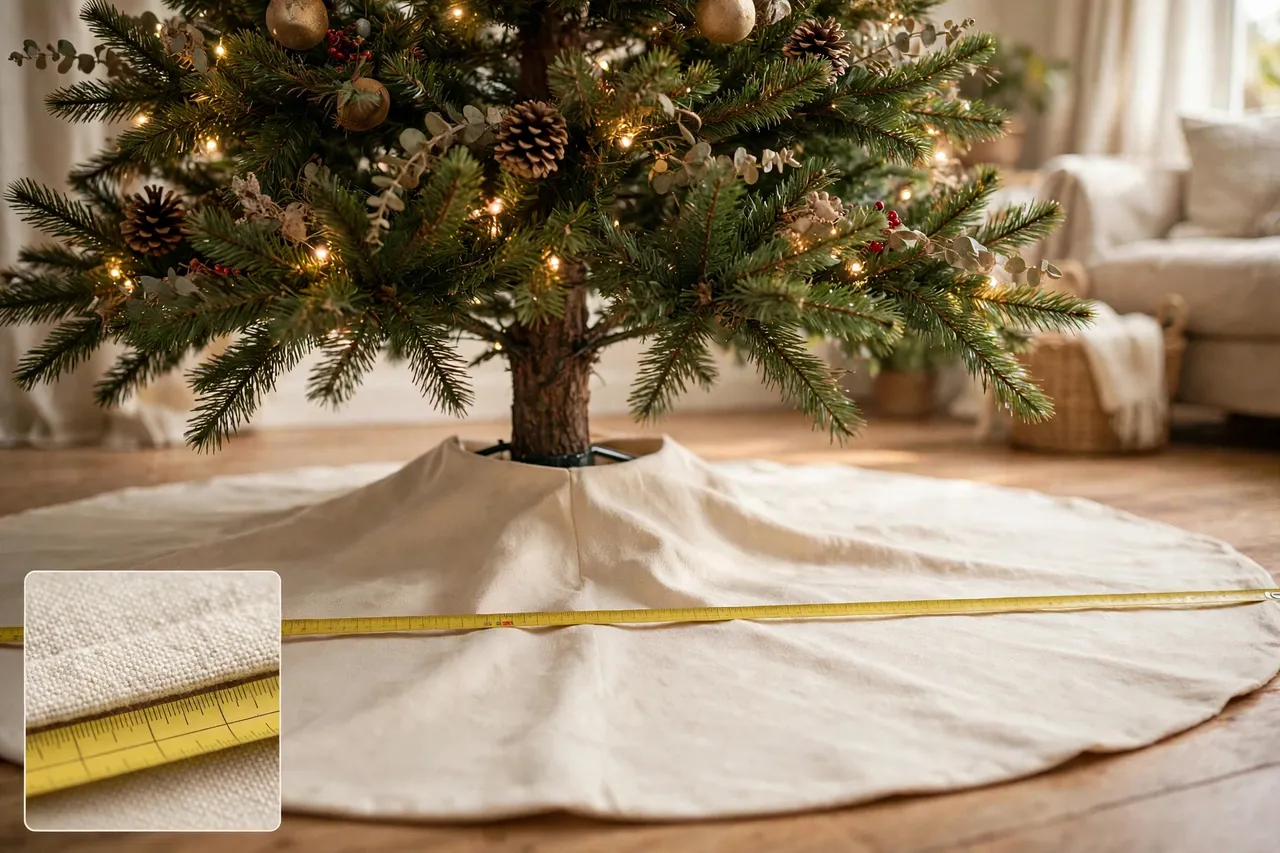
Measure the widest spread of your lowest branches, from tip to tip, straight across the floor. Do not measure the stand alone. The branches set the visual width of the tree, so the skirt must relate to them, not just to the metal or plastic underneath.
As a simple rule, choose a skirt at least 6 inches wider than the full width of your tree at its base. Balsam Hill gives the same rule in its skirt size guide: a skirt should extend at least 6 inches beyond the full width of the tree, so a 54-inch-wide tree needs a 60-inch skirt. Balsam Hill’s tree skirt size guide matches skirt diameter to tree height in the same way, so you can check your tree against its table before you buy.
Use this quick starting table, then adjust for your room. If you pile up many gifts, go one size up so the skirt still shows around the boxes.
| Tree height | Typical base width | Skirt diameter to try first |
|---|---|---|
| Tabletop, 2 to 3 feet | About 18 to 24 inches | 24 to 30 inches |
| Small, 4 to 5 feet | About 30 to 36 inches | 36 to 48 inches |
| Standard, 6 to 7 feet | About 42 to 54 inches | 48 to 60 inches |
| Tall, 8 to 9 feet | About 54 to 66 inches | 72 to 84 inches |
For a slim tree, stay near the smaller end of the range. Slim trees have less branch spread, so a huge skirt looks out of scale and eats floor space. For a full tree, stay near the larger end. Full branches need a wider skirt, or the lowest branches will hang past the edge and hide the skirt completely.
Check the center hole, too. It should fit around your trunk and stand without forcing. A hole that is too tight bunches the fabric. A hole that is too wide leaves a gap you will see every time you walk past the tree.
Faux Fur Skirts: The Cozy, Snowy Base
A faux fur skirt looks like fresh snow piled around the trunk. It works best on a white or flocked tree, on a tree with soft white lights, and in a room that already feels warm and soft. If you want a winter look without a single snowflake ornament, start here.
Faux fur hides a lot. Needles sink into the fibers instead of sitting on top, and small cords disappear under the pile. That same pile makes cleaning slower, though. Shake the skirt outside before you store it, and brush it gently instead of vacuuming it hard, or you will flatten the fur.
Choose cream or white faux fur for the classic snowdrift look. Choose gray faux fur if your room runs cool and modern. Avoid long, shaggy fur in a home with toddlers or large dogs, because little hands and paws will pull at it all season.
Burlap Skirts: The Rustic Farmhouse Base
Burlap gives your tree a farmhouse base in one step. Its rough, open weave reads as natural and handmade, even when you buy it ready-made. It pairs well with wooden ornaments, dried orange slices, simple ribbon, and warm white lights.
Burlap holds its shape better than soft fabrics do. It lies flat, it does not slide as easily, and it lets you layer a second piece on top, such as a lace runner or a thin plaid cloth, without a lumpy mess. The trade-off is texture. Burlap feels scratchy, so it suits a tree you admire more than a tree kids crawl under to play.
Look for burlap with a finished edge. Raw burlap frays fast, and loose threads end up on your floor and on gifts. A bound edge, a lace trim, or a stitched hem keeps the skirt neat through the whole season and through many years of storage.
Knit and Crochet Skirts: The Handmade, Heirloom Base
A knit skirt feels like a thick sweater wrapped around the base of the tree. Chunky cables, soft wool blends, and cable-knit patterns turn the bottom of the tree into the coziest part of the room. Knit skirts suit trees with warm lights, wooden ornaments, and simple, homey decor.
Knit fabric stretches, so check the size with care. A knit skirt can look perfect on the first day and sag wider by New Year. A lined knit skirt holds its shape far better than an unlined one, so read the label before you buy.
If you knit or crochet, this style also makes a strong handmade gift. Use washable yarn, because a tree skirt collects needles, dust, and the odd splash of tree water. A skirt you cannot wash becomes a one-season piece, no matter how pretty it starts out.
Velvet, Quilted, and Cotton Skirts: The Classic Choices
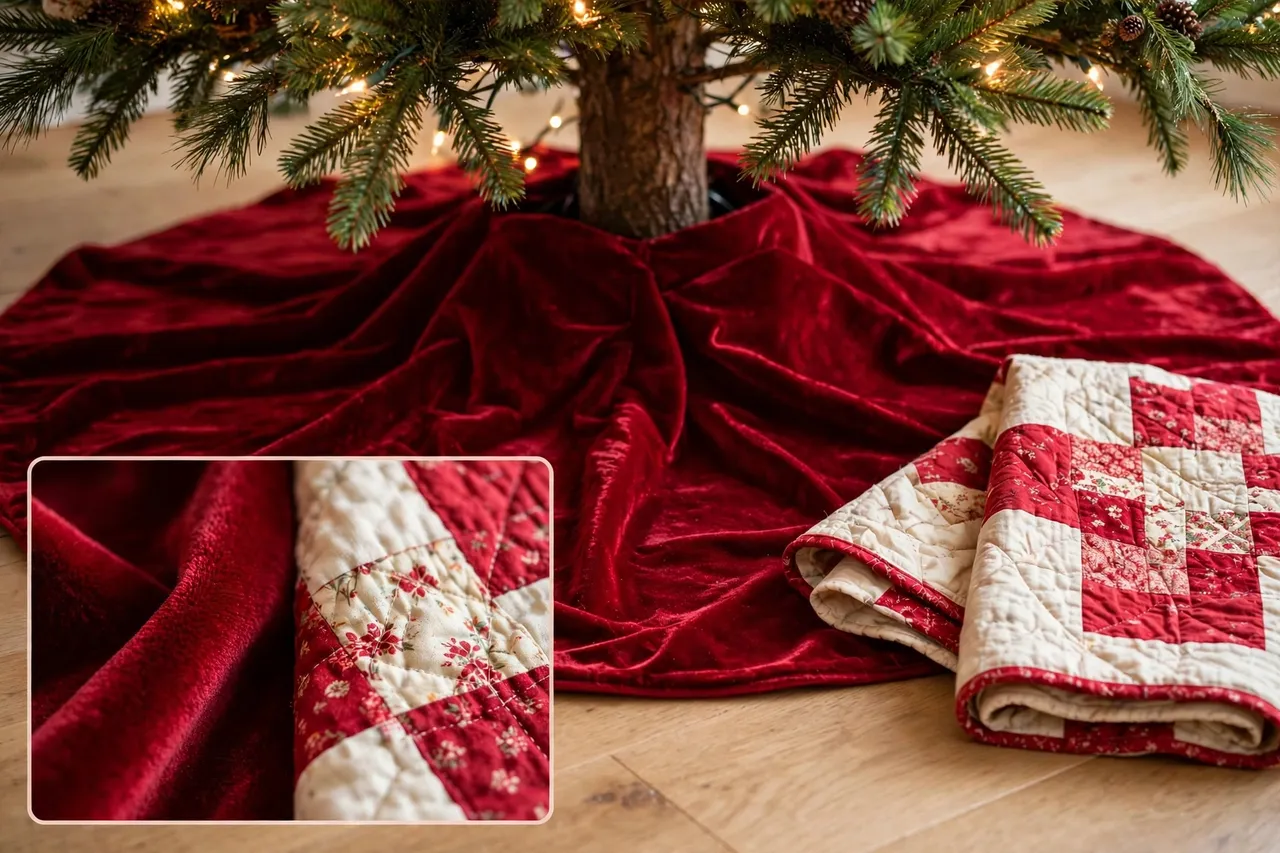
Velvet brings instant dressiness to the base of a tree. Deep red, forest green, and navy velvet look rich under warm lights, and velvet catches light in a way flat cotton never does. Velvet also shows dust and pet hair, so keep a lint roller near the tree if you have pets.
Quilted cotton skirts feel lighter and more practical. A quilted skirt often has a pattern on one side and a plain backing on the other, and many quilted skirts wash well. Patchwork quilted skirts suit a family tree full of mixed ornaments, because the busy pattern ties different colors together instead of fighting them.
Plain cotton skirts give you the most control. You can add your own trim, switch the look with a ribbon, or use the skirt year after year while you change the rest of the tree. If you want one skirt to last through many themes, pick a solid cotton skirt in a color you love, not a print tied to one year.
Felt sits in its own small group. Felt does not fray, it cuts cleanly, and it makes a great beginner DIY skirt. Felt skirts feel thinner than velvet or quilted skirts, though, so layer felt over a sturdier backing if you want a fuller, more finished base.
Match the Skirt to Your Tree Color and Room
Your skirt should talk to your tree and your room, not shout over them. Start with the tree itself. A green tree takes almost any skirt color. A white or flocked tree looks best with white, cream, silver, or soft gray at its base, because a dark skirt can cut the snowy look in half.
Next, look at your room. If your furniture runs neutral, you can go bold at the base: red plaid, deep green velvet, or a rich gold pattern. If your room already holds lots of color and pattern, pick a solid skirt and let the tree do the talking. Two loud patterns at the base will fight each other, and the eye will not know where to rest.
Match one color, not every color. Pull one shade from your ornaments, your ribbon, or your throw pillows, and repeat it in the skirt. For example, if your tree carries gold ribbon, a cream skirt with gold trim ties the base to the tree without copying the whole tree. If you want help picking a whole look first, our guide to themes for Christmas decoration shows how one theme can run through the entire room, and the skirt simply finishes that theme at the floor.
Color and Pattern Ideas That Work at the Base
- Classic red and green plaid: warm, traditional, and forgiving with mixed ornaments.
- Cream, white, or champagne: calm and snowy, best on flocked or white trees.
- Deep green velvet: rich and quiet, so bright ornaments stand out above it.
- Natural burlap with cream lace: rustic but soft, good for farmhouse rooms.
- Gold or silver on a dark base: dressy and bright under warm or cool lights.
- Buffalo check in red and black: bold and cozy, best when the rest of the room stays simple.
On a brown or wood-toned tree, keep the skirt warm and simple. A cream, tan, or soft gold skirt lets the unusual tree color shine, while a loud print can steal attention from the branches. Our guide to decorating a brown Christmas tree covers that balance in full, and the same rule applies at the base: let the tree lead, and let the skirt support it.
Personalized Skirts: Names, Dates, and Family Stories
A personalized skirt turns a plain base into a keepsake. Embroidered family names, a wedding year, or a baby’s first Christmas date make the skirt part of the family’s story, not just another decoration you swap each year.
Keep the personal touch small and near the edge. A name stitched in the center disappears under the stand. A name near the outer hem stays visible even when gifts pile up, and it photographs well on Christmas morning.
Choose embroidery over iron-on letters for a skirt you want to keep. Iron-on letters peel after washing and storage. Embroidered names survive years of folding, washing, and attic heat far better, and they look softer and more handmade.
For a family tree, let each child add one small stitched star, patch, or initial over the years. The skirt then grows with the family, and each December it tells the story of who added what, and when. That slow, personal build beats a brand-new skirt every year, because no store can sell your family’s history.
Tree Skirt or Tree Collar? How to Choose
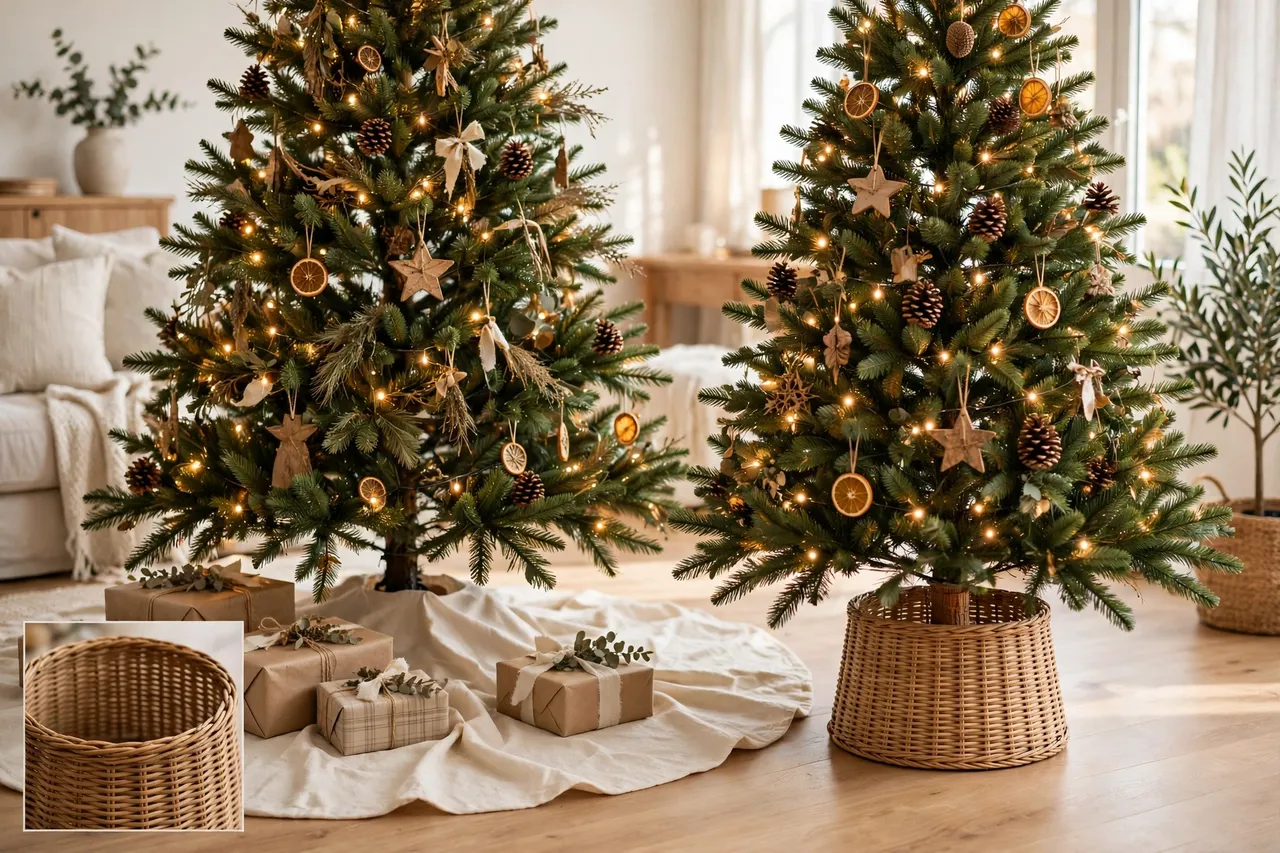
A tree collar is a stiff ring that stands upright around the trunk, usually 4 to 10 inches tall and 16 to 24 inches across. It looks like a basket, a metal band, or a wooden box around the base. A skirt lies flat on the floor and spreads outward. Both hide the stand, but they solve different problems.
Pick a skirt when you want softness, a wide gift area, and a place that catches needles. Pick a collar when you want a clean, modern base, easy access to the stand, and nothing for pets or toddlers to drag around. Collars also suit small rooms, because they take up far less floor space than a wide skirt.
| Feature | Tree skirt | Tree collar |
|---|---|---|
| Shape | Flat fabric that spreads on the floor | Stiff ring that stands around the trunk |
| Stand coverage | Full, when sized right | Partial, mainly the trunk area |
| Needle catching | Strong, needles rest on the fabric | Weak, needles fall past it to the floor |
| Water and stand access | Lift or shift the fabric | Easy, lift the collar off |
| Pets and kids | Edges can drag and trip | Stays put, no loose edges |
| Storage | Bulky, fold or roll with care | Compact, many fold flat |
You can use both together, but only with care. A low collar under a large, light skirt can tidy the trunk area while the skirt still gives you a wide, soft base. A tall collar under a skirt, though, pushes the skirt up into a lumpy ring and hides the collar anyway. If you love the collar look, skip the skirt. If you love the soft skirt look, skip the collar.
Think about your tree type, too. A real tree drops needles and needs water, so a skirt that catches needles and lets you lift one edge for watering makes daily care easier. An artificial tree needs neither, so a collar becomes a fair, low-fuss choice. If you have a flocked tree, a white faux fur skirt keeps the snowy look going all the way to the floor, while a collar can break that soft line. Our guide to what a flocked Christmas tree is explains that snowy finish, and the skirt is the easiest way to carry it down to the floor.
DIY or Bought? An Honest Comparison
Buy a skirt when you want a finished look fast, a tricky fabric like velvet or faux fur, or a size you cannot cut at home. Bought skirts also give you a clean center hole, a bound edge, and a closure that actually stays shut.
Make a skirt when you want a personal fabric, an odd size, or a keepsake no store sells. A DIY skirt also lets you match your curtains, your table runner, or a beloved old quilt, and that match is hard to buy.
Christmas tree skirting ideas work just as well as a phrase for DIY projects as for bought ones, because the question stays the same: what should sit at the base of this tree, in this room, for this family? Answer that first, and the make-or-buy choice gets easy.
A Simple No-Sew Felt Skirt in an Afternoon
- Measure your tree base and add at least 6 inches on each side, then pick a felt color you love.
- Fold a large square of felt in quarters, and cut a wide curve across the open end to make a circle.
- Cut a small center hole and one straight slit from the hole to the outer edge.
- Glue a ribbon trim around the outer edge, and glue felt shapes, such as stars or trees, near the hem.
- Let the glue dry flat, then lay the skirt around the trunk and close the slit with fabric glue dots or sewn ties.
Pre-wash washable fabric before you sew, or your finished skirt may shrink after its first wash. Press seams as you go, because a pressed skirt lies flatter than a wrinkled one. And test any glue or trim on a scrap first, so a color bleed or a stiff glue line does not ruin the whole piece.
If you sew, a lined circle skirt is the most forgiving first project. Cut two circles, one for the top and one for the lining, sew them together at the edge, turn the skirt right-side out, and topstitch near the edge. Add ribbon ties at the slit, and you have a skirt that looks bought but carries your own fabric choice.
Make the Skirt Work With the Rest of the Tree
The skirt is the last piece you place, but it should feel like part of the tree, not an afterthought. Lay the skirt down before you place gifts, and step back to check it from the doorway. That doorway view shows what guests see first, and it catches problems you miss up close.
Let the skirt echo one other piece in the room. A red plaid skirt echoes a red plaid ribbon on the tree. A cream faux fur skirt echoes a cream throw on the sofa. One echo ties the base to the room. Five echoes turn the room into a theme park.
Ribbon deserves a special note here, because ribbon and skirt often share the same color story. If your tree wears wide ribbon, match the skirt to the ribbon’s quieter color, not its loudest one. Our guide on how to put ribbon on a Christmas tree shows how ribbon flows down the branches, and the skirt should catch that flow at the floor, not compete with it.
Gold trees need the same restraint. A gold skirt under a gold tree can wash out and look flat. A cream, ivory, or deep green skirt under a gold tree gives the gold room to shine. Our gold Christmas tree decorations guide walks through that balance, and the base follows the same rule: contrast beats more of the same.
Skirts for Pets, Kids, and Real Trees
Pets and kids change the skirt math. A long, loose skirt invites pulling, chewing, and tripping. In a busy family room, pick a shorter skirt, a heavier fabric, or a collar instead. Skip dangling tassels, loose ribbons, and small glued-on pieces that a child or pet could pull off.
For a real tree, pick a skirt you can wash or shake out. Needles will land on it every day, and tree water will splash it at least once. A washable cotton or felt skirt beats a dry-clean-only velvet skirt in a real-tree home, because you will clean it more than you think.
Keep cords under the skirt, not across it. Run the light cord along the floor to the wall, then lay the skirt over the cord near the trunk. A cord that crosses the skirt creates a bump guests trip over, and a bump under a skirt looks like a lump you forgot to smooth.
Water with care. Lift one edge of the skirt, water the stand, and let any drips fall on the skirt, not on a bare wood floor. If your skirt is not washable, lay a small waterproof mat under the stand first, then place the skirt over the mat’s edges so the mat stays hidden.
Keep Your Skirt Looking Good All Season
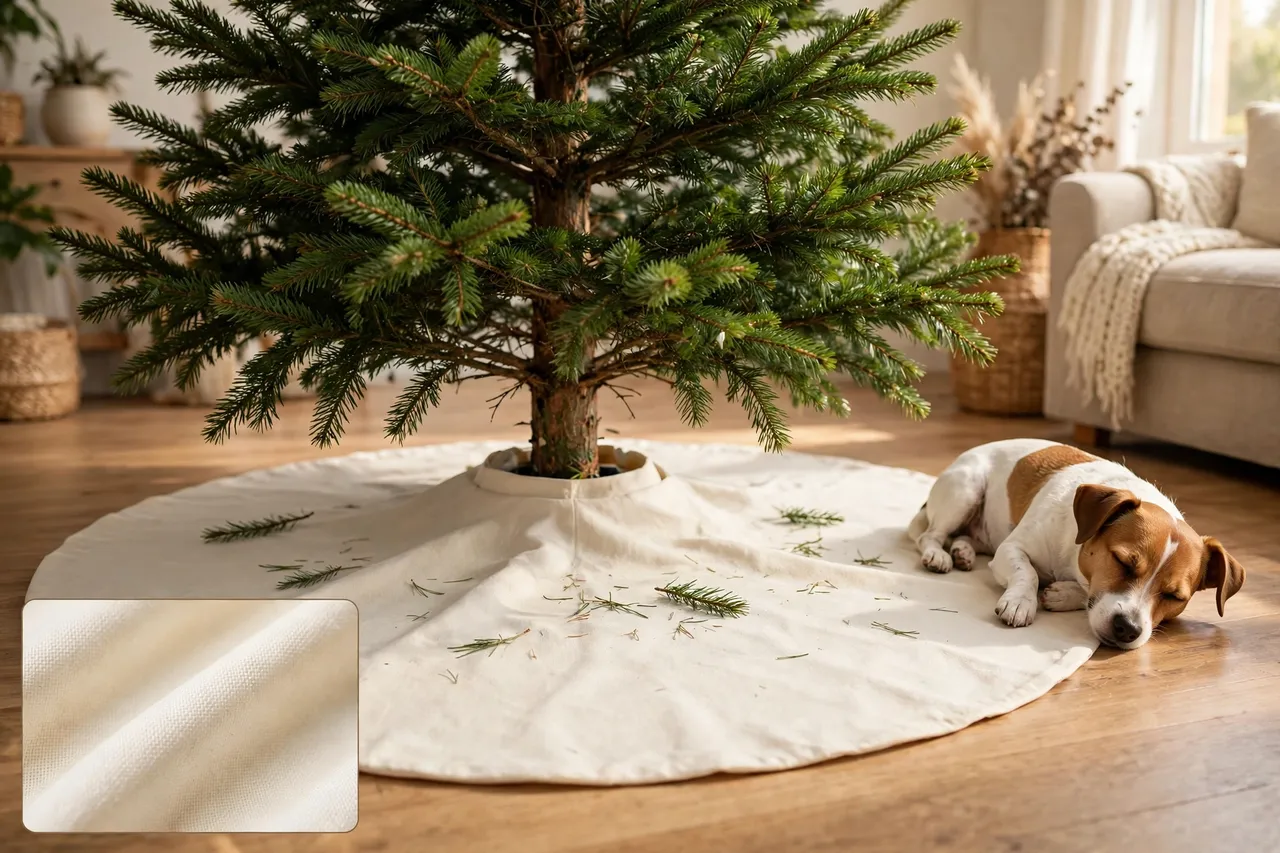
A skirt looks best when it lies flat. Each week, smooth out wrinkles with your hands, pull the skirt back into a circle, and tuck any edge that has crept under a gift. Two minutes of smoothing beats a full re-do on Christmas Eve.
Shake a real-tree skirt outside once a week to drop trapped needles. Spot-clean spills right away with a damp cloth and mild soap, because pine sap and hot cocoa set fast on fabric. Always check the care label first, since faux fur and velvet need gentler care than cotton or felt.
After the season, fold the skirt loosely or roll it instead of pressing it into a tight ball. A tight fold leaves creases that show next year, and a crushed velvet skirt may never recover its smooth nap. Store it in a breathable bag, not a sealed plastic bin in a hot attic, so it stays fresh for next December.
Common Skirt Mistakes to Avoid
- Buying by tree height alone: branch width sets the skirt size, not height, so measure across the lowest branches.
- Picking a skirt smaller than the stand: the stand will peek out, and the whole base will look unfinished.
- Matching every color at once: match one color from the tree or room, and let the rest stay calm.
- Adding loose trim in a pet home: tassels and dangling ribbons invite chewing and pulling.
- Forgetting the slit: a skirt with no slit or a weak closure will not stay closed around the trunk.
- Hiding cords across the skirt: run cords flat on the floor first, then lay the skirt over them near the trunk.
Your Quick Skirt Decision Checklist
Use this checklist in the store or at your sewing table, and you will leave with a skirt that fits the first time.
- Measure the lowest branch spread, then add at least 6 inches for the skirt diameter.
- Check the center hole against your trunk and stand before you buy or cut.
- Pick a fabric that fits your home: washable for pets, kids, and real trees; velvet or faux fur for a dressier look.
- Match one color from your tree or room, not every color.
- Choose a closure that stays shut: ties, buttons, or hook-and-loop fasteners.
- Check the care label, and pick a skirt you can actually clean.
- Step back to the doorway and check the base before you place gifts.
Related Guides
If you are still shaping the whole tree, start with tree decorating ideas for Christmas for the big picture, then come back to the base with fresh eyes. A skirt looks even better when the tree above it already feels balanced.
Frequently Asked Questions
What size Christmas tree skirt do I need?
Measure the widest spread of your lowest branches, then choose a skirt at least 6 inches wider than that width. A standard 6 to 7 foot tree usually needs a 48 to 60 inch skirt, while a tabletop tree needs only 24 to 30 inches. Always check the stand width, too, so the skirt covers it fully.
How do I measure for a Christmas tree skirt?
Measure straight across the lowest branches, from tip to tip, while the tree stands in place. That width sets your skirt size. Then measure the stand itself, and make sure the skirt diameter beats both numbers. Finally, check the center hole against your trunk so the skirt sits flat without bunching.
What size Christmas tree skirt do I need for a 6-foot tree?
Most 6-foot trees need a 48 to 54 inch skirt, and many size guides point to that range for a 6-foot tree. If your tree runs full or you stack many gifts under it, go up to 60 inches so the skirt still shows around the boxes. Slim 6-foot trees can use the smaller end of the range.
Can I use a Christmas tree skirt that is smaller than my tree base?
You can, but it will not look finished. A skirt smaller than the base leaves the stand visible and makes the tree look out of proportion. It also catches fewer needles and gives gifts less room. If you already own a small skirt, layer it over a larger plain cloth, or save it for a smaller tree.
Can I use both a skirt and a collar together?
Yes, but only when you keep the pairing low and simple. A low collar under a large, light skirt can tidy the trunk while the skirt still gives you a wide, soft base. Skip the pairing if the collar stands tall, because it will push the skirt into a lumpy ring and hide the collar anyway.
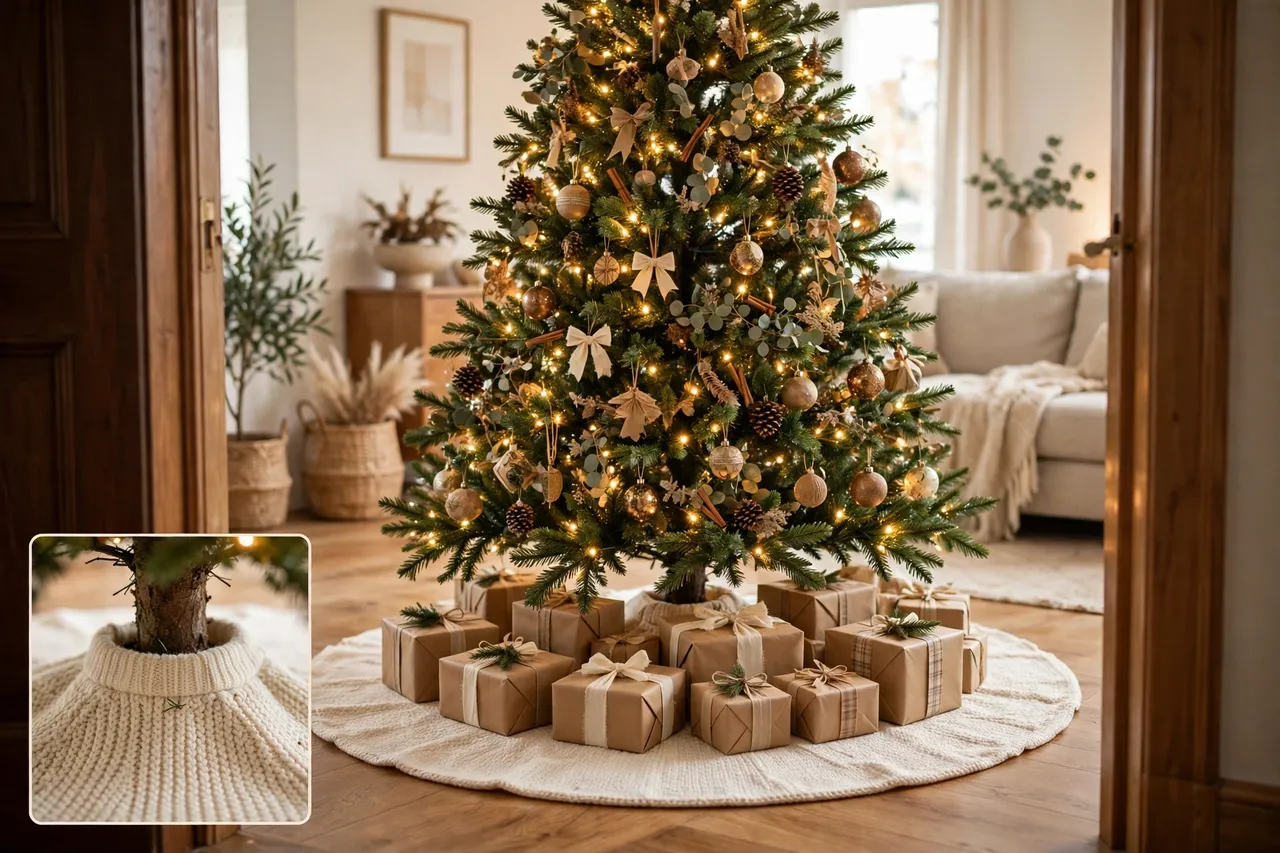
Start with size, pick a fabric that fits your real life, and match just one color from your tree or room. That simple order turns the base of your tree from an afterthought into the finishing touch. Lay your skirt down, step back to the doorway, smooth one last wrinkle, and enjoy a tree that looks complete from top to floor.


