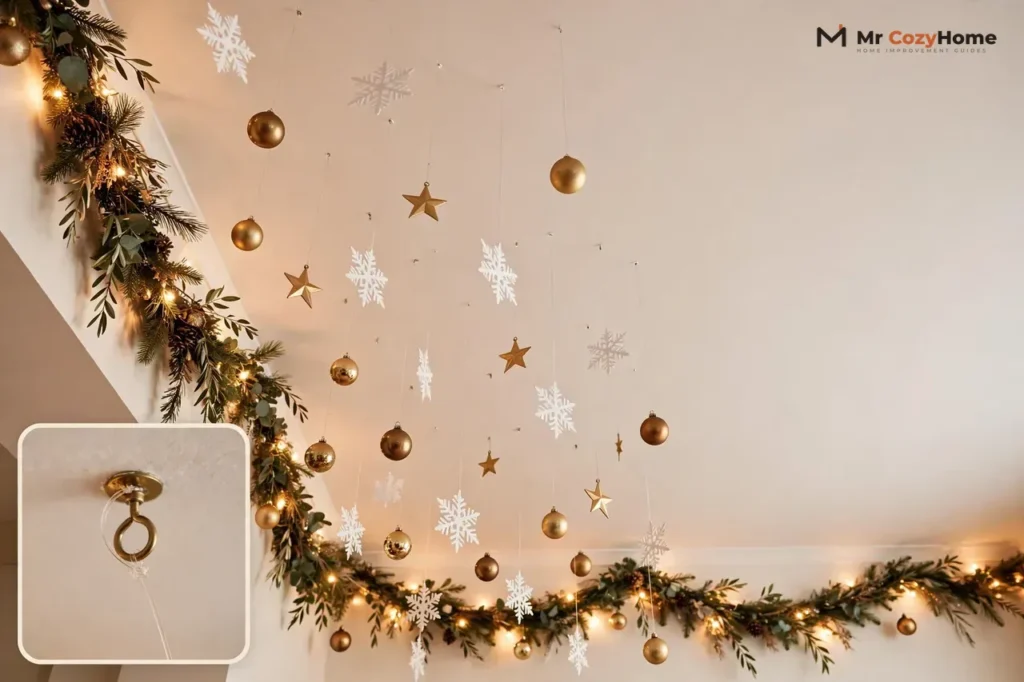
Ceiling Xmas decor turns the most ignored surface in your home into the star of your holiday look. Hang lightweight snowflakes, stars, and ornaments on clear line, drape soft fabric or garland swags across the ceiling, and add warm ceiling lights for a glow that fills the whole room. Keep every piece light, keep it clear of fans and hot bulbs, and use removable hooks so you can take it all down in January without a mark on the ceiling.
That last point matters most. A ceiling display looks magical only when it feels safe and easy to live with. If you duck under low ornaments every time you cross the room, or you worry each night that a heavy piece might fall, the magic fades fast. This guide shows you how to plan the height, pick the right way to hang each piece, and decorate room by room.
Start With a Ceiling Plan That Fits Your Room
Before you hang a single snowflake, stand in the doorway and look up. Notice the ceiling height, the light fixtures, the fan, the vents, and the spots where people walk. Ceiling decor christmas looks best when it follows the room, not when it fights it. A low, flat ceiling suits a simple border of lights and a few hanging pieces over the table. A high ceiling can carry draping, swags, and layers at different heights.
Pick one focal point for each room. In the living room, that might be the space above the coffee table. In the dining room, it is the chandelier over the table. In the entryway, it is the path guests walk through when they arrive. One strong focal point beats a ceiling covered edge to edge with random pieces, because the eye knows where to land first.
Choose a color story before you open your decoration boxes. White, silver, and gold feel calm and snowy. Red and green feel classic and bold. Pick two main colors and one accent, then repeat them in the ceiling pieces, the tree, and the table. When the ceiling shares colors with the rest of the room, the whole space feels planned, even if you only hung a dozen pieces.
Measure the ceiling height, the distance from the ceiling to the top of the door frames, and the height of the tallest person who walks under the display. Then decide your lowest point before you start. In walkways, keep the lowest ornament well above head height so no one brushes it. Over a dining table, you can hang pieces lower, because no one walks through that space, but you still need a clear view across the table.
Height and Clearance Rules That Keep the Room Comfortable
Clearance rules sound boring, but they decide whether your display feels delightful or annoying. Use the table below as your starting point, then adjust it for your own ceiling height and furniture.
| Spot in the room | Keep this clear | Why it matters |
|---|---|---|
| Walkways and doorways | Lowest piece well above head height | Guests walk through without ducking |
| Over a dining table | About 28 inches above the tabletop | People see each other and talk with ease |
| Near a ceiling fan | No decor on blades, clear of the blade path | Blades can snag, throw, or break hanging pieces |
| Near heat sources and bulbs | Decor kept away from hot bulbs and heaters | Heat can scorch fabric and melt plastic |
| Near sprinklers and detectors | Nothing blocking a sprinkler or detector | Blocked safety devices cannot do their job |
For ceiling fans, take the safest route. Turn the fan off, let the blades stop fully, and never attach anything to the blades themselves. Hang pieces from the ceiling around the fan, or from a point that keeps them well clear of the blade path, and test the fan on low before guests arrive. If a piece swings toward a blade, move the anchor point or shorten the line.
How to Hang Christmas Decorations From the Ceiling Without Damage
The best ceiling display leaves no trace in January. Start by matching the hanging method to the ceiling surface and the weight of the piece. Smooth, painted drywall holds removable adhesive hooks well. Textured or popcorn ceilings do not, because the bumpy finish stops the smooth adhesive film from gripping. For textured ceilings, use small clear tacks, clips made for drop ceilings, or tension rods between walls instead of adhesive.
Read the weight rating on every hook and clip, then stay well under it. A hook rated for a few pounds can hold a paper snowflake with ease, but a garland strand with lights and ornaments adds up fast. Spread the weight across several hooks instead of loading one point. When you hang a garland, space the hooks close enough that no span sags or pulls, and test each anchor with a gentle tug before you add the decor.
- Removable adhesive hooks for smooth ceilings and light pieces
- Drop-ceiling grid clips for metal grid frames, never for the soft tiles alone
- Small cup hooks or beam clips for wood beams and trim
- Magnetic hooks for metal surfaces, tested first with the real ornament
- Clear fishing line for the floating look, ribbon when the hanger should show
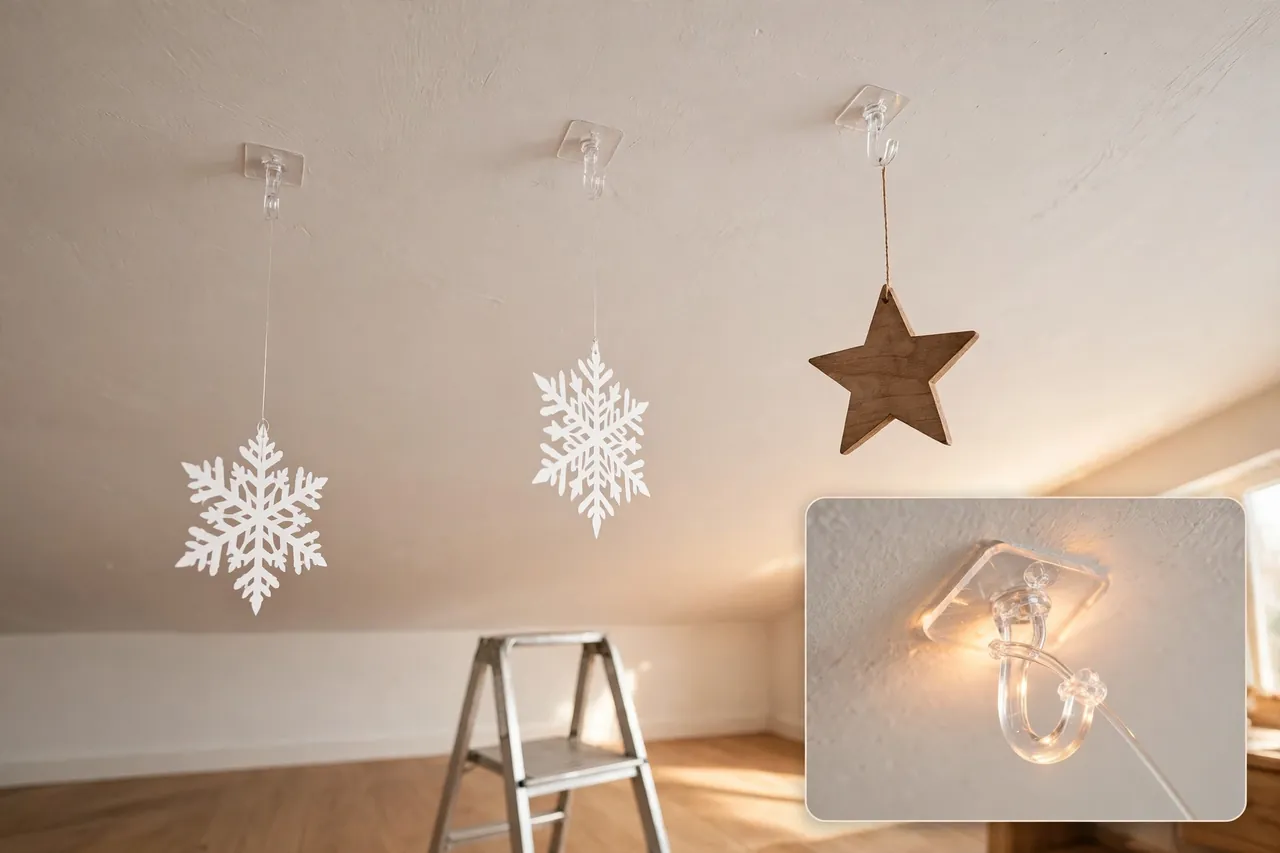
Before you climb a ladder, set it up right. Place the ladder on a flat, dry floor, open it fully, and lock the spreaders. Keep your hips inside the rails, and never stand on the top step or lean far to one side to reach a hook. Move the ladder instead of stretching for one more inch. Ask another person to hold the ladder steady on a high ceiling, and keep the floor below clear.
Clean the ceiling spot before you stick anything to it. Dust and cobwebs weaken adhesive, so wipe the area with a dry microfiber cloth or a duster on a pole. Press each adhesive hook firmly for about 30 seconds, then wait at least an hour before you hang lights or decor from it, so the adhesive sets fully. That waiting step feels slow, but it prevents the sad moment when a whole strand slides down at midnight. These hook and spacing tips follow the ceiling-light guide from Angi, which also suggests spacing hooks about 2 feet apart along a light run.
- Plan your layout on the floor first, with the lengths and anchor points marked.
- Clean each anchor spot, then press each hook firmly and let it set.
- Hang the lightest pieces first, step back, and check the shape.
- Add garlands and lights last, so they do not snag the hanging pieces.
- Run fans and lights for one evening, then fix any piece that sags or swings.
Hanging Snowflakes, Stars, and Ornaments That Look Like They Float
Hanging snowflakes, stars, and ornaments from the ceiling creates the classic winter-sky effect, and it suits almost any room. Mix sizes for depth. Hang large snowflakes higher and closer to the ceiling, medium pieces in the middle layer, and a few small stars lower down. The eye reads the layers as falling snow, and the display feels full without crowding the room.
Vary the lengths on purpose. If every ornament hangs at the same height, the ceiling looks like a flat shelf. Cut lines in three lengths, short, medium, and long, and step back often to check the shape. Cluster pieces over the coffee table or the dining table, where people look up and admire them, and leave open space near doorways and walkways.
Paper snowflakes make a wonderful family project, and they weigh almost nothing, so they suit adhesive hooks and fishing line perfectly. Wooden stars, felt ornaments, and shatterproof balls also work well overhead, because they will not break into sharp pieces if one slips. Save heavy glass ornaments for the tree or a sturdy shelf, not for a line over a walkway.
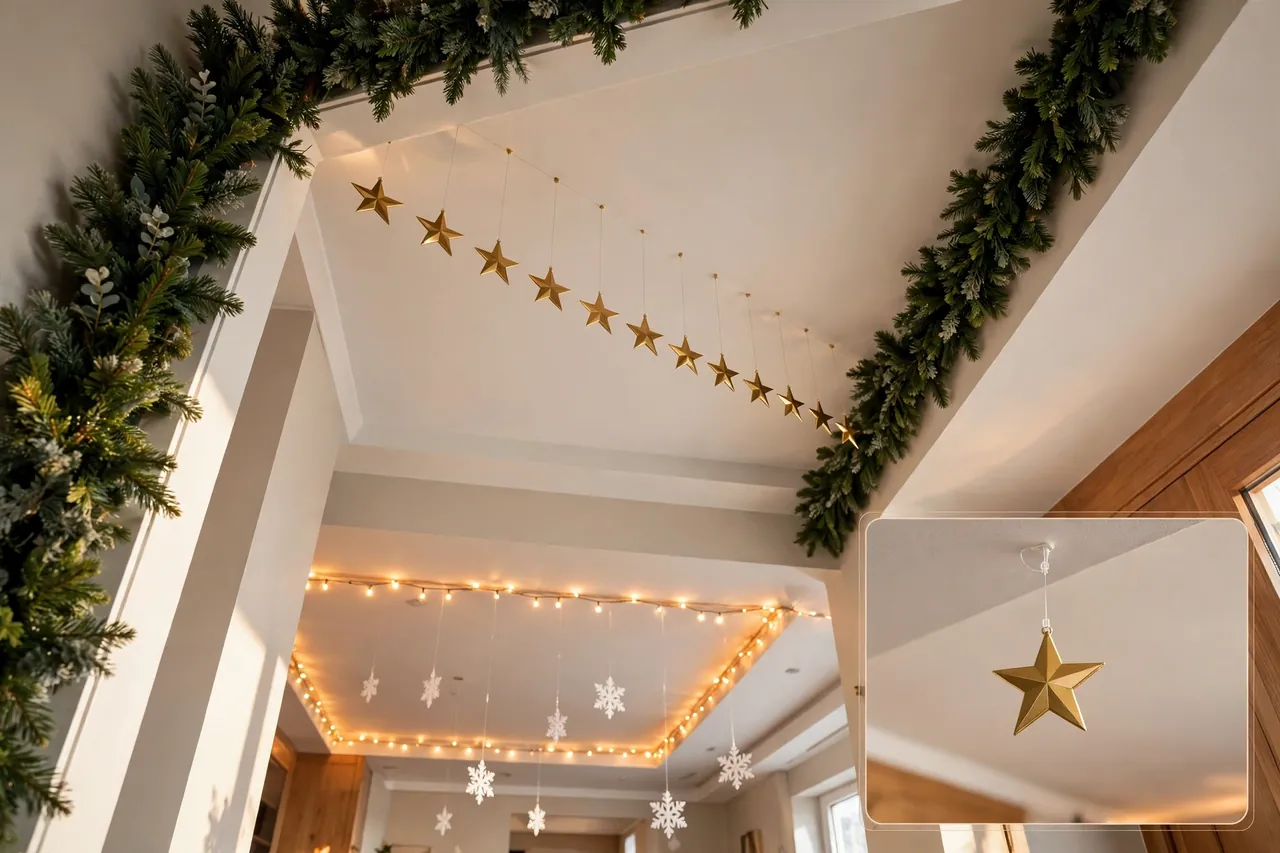
If you love the look of Christmas decorating hallway ideas, carry the same idea upward. A hallway ceiling with a line of snowflakes or a garland along each edge feels like a snowy tunnel. Keep hallway pieces high and tight to the ceiling, because the space is narrow and people pass close to the walls.
Ceiling Draping: Fabric, Tulle, and Garland Swags
Ceiling draping adds softness that hard ornaments cannot give. Tulle, sheer fabric, and lightweight cotton create clouds, waves, and canopies overhead, and they catch the light in a way that feels warm and dreamy. Start with white or ivory tulle for a snowy look, or match the fabric to your color story for a bolder room.
For a simple border drape, gather tulle along the edge where the ceiling meets the walls, and clip it in soft swags. Let the fabric dip gently between anchor points instead of pulling it tight. A loose dip looks relaxed and elegant, while a tight pull looks flat and strained. Add string lights behind the tulle for a glow that shines through the fabric, but use cool LED lights for this look, and keep lights from touching the fabric.
For a canopy, run fabric from a center point, such as a chandelier medallion or a ceiling hook, out toward the corners of the room. The fabric falls in soft panels, like a tent, and it turns a plain ceiling into a celebration space. This style suits a dining room or party room best, where guests sit under the canopy. Keep it high enough that no one brushes it, and clear of fans and fixtures.
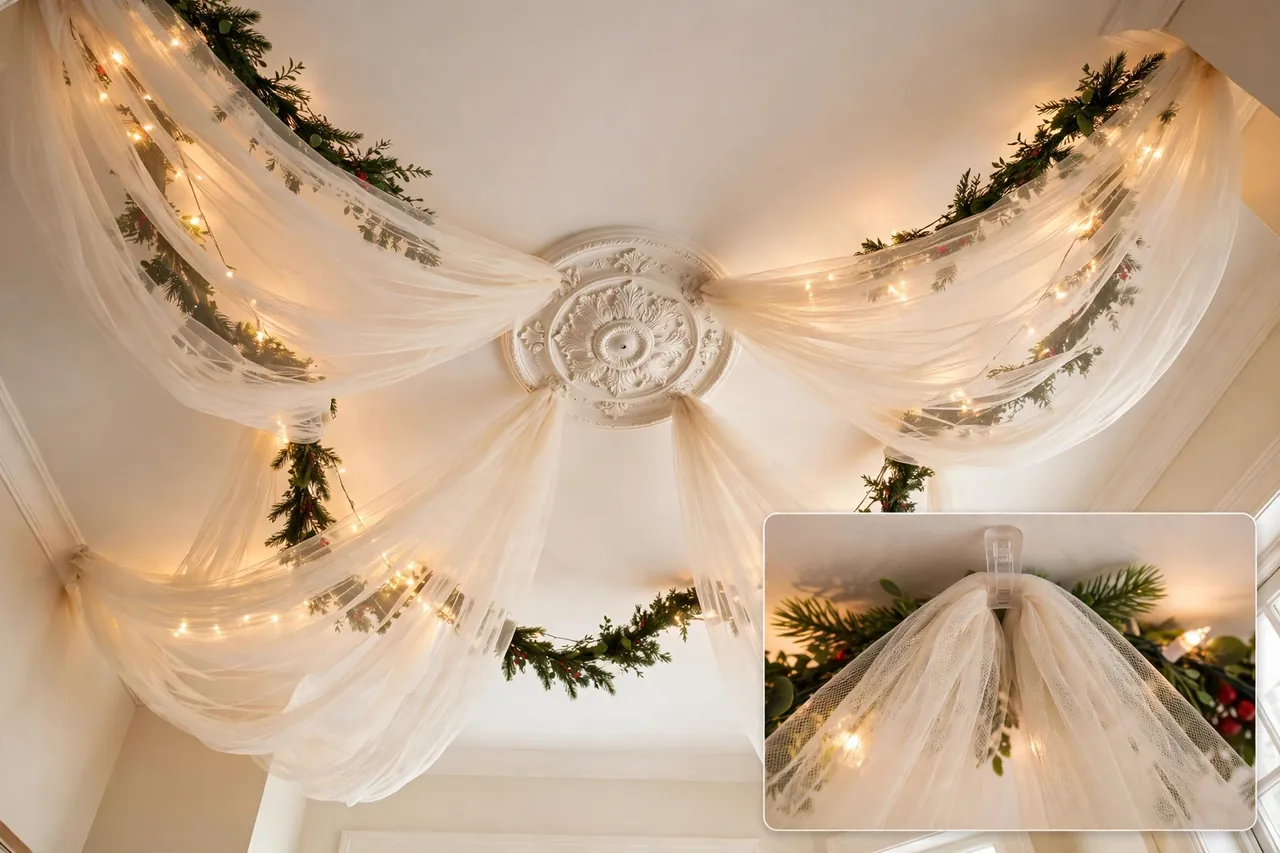
Garland swags give draping a greener, more traditional feel. Drape a faux garland in a curve from one anchor point to the next, and let it sag in the middle for a natural swag shape. Tuck small ornaments, pinecones, or berries into the garland, and weave in a strand of lights for sparkle. Faux garland works better overhead than fresh greenery for most homes, because it stays light, holds its shape all season, and drops no needles on the table.
Before you drape fabric near any light, check the heat. Keep fabric, tulle, and paper well away from hot bulbs, and switch to cool LED bulbs or battery LED strands where fabric sits close to a fixture. Turn draped lights off when you leave the room or go to bed, and check the drape once a week for sagging or pieces that slipped closer to a bulb.
Ceiling Lights and Projectors That Make the Whole Room Glow
Ceiling-mounted lights change the mood of a room faster than any other ceiling piece. String lights along the ceiling edge give a clean outline, while a zigzag pattern across the ceiling fills the room with light. A scattered star-field pattern, with clusters of tiny lights and open gaps, feels like a night sky, and it pairs beautifully with hanging snowflakes.
Pick LED lights for ceiling work. LEDs run cooler than old incandescent bulbs, they use less power, and they come in warm white, cool white, and color options. Warm white suits a cozy living room, while cool white suits a snowy, icy theme. Match the wire color to your ceiling when you can: white wire disappears on a white ceiling, while green wire blends with garland.
Plan the power route before you hang the first strand. Start near an outlet, run the cord down a corner where it stays out of the way, and use a cord cover if the cord must cross a walkway. A timer plug or an automatic light switch timer can switch your ceiling lights on at dusk and off at bedtime, so you enjoy the glow without leaving lights on all night.
Projectors add a second layer of magic with very little weight. A small projector on a shelf or a stable stand can cast snowflakes, stars, or gentle moving patterns across the ceiling, and it needs no hooks in the ceiling at all. Aim it at a plain stretch of ceiling, away from fans and hanging decor, so the pattern stays sharp. Keep its cord tidy, and test it in the dark before party night, because daylight hides the effect.
For more light ideas that pair with a ceiling display, see Christmas light ideas for the whole home. Ceiling lights work best when they match the lights on the tree, the mantel, and the windows, so the house glows as one story instead of separate displays.
How to Dress a Chandelier for Christmas
A chandelier already draws the eye upward, so it makes the perfect center for Xmas decorations for ceiling displays. Dress it lightly, and let the fixture itself still shine. Heavy garland and large ornaments can strain the fixture, block the light, and hide the crystals or arms that make a chandelier beautiful.
Before you decorate a chandelier, switch the light off and let the bulbs cool fully. Dust the fixture first, because holiday decor traps dust, and a clean chandelier sparkles more. Then wrap a lightweight faux garland around the top section or the chain, rather than the arms, so the garland stays put and the arms stay clear. Tuck small ornaments or berries into the garland gaps, and step back to check the shape before you add more.
Keep every piece away from hot bulbs. Decorations that touch a bulb can scorch, melt, or catch fire, so leave a clear gap around each bulb. Battery-operated LED string lights add sparkle with very little weight, about 4 to 6 ounces for a 20-foot strand, and they run cool enough for chandelier work. Check the chandelier once a week, and move any piece that drooped toward a bulb. These chandelier safety points match the guidance from Seus Lighting, which also suggests dressing the ceiling medallion around the fixture instead of loading the fixture itself.
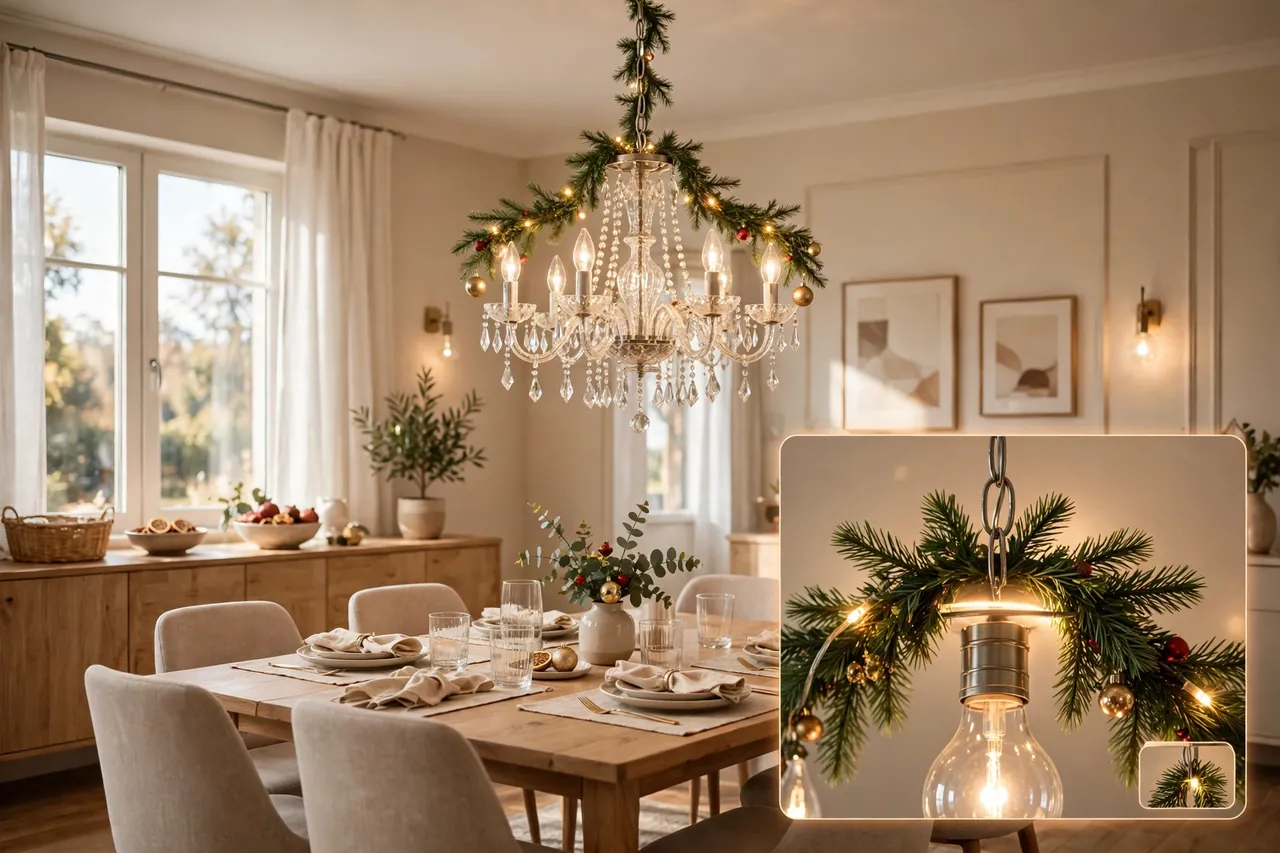
Over a dining table, the chandelier sets the mood for the meal, so pair it with the table below. Match the chandelier ornaments to the table colors, and keep the lowest piece high enough that guests see each other across the table. For table styling that works with your ceiling display, see Christmas table decoration ideas that keep the table warm without crowding it.
Room-by-Room Ceiling Ideas
Each room asks for a different ceiling look, because each room serves a different job. Use the ideas below as starting points, then adjust them to your ceiling height and your family.
Living Room Ceilings
The living room carries the main display, so give it the fullest ceiling. Hang snowflakes and stars over the seating area, run lights along the ceiling edge, and drape a garland swag across a beam or a wide doorway. Keep the center of the room open enough that the tree still owns the floor, and let the ceiling echo the tree colors from above.
Entryway Ceilings
The entryway sets the first impression, so make it welcoming but not crowded. A line of hanging stars, a garland along each ceiling edge, or a single snowflake cluster over the console table works beautifully. Keep pieces high and tight to the ceiling here, because guests carry coats and bags and need clear space to move.
Dining Room Ceilings
The dining room ceiling centers on the table. Dress the chandelier lightly, add a ceiling medallion wreath if you like, and hang a few ornaments at staggered heights around the center, not over it, if the chandelier already fills that space. Dim the ceiling lights a little at dinner, and let candles and the chandelier glow carry the meal.
Kids’ Room Ceilings
Kids’ rooms invite the most playful ceiling decor, and they need the strictest safety rules. Hang lightweight paper snowflakes, felt stars, and soft ornaments that cannot hurt a child if one falls. Keep every piece well out of reach from beds, bunk beds, and climbing furniture, and never hang anything heavy over a bed. Let kids cut their own snowflakes, and hang their favorites where they can admire them from the bed.
Windows, Themes, and the Whole-House Look
Ceiling decor works hardest when it connects to the rest of the house. Match the ceiling colors to the window displays and the table, so the eye travels through the room without a jarring change.
Take Everything Down Without Damage
Takedown day decides whether next year starts with a clean ceiling or a repair job. Work in the reverse order of setup, so a falling garland cannot snag a hanging ornament on its way down.
- Take down hanging ornaments first, then garlands and drapes, then lights.
- Remove hooks and clips last, warming each adhesive strip gently before you peel it.
- Peel slowly straight down, following the maker’s removal steps, never yank sideways.
- Label each bag with the room name and ceiling spot as you pack it.
- Walk each room with a flashlight, and touch up any tiny tack holes while the ladder is out.
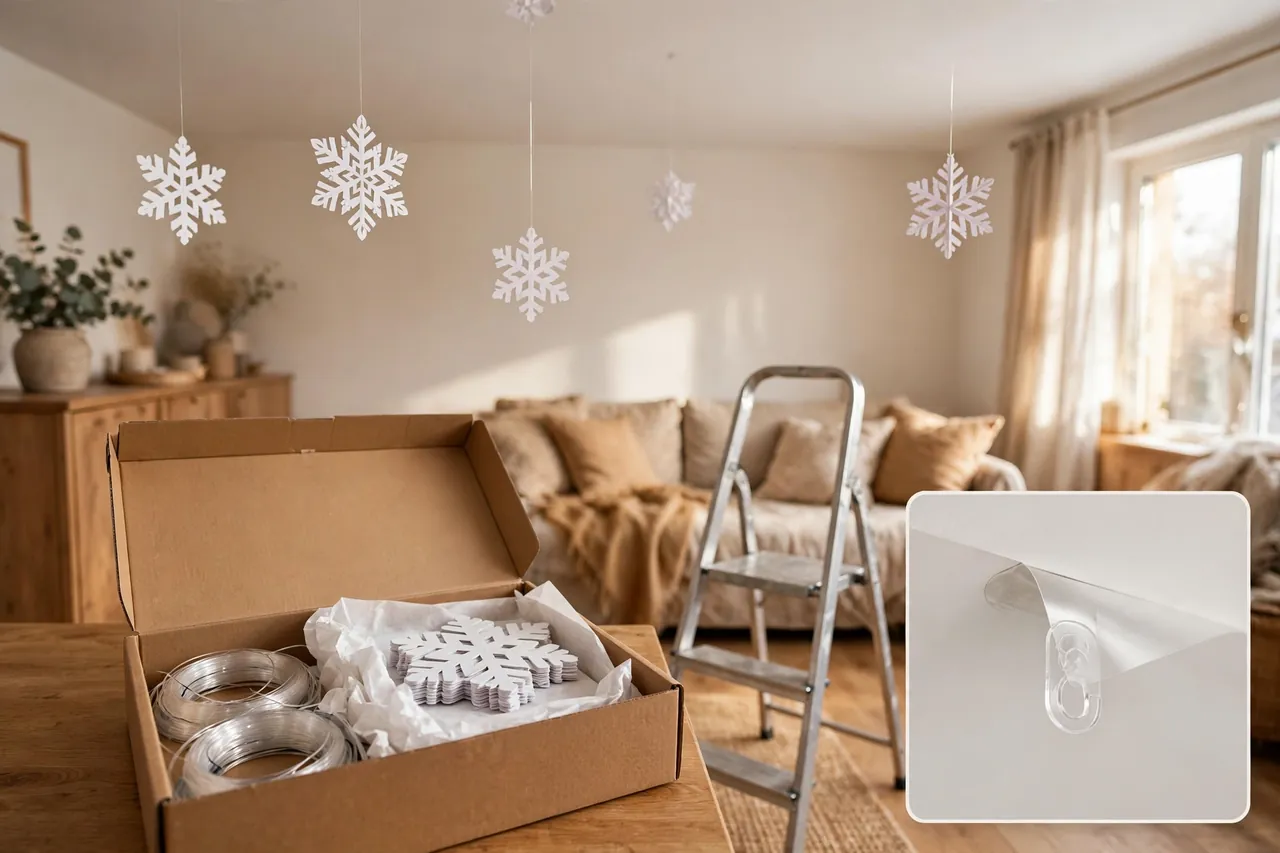
Coil fishing line around a small card so it does not tangle into a knot by next December. Store paper snowflakes flat between sheets of tissue, and keep fabric drapes clean and dry so they do not mildew in storage. A labeled box turns next year’s decorating from a puzzle into a pleasure.
Related Guides
Christmas Hanging Decorations: Ideas and Damage-Free Ways to Hang Them · How to Hang Garland: A Simple Guide for Mantels, Doorways, and Entryways
Safety note: this guide covers light, decorative ceiling displays only. If a piece feels heavy, needs drilling into a joist, or sits near wiring, stop and ask a qualified professional. Never hang decor from a fixture that was not built to hold weight.
Frequently Asked Questions
How can you hang Christmas lights on a ceiling without using nails or hooks?
Use removable adhesive hooks and clips, which suit smooth ceilings and light strands well. For smaller projects, adhesive putty or clear tape made for hanging can work, and drop ceilings take clips made for the metal grid. Clean the surface first, press each hook firmly, and wait at least an hour before you hang the lights.
Can you put garland on a chandelier, and how do you keep it from falling?
Yes, when you keep it light. Wrap a lightweight faux garland around the top section or chain instead of the arms, and let its own grip hold it in place. Tuck the ends into sturdy branches, add a little floral wire if a section shifts, and fluff the branches until the garland lies the way you like it.
Is it safe to decorate a chandelier for Christmas?
Yes, with a few precautions. Keep decor lightweight, keep it away from hot bulbs, and check it once in a while so nothing droops or shifts during the season. Battery LED lights add sparkle with little weight, and you should turn the lights off when you leave the room or go to bed.
How much garland do I need, and how low should it hang over a dining table?
You often need less than you think, since one 5-foot garland wrapped twice around a chandelier top can look full without cutting. Over a dining table, keep decor from dipping lower than about 28 inches above the tabletop, so it never blocks sightlines or conversation.
How do you hang ornaments from the ceiling so they look like they float?
Hang lightweight ornaments on clear fishing line tied to removable ceiling hooks, with lines cut at three different lengths. Mix large, medium, and small pieces, cluster them over a table or seating area, and keep them clear of walkways, fans, and hot bulbs. Step back often to check the shape.
Your ceiling already holds the best seat in the house for Christmas magic, because every guest looks up, even without thinking about it. Start with one room, one focal point, and a few light pieces, and let the display grow as your confidence grows. Hang the snowflakes, drape the garland, switch on the lights, and step back into the doorway. When the ceiling glows and the room still feels easy to live in, you got it right.