
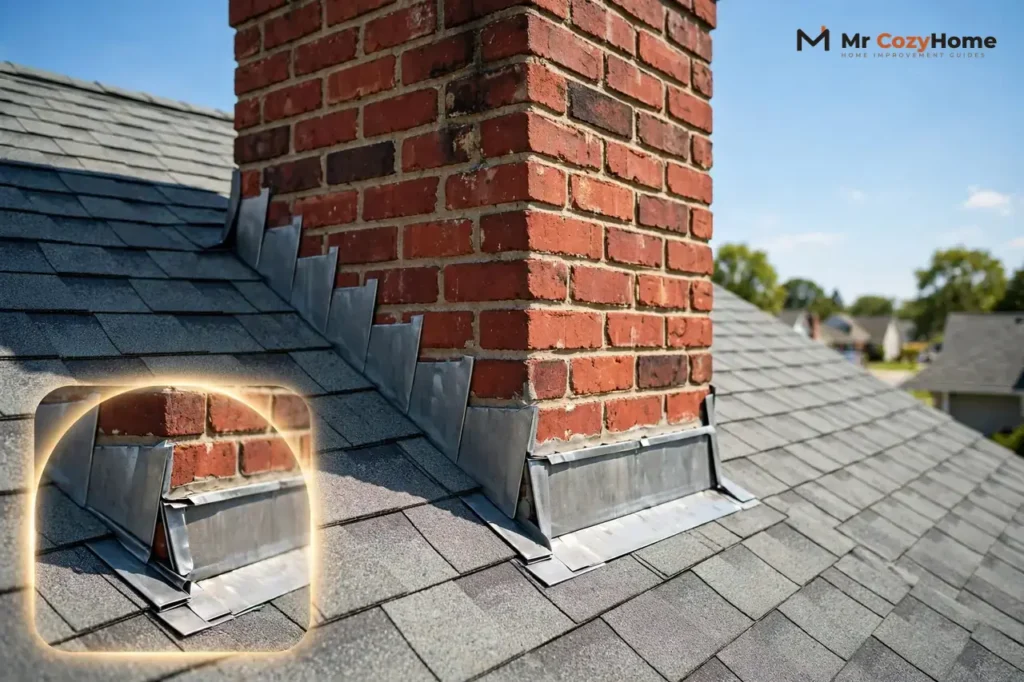
A roof leak near the chimney almost always means one thing: the flashing has failed. Chimney flashing repair fixes that leak at its source — the thin metal seal where your chimney meets the roof — before water rots the wood under your shingles. Most chimney leaks are not a roofing problem at all. They are a flashing problem.
Here is the fact that should push this job to the top of your list. GAF, one of America’s biggest roofing makers, says in its guide to roof flashing that when a roof leaks, 95% of the time the leak is at a flashing point. That means a small stain on your ceiling today can turn into soft, rotted roof decking in a season or two. The good news is that a chimney leak repair is often simple: clean out the old sealant and reseal it, or replace the worn metal. This guide shows you what chimney flashing is, how to find the leak, which fix fits your roof, what it costs, and when to call a pro.
What Chimney Flashing Is — and Why It Fails
Chimney flashing is the metal shield that seals the gap where your chimney passes through your roof. Your roof and your chimney move on their own. The roof flexes with heat and cold, and the chimney stands on its own footing. Without flashing, rain would run straight down the brick and into the hole in your roof.
Flashing is not one piece of metal. It is a small system of parts that work as layers, each one shedding water onto the next. GAF explains it as a two-part system: base flashing below and counter flashing above, built so the two parts can move on their own and still keep water out.
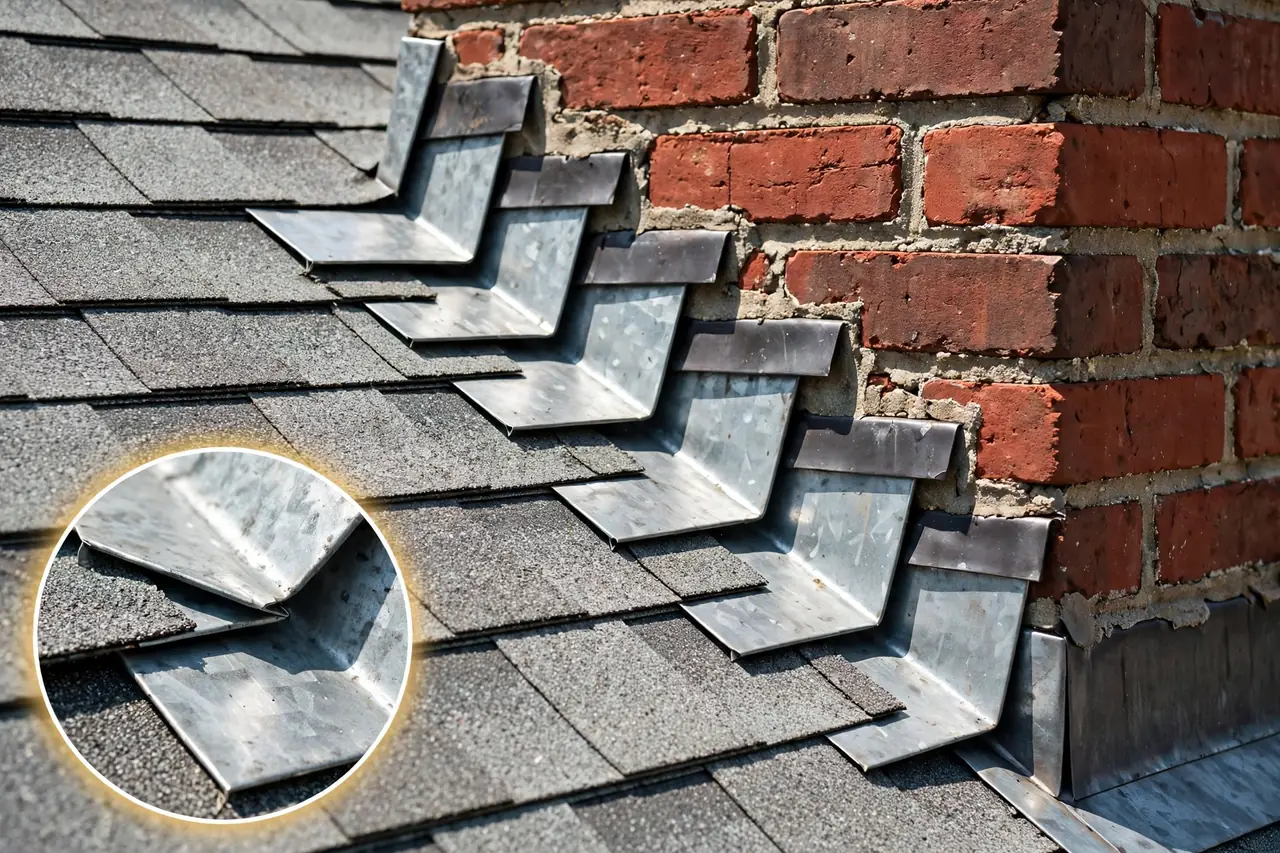
Step flashing: the woven layer
Step flashing is a set of L-shaped metal pieces that run up both sides of the chimney. Each piece sits under one course of shingles and over the shingle below it, like steps. That weave is what keeps wind-driven rain from getting under the shingles at the chimney wall.
Owens Corning’s installation instructions say step flashing should be corrosion-resistant metal, at least 10 inches wide and 2 inches longer than the shingle exposure, with each piece lapped at least 2 inches over the one below. If a roofer skips a piece or nails it in the wrong place, water finds the gap fast.
Counter flashing: the top cover
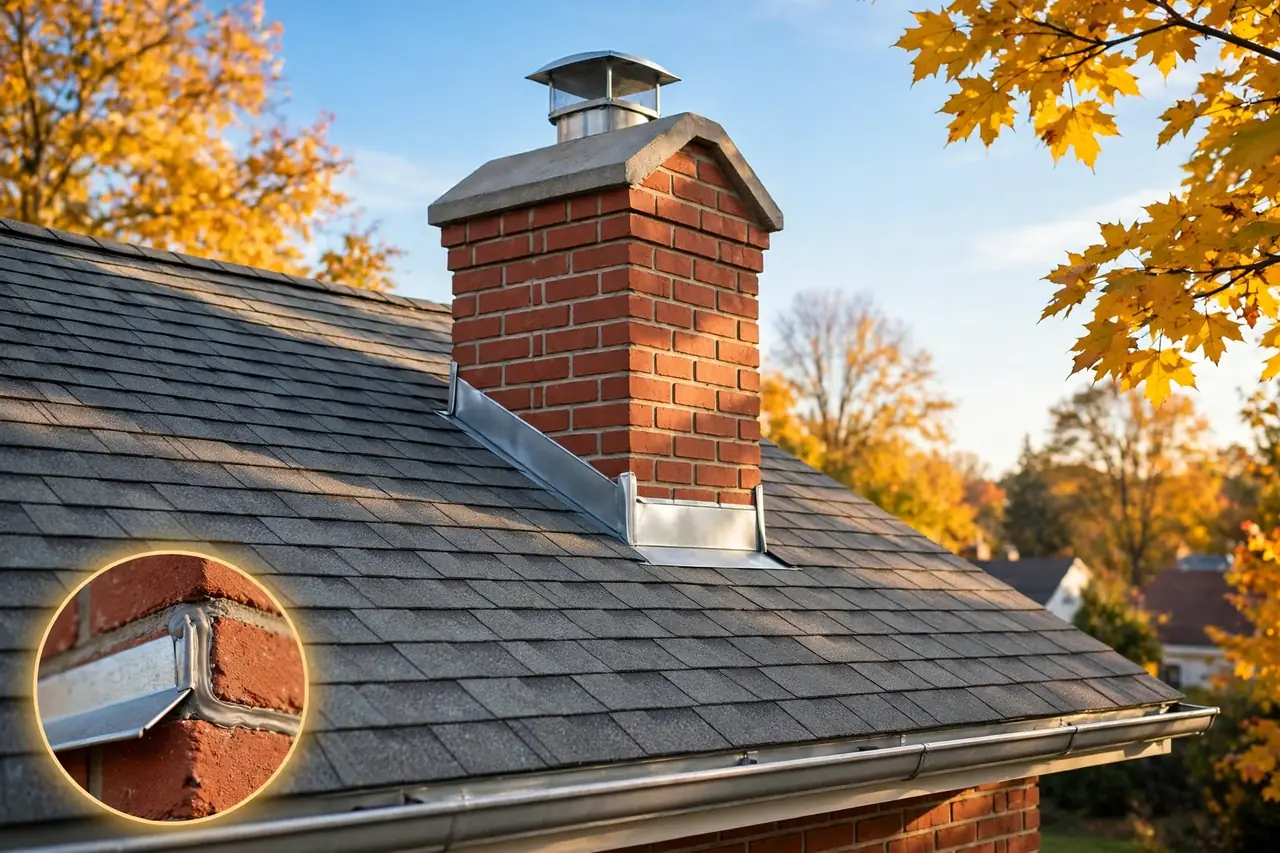
Counter flashing is the metal folded down over the top of the step flashing. Its top edge is tucked into a groove cut in the chimney’s mortar joint, called a reglet, and sealed there. It is the part you can see from the ground: a metal band hugging the brick just above the roof.
This top layer matters most. Without it, the whole seal depends on a bead of caulk, and caulk fails every few years. With it, rain runs down the brick, hits the metal, and drops onto the roof instead of behind it.
Base flashing and the cricket
Base flashing, also called apron flashing, is the wide sheet on the low side of the chimney. It catches water running down the roof and sends it around the chimney. On the high side, wide chimneys need a cricket — a small peaked saddle that splits the water flow so it does not pool behind the brick.
Building code calls for a cricket on any chimney more than 30 inches wide that does not meet the roof ridge. If your chimney is wide and has no cricket, water sits against the brick every time it rains, and the flashing there wears out first.
Why flashing fails
Flashing fails for a few plain reasons. Sealant dries out and cracks in sun and heat. Steel rusts where the coating wears off. Freeze and thaw cycles pry the metal away from the brick a little more each winter. And bad work fails early: flashing nailed to the chimney instead of the deck, pieces laid in the wrong order, or a thick smear of tar used instead of real metal.
Age plays a part too. GAF puts galvanized steel flashing at a 20 to 30 year life, about the same as an asphalt roof. Copper lasts far longer, 80 to 100 years, but it costs much more. If your roof is 20 years old and the ceiling stain just showed up, worn flashing is the first thing to suspect.
Signs Your Chimney Flashing Is Leaking
A chimney leak rarely announces itself with water pouring in. It starts small, and the signs show up in places you might not connect to the roof. Look for them after rain, and check the attic on a dry day too.
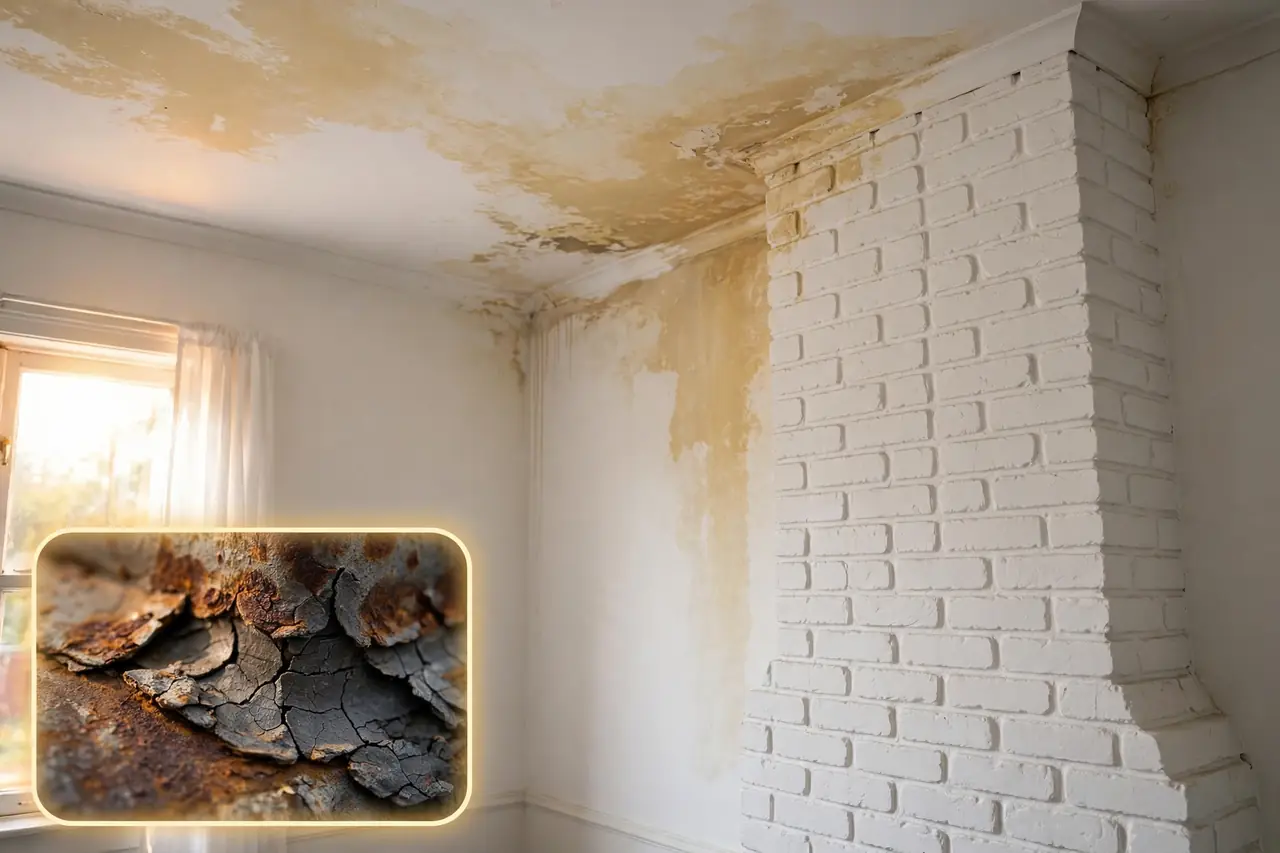
- Brown or yellow stains on the ceiling or wall next to the chimney. The stain often sits right where the ceiling meets the chimney breast, and it grows darker after heavy rain.
- Damp or soft wood in the attic around the chimney, or water marks on the rafters.
- Rust stains running down the brick, or rust on the metal you can see from the ground.
- Cracked, missing, or peeling sealant along the top edge of the metal.
- Flashing that looks bent, lifted, or pulled away from the brick.
- A musty smell in the room below the chimney, or paint and plaster bubbling near it.
- Water dripping in the firebox when it rains, even though the cap looks fine.
One sign deserves quick action: a stain that keeps growing. A stain that grows after every storm means water is getting in right now, and every wet week adds rot to the wood you cannot see. A small reseal this month can save you a deck repair next year.
If you are not sure where the water is coming from, a home leak detector can help you narrow it down before you pay for a roof visit. Our guide on how leak detection works explains the tools and what they can and cannot prove.
How to Find the Leak: Flashing, Crown, or Cap?
Fixing chimney flashing only works if the flashing is the real leak. Water from a cracked crown, a missing cap, or open mortar can show up in the same place. Before you spend money, narrow it down. You can do most of this from the ground and the attic — no roof climbing needed.
Step 1: Watch when it leaks
Timing is your best clue. Write down when the stain gets worse. A leak that shows up only in heavy or wind-driven rain points to the flashing, because wind pushes rain sideways into the roof joint. A leak in long, steady rain or snowmelt, with damp brick high in the attic, points more to the crown or the masonry soaking up water.
Water in the firebox points up, not sideways. If drips fall into the firebox when it rains, the water is likely coming down the flue — a missing or damaged cap, or a cracked crown letting water into the masonry around the flue.
Step 2: Look from the attic
On a dry day, take a flashlight into the attic and look at the wood around the chimney. Wet framing right at roof level points to the flashing. Damp or stained brick above the roof deck points to the crown or the mortar. Daylight showing through around the chimney is a clear sign the seal has opened.
Do this check soon after rain if you can. Wet wood is easy to spot right after a storm and hard to spot a week later.
Step 3: Look from the ground
Stand back with binoculars and look at the chimney from all four sides. Check the crown on top for cracks. Check the cap for rust or a tilt. Check the flashing for lifted edges, rust, and thick old sealant smeared over the metal. Layers of old sealant are a red flag: someone kept patching the same spot instead of fixing it.
Our guides to chimney cap repair and chimney cap replacement can help you tell a cap problem from a flashing problem, and a chimney topper may be the fix if the cap itself is the weak point.
Step 4: The hose test
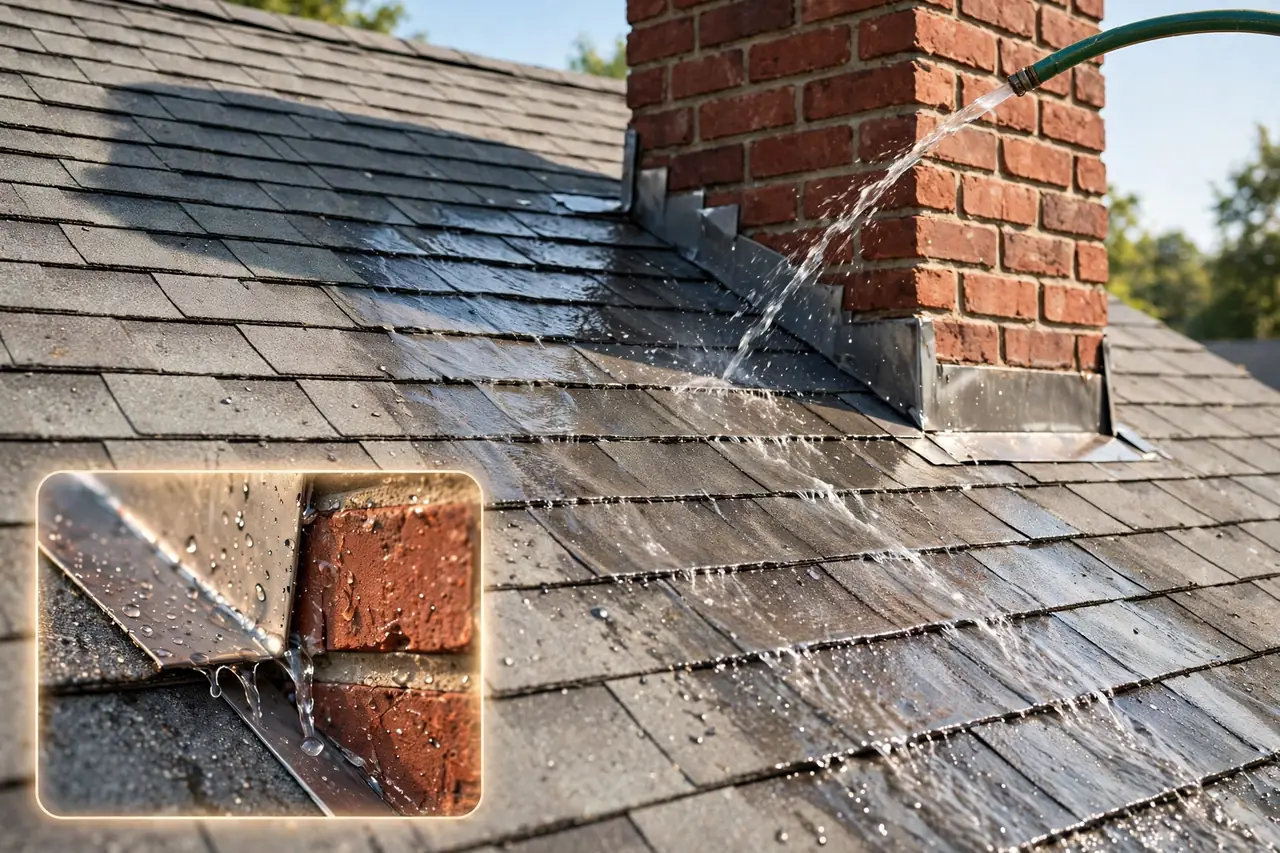
Roofers find the exact seam with a hose test. On a dry day, one person runs a garden hose slowly over one section of flashing at a time, starting low, while another person watches from inside the attic. When water shows up inside, you have found the section that leaks.
Test one section at a time and wait a few minutes between sections. If you wet the whole chimney at once, you will never know which part failed. This test is best done by a roofer, since it still needs someone on the roof — but knowing how it works keeps you from paying for a repair aimed at the wrong part.
Chimney Flashing Repair Options: Reseal, Reflash, or Rebuild
There are three levels of chimney flashing repair, and the right one depends on the state of the metal. A good roofer picks the smallest fix that will last, not the cheapest one that will fail again next winter.
Option 1: Reseal the joints
Resealing fits when the metal is sound — no rust holes, no cracks, no missing pieces — and only the sealant has failed. The roofer pulls out all the old caulk and roofing cement, cleans the mortar joint and the metal, and applies fresh polyurethane or butyl sealant into the reglet and seams.
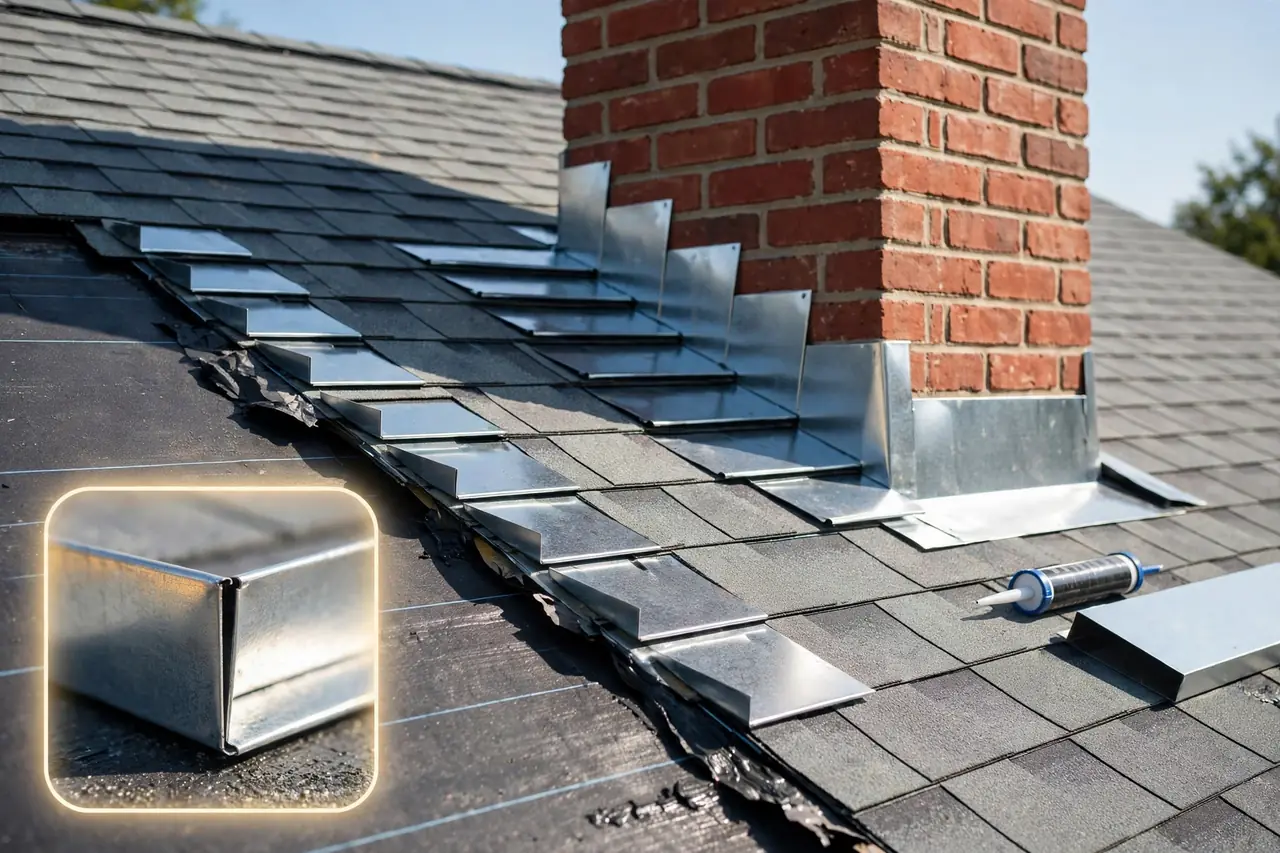
Two details decide whether a reseal lasts. First, the surface must be clean and dry, or the new sealant will not bond. Second, gaps wider than about half an inch need a backer, like tape or metal, before sealant goes on. Sealant alone cannot bridge a wide gap.
A reseal is a maintenance fix. Expect it to hold for years if the flashing was built right, but it will not save rusted metal or flashing that was never layered right in the first place.
Option 2: Replace the flashing (reflash)
A full reflash is the right call when the metal is rusted through, bent, tarred over, or was installed wrong. The roofer removes the shingles around the chimney, takes out the old step and counter flashing, and lays a self-sticking membrane on the deck as a second line of defense. Then new step flashing is woven in with the shingles, course by course, and new counter flashing is set into a fresh groove in the mortar.
This is the durable fix. A full reflash should last as long as the roof itself, 25 to 30 years, when it is done right. It is also the best time to add a cricket if your wide chimney never had one. The best moment of all is during a roof replacement, when the shingles are already off.
Option 3: Fix the crown and masonry too
Sometimes the flashing is only half the leak. A cracked crown lets water pour down through the masonry, and open mortar joints let the brick soak it up like a sponge. Fixing the flashing alone will not stop those leaks.
Small crown cracks can be sealed with a flexible crown coating; a badly broken crown needs to be rebuilt. Loose mortar gets raked out and repointed before the counter flashing goes back in. If the brickwork is crumbling, a mason repairs the chimney first, and the roofer installs new flashing after. Our guide to repairing a fireplace covers the masonry side of the job, and if the damage reaches the firebox, cleaning a brick fireplace after the repair clears the soot and water stains.
| Repair | When it fits | How long it lasts |
|---|---|---|
| Reseal | Metal sound, sealant failed | 5–10 years |
| Partial reflash | One side rusted or damaged | 15–25 years |
| Full reflash | Metal rusted, wrong, or tarred | 25–30 years |
| Reflash + cricket | Wide chimney, no cricket | Life of roof |
| Crown + flashing | Crown cracked too | Decades |
How Much Does Chimney Flashing Repair Cost?
Costs are the shortest part of this guide on purpose. Prices change with your region, your roof, and your chimney, so treat every number here as a range, not a quote. The figures below come from Angi’s 2026 cost guide, checked on November 13, 2026, and cross-checked against roofer guides from the same year.
Angi puts a professional chimney flashing repair at $400 to $1,600 in 2026, with a national average near $1,000. A simple reseal of sound flashing starts lower, from around $200. A full replacement with new step and counter flashing sits in the middle of that range for a standard chimney, and large or stone chimneys can push past $2,000.
What moves your price? Chimney size is first — a wide chimney needs more metal and more labor, and one over 30 inches wide may need a cricket built too. Roof pitch matters next: a steep roof needs more safety gear and time. Material matters as well, since copper costs far more than galvanized steel. And if the crown or brickwork needs repair at the same time, that is a separate masonry cost on top.
Fireplace and chimney sizes vary a lot from home to home, so a quote for a neighbor’s chimney may not match yours. Our guide to average fireplace size shows how much these measurements can differ. Get two or three written quotes, and ask each roofer to state whether the price covers a reseal or a full reflash — the two jobs are very different, and a cheap reseal quote will not fix rusted metal.
| Job | Typical range |
|---|---|
| Reseal sound flashing | $150–$800 |
| Partial reflash (one side) | $400–$1,200 |
| Full flashing replacement | $400–$1,600 |
| Full reflash + cricket | $1,500–$3,500 |
One money tip: a reseal done at the first cracked joint can stop the repair from growing into a full replacement. Water that works behind the metal for two winters can rot the decking, and decking work costs far more than any flashing job.
DIY or Call a Pro?
Fixing chimney flashing sits on the line between a do-it-yourself job and a pro job, and the line is the roof itself. A simple reseal is within reach for a careful homeowner on a low, walkable roof. Anything that means removing shingles or cutting into mortar is pro work.
DIY fits only when the metal is sound, the roof is low and walkable, and the job is a reseal. That means cleaning out old sealant, drying the joint, and applying fresh sealant made for roofing. You will need a sturdy ladder, a wire brush, a caulk gun, and roofing-grade polyurethane sealant. Never work on a wet roof, and never work alone.
Call a roofer when the metal is rusted, bent, or missing; when the step flashing was never woven into the shingles right; when the chimney is wide and needs a cricket; or when the leak is still there after a reseal. Call a chimney pro as well if the crown is cracked or the brickwork is crumbling — that is masonry work, and a roofer cannot fix it with metal.
Two more reasons to call a pro. First, a roof warranty can be voided by do-it-yourself work on the roofing system, and GAF warns that many makers require a qualified contractor for roof work. Second, a pro brings the hose test and the eye for which part is actually leaking. Paying for the right fix once beats paying for two wrong ones.
If your fireplace is gas, keep up with its own upkeep while the roof work is going on. Our gas fireplace upkeep guide covers the checks that keep a gas unit safe, and a chimney sweep visit is the easiest way to get a trained eye on the whole chimney, flashing included.
How to Keep Chimney Flashing From Leaking Again
A good repair should last decades, but only if you give it a little care. Flashing fails quietly, so the habit that saves you money is a quick look once a year, in the fall, before the rain and freeze season starts.
- Look at the chimney from the ground with binoculars. Check the sealant line, the metal edges, and the crown for new cracks.
- Check the attic after the first heavy rain of the season. Dry wood around the chimney means the seal is holding.
- Clear leaves and debris from behind the chimney. A pile of wet leaves holds water against the flashing all winter.
- Keep gutters clear so water does not back up onto the roof around the chimney base.
- Book a yearly chimney inspection. The Chimney Safety Institute of America recommends an annual check of chimneys, fireplaces, and vents, and that visit is the easiest way to catch a failing seal before it becomes a leak.
- Do not let anyone smear tar over the flashing as a quick fix. Tar cracks, traps water, and makes the real repair harder and more costly later.
One fall check a year is the cheapest flashing repair there is. If the chimney looks rough or the fireplace needs work too, our fireplace renovation ideas can help you plan the bigger job once the leak is fixed for good.
Safety First: Read This Before You Climb Up
Roof work is one of the most dangerous jobs a homeowner can try. Falls from roofs and ladders cause serious injuries every year, and a chimney sits on the steepest, highest part of most roofs. Never climb onto a wet, icy, or steep roof, and never work on a roof alone. If you feel unsure on a ladder, that is your answer: stay on the ground and call a roofer.
Water damage brings its own risks. A leak that has been going on for a while can mean rotted wood underfoot, mold in the attic, and wiring that has been wet. Do not step on soft or spongy decking, and do not touch wiring near a leak. If you smell gas, or your carbon monoxide alarm sounds, leave the house and call emergency services first.
Safety disclaimer: this guide is general home advice, not a substitute for a professional inspection. When in doubt, book a qualified roofer or a CSIA-certified chimney sweep and let a trained pro decide what is safe.
Related Guides
If your chimney needs more than a flashing fix, these guides cover the rest of the system: chimney cap repair, chimney cap replacement, chimney topper options, chimney sweep cost, repairing a fireplace, and how to clean a brick fireplace.
Frequently Asked Questions
How much does it cost to repair chimney flashing?
In 2026, a professional chimney flashing repair runs about $400 to $1,600, with a national average near $1,000, according to Angi. A simple reseal of sound flashing starts from around $200. A full replacement with new step and counter flashing costs more, and a wide chimney that needs a cricket can push the job higher still.
How do I know if my flashing needs repair?
Look for brown or yellow stains on the ceiling or wall by the chimney, rust on the metal, and cracked sealant along the top edge. In the attic, wet wood at roof level says the same. A leak that shows up only in heavy or wind-driven rain is a strong sign the flashing has failed.
How do I know if my chimney leak is the flashing or the crown?
Wet framing at roof level points to the flashing, while damp brick above the roof deck and leaks in long, steady rain point to the crown or the masonry. Water dripping into the firebox points to the top of the chimney — a missing cap or a cracked crown. If it stays after a reflash, check the crown next.
Can you fix chimney flashing on a roof yourself?
You can reseal sound flashing yourself if your roof is low, walkable, and dry, and you are comfortable on a ladder. Clean out the old sealant, let the joint dry, and apply roofing-grade sealant. But replacing step or counter flashing means removing shingles and cutting into mortar, and that is pro work. Never climb on a wet or steep roof.
Is it normal for a chimney to leak during heavy rain?
No. A chimney in good condition is built to keep water out, even in heavy rain, so a leak means something has failed — the flashing, the crown, the cap, or the mortar. Heavy rain only makes the weak point show up faster, because wind drives water into gaps that light rain never reaches. Get it checked soon.


