

A non-programmable thermostat is the simplest kind of thermostat you can buy. You set one temperature by hand, and your heating or cooling system holds that temperature until you change it again. It has no schedule, no app, and no automatic setback. If you want simple, cheap, reliable control and you do not mind walking to the wall to change the temperature, this type of thermostat may suit you well.
Think of it as a light switch for comfort. Installing one is just as simple — see how to install a thermostat. You pick the temperature, the system runs until the room reaches it, and then it stops. Nothing changes overnight or while you are out unless you change it yourself.
What Is a Non-Programmable Thermostat?
A non-programmable thermostat, also called a manual thermostat, is a basic temperature control that you adjust by hand every time you want a change. You turn a dial, slide a lever, or press up and down buttons to pick your temperature. The thermostat then tells your furnace, air conditioner, or heat pump to run until the room reaches that number.
Once the room hits your setting, the system shuts off. When the room drifts away from that setting, the system starts again. The setting stays put through the day and the night. It does not drop the heat while you sleep or ease off the air conditioning while you are at work. Only you can make that change.
That is the whole idea. A non-programmable thermostat does not connect to Wi-Fi, does not learn your routine, and does not run a schedule. It does one job, and it does it with very few parts that can fail. Trane describes non-programmable units as the very basic thermostats, with older round dial models still in use in homes with heat but no central air conditioning, and newer models with digital displays and buttons. You will also see it listed as a “thermostat non programmable.” The spelling changes, but the product does not.
How a Non-Programmable Thermostat Works in Daily Life
Your day with a non-programmable thermostat looks the same every day. You wake up, you feel cold, and you walk to the wall and raise the setting. You leave for work, and the heat keeps running at that same setting unless you turn it down first. You come home, and the house feels the same as when you left it.
Inside the unit, a sensor reads the room temperature and compares it with the number you picked. If the room is colder than your heat setting, the thermostat calls for heat. If the room is warmer than your cool setting, it calls for cooling. When the two numbers match, it tells the system to rest. Cielo explains it plainly: you set your desired temperature, and the thermostat signals your HVAC system to heat or cool until that temperature is reached.
That simplicity shapes everything else about it. There is no menu to learn and no clock to set. Guests, kids, and older family members can use it without a lesson. And because it has no software, it never needs an update and never loses a Wi-Fi signal.
The trade is just as clear. Every energy-saving change depends on you remembering to make it. If you forget to turn the heat down before bed, the system heats the house all night at full comfort. If you forget before a weekend away, it cools an empty house all weekend.
The Two Types: Mechanical and Digital
Every non-programmable thermostat falls into one of two types. Both do the same job, but they feel very different to use, and the digital type is the better buy for most homes today.
Mechanical Thermostats
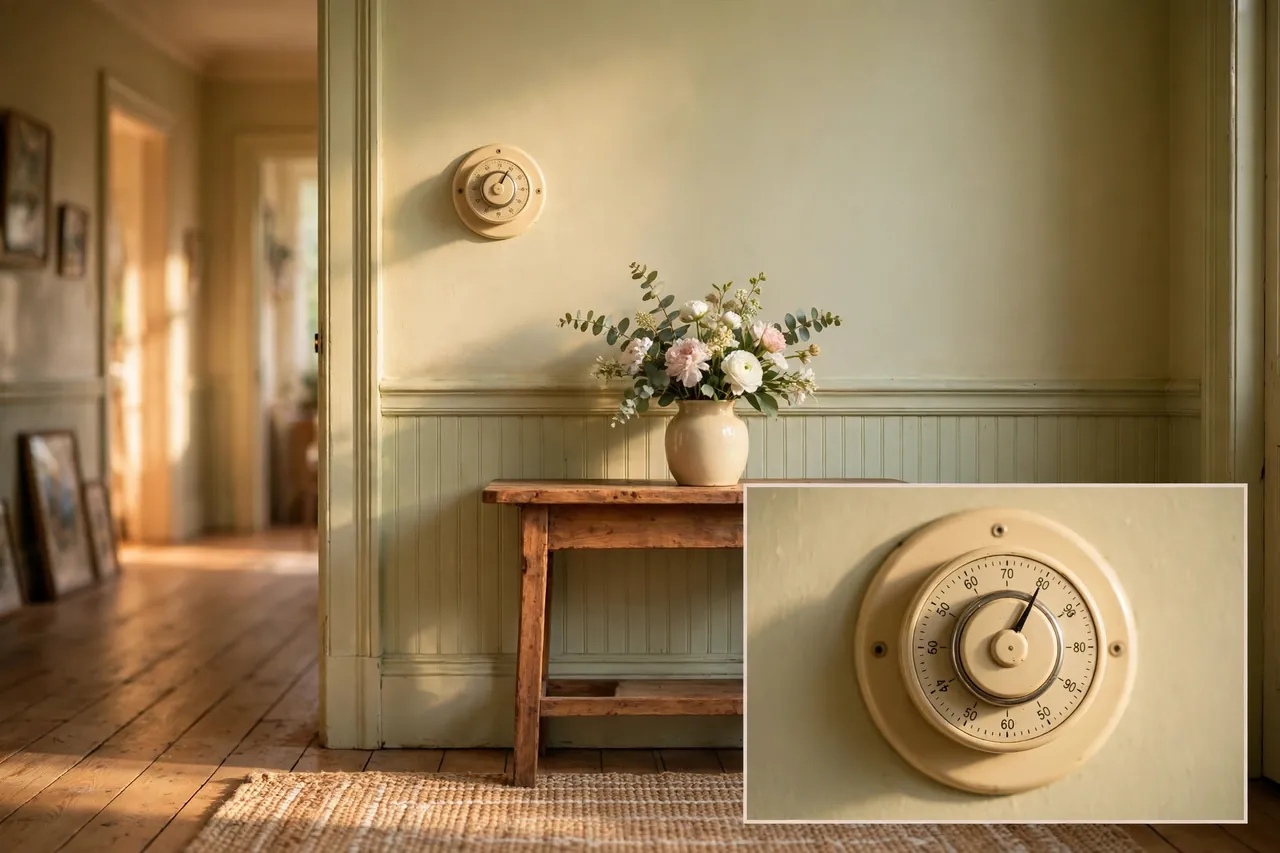
A mechanical thermostat is the classic round dial on the wall. Inside it, a bimetallic strip made of two joined metals bends as the room warms and cools. That bending opens or closes the circuit that tells your system to run. You turn the dial to your number, and the strip does the rest.
Mechanical models cost the least and rarely break. However, they are the least exact type you can buy. The room temperature can drift a few degrees from your setting before the system reacts, so comfort feels uneven. Some very old mechanical models also contain a small glass vial of mercury, which is toxic. If your old thermostat has a silvery liquid in a glass tube, do not throw it in the trash. Take it to a household hazardous waste collection point.
Digital Thermostats
A non-programmable digital thermostat does the same manual job with an electronic sensor and a clear display. You press buttons to pick an exact number, and the display shows both the room temperature and your setting at the same time. Most models hold the room within about one degree of your setting, so comfort feels steadier than with a dial.
Digital models usually run on two AA batteries, on power from your system, or on both. Many add small comforts that cost nothing in complexity: a backlit display you can read in the dark, a fan switch with Auto and On, and a compressor guard that stops your air conditioner from restarting too soon after it shuts off. The Honeywell Home FocusPRO 5000 (model TH5110D) is a common example. Its manual states that it gives electronic control of 24-volt single-stage heating and cooling systems or 750-millivolt heating systems, with a heat range of 40 to 90 degrees Fahrenheit and a cool range of 50 to 99 degrees.
For most buyers, the choice is simple. Pick a digital model unless you specifically want the cheapest possible replacement or you love the old round look. The digital type costs only a little more, and it reads the temperature far more exactly.
Who Should Buy a Non-Programmable Thermostat?
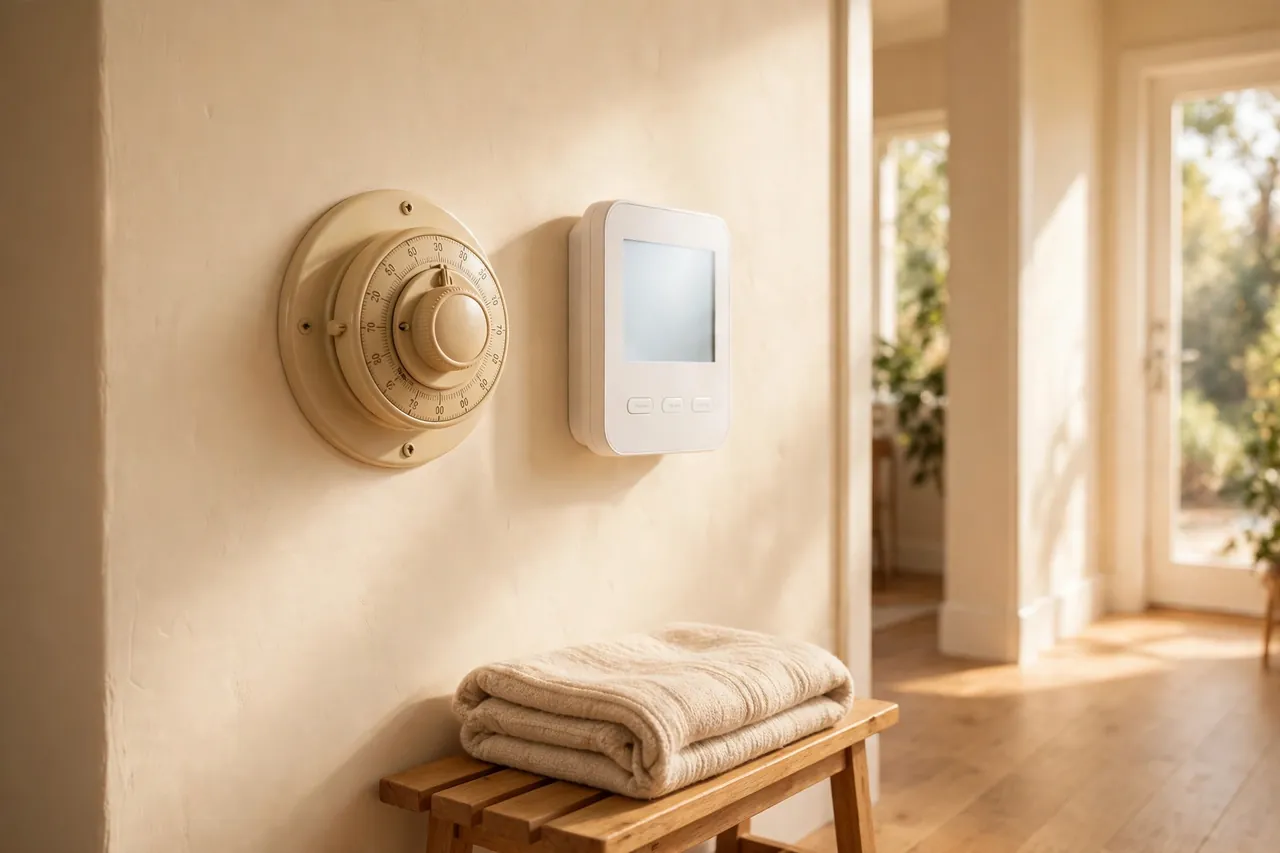
A non-programmable thermostat suits people whose home life is steady and simple. It fits best when someone is usually home, the temperature rarely needs to change, and nobody wants to learn a menu or an app.
You are a good match if any of these sound like you:
- You are home most of the day and you can adjust the temperature when you feel like it.
- You keep one steady temperature all day and night and you are happy with that.
- You rent, and you want a cheap, simple replacement that does not need Wi-Fi or a landlord’s app account.
- You have a simple system, such as a furnace with air conditioning or a heat-only setup, and you want a control that matches it.
- You want the lowest upfront cost and the fewest things that can go wrong.
- You, or someone in your home, finds screens and schedules confusing and just wants buttons that do one thing.
Renters deserve a special note. A non-programmable thermostat is often the easiest swap in a rental because it needs no account, no password, and no phone. Ask your landlord before you change anything on the wall, though. In many rentals, the thermostat belongs to the property, and the landlord may want to approve the model or fit it for you.
Heat-only homes are another strong match. If your home has a furnace or boiler and no air conditioning, a simple heat-only control covers everything you need. Our guide to heat-only thermostats explains which models fit that setup and what to check before you buy one. Small spaces suit it too: a guest room, a small apartment, or a vacation cabin that holds one steady temperature does not need a schedule.
Who Should Look Elsewhere
Skip this type if your days follow a fixed routine and your energy bills bother you. If you leave for work at the same time each morning and often forget to adjust the temperature, a thermostat with a schedule will save you real money without any daily effort. That is the one clear reason to look at a programmable model instead, and our full comparison of the two types will help you weigh that choice when it is ready.
What to Check Before You Buy
Buying the wrong thermostat wastes a trip to the store and a Saturday afternoon. Check these five things before you order or pick one off the shelf. They take ten minutes, and they decide whether the new control works with your system at all.
1. Voltage: Low Voltage or Line Voltage
Most homes with a furnace, air conditioner, or heat pump use a low-voltage thermostat. It runs on about 24 volts from a transformer in your heating system. A non-programmable digital thermostat such as the Honeywell FocusPRO 5000 is built for that 24-volt world, plus some 750-millivolt heating systems.
Electric baseboard heaters are different. They often use a line-voltage thermostat wired straight to 120 or 240 volts. A low-voltage thermostat must never go on a line-voltage heater. It will not work, and it can burn out or create a safety hazard. If your heat comes from baseboards with thick wires and no furnace, you need a line-voltage model made for that job. When in doubt, ask an HVAC technician to confirm your voltage before you buy.
2. System Type: Furnace, Heat Pump, or Heat Only
Match the thermostat to your equipment. A basic model covers a single-stage furnace with air conditioning, a heat pump without backup heat, or a heat-only system. If you have a heat pump, check that the box says it supports heat pumps. Heat pumps need a control that can run their reversing valve, and a furnace-only model cannot do that.
Multi-stage systems need a matching control too. A thermostat built for one stage of heat and one stage of cool cannot run a two-stage furnace at both stages. Read the box for “1 heat / 1 cool” or “2 heat / 2 cool” and match those numbers to your system.
3. How Many Wires You Have
Take a photo of your current wiring before you remove anything, and count the wires. Most simple systems use only a few wires, and a basic non-programmable thermostat fits them well. Count the wires, note which terminals they sit on, and compare that list with the new thermostat’s manual.
Do not guess what a wire does from its color alone. Colors often follow a pattern, but installers do not always follow it. Our guide to thermostat wire colors explains what each wire usually does and why you should trust the terminal label and your photo, not the color by itself.
4. Power: Batteries or a Common Wire
Many non-programmable digital thermostats run on two AA batteries, so they work even if your system has no common wire, often called a C-wire. That is one reason they are such easy replacements. Batteries last about a year in most homes, so keep a spare pair near the thermostat and change them when the low-battery warning shows.
Some models can also draw power from the C-wire if your system has one. That keeps the display lit without batteries. Either way, check the manual for your model and confirm how it gets its power before you mount it.
5. Features Worth Paying a Little Extra For
Even a simple thermostat can include a few useful features. Look for a backlit display, a temperature swing you can trust to about one degree, auto changeover if your home needs heat in the morning and cooling in the afternoon, and compressor protection for your air conditioner. A filter-change reminder is a nice bonus, but it is not a reason to pay much more. Skip Wi-Fi, touchscreens, and learning features here. They belong to other thermostat types, and paying for them on a non-programmable model makes no sense.

How Much Does a Non-Programmable Thermostat Cost?
A non-programmable thermostat is the cheapest thermostat you can buy, and the gap is large. Basic mechanical models and simple digital models usually cost between about 15 and 50 dollars for the unit itself, according to a 2026 cost comparison of thermostat types. Most buyers land in the middle of that range for a good digital model.
For a concrete example, the Honeywell Home X1N non-programmable thermostat with single-stage conventional and heat pump support was listed at Target for 49.99 dollars on sale, down from a regular price of 54.99 dollars, when checked on November 6, 2026. Prices move with sales and stock, so check the live price before you buy.
Installation adds cost only if you hire it out. A simple swap on a low-voltage system is a short job for a technician, and many homeowners do it themselves in under an hour. If your wiring is unclear, your voltage is uncertain, or your system is a heat pump with backup heat, pay for a professional visit. A wrong wire can damage your heating system, and that repair costs far more than the visit.
Think about the running cost too. The unit is cheap, but it cannot cut your bills by itself. It saves energy only when you remember to adjust it. If you rarely adjust it, a model with a schedule could pay for its higher price through lower bills over time. That is the real cost comparison to make, not just the price on the box.
How to Install a Non-Programmable Thermostat: Basic Steps
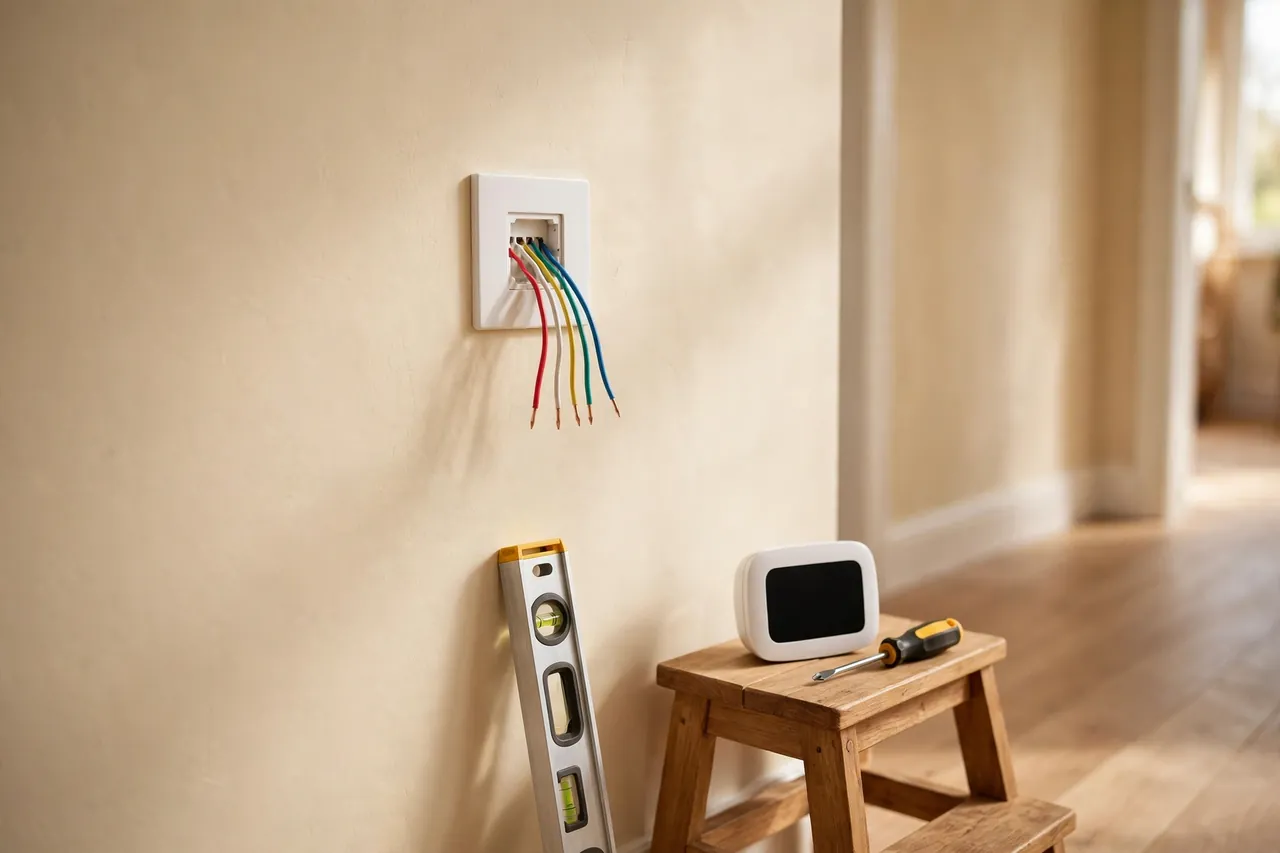
Most low-voltage swaps follow the same short routine. Read your model’s manual first, because each model has its own terminal labels and setup steps. The outline below shows the shape of the job so you know what to expect.
Turn off the power to your heating and cooling system at the breaker before you touch any wire. Do not rely on the thermostat’s Off setting. The wires at the wall carry live low-voltage power, and working on them with the power on can short the system or damage its control board.
- Turn off power at the breaker, then confirm the old thermostat screen is blank.
- Remove the old thermostat cover and take a clear photo of the wires and their terminal labels.
- Label each wire with the tape flags from the new thermostat’s box, using the terminal letter, not the wire color.
- Remove the old wall plate, then mark the screw holes and mount the new wall plate level on the wall.
- Connect each labeled wire to the matching terminal on the new thermostat, then tug each wire gently to confirm it is held firm.
- Fit the batteries if your model uses them, then clip the thermostat onto its wall plate.
- Turn the power back on at the breaker and set the system type in the setup menu if your model asks for it.
- Set the mode to Heat or Cool, pick a test temperature a few degrees from the room temperature, and listen for the system to start.
- Wait for the room to reach your setting, then check that the system shuts off as it should.
If any step confuses you, stop and call a qualified HVAC technician. That is the right call when wires are unlabeled, the wall has extra wires you cannot identify, or the system does not start after the swap. A short professional visit costs far less than a damaged control board.
How to Use It Well and Save Energy Anyway
A non-programmable thermostat cannot save energy on its own. You can still save a useful amount by building three small habits around it. The habits are simple, and they work because they copy what a schedule would do for you.
First, pick one sensible temperature and stick to it. In winter, many homes feel fine at about 68 degrees during the day. In summer, about 78 degrees feels fine when you are home and active. Every degree you ease off in the direction of the outdoors trims your bill a little, so avoid big swings that feel uncomfortable and waste energy on recovery.
Second, make the setback a habit, not a hope. Turn the heat down before bed and before you leave for the day, then turn it back up when you return. The U.S. Department of Energy says that setting the temperature back by 7 to 10 degrees for 8 hours a day can cut heating bills by as much as 10 percent a year. A non-programmable thermostat makes you the timer, so tie the change to something you already do, such as locking the door or brushing your teeth.
Third, let the fan help. Set the fan to Auto for normal use so it runs only when the system heats or cools. Switch it to On only when you want to even out the air in the house for a short while, such as after cooking.
For season-by-season numbers that fit your climate, see our guide to recommended thermostat settings for summer and winter. It gives you starting points you can set once and use all season.
Common Problems and Quick Fixes
Most non-programmable thermostat troubles have simple causes. Work through the cheapest checks first before you assume the unit has failed.
The Display Is Blank
Change the batteries first. A blank screen on a battery-powered model almost always means dead batteries. If fresh batteries do not help, check the breaker for your heating system. A tripped breaker cuts power to the whole system, and the thermostat goes dark with it.
The System Does Not Start
Check the mode switch. Many “broken” thermostats are simply set to Off or to Cool in the middle of winter. Then check your set temperature. In Heat mode, the setting must sit above the room temperature for the system to start. In Cool mode, it must sit below it. If both look right, turn the power off at the breaker, remove the thermostat, and confirm each wire sits firmly in its terminal.
The Room Feels Too Hot or Too Cold
Check where the thermostat lives. A thermostat in direct sun, above a lamp, near a drafty door, or over a heat vent reads the wrong temperature. It heats or cools the house based on that wrong reading. Move lamps and heat sources away from it, and close any gap behind the wall plate that lets cold wall air reach the sensor.
Also check the temperature swing. A mechanical dial can let the room drift several degrees before it reacts. If comfort swings bother you, a digital model that holds within about one degree usually fixes the problem without any other change.
The Air Conditioner Short-Cycles
If your air conditioner starts and stops every few minutes, turn the system off and let it rest. Many digital models include compressor protection that blocks a restart for a few minutes after a shutdown, and fighting that guard makes things worse. If short-cycling keeps happening after a rest, call a technician. It can point to a wiring fault, a sensor problem, or an issue with the cooling system itself.
Honest Limits
A non-programmable thermostat is honest about what it cannot do, and you should be honest with yourself about whether that matters. It cannot lower the temperature while you sleep unless you do it. It cannot warm the house before you get home. It cannot warn you that the house is freezing while you are on vacation, and it cannot show you how much energy you used last month.
It also cannot fix a system problem. If your furnace is oversized, your ducts leak, or your home has poor insulation, a new thermostat of any type will not solve the comfort problem. It only tells the system when to run. The system and the house still set the limits of what comfort costs.
Related Guides
Thermostat Wire Colors: What Each Wire Means and Where It Goes · Heat Only Thermostat: What It Is and How to Choose One · Recommended Thermostat Settings for Summer and Winter
Frequently Asked Questions
What is a non-programmable thermostat?
A non-programmable thermostat is a simple, manual control that lets you set and hold one temperature without any built-in schedule. You adjust it by turning a dial or pressing buttons, and it stays at that setting until you change it again. It works well if you value straightforward, reliable control and a low cost.
How does a non-programmable thermostat work?
A non-programmable thermostat, also called a manual thermostat, lets you set the temperature by hand and control heating or cooling without scheduling. Its sensor reads the room temperature, compares it with your setting, and tells the system to run until the two match. You adjust the setting as needed, at any time.
Are non-programmable thermostats energy-efficient?
On their own, they are not very energy-efficient, because they hold one temperature until you change it by hand. They cannot make automatic setbacks while you sleep or while the house is empty, so they miss easy chances to save energy. Your savings depend entirely on how often you remember to adjust the setting yourself.
Can I still save energy with a non-programmable thermostat, and what practical tips work best?
Yes, you can save energy with steady habits. Hold a sensible baseline, such as about 68 degrees in winter and 78 degrees in summer, turn the setting back before bed and before you leave, and avoid large temperature swings. If you later want automatic savings, a programmable or smart thermostat can add a schedule.
Is it necessary to program my thermostat?
No, it is not necessary to program a non-programmable thermostat, because it has no scheduling features at all. You simply adjust the temperature by hand whenever you want a change. That makes it a good fit for spaces where someone wants constant, simple temperature control without menus or schedules.
A Short Note Before You Decide
A non-programmable thermostat is a small, honest purchase. It costs little, it rarely breaks, and it asks nothing of you except a walk to the wall when you want a change. If your home life is steady, someone is usually home, and you like simple controls, it is a smart buy. Pick a digital model, check your voltage and system type first, and set the temperature habits that keep your bills in check.
If your days run on a fixed routine and you often forget to adjust the temperature, look at a model with a schedule instead. The extra cost buys you savings you do not have to remember. Either way, choose the thermostat that fits how you actually live, and it will serve you well for years.
Heating and cooling work involves electricity and, in many homes, gas or oil equipment. This guide gives general information only, and your home, wiring, and system may differ from the examples here. Turn off power at the breaker before you touch any thermostat wire, and call a qualified HVAC technician or electrician if you are unsure about voltage, wiring, or compatibility. Never work on wiring you do not understand, and follow your thermostat manual and local electrical codes.


