
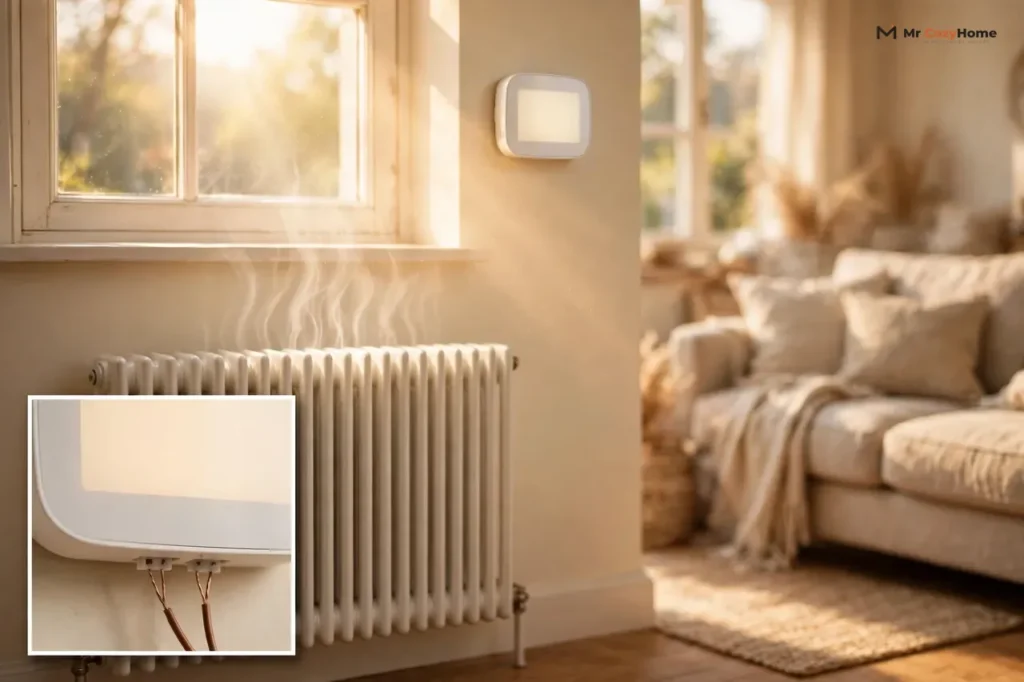
A heat only thermostat is a thermostat that controls heating alone. It turns your furnace or boiler on when the room gets cold and turns it off when the room reaches the temperature you set. It has no cooling control, so it cannot run an air conditioner.
If your home has heat but no central air conditioning, this is the thermostat you need. Most heat-only homes use a simple two-wire setup, and many basic models run on batteries, so they work even without extra wiring. A smart thermostat can work too, but only if you solve the power problem first, which this guide explains step by step. For a smart upgrade on a two-wire system, see how to install a thermostat.
What Is a Heat Only Thermostat?
A heat only thermostat does one job: it manages heat. You set a temperature, and the thermostat watches the room. When the room drops below your setting, it sends a signal to start the heater. When the room warms up, it sends the signal to stop.
You will also see the words “thermostat heating only” on boxes and product pages. It means the same thing. Some people say “thermostat just for heat.” All three phrases describe a control made for a heating-only system.
A heat only thermostat suits a home with a furnace and no central air conditioning, a boiler with radiators or radiant floors, or a single heating zone with no cooling at all. It does not suit a home with central air conditioning, because it has no way to call for cool air.
Do not confuse a heat-only thermostat with a thermostat set to “Heat” mode. A normal heat-and-cool thermostat has a Heat mode too, but it also has cooling terminals and a Cool setting. A true heat-only thermostat has no cooling function at all.
How a Heat Only Thermostat Works
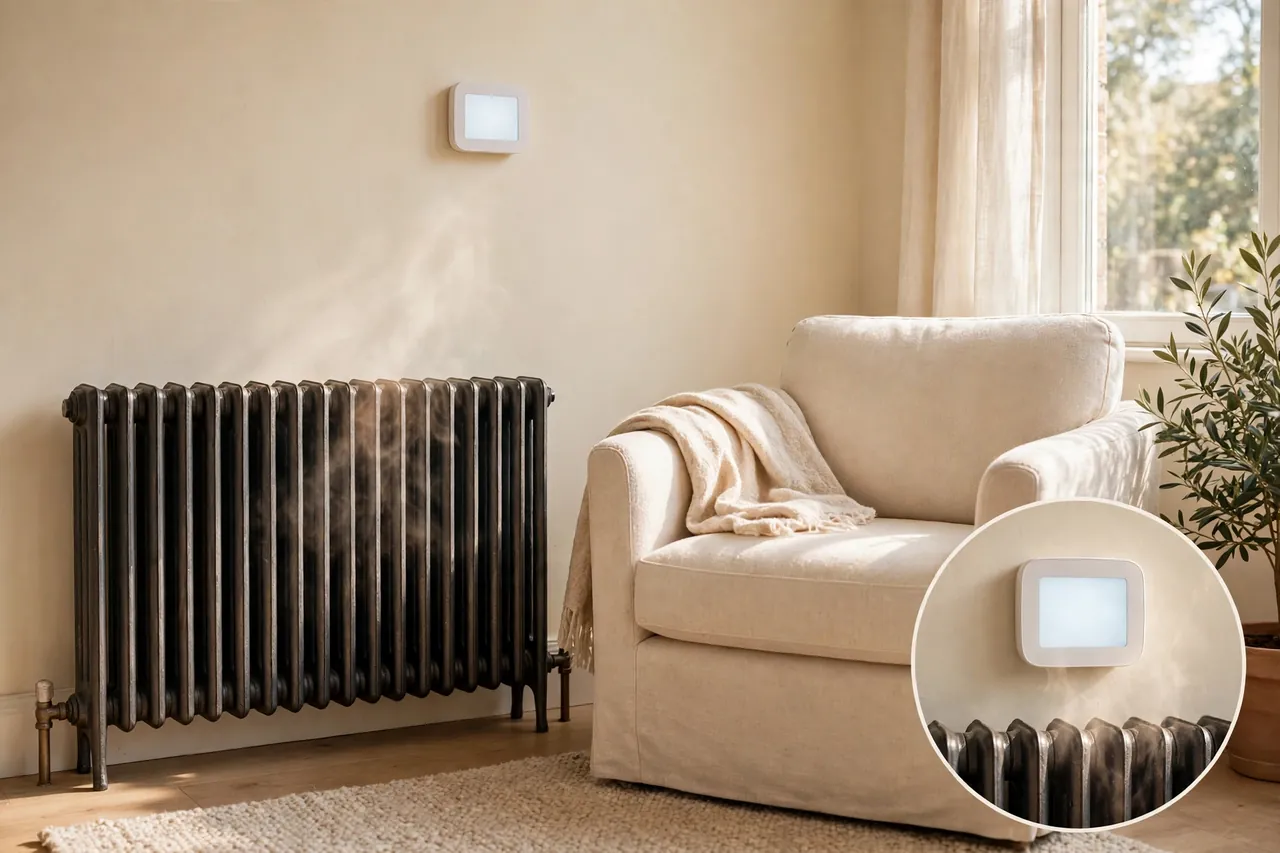
The idea is simple. The thermostat reads the room temperature with a sensor and compares it with your setting. If the room is colder, it closes a switch and the heater starts. If the room is warm enough, it opens the switch and the heater stops.
Most low-voltage heat-only systems use just two wires between the thermostat and the heater. One wire brings 24-volt power from the heating system, and the other carries the call for heat. When the thermostat joins the two wires, the furnace or boiler fires up.
That is the whole job in most homes. There is no fan wire to manage and no cooling wire to switch. For the full wire-by-wire mapping, read our guide to thermostat wire colors, which shows what each terminal does.
Some heat-only thermostats add a small twist. A boiler thermostat for a radiant floor may watch the floor temperature as well as the air temperature, so the floor never overheats. A steam system may use a wider swing, so the boiler does not cycle on and off too often. The core idea stays the same: sense, compare, switch, repeat.
Which Heating Systems Use a Heat Only Thermostat?
Many kinds of heat work with a heat-only thermostat, but the wiring and voltage decide the match. Check your system type before you buy, because the wrong voltage can damage a new thermostat.
Heating systems that commonly use a heat only thermostat
| Heating system | How it heats | Thermostat type |
|---|---|---|
| Gas or oil furnace | Warm air through ducts | Low-voltage, 24-volt |
| Hot-water boiler | Hot water to radiators or baseboards | Low-voltage, 24-volt |
| Steam boiler | Steam to radiators | Low-voltage, 24-volt |
| Radiant floor heat | Warm water in floor tubes | Low-voltage, often with a floor sensor |
| Electric baseboard heat | Heated fins along the wall | Line-voltage, 120 or 240-volt |
| Millivolt gas heater | Small gas valve, no mains power | Millivolt-rated only |
A gas or oil furnace is the most common case. The thermostat calls for heat, the furnace lights, and the blower pushes warm air through the ducts. A hot-water boiler works the same way at the thermostat, but it opens a zone valve or starts a pump instead of a blower.
A thermostat for boiler systems needs one extra check. Some boilers use a zone control panel, and some connect straight to the boiler with two wires. Either way, the thermostat only closes the heat circuit. If your boiler manual names a specific thermostat type, follow it.
Electric baseboard heat is the big exception. Baseboard heaters run on household line voltage, usually 120 or 240 volts, so a standard low-voltage thermostat cannot control them. You need a line-voltage thermostat built for that voltage, and most homes need one per heater zone.
Millivolt systems are the other exception. These small gas heaters make their own tiny amount of power, far below 24 volts. A normal low-voltage or smart thermostat will not work with them. Buy only a thermostat rated for millivolt systems.

Heat Only Thermostat vs. Heat and Cool Thermostat
The two types look alike on the wall, but they do different jobs. The table below shows the real differences, so you can spot which one you have.
Heat-only vs. heat-and-cool thermostats
| Feature | Heat only thermostat | Heat and cool thermostat |
|---|---|---|
| Controls heating | Yes | Yes |
| Controls cooling | No | Yes |
| Typical wires | 2 wires | 4 to 5 wires or more |
| Fan control | Usually none | Usually yes |
| Smart models | Fewer choices, power is the hard part | Many choices |
| Best for | Heat-only homes, boilers, furnaces without AC | Homes with central heating and cooling |
Can you use a heat-and-cool thermostat on a heat-only system? Yes, in most cases. You connect only the heating wires and leave the cooling terminals empty. Many people do this when they want a smart thermostat, because smart heat-and-cool models are easier to find than smart heat-only models.
Can you use a heat-only thermostat on a system with air conditioning? No. It has no cooling terminal and no Cool mode, so it cannot start the air conditioner. If you add central air conditioning later, you will need a new thermostat.
Types of Heat Only Thermostats: Non-Programmable, Programmable, and Smart
Three types cover almost every heat-only home. The right one depends on your routine, your wiring, and how much control you want.
Non-Programmable Thermostats
A non-programmable thermostat holds one temperature until you change it. You turn the dial or press a button, and the heat follows. It is simple, cheap, and hard to break. It suits a home where someone is around most of the day, or a rental where the tenant wants simple controls.
Most basic heat-only models are non-programmable, and many run on batteries. That matters, because a battery model needs no extra power wire. For a closer look at this type, read our guide to non-programmable thermostats.
Programmable Thermostats
A heat only programmable thermostat follows a schedule you set. It warms the house before you wake up, drops the temperature while you are at work, and warms it again before you come home. You set the schedule once, and the thermostat repeats it.
A schedule saves real money. The U.S. Department of Energy says you can save as much as 10% a year on heating and cooling by turning the temperature back 7 to 10 degrees Fahrenheit for 8 hours a day, while you sleep or are away. A programmable thermostat does that setback for you, every day, without you thinking about it.
Smart Thermostats
A smart thermostat adds Wi-Fi, an app, and learning features to a programmable schedule. You can change the temperature from your phone, check whether the heat is on, and get alerts if the temperature drops too low. Some models learn your routine and adjust the schedule for you.
Smart models cost more, and they need steady power, which is the hard part on a heat-only system. The next section explains that problem and the fixes that actually work. Do not buy a smart thermostat for a heat-only system until you know how you will power it.
Can a Smart Thermostat Work With Heat Only?
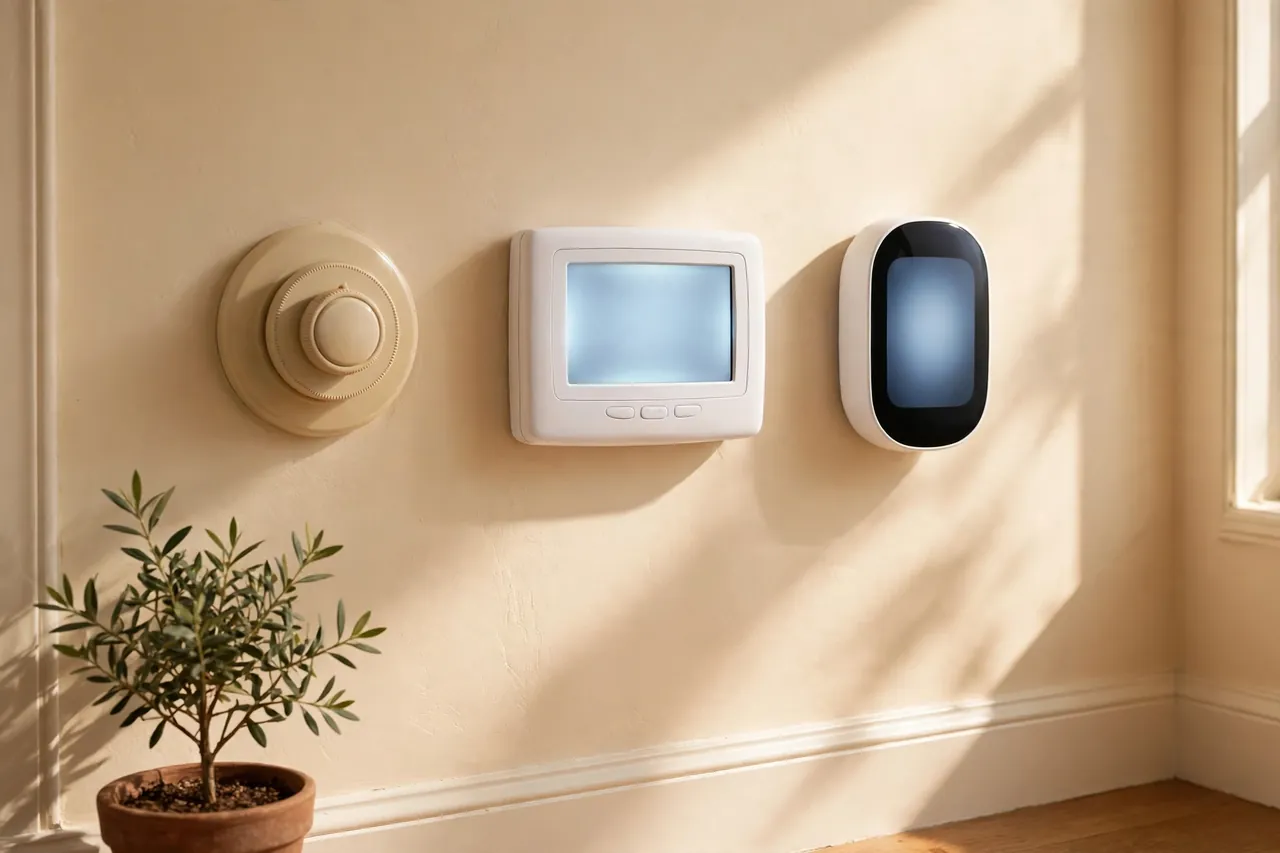
Yes, a smart thermostat can work with a heat-only system, but power decides whether it works well. A basic thermostat can run on batteries. A smart thermostat cannot. It needs steady 24-volt power for its screen, its Wi-Fi radio, and its processor, and a two-wire heat-only setup often cannot supply it.
The problem is the missing C wire. The C wire, or common wire, gives the thermostat a steady return path for power. Most heat-only systems have only two wires, so there is no C wire at the wall. Without one, a smart thermostat may drain its battery, drop off Wi-Fi, or click the heat on and off as it tries to steal power.
Google states the rule plainly in its Nest thermostat compatibility guide: Nest thermostats work with most 24-volt systems, but heat-only, cool-only, and heat pump systems need a C wire or the Nest Power Connector. Emerson states the same rule for its Sensi thermostats: a C wire is required for heat-only, cool-only, and heat pump systems, even though most combined heat-and-cool systems can run without one.
Verified Fixes for the Missing C Wire
Four fixes work on a heat-only system. Pick the one that fits your wiring, and stop if any step goes past your comfort level.
Fixes for a smart thermostat on a heat-only system
| Fix | What it needs | Best when |
|---|---|---|
| Use a spare wire as the C wire | An unused wire in the wall cable, connected at both ends | Your cable has 3 or more wires |
| Fit the maker’s power accessory | A Nest Power Connector or similar kit, fitted at the furnace or boiler | You have 24-volt heat-only wiring and no spare wire |
| Run a new thermostat cable | A new cable with at least 3 wires, from heater to thermostat | You want the cleanest long-term fix |
| Choose a battery-powered smart model | A model that runs on batteries, such as a Sensi | You want smart control with no wiring changes |
First, look for a spare wire. Pull the thermostat off its base and look behind it. Installers often run a cable with more wires than the old thermostat used, and the extra wire sits folded back in the wall. If you find one, connect it to the C terminal at the furnace or boiler control board and to the C terminal on the new thermostat. Label it at both ends so the next person knows what it is.
Second, use the maker’s power accessory. Google’s Nest Power Connector fits at the furnace, boiler, or zone controller and gives the thermostat the power it needs without a new cable run. Follow the maker’s instructions for your exact model, because the fitting point changes with the system type.
Third, run a new cable. This is the cleanest fix, but it means fishing a wire through walls, so most people hire a pro for it. If you run a new cable, run one with five wires, not three. The extra wires cost almost nothing now and leave room for cooling or a fan later.
Fourth, pick a battery-powered smart thermostat. Some Sensi models run on batteries, so check the exact model first. A battery model keeps the whole job at the wall, with no work inside the furnace cabinet.
One fix does not work here. Ecobee states on its support page for two-wire heat-only systems that the Power Extender Kit cannot be installed with a heat-only thermostat, and that a two-wire setup needs a different route, such as running new wires, an external 24-volt transformer, or a Fast-Stat Common Maker. Do not buy an ecobee for a two-wire system expecting the kit in the box to solve the power problem. It will not.
Systems a Smart Thermostat Cannot Control
Three systems rule out a standard smart thermostat, no matter which fix you try. Line-voltage electric baseboard heat needs a line-voltage smart thermostat, such as a Mysa baseboard model, one per zone. Millivolt gas heaters need a millivolt-rated thermostat. Proprietary or communicating systems, which often show wire labels such as 1, 2, 3 or A, B, C, need the maker’s own control.
If you see thick wires at the thermostat, stop. Thick wires usually mean line voltage. A low-voltage smart thermostat connected to line voltage will fail at once and can create a fire risk. Check the voltage first, or call a pro.
How to Tell If Your System Is Heat Only
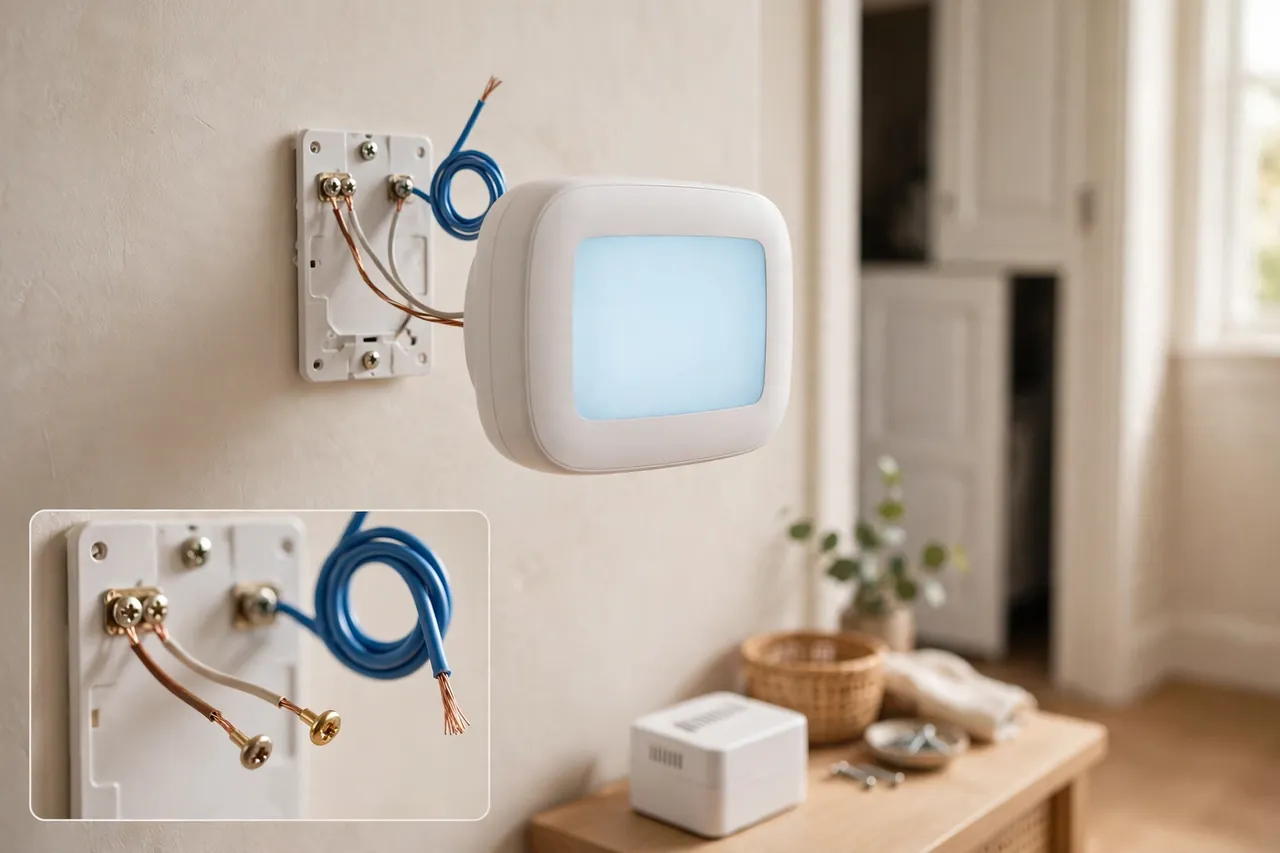
You can confirm a heat-only system in five minutes, without tools. Do these three checks in order.
- Look at the mode switch on your thermostat. If it shows only Off and Heat, with no Cool setting, your system is heat only.
- Pull the thermostat off its base and count the wires. Two wires usually means heat only. Write down the terminal letter each wire sits on, not the wire color, because colors are not always standard.
- Look at the equipment. A furnace with no outdoor air conditioning unit, or a boiler with radiators and no cooling equipment, confirms a heat-only home.
If you see wires on terminals marked Y or O/B, your system likely has cooling or a heat pump, even if you never use it. If you see only R and W, you have the classic heat-only pair. Our guide to thermostat wire colors explains what each terminal letter means, so you can read your own wiring with confidence.
Still unsure? Take a clear photo of the wires and the terminal letters, then check the maker’s online compatibility tool before you buy. Google, ecobee, Honeywell, and Sensi all run one. A photo and a compatibility check cost nothing and prevent a wrong purchase.
How to Choose the Right Heat Only Thermostat
Choose in this order: system match first, power second, features third. A thermostat with great features that does not match your system is a return, not an upgrade.
- Match the voltage and system type. Low-voltage 24-volt for a furnace or boiler, line-voltage for baseboard heat, millivolt-rated for a millivolt heater.
- Check the stages. Most heat-only homes need single-stage heat. If your furnace or boiler has two heating stages, buy a thermostat that supports two-stage heat.
- Count your wires and settle the power question. Battery model, spare C wire, power accessory, or new cable, decide this before you shop, not after the box arrives.
- Pick the control type that fits your routine. Simple dial for a steady routine, programmable for a regular schedule, smart for remote control and alerts.
- Check the extras that matter to you. A large display helps poor eyesight. A lock stops curious hands from changing the setting. A freeze alert warns you if the heat fails while you are away.
- Confirm the temperature range. A basic heat-only model may cover 40 to 90 degrees Fahrenheit, which suits most homes. If you heat a garage or a cabin you keep very cool, check the low end of the range.
Is a smart thermostat worth the extra cost on a heat-only system? It depends on what you gain. ENERGY STAR says a certified smart thermostat saves about 8% of heating and cooling bills on average, or about $50 a year, according to its smart thermostat FAQ. If your old thermostat already follows a good schedule, your saving will be smaller. If your old thermostat holds one temperature all day, a smart schedule can save more. For day-to-day temperature choices, our guide to recommended thermostat settings for summer and winter gives practical set points for each season.
How to Install a Basic Heat Only Thermostat
A basic battery-powered heat-only thermostat is a fair DIY job for most homeowners. A smart thermostat that needs work inside the furnace cabinet is a bigger job. Read the whole outline first, then decide which side of that line your job falls on.
Turn off the power before you touch any wiring. Switch off the heating system at the breaker or the furnace switch, and confirm the old thermostat screen is dark. This step comes first, every time, even for a simple swap.
- Take a photo of the old wiring. Show every wire and the terminal letter it sits on.
- Label each wire with the terminal letter, using tape and a pen. Label by letter, not by color.
- Remove the old thermostat base from the wall and fit the new base level, using the built-in level if it has one.
- Connect each wire to the same terminal letter on the new base. On a two-wire system, that is usually R and W.
- Fit batteries if the model takes them. Set the system type to heat only, and to furnace or boiler, as your model asks.
- Turn the power back on. Set the temperature a few degrees above the room temperature and listen for the heater to start.
- Wait for the room to reach the new setting, then check that the heater stops. Test the heat twice before you call the job done.
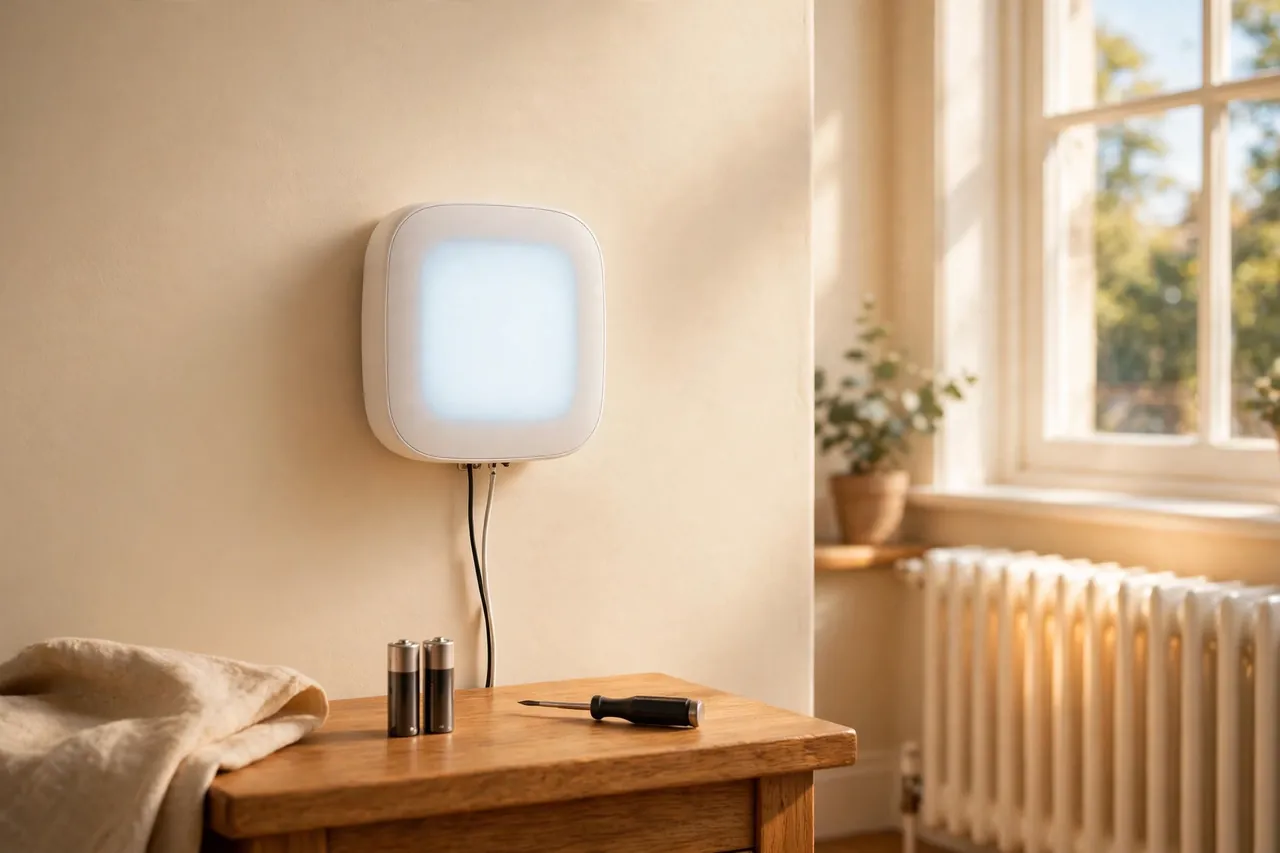
If the heater does not start, turn the power off again and check each wire. A loose wire is the most common cause, and a wire in the wrong terminal is the next most common. If both look right and the heat still does not start, stop and call a heating pro. Do not keep switching wires to guess the answer.
Common Problems With a Heat Only Thermostat
Most heat-only thermostat problems have simple causes. Work through them in order, cheapest and safest first.
The Heat Does Not Come On
Check the power first. A dead battery stops a battery thermostat at once. A tripped breaker stops the whole heating system. A furnace switch left off after summer does the same. Check all three before you blame the thermostat.
The Heat Runs All the Time
A thermostat that never stops calling for heat usually has a stuck switch, crossed wires, or a setting problem. Turn the temperature down below the room temperature. If the heat keeps running, turn off the power and call a pro. Do not leave a heater running with no control.
The Temperature Swings Too Much
Wide swings often mean the thermostat sits in a bad spot. A thermostat in direct sun, above a radiator, near a drafty door, or in a hallway nobody uses will read the wrong temperature. Move it to an inside wall in a room you actually live in, away from heat sources and drafts.
The Smart Thermostat Keeps Dropping Wi-Fi
Wi-Fi drops on a heat-only system usually mean a power problem, not a Wi-Fi problem. The thermostat is starving for steady power. Check for a C wire or fit the maker’s power accessory. A stronger Wi-Fi signal will not fix a thermostat that has too little power to run its radio.
The Display Is Blank
A blank display on a battery model usually means dead batteries. Replace them and check the contacts for corrosion. A blank display on a wired smart model usually means a power or wiring fault. Turn off the power, check the connections, and call a pro if the display stays dark.
When to Call a Professional
Some heat-only jobs belong to a pro, and knowing the line saves money and keeps you safe. Call a heating technician when any of these apply.
- You see thick wires, which mean line voltage, or you cannot confirm the voltage.
- Your system is millivolt, steam, zoned with a control panel, or proprietary.
- The job needs work inside the furnace or boiler cabinet, or a new cable run through walls.
- The heater does not start after a correct install, or it runs with no control.
- You smell gas, see scorch marks, or find damaged wiring. Turn off the power and call a pro at once.
A pro visit also makes sense before winter if your boiler or furnace is old, noisy, or skipped service last year. A fall tune-up catches small faults before the coldest night, when every heating company is booked. Our home winterization checklist walks through the full pre-winter heating check, so you can test the heat in October, not on the first freezing night. Sealing drafts and adding insulation also cuts the work your thermostat has to do, as our guide to how to improve home insulation shows.
Related Guides
If your heat-only system is part of a bigger winter plan, these guides help next. Our home winterization checklist covers the full pre-winter check, from pipes to alarms. Our guide to how to improve home insulation shows how to keep the heat your thermostat makes inside the house.
Frequently Asked Questions
What does two-wire heat-only mean and what systems is it compatible with?
Two-wire heat-only means the thermostat uses just two wires, usually R and W, to complete the circuit that calls for heat. It suits heating systems controlled by a simple on-and-off signal, typically a 24-volt furnace or boiler. It does not support cooling, fan control, or a smart thermostat that needs steady power without an extra fix.
Will a smart thermostat work with my existing heat-only system?
Yes, most heat-only systems can work with a smart thermostat made for single-function heating control, but you must solve the power question first. Check your wiring and voltage, then confirm the model is rated for heat-only setups. Many makers require a C wire or a power accessory on heat-only systems, so check compatibility before you buy.
Do smart thermostats need a C wire?
Not always, but heat-only systems are the exception. Google and Emerson both state that heat-only systems need a C wire or a power accessory, even though many combined heat-and-cool systems can run without one. Basic battery thermostats run fine with no C wire, but most smart models need steady power to run the screen and Wi-Fi.
Is professional installation necessary for a smart heat-only thermostat?
Not always. Some models suit a straightforward DIY install, especially battery-powered ones with simple wiring. Others need professional wiring, above all when the system is old, zoned, or has unusual wiring. If you are comfortable with basic electrical work and follow the wiring diagram, you may handle it yourself. For safety and best performance, hire a pro for older or complex systems.
Can I control my heat-only thermostat remotely?
Yes, most modern smart thermostats offer remote control through a phone app or web portal. You can adjust the heating schedule, check the temperature, and watch energy use from anywhere with an internet connection. Confirm the model you choose supports remote control and works with your smart home system before you buy.
A heat only thermostat is a simple device, and that simplicity is its strength. Match it to your system, settle the power question before you buy a smart model, and set a schedule that fits your day. Do that, and your heat will run when you need it, stop when you do not, and cost you less through the winter.
Disclaimer: This guide covers general home information only. Turn off the power at the breaker before you touch thermostat wiring, and never work on line-voltage, gas, or boiler wiring unless you are sure it is safe. Hire a qualified heating technician or electrician for wiring you do not understand, for work inside the furnace or boiler, and for any system that smells of gas or shows damage.


