The best Christmas window candles for most homes are battery operated window candles with a timer. You set them once, and they glow each evening on the same schedule, with no cords, no open flame, and no trip to every window each night. For a window with no sill, pick window candles with suction cups instead of a base, and for a window that faces a dark street, choose a brighter LED so the glow still reads from outside.
That short answer covers the most common home, but the right pick still depends on your windows. A deep sill, a narrow sill, a porch roof, and a bedroom window each point to a different candle. This guide walks you through the four choices that matter: power, control, mount, and look. By the end, you will know exactly which type to buy and where to put it.
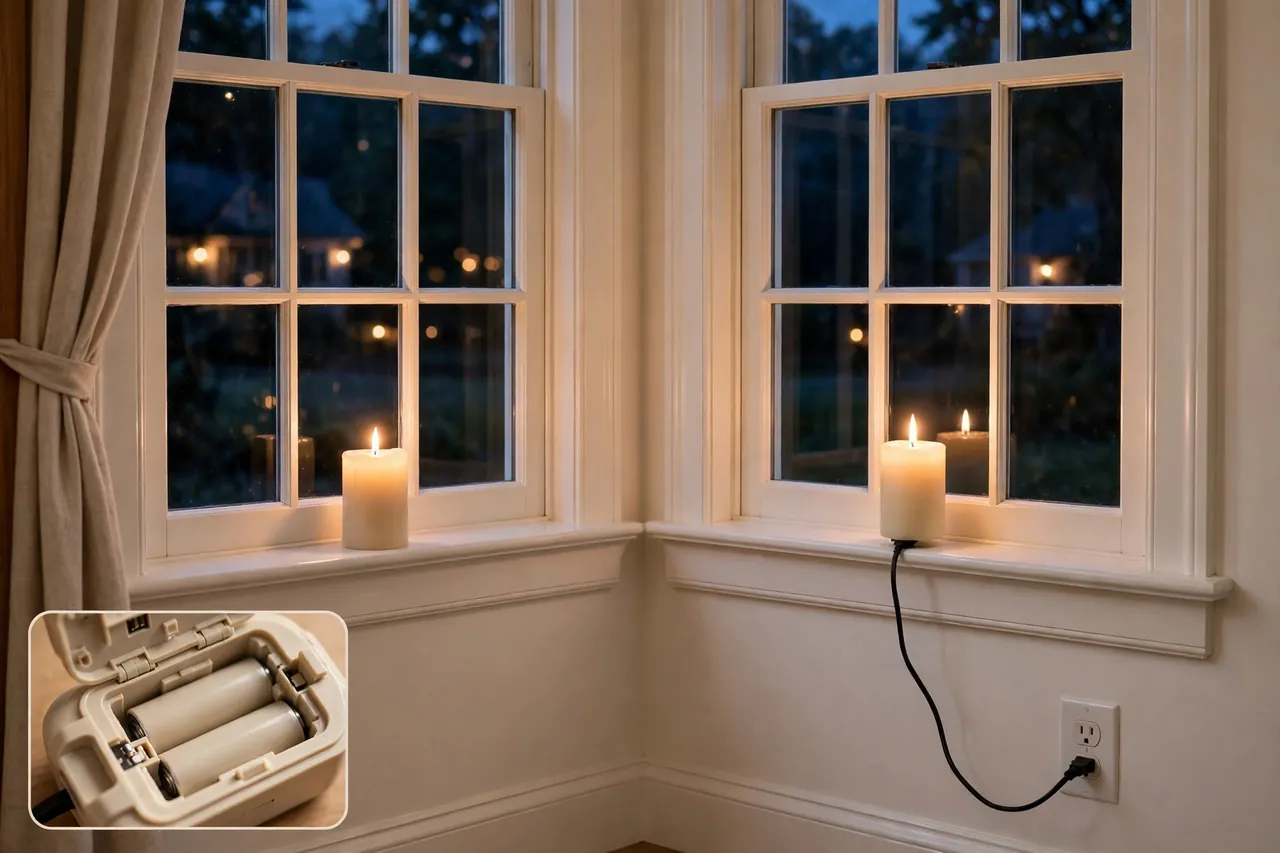
Battery vs Plug-In Window Candles
Every window candle gets its power one of two ways: from batteries or from a wall outlet. This one choice shapes where you can place the candle, how much work it takes each night, and what it costs over the season.
Battery Operated Window Candles
Battery operated window candles with timer controls are the most popular choice, and for good reason. They need no outlet, so you can center one on any sill, even in an old home where outlets sit far from the windows. Most run on two AA batteries, and many sets add a remote so you can switch a whole row of windows on from the doorway.
Batteries also make upstairs windows easy. You do not need to run an extension cord up the stairs or hide a cord behind a curtain. You just place the candle, set the timer, and walk away. The trade-off is simple: you will buy batteries, and you will need to change them once or twice a season.
Plug-In Electric Window Candles
Plug-in electric window candles draw steady power from an outlet, so they never run out of charge mid-evening. They suit windows that sit right beside an outlet, and they make sense if you keep candles lit all year, not just at Christmas. A plug-in candle also tends to cost less over time than feeding batteries to a dozen windows.
The catch is the cord. A cord across a sill looks messy, and a cord pinched in a window sash can wear down over time. If you use a plug-in candle, check the cord each season for frays, and never run it under a rug or through a closed window. For windows far from an outlet, battery power wins on looks alone.
Which Power Type Wins for Your Home?
Choose battery powered window candles with timer controls when your windows lack nearby outlets, when you want a clean look with no cords, or when you decorate many windows at once. The best window candles for a busy home are the ones you set once and forget, and battery timer models do exactly that. Choose plug-in candles when an outlet sits right at the window and you plan to keep the glow going well past Christmas. Many homes mix the two: battery candles upstairs and in far rooms, plug-in candles in the living room where outlets are close.
If you already own plug-in candles without a built-in timer, a plug-in timer can give them the same set-it-and-forget-it schedule. Our guide to using a timer plug walks through that setup step by step.
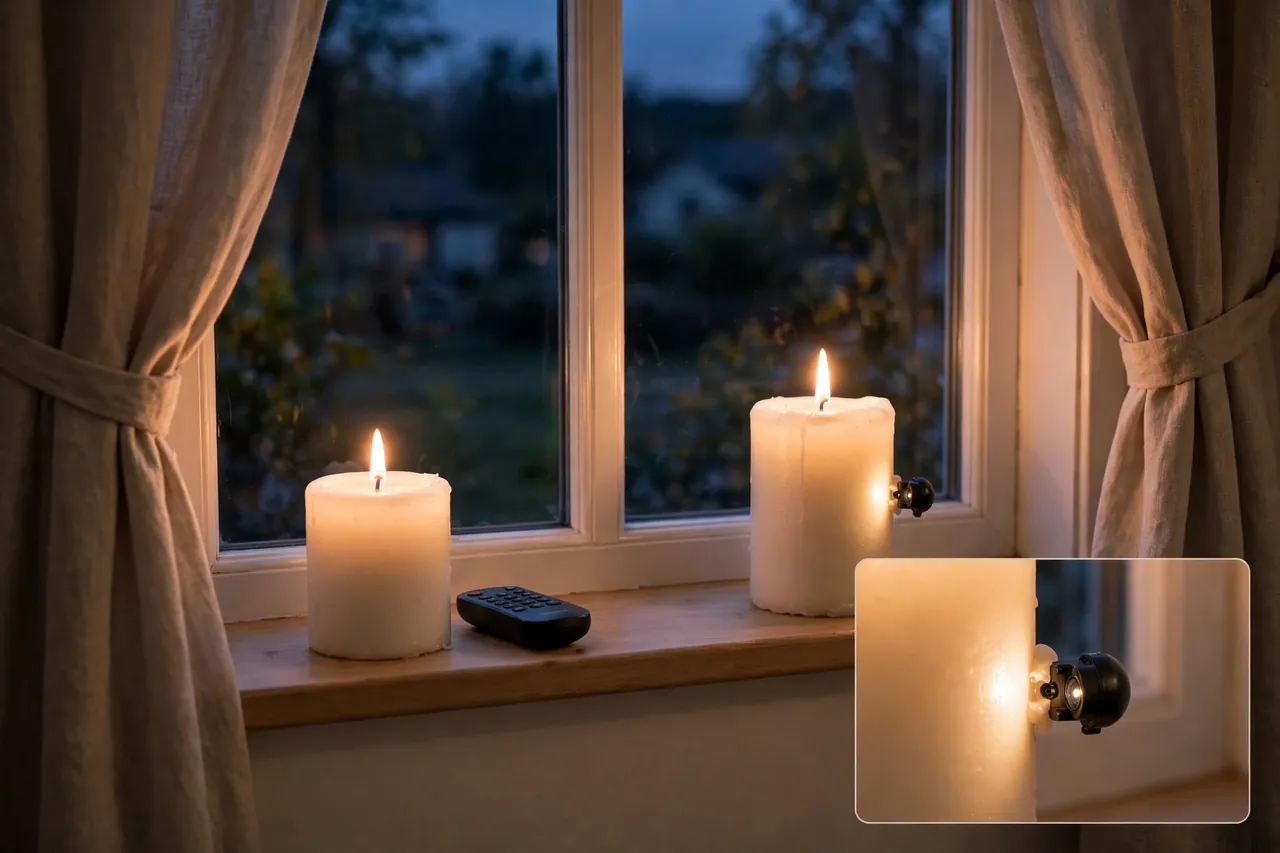
Timers vs Dusk-to-Dawn Sensors
Once you pick a power type, you pick how the candle decides when to glow. The two main controls are a daily timer and a dusk-to-dawn sensor, and they behave very differently on a dark winter night.
How a Window Candle Timer Works
Window candles with timer controls run for a fixed number of hours, then switch off until the same time the next day. Common timer cycles are 4, 6, 8, and 12 hours. On most battery models, the 24-hour cycle starts the moment you switch the candle on, so if you switch it on at 5 p.m. with a 6-hour timer, it glows until 11 p.m. and starts again at 5 p.m. the next day.
Remote-controlled window candlesticks with timer settings make this even easier. You can pick the hour cycle from across the room, switch between flicker and steady light, and start every candle at the same moment so a row of windows glows in sync. Christmas window candles with timer settings give you the most control over battery life, because a 6-hour nightly glow uses far less power than an all-night glow.
How a Dusk-to-Dawn Sensor Works
Electric window candles with sensor dusk to dawn controls work a different way. A small light sensor on the candle watches the daylight around it. When daylight fades at dusk, the candle switches on by itself. When morning light returns, it switches off. You never set a time, and the candle adjusts on its own as days grow longer or shorter.
Window candles with sensor controls need one thing to work right: the sensor must face the window and the outdoor light. If you turn the sensor toward the room, indoor lamps can confuse it. Window candle lights with sensor controls also stay lit all night, which looks lovely but drains batteries faster in winter, when dark hours can stretch to 12 or 14 hours a day.
Timer or Sensor: Which Should You Choose?
Pick a timer when you want a set bedtime for the glow, when you want the longest battery life, or when your windows sit under a porch roof. A porch roof can block daylight from a sensor, so sensor candles under a deep porch may stay lit too long or never switch off. Pick a dusk-to-dawn sensor when you want zero setup, when you like an all-night glow, and when your windows get clear daylight. Battery window candles with timer controls suit most buyers best, because they save batteries and keep bedrooms dark after bedtime.
Here is the quick comparison, drawn from manufacturer guides and retailer listings for these products:
| Feature | Daily Timer Candle | Dusk-to-Dawn Sensor Candle |
|---|---|---|
| On hours per night | Fixed: 4, 6, 8, or 12 hours | All dark hours, often 12 to 14 in winter |
| Battery life on one set | About 30 to 70 days on a 6-hour cycle | About 20 to 60 days |
| Setup | Switch on at the time you want each night | Point the sensor at the window and leave it |
| Best for | Bedrooms, porches, saving batteries | Hands-free all-night glow, clear windows |
| Watch out for | Forgetting the start time after a battery change | Porch roofs and indoor lamps confusing the sensor |
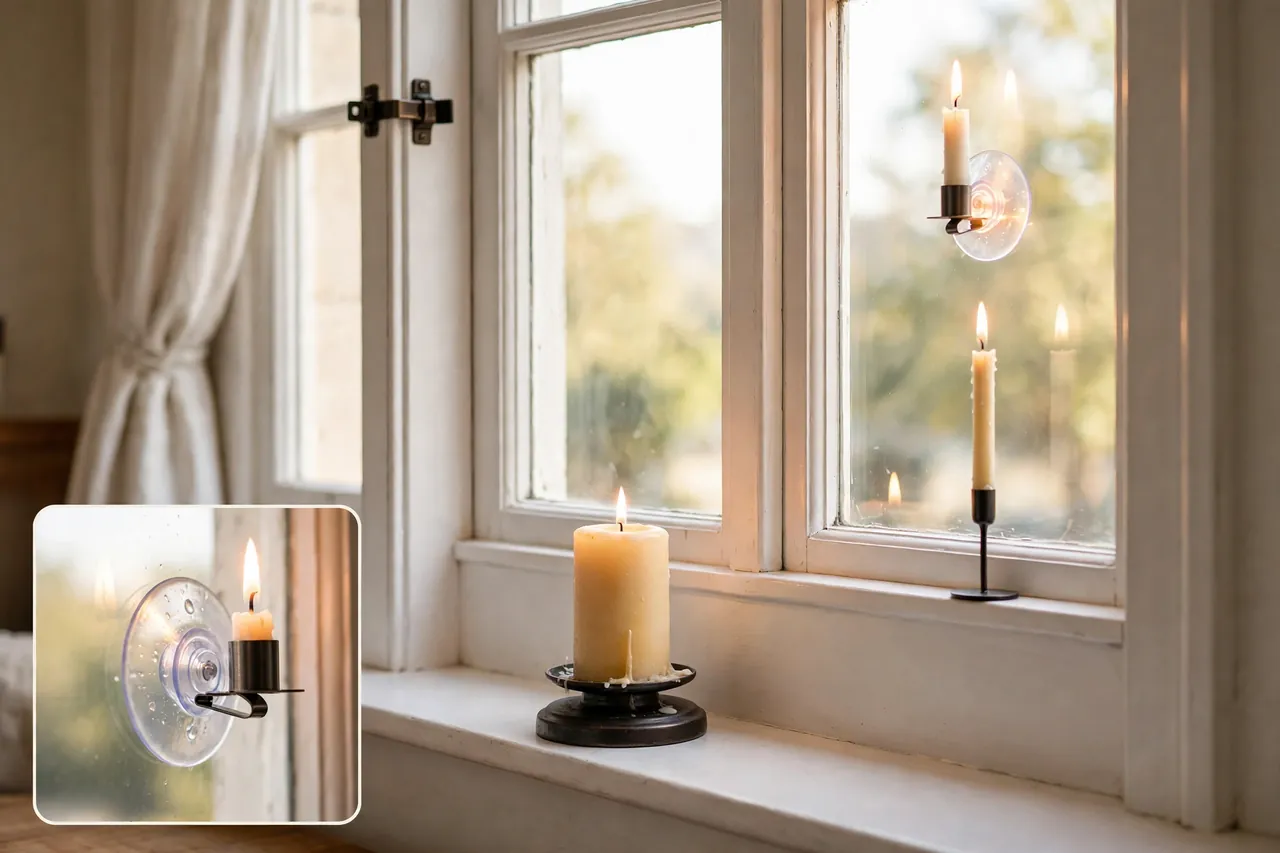
Window Candles With Suction Cups vs Brackets and Bases
A candle that will not stay put is the most common window candle frustration. The mount you choose matters as much as the light itself, because windows come in very different shapes.
Weighted Bases for Deep Sills
A classic window candle sits in a base on the sill. The best bases carry weight, either a metal base or a plastic base with a weight inside. A light, hollow base tips over when a curtain brushes it or a pet bumps the sill. If your sills are deep and flat, a weighted base is the simplest, most stable choice, and it looks the most traditional from the street.
Slim Bases for Narrow Sills
Many modern homes have narrow sills that will not hold a standard base. For these windows, look for slim-base models, some as shallow as 1.5 inches deep. Measure your sill before you order, and compare that number with the base depth in the listing. A base that hangs past the sill edge will tip, no matter how pretty the candle looks.
Window Candles With Suction Cups
Window candles with suction cups skip the sill completely. A suction cup grips the glass, and a small clip or holder carries the candle. This mount suits windows with no sill at all, windows blocked by plantation shutters, and French windows where a base has nowhere to sit. It also keeps candles out of reach of small hands and pets that bump the sill.
Suction cups work best on clean, smooth glass. Wipe the glass first, press the cup flat, and check it after a cold night, since temperature swings can loosen the seal. Maker guides note that suction cups hold best on double-pane or triple-pane glass, where moisture buildup between panes is less likely to break the seal.
Window Candles With Bracket Mounts
Window candles with bracket mounts use a small clip or bracket that grips the sash or hangs from the window frame. Brackets suit windows where a suction cup will not hold and a base will not fit, and they keep the candle steady without tape or glue. If your set includes brackets, test one window first and leave it overnight before you mount the rest. A mount that survives one cold night will survive the season.
For windows that still wobble, a small ball of removable mounting putty under the base adds grip without damage to paint or wood. Avoid tape on painted sills if you can, since tape can peel paint when you take the candles down in January.
How to Choose the Right Size, Brightness, and Color
Size comes first, because a candle hidden behind a window bar looks broken from the street. Measure from your sill to the nearest horizontal window bar, called a mullion. Then pick a candle height that puts the flame above that bar. Some candlesticks adjust to two heights, which helps you clear a mullion without buying a new set.
Brightness comes next. A steady flame reads a little brighter than a flickering flame on the same candle, so pick steady light when your home sits far back from the street. Flicker looks more like a real flame up close, so it suits front windows that guests see from the porch. Some sets let you switch between the two, which is the best of both worlds.
Color sets the mood. Warm white light, around 2700K to 3000K, gives the classic cozy Christmas look and matches old brass bases. Amber light mimics a real wax flame even more closely. Cool white light looks crisp and modern, but it can feel cold next to warm porch lights, so match it with the rest of your outdoor lights. For a full outdoor plan, our LED outdoor Christmas decorations guide pairs well with this one.
Where to Place Window Candles
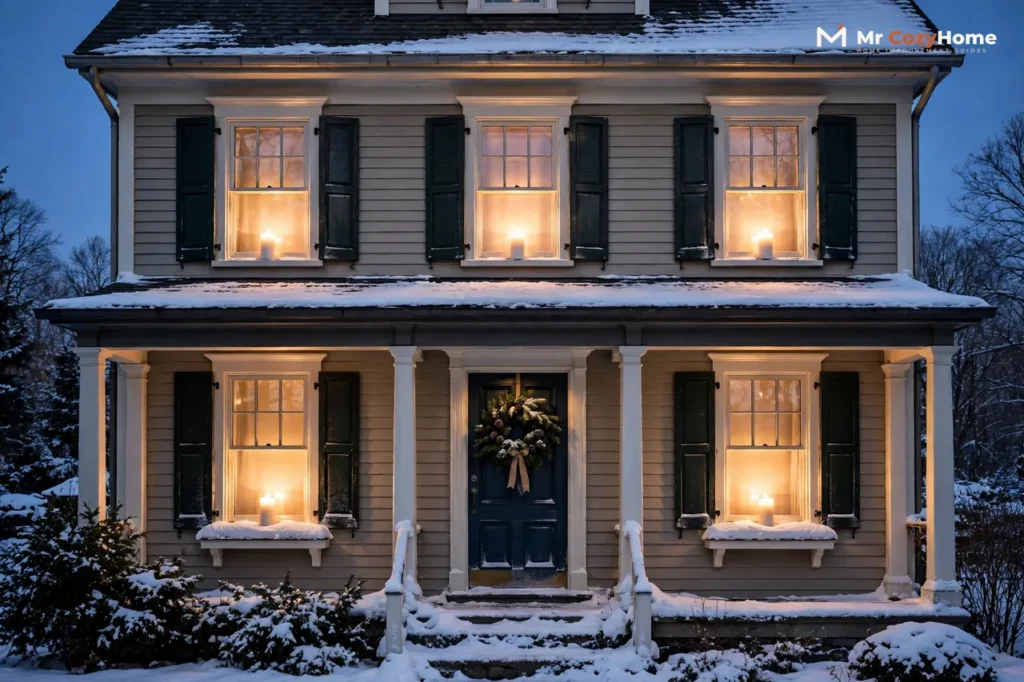
Start with the front of your home, since that is what guests and neighbors see. One candle centered in each front window gives a calm, even look from the street. Two candles crowd a small window, and one candle lost in a huge bay window looks lonely, so match the count to the window size: one for a standard window, two or three spread across a wide bay.
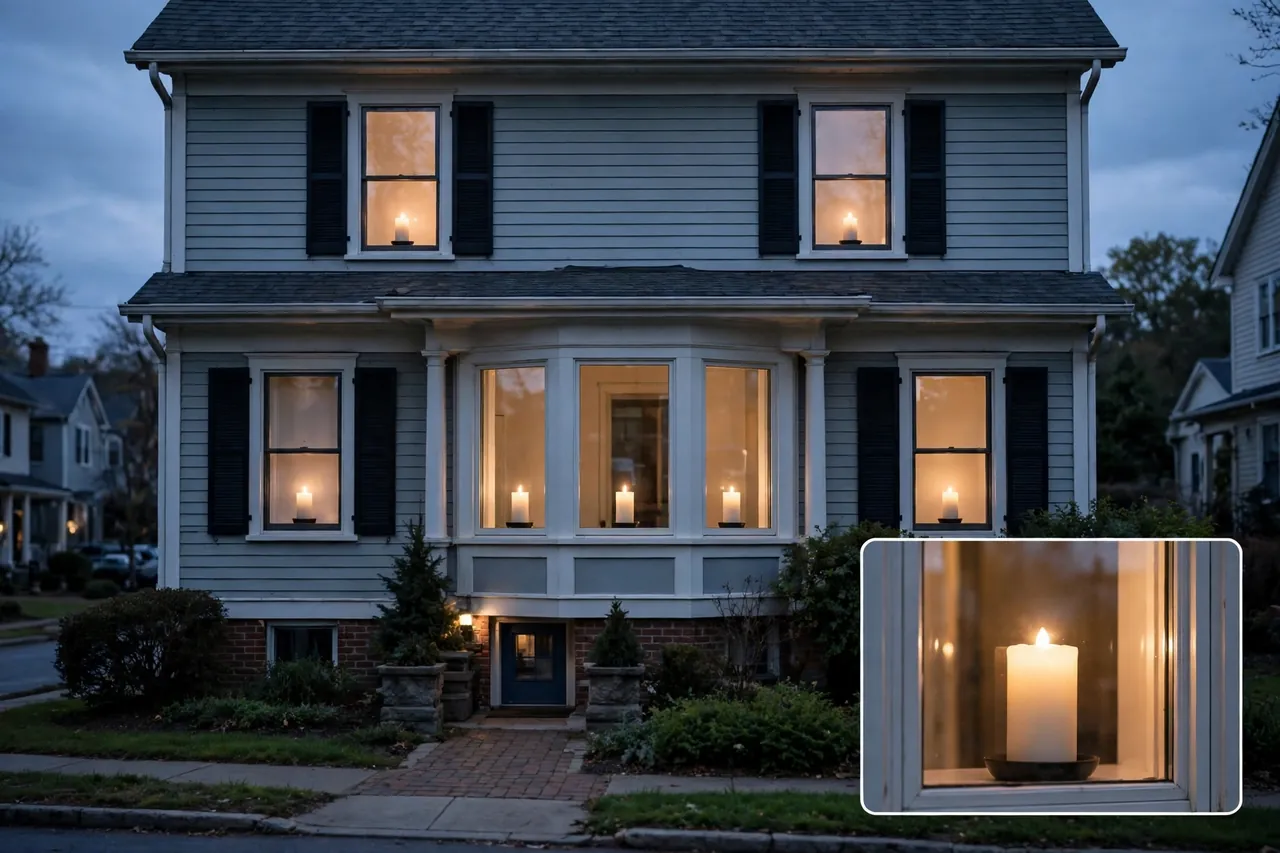
Place candles where the flame shows clearly through the glass. Center the candle in the pane, keep it clear of curtain folds, and step outside at night to check the view. A candle that looks perfect from inside can sit hidden behind a mullion or a curtain hem from the street, and only the outdoor check catches that.
Skip windows that face a bright porch light or a streetlamp, since strong light washes out a small LED flame. Skip windows where curtains hang right against the glass, too, unless you use cool LED candles and keep fabric clear of the base. And keep bedroom window candles on a timer, not a dusk-to-dawn sensor, so the room goes fully dark at bedtime.
Window candles also work beyond the front rooms. A candle in a kitchen window glows for the family inside, and a candle in an upstairs window makes a two-story home look finished from the street. Just keep the same color and base finish across all windows, so the house reads as one thoughtful display instead of a mix of leftovers.
How to Set Up Window Candles Step by Step
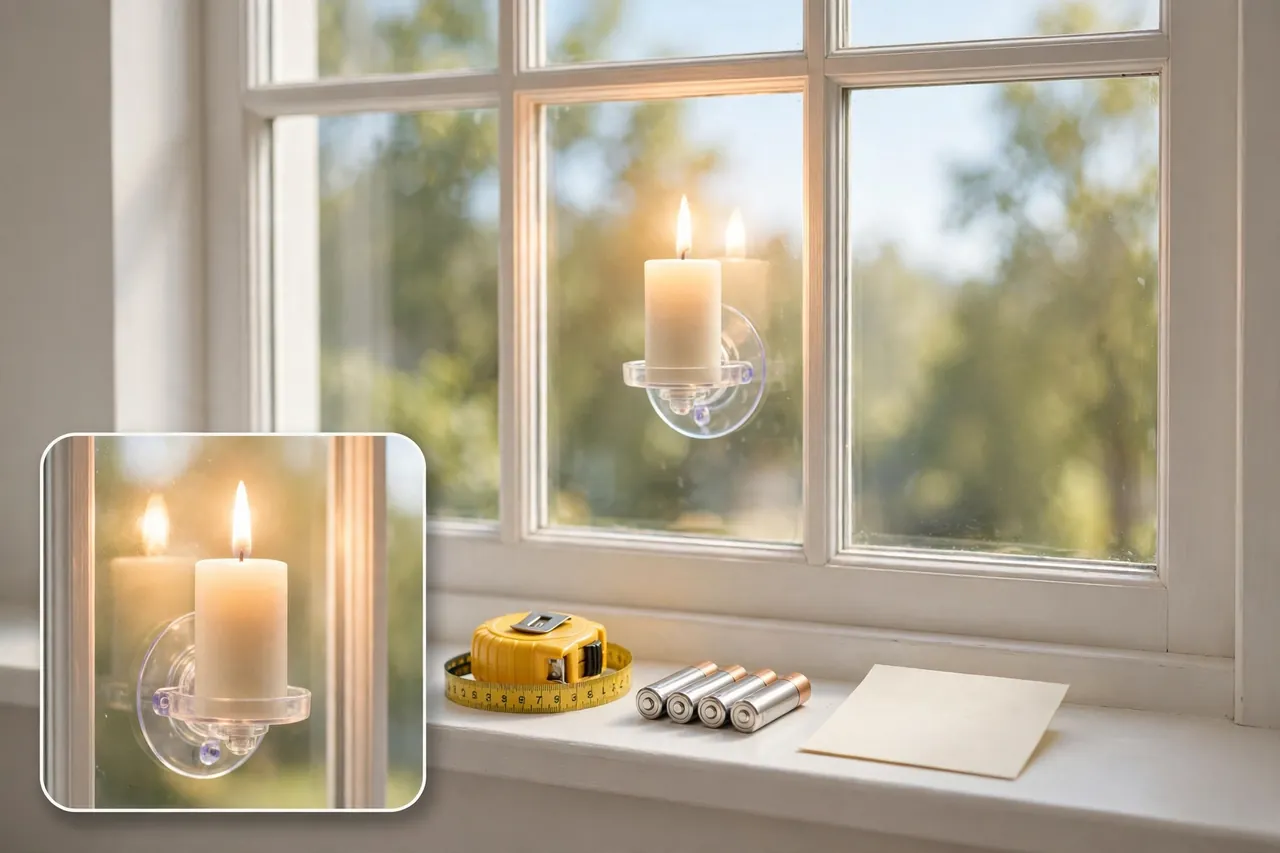
Set up one window first, check it at night, then repeat the same steps for the rest. That one test window saves you from mounting ten candles wrong.
- Measure the sill and check the window bars, then pick a base, suction cup, or bracket that fits that window.
- Put fresh batteries in the candle, and use the same battery type in every candle so they dim at the same rate.
- Set the timer at the exact time you want the candles to glow each night, or point the sensor toward the window for dusk-to-dawn models.
- Mount the candle, center it in the pane, and keep it clear of curtains, blinds, and plants.
- Step outside after dark and check the view from the street, then adjust the height or position if a bar blocks the flame.
- Write down the battery-change date on a small note inside a kitchen drawer, so you know when the next swap falls due.
When you change batteries, reset the timer at your chosen start time, because most timer candles restart their 24-hour cycle the moment you switch them back on. A candle that glows at noon after a battery swap just needs its timer restarted at dusk.
What Window Candles Cost
Window candles usually sell in packs of 4, 6, 8, or 10, so compare the price per candle, not just the pack price. Budget sets cost less up front but often use hollow, lightweight bases and dimmer LEDs, while mid-range and premium sets add weighted metal bases, brighter LEDs, remotes, and warranties. One maker, 612 Vermont, backs its window candles with a 3-year warranty, which is rare in this market and worth weighing if you decorate every year.
As one verified example, the Vermont Country Store listed a set of 4 cordless LED window candles with an adjustable base at $69.95, checked on November 1, 2026. That price covers the candles and bases, not batteries, so add a pack of AA batteries to your budget. Amazon listings for several 612 Vermont 4-packs showed no featured offers at the same check, so prices there could not be verified and are not quoted here. Expect to pay more per candle for metal bases and remote controls, and less for simple plastic-base sets.
Count the full season cost before you buy. A home with 12 windows needs three 4-packs, plus batteries for each candle, plus spares. Timer candles stretch one set of batteries to 30 to 70 days on a 6-hour cycle, so one battery swap often covers the whole season. Dusk-to-dawn candles burn longer each night, so budget for a second set of batteries.
Troubleshooting: When Window Candles Won’t Stay Lit or Won’t Stay Put
When a candle glows at the wrong time, check the timer first. A battery swap restarts most timers, so a candle that lights at noon simply needs a restart at your chosen evening time. When a sensor candle stays lit all day, check what the sensor faces: a porch roof, a heavy curtain, or an indoor lamp can all fool it. Move the candle toward clear glass and turn the sensor toward the outdoors.
When a candle dims early, swap all its batteries at once, and never mix old and new batteries in one candle. Mixed batteries drain unevenly and can leak. When a suction cup drops overnight, clean the glass, warm the cup in your hands, and press it flat again. When a base still tips, switch to a slimmer or heavier base, or move that window to a suction cup or bracket mount.
When one candle in a set glows dimmer than the rest, check for a weak battery or a loose bulb before you blame the whole set. LED window candles use small bulbs that can loosen in shipping, and a gentle reseat often fixes a dim flame. If a remote stops working, check the remote battery first, since that tiny battery runs out long before the candle batteries do.
Safety and Real-Flame Candles
Electric and battery candles are the right pick for windows, and the numbers explain why. The National Fire Protection Association reports an average of 7,400 home fires started by candles each year between 2015 and 2019, causing about 90 deaths and $291 million in property damage, with Christmas Day the peak day for candle fires. In three of every five candle fires, the candle sat too close to something that could catch fire. LED candles remove the open flame from that equation entirely, which is why they suit windows near curtains, kids, and pets.
If you still love a real flame somewhere in your home, keep it far from windows and curtains, never leave it burning in an empty room, and never place it where a curtain could blow into the flame. Real-flame candles do not belong on a windowsill at all, since drafts, curtains, and pets all raise the risk. For the windows, let the LED candles do the glowing.
Stay safe with the electric kind, too. Use the battery type the maker lists, replace all batteries at once, and recycle old batteries instead of tossing them in the trash. Check plug-in cords each season for wear, keep cords out of window sashes, and store candles without batteries after Christmas so stored batteries cannot leak. If a battery looks swollen or leaks, throw it away safely and clean the compartment before you use that candle again.
Disclaimer: homes, windows, and wiring vary, so treat this guide as general advice, not a substitute for your candle maker’s instructions. For any electrical concern, or if a plug-in candle smells hot or shows damage, unplug it and ask a qualified electrician for help.
Related Guides
If you want to build out the whole display around your window candles, these guides pick up where this one leaves off. Our Christmas window decorating ideas cover the full window look, while outdoor Christmas window decorations take the display outside. For candles in the rest of the home, see candle home decoration, and for the wider light plan, browse our Christmas light ideas.
Frequently Asked Questions
How long do battery-operated window candles last?
Most timer-based LED window candles last 30 to 70 days on a 6-hour nightly cycle with good alkaline AA or AAA batteries. Dusk-to-dawn models run longer each night, so they typically last 20 to 60 days on one set. Shorter timer cycles stretch battery life further.
Are battery-operated window candles safe?
Yes. They use no open flame, produce no dripping wax or soot, and their LED bulbs stay cool to the touch. That makes them safe near curtains, kids, and pets. Still use undamaged batteries of the maker’s listed type, and follow the maker’s instructions.
Are electric window candles safe for homes with pets and children?
Yes, and that safety is one of their biggest advantages. With no flame, heat, smoke, or dripping wax, an electric window candle cannot burn a curious child or pet that bumps the sill. Keep cords out of reach on plug-in models, and mount candles where pets cannot knock them down.
What’s the difference between timer and dusk-to-dawn candles?
Timer candles run for a fixed number of hours, usually 4, 6, 8, or 12, then repeat the same cycle every 24 hours. Dusk-to-dawn candles switch on when daylight fades and off at sunrise, so they glow all night. Timers save batteries, while sensors save effort.
How do you start the timer on battery-powered window candles?
Put fresh batteries in, then switch the candle on at the time you want it to glow each night. The 24-hour cycle starts at that moment on most models, so a candle switched on at 5 p.m. with a 6-hour timer glows until 11 p.m. daily. Remote sets let you pick the cycle with a button press.
Can I use battery window candles without a windowsill?
Yes. Choose window candles with suction cups, which grip the glass directly and suit windows with no sill, narrow sills, or plantation shutters. Bracket mounts that grip the sash work too. Clean the glass first, and test one mount overnight before you hang the rest.
What LED color temperature is best for window candles?
Warm white light, around 2700K to 3000K, gives the classic cozy Christmas look most homes want. Amber light mimics a real wax flame even more closely. Cool white suits a modern home, but match it with your other outdoor lights so the display looks planned.
Window candles earn their place because they do one job beautifully: they make your home look warm and welcoming from the street, night after night, with almost no work from you. Pick battery power with a timer for most windows, add suction cups or brackets where sills fail you, and check the view from outside once. Then enjoy the glow all season long, and come back to our window decorating guides when you plan next year’s display.