
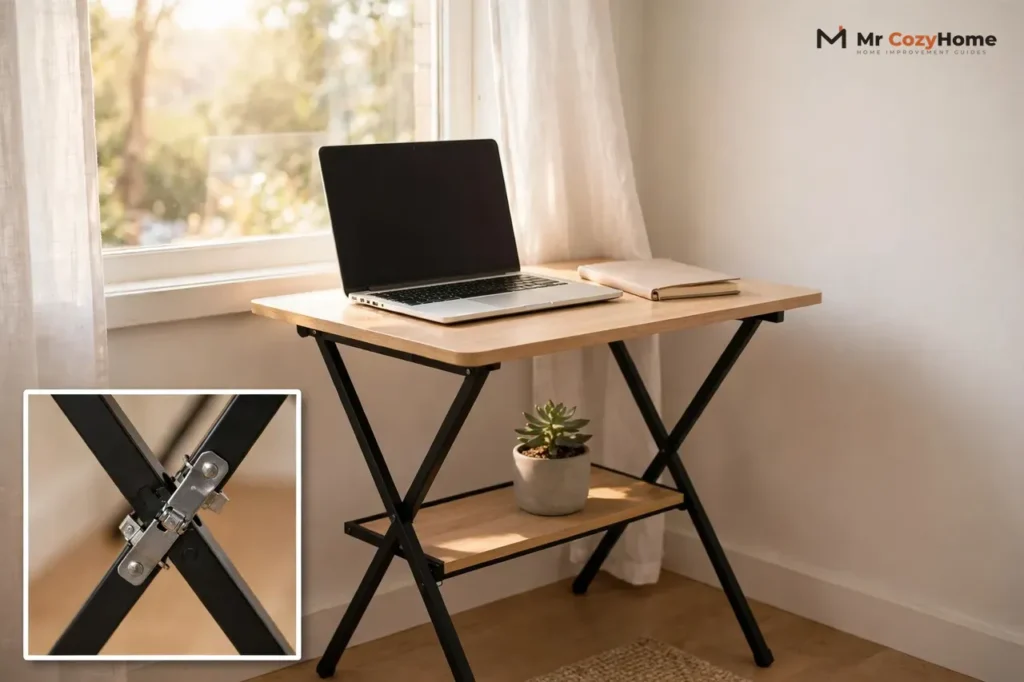
A collapsible desk is a freestanding desk that folds flat for storage — no screws, no wall, no landlord permission — and the best-known folding-leg models collapse to just 1.5 inches thick, thin enough to slide under a bed. The GreenForest folding desk, for example, measures 27.3 inches wide, folds to 1.5 inches, and holds a 4.7-star rating across more than 12,900 reviews, according to an October 2026 apartment-desk roundup.
One desk in this guide holds 200 pounds and another holds only 15 — and the cheap-looking one is not the weak one. Keep reading and you will know which type holds your monitor, which one slides under a bed, and which one to skip on thick carpet.
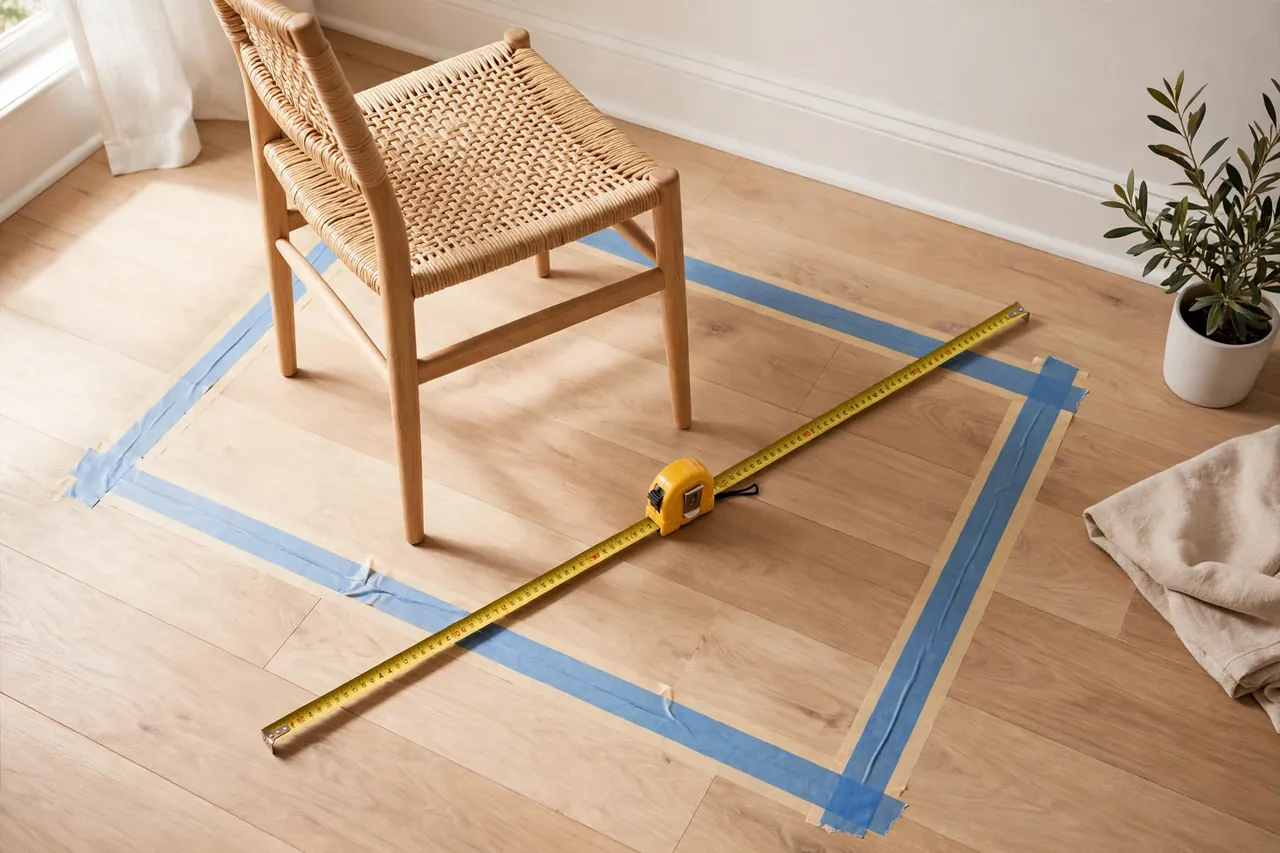
💡 Practical Home Tip: Before you buy, tape the desk’s open footprint on the floor with painter’s tape, put your chair in place, and sit down. If you cannot push the chair back 30 inches or your knees hit the wall, the desk is the wrong size — and tape is cheaper than a return.
What Is a Collapsible Desk?
A collapsible desk is a freestanding desk that folds, drops, or rolls away when you finish working, so a bedroom corner or living-room wall becomes an office only while you need one. Its legs fold under the top, its leaves drop down, or its casters roll it into a closet — and nothing touches your wall.
That last point is the whole idea. A collapsible desk stands on the floor under its own weight, so it works in a rental, a dorm, or any room where drilling is off the table. You unfold it where you want to work, fold it when you finish, and store it behind a door, under a bed, or in a closet.
It is not the same as our guide to a fold up desk, which covers the wall-mounted kind: a board that hinges to the wall and folds flat against it. That desk saves even more floor space, but it hangs its whole load on screws in your wall. This guide covers only the freestanding kind — the desks that need no wall at all — so if you own your walls and want the floor completely free, read that guide next.
Collapsible desks suit three people best: renters who cannot drill, students and movers who carry furniture up stairs, and anyone whose room changes jobs during the day. You give up a little stability and a permanent spot, and you get a desk that disappears on demand.
But “disappears” means different things for different types. A desk that folds to 1.5 inches and one that folds to 3 inches need very different storage spots.
Collapsible Desk vs Fold Up Desk: Which One Fits Your Room?
Pick a collapsible desk when you cannot drill, you move often, or you want to roll the desk away; pick a fold up desk when you need the floor completely free and you own the wall. The collapsible desk stands on its own legs, while the fold up desk hangs from brackets screwed into studs.
| Factor | Collapsible desk (this guide) | Fold up desk (wall-mounted) |
|---|---|---|
| Needs drilling | No — stands on the floor | Yes — brackets into studs |
| Floor space when closed | Still needs a storage spot | Zero — folds flat to the wall |
| Moves between rooms | Yes — carry or roll it | No — fixed to one wall |
| Weight it holds | 15–200 lb, by model | 20–150 lb, by bracket and wall |
| Best for | Renters, movers, shared rooms | Owners, tiny rooms, fixed spots |
| Price from | $75.98 | $109.99 |
Weight is where people misread the comparison. A wall-mounted desk is only as strong as its screws and your wall — a bracket rated for 100 pounds still falls if its screws sit in bare drywall. A collapsible desk is only as strong as its legs and hinges, and the floor does the holding. Neither number on the box tells the whole story.
Read the table as a trade, not a contest. The wall-mounted desk wins on floor space: when it folds up, the floor underneath is empty floor. The collapsible desk wins on freedom: it moves to the living room on a Saturday, to the bedroom on a Monday, and into a moving van without a single hole to patch.
Guess which type fails most often in rentals? It is not the one you think.
The 4 Types of Freestanding Collapsible Desk
The four freestanding types are folding-leg desks, drop-leaf gateleg tables, rolling desks on casters, and compact laptop desks. Folding-leg desks collapse thinnest, gateleg tables grow widest, rolling desks move easiest, and laptop desks fit the tightest corners — and each one suits a different kind of small room.
Folding-Leg Desks
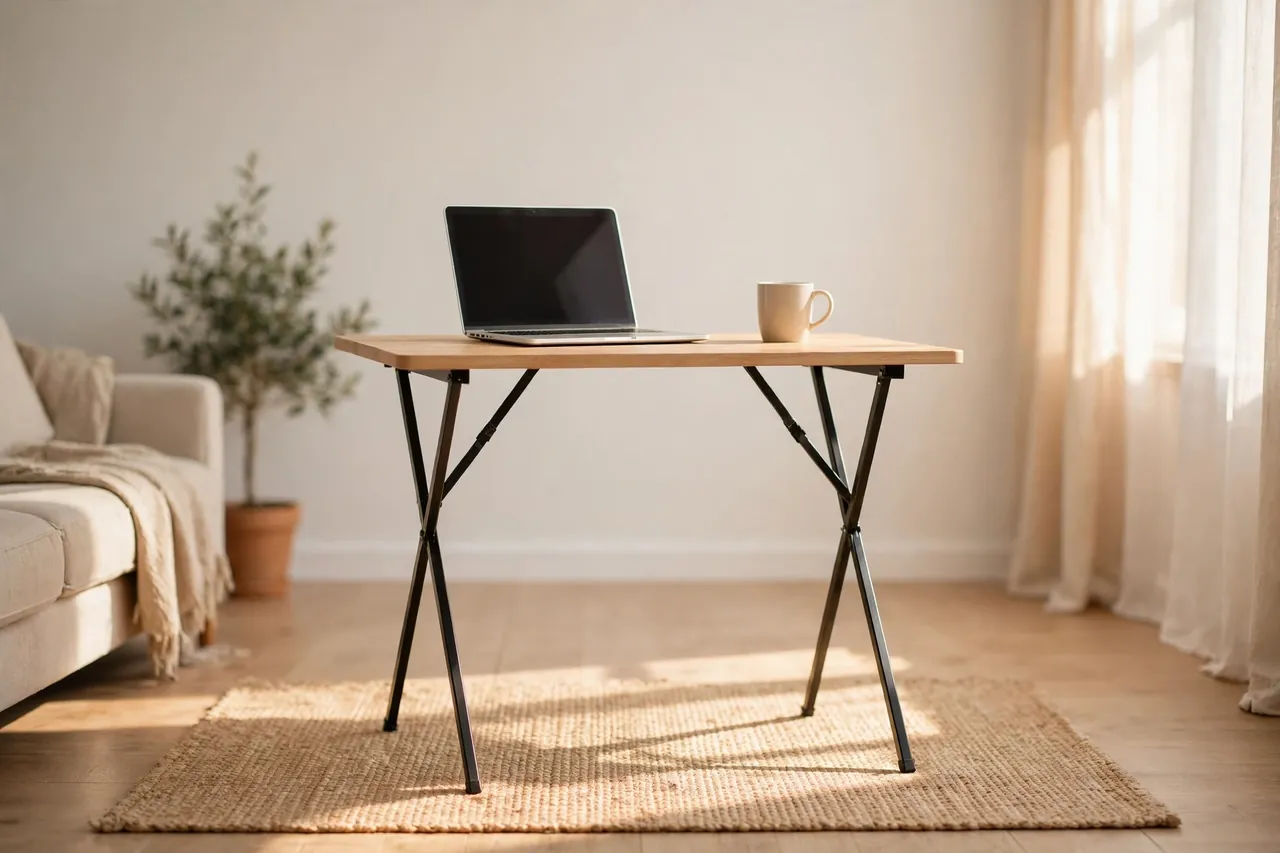
This is the classic collapsible desk: a top with legs that swing flat underneath it. Open it and you have a full desk; fold it and you have a slab about as thick as a laptop. The GreenForest folding desk is the best-known example — 27.3 inches wide, 22 inches deep, no assembly, and it folds flat to 1.5 inches so it slides under a bed or behind a door. Its X-shaped metal legs resist wobble while you type, and a built-in shelf underneath holds books or a plant, according to the October 2026 roundup that rated it 4.7 stars across more than 12,900 reviews.
The TEMI folding desk is the wider cousin: 35.8 inches wide, a 200-pound capacity on an arc-welded steel frame, and it folds to 2.9 inches. That extra width is what separates a laptop perch from a real workspace — you can set a screen on one side and still have writing room on the other. Adjustable feet level it on uneven floors, which matters more than it sounds: a desk that rocks on carpet feels broken even when it is not.
Drop-Leaf and Gateleg Tables
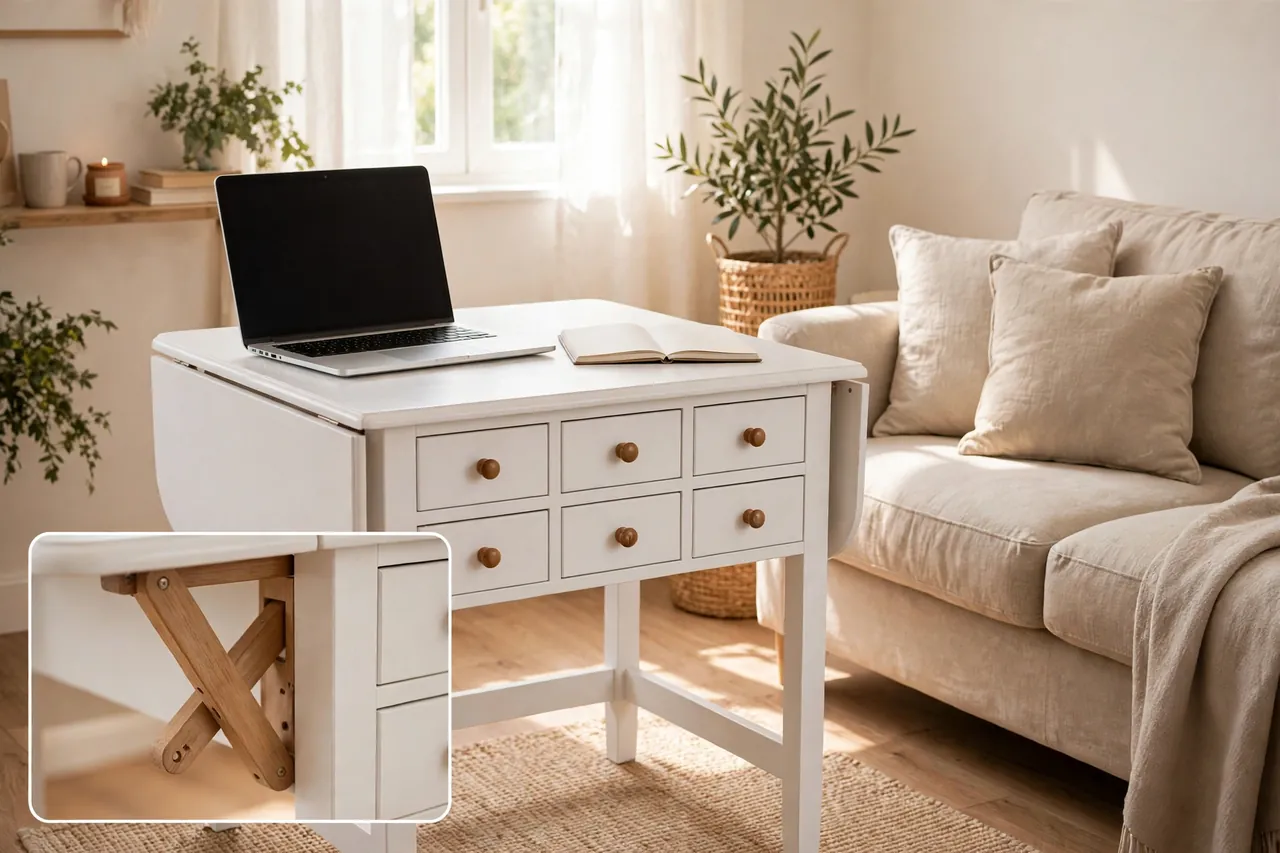
A gateleg table is the oldest collapsible desk of all: a narrow center console with leaves that fold up on each side. With both leaves down it is a slim console about 10 inches wide that hugs the wall; with both up it becomes a full table nearly 60 inches long. The IKEA NORDEN gateleg table works exactly this way — 10 1/4 inches folded, 35 inches with one leaf up, 59 7/8 inches fully open — and it carries six drawers under the top.
The NORDEN costs $359.99 at IKEA US, checked November 11, 2026, which makes it the priciest desk in this guide by a wide margin. What the money buys is width and storage: no folding-leg desk grows to seat four people, and none hides six drawers. What it costs is weight — reviewers note the table weighs a little over 100 pounds, so it stays where you put it.
Rolling Desks on Casters
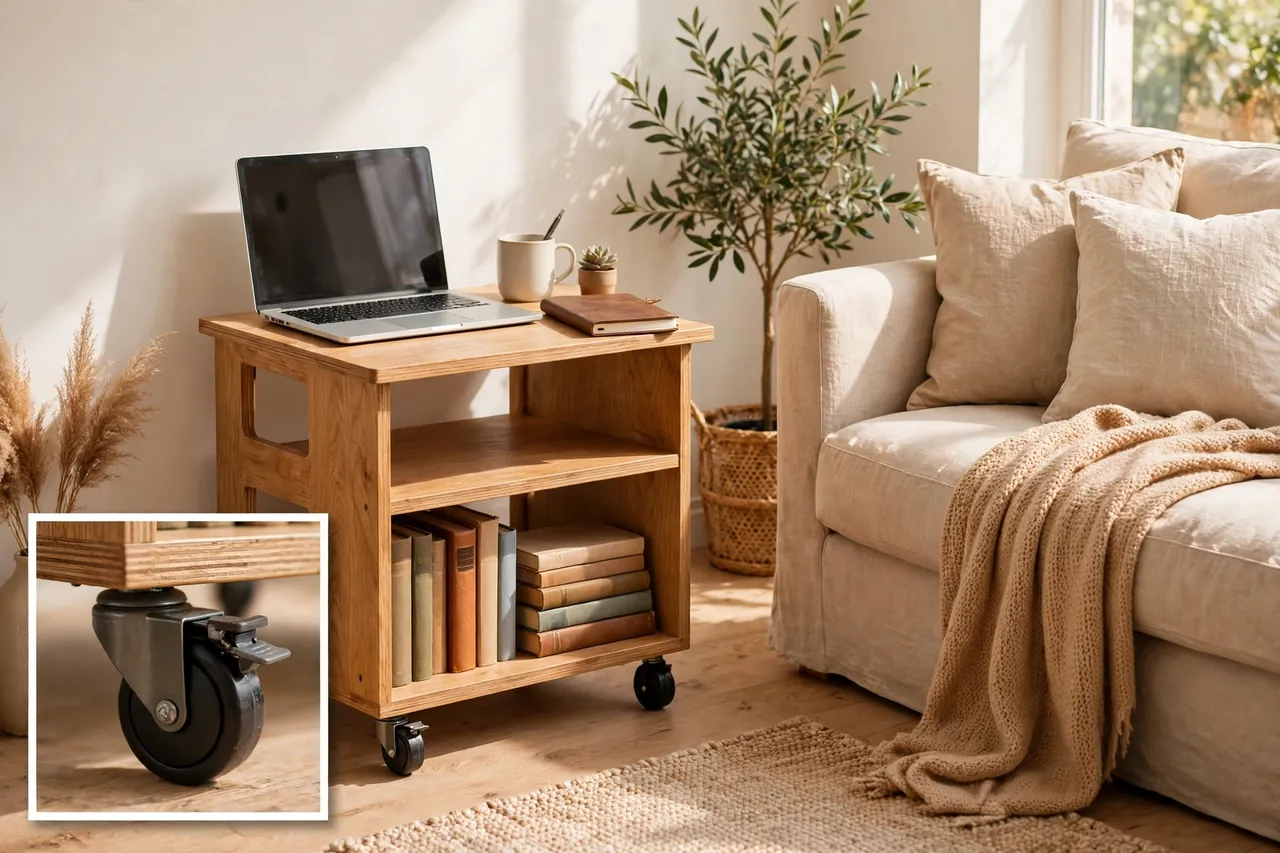
A rolling desk trades folding for wheels: it may fold a little, but its real trick is that you push it where you need it. The GreenForest rolling desk is 24.8 inches wide with six locking casters and an open shelf, so you can roll it to the sofa for an evening session and park it in a corner when you finish. Lock the casters before you type.
Rolling desks hide the widest quality gap in this guide. The QZMDSM rolling desk adjusts from 28 to 35.4 inches high and carries three open shelves, but its maximum load is only 15 pounds — the lowest in the roundup. A laptop and a notebook are fine; a monitor arm is not. Always read the load rating before the price.
Compact Laptop Desks
Compact laptop desks are folding-leg desks shrunk for one job: a laptop, a mouse, and not much else. The VASAGLE folding desk is 31.5 inches wide and folds flat to 2.4 inches, thin enough to store behind a door or under a sofa. The WOHOMO folding desk is the same width, folds to 2.76 inches, and weighs only 14.9 pounds, so you can carry it one-handed up a flight of stairs.
These desks suit bedrooms, dorms, and balconies where even a 27-inch desk crowds the room. The limit is depth: most compact desks run 15 to 16 inches deep, which fits a laptop but leaves no room for a notebook beside it. If you write on paper while you work, step up to a 22-inch-deep folding-leg desk instead.
How Much Does a Collapsible Desk Cost?
A collapsible desk costs from $75.98 to $359.99 for the verified models in this guide, checked November 11, 2026. Folding-leg desks start cheapest, rolling desks sit in the middle, and a solid-wood gateleg table costs the most — and the price gap mostly buys weight, width, and fold thickness.
| Model | Type | Open size | Folds to | Price |
|---|---|---|---|---|
| GreenForest folding desk, black | Folding-leg | 27.3 x 22 in | 1.5 in | $75.98 |
| Katie foldable desk by The Twillery Co. | Folding-leg | 31.5 x 15.7 in | Flat, legs fold | $159.99 |
| GreenForest rolling desk | Rolling | 24.8 x 19.7 in | Rolls away | Check current listing |
| IKEA NORDEN gateleg table, white | Drop-leaf | Up to 59 7/8 x 31 1/2 in | 10 1/4 in wide | $359.99 |
The GreenForest folding desk at $75.98 (black, 22 x 27.3 inches, fulfilled by Amazon) is the budget pick: no assembly, a shelf included, and the thinnest fold in this guide. The Katie foldable desk by The Twillery Co. costs $159.99 on Wayfair US — a 31.5-inch-wide top on a white steel base that folds up for storage, and at 28 pounds it still moves easily between rooms. The IKEA NORDEN gateleg table is the premium pick at $359.99 on IKEA US, in stock at check time, with six drawers.
Two prices were deliberately left out. The Origami folding computer desk (model RDE-01) shows only a $139.99 list price on price trackers, with no current in-stock price verified on the day of checking, so no price is quoted here. The TEMI folding desk’s price also varied by color and seller, so it is listed for its 200-pound capacity and 35.8-inch width only. Check the retailer page on the day you buy.
Price tells you what the desk costs. It never tells you whether the desk will wobble — and that is the question the next section answers.
What Most People Get Wrong About Collapsible Desks
Most people get collapsible desks wrong in one way: they read the weight rating as a promise, then blame the desk when it wobbles. A rating describes the frame standing still on a hard floor, not a desk on thick carpet with a monitor arm clamped to one corner — and carpet, casters, and uneven legs change the real number.
Here is the problem with that number. Manufacturers print a static load capacity — the weight a desk holds while resting still, evenly loaded. The dynamic load, the weight it handles while you type, lean, or set a heavy item down, is far lower: about one quarter of the static rating, according to the EngineerFix guide to choosing a fold-up work table. A desk rated for 200 pounds handles roughly 50 pounds of real working load with a margin. That is still plenty for a laptop, but it is not a license to pile on a monitor arm, a printer, and a stack of books.
The second mistake is blaming the desk for the floor. A folding desk that rocks on carpet usually has one leg sinking into pile, not a bent frame. Adjustable feet fix this in thirty seconds — turn them until all four legs press evenly — yet most owners never touch them.
Now you know what the numbers hide. The next section turns that knowledge into measurements you can take tonight with a tape measure.
How to Pick the Right Size for a Small Room
Pick a collapsible desk 30 to 36 inches wide and at least 20 inches deep for a small room, with 30 to 36 inches of clear space behind the chair so you can push back and stand up. That size holds a laptop, a notebook, and a mug without crowding you, and it still folds away when the day ends.
Depth matters more than width: most apartment desks fail on depth, because a 32-inch-wide desk with only 16 inches of depth leaves nothing to spread a notebook out on. A desk 20 inches deep or more holds a monitor and a keyboard with room to write; 18 inches is writing-only; 16 inches is a laptop perch.
Height is the second measurement. A sitting desk works at 29 to 30 inches — the GreenForest folding desk runs a little tall at 31.9 inches, which some people love as a short standing surface. A rolling desk that adjusts, like the QZMDSM at 28 to 35.4 inches, covers both sitting and short standing sessions.
Measure in this order, and write the numbers down before you shop.
- Measure the wall or corner run where the desk will open, then subtract 2 inches on each side for your elbows and the fold. That is your maximum width.
- Measure from the wall outward until you hit furniture or a walkway. That is your maximum depth — and if it is under 20 inches, plan on a laptop-only desk.
- Measure the storage spot: behind the door, under the bed, or in the closet. Compare it with the folded thickness — 1.5 inches for the GreenForest, 2.4 for the VASAGLE, 2.9 for the TEMI.
- Sit in your chair at the taped outline and push back. You need 30 to 36 inches behind the desk, or you will stand up into a wall every time.
- Check the outlet. A desk that moves needs a cord that reaches, so count the steps from the desk to the nearest socket.
Once the size is set, the desk still needs a home for your gear — a desk without storage ends up buried under it. Our guide to the best storage ideas for small rooms is the single most useful next read, because it shows where everything lives when the desk folds away.
Renters: Set Up a Desk Without Losing Your Deposit
Renters can set up a collapsible desk without losing a deposit because no part of it touches the wall: unfold it, work, fold it, and slide it behind a door. No holes, no anchors, no landlord letter — and when you move, the desk moves with you in one trip down the stairs.
Most leases ban drilling without written permission, and getting that permission in writing before you start avoids an argument at move-out. A folding or rolling desk sidesteps the question entirely, which is why rental guides call it the safest no-drill route for shared walls. If your heart is set on a wall-mounted desk instead, ask your landlord in writing first — some allow small holes if you fill and paint them when you leave. Our fold up desk guide covers that wall-mounted route, including the stud-finding and safety steps, for readers who own their walls.
Moving day is where a collapsible desk pays for itself. A fixed desk needs disassembly, a van, and a second pair of hands; a folding-leg desk folds flat, slides into a car, and opens in the new apartment in under thirty seconds. If your bedroom doubles as your office, our guide to organizing a bedroom so it stays that way shows how to give the desk a permanent home.
The deposit is safe — and the next section shows how to make the desk last.
How to Keep a Collapsible Desk Steady and Make It Last
Keep a collapsible desk steady by locking its legs or casters, leveling its feet, and keeping heavy gear centered over the frame instead of on the front edge. A desk that rocks on carpet usually needs its adjustable feet turned, not a new desk — and that one fix takes thirty seconds.
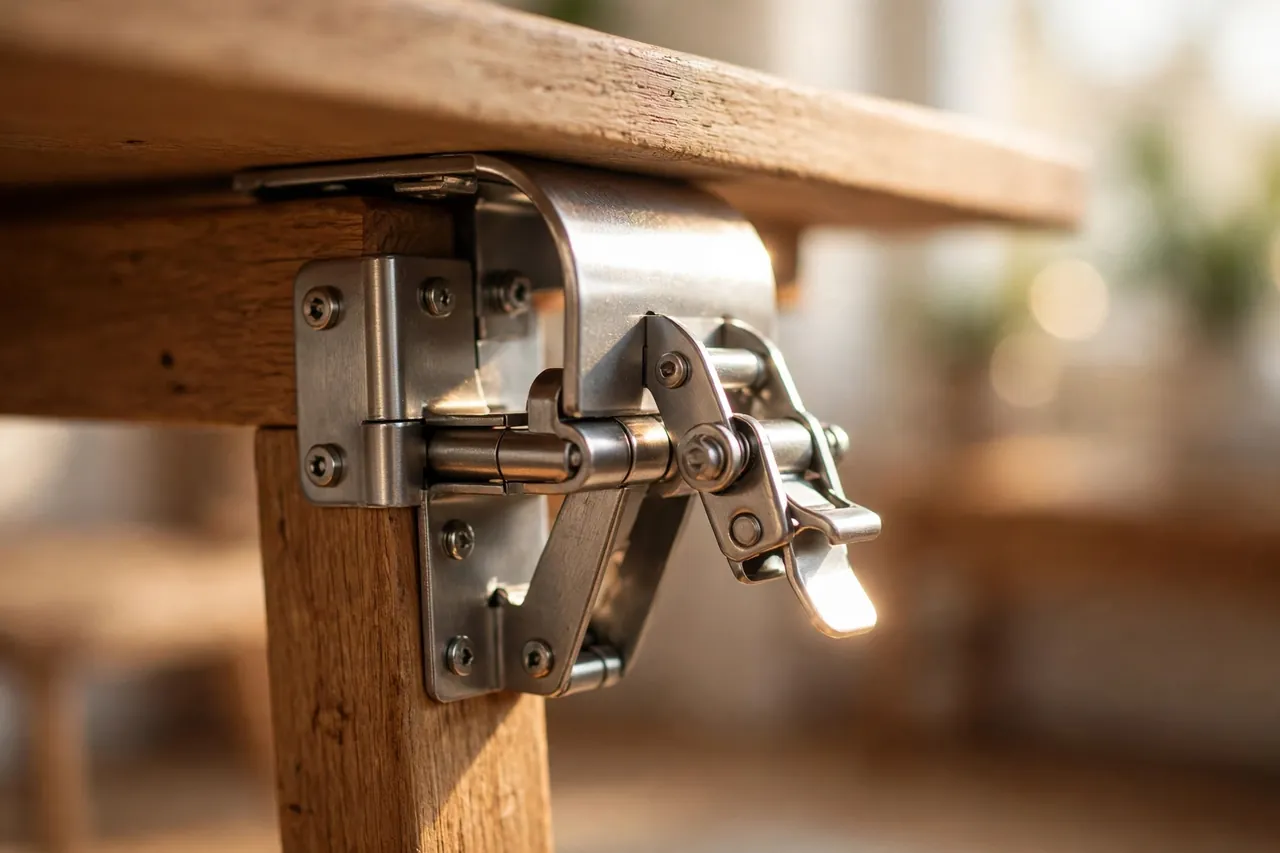
Hinges and folding brackets wear out first, followed by leg locks loosening and casters going stiff. A desk folded twice a day cycles its hinges more than 700 times a year, so cheap stamped-steel hinges loosen and sag long before the desktop fails. Buy for the hinge, not the finish.
Run through this check every few months, and the desk will outlast the lease.
- Lock every caster and leg latch before you sit down, every single time. An unlocked wheel is the most common cause of a “wobbly” desk.
- Turn the adjustable feet until all four legs press evenly, especially after moving the desk to a new spot or a different floor.
- Tighten the hinge and leg screws with a screwdriver. A loose hinge puts sideways force on the frame and shortens its life.
- Keep liquids off engineered-wood tops, which swell when wet. A desk pad costs a few dollars and saves the top.
- Fold the desk away when you finish, so the room gets its floor back and nothing heavy sits on the hinges overnight.
- Keep heavy items centered over the frame, not on the front edge, where leverage is worst.
Daily habits matter as much as build quality. Fold the desk up when you finish, keep the top clear, and store it dry — a damp closet warps an engineered-wood top faster than a year of typing.
Related Guides
These MrCozyHome guides solve the next problems a collapsible desk creates — storage for your gear, a tidy room around it, and the wall-mounted alternative.
- Fold Up Desk: What It Really Does, What It Costs, and How to Mount One Safely — the wall-mounted alternative, for readers who own their walls and want the floor completely free.
- Best Storage Ideas for Small Rooms — where your gear lives when the desk folds away.
- How to Organize a Bedroom So It Stays That Way — a clutter-free home for a bedroom desk.
- Bedroom Shelving Ideas That Add Storage Without Crowding Your Room — shelves that pair with a freestanding desk.
- How to Clean Your Room — a fresh start for the corner your desk will live in.
Frequently Asked Questions
What is the best writing desk for a small apartment?
The best writing desk for a small apartment is the GreenForest folding desk, which measures 27.3 inches wide, includes a built-in shelf, and folds down to 1.5 inches so it slides under a bed or behind a door. It holds a 4.7-star rating across more than 12,900 reviews, and it needs no assembly at all.
What is the most space-efficient desk type?
Wall-mounted fold-down desks are the most space-efficient because they return the entire floor area when closed. Portable folding tables are second, collapsing to between 1.5 and 2.9 inches thick. Drop-leaf and gateleg tables follow, then ladder desks, and finally slim fixed desks that hold their footprint permanently.
What size desk is best for a small room?
A desk between 30 and 36 inches wide suits most small rooms. Thirty inches fits a laptop and notebook, 36 inches adds writing room beside a screen, 40 inches accommodates a monitor plus a workspace, and 48 inches suits dual monitors. Depth matters as much as width: 18 inches is writing-only, while 20 inches or more handles a computer setup.
Where is the best place to put a desk in an apartment?
The best spot is usually a bedroom corner opposite the door, where the chair pulls back into open floor rather than into furniture. Keep 30 to 36 inches of clearance behind the chair, avoid direct window glare on your screen, and in a hallway or foyer use a fold-down desk that leaves the passage clear when closed.
What are collapsible office solutions for alternative living spaces?
Collapsible office solutions are space-saving furniture pieces that fold, slide, or disassemble flat to preserve floor space in compact dwellings. They include wall-mounted drop-leaf desks, folding monitor arms, roll-away nesting chairs, and portable laptop trays — all built to vanish when the workday ends.
Start with the tape test tonight. Mark the desk on your floor, sit in your chair, and see if the size fits your body before it fits your budget. Then buy the desk your room can actually hold, fold it away at the end of the day, and watch a room you thought was too small turn into an office again.


