
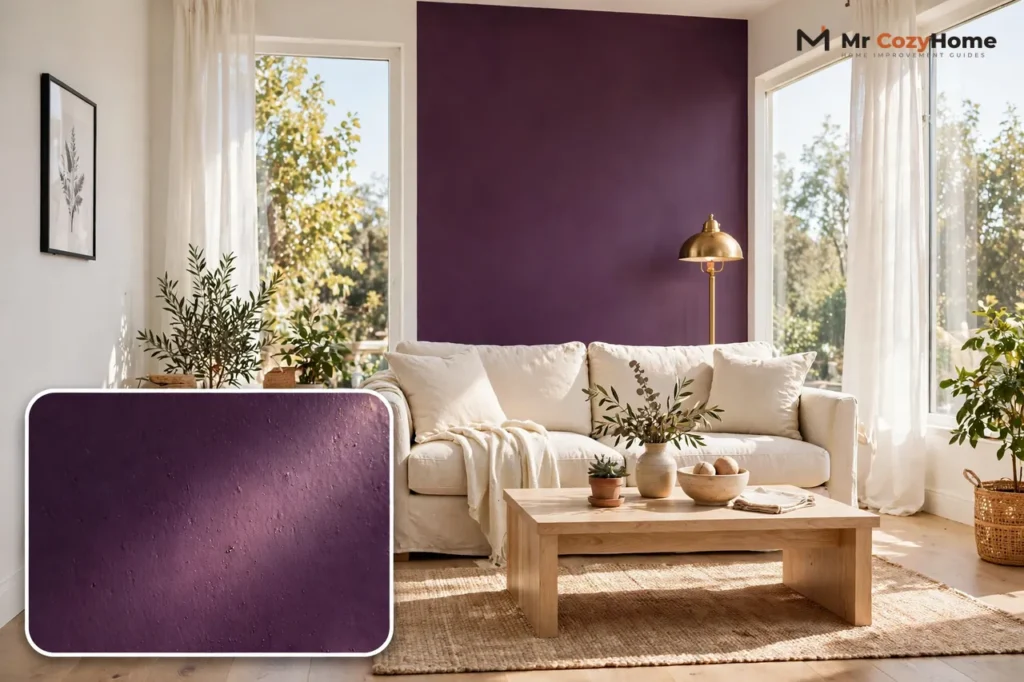
Purple wall paint works when the shade matches the room’s light, not when you fall in love with a tiny chip in the store. Soft lavenders calm a bedroom, deep plums warm a dining room, and Benjamin Moore’s Shadow 2117-30 — a former Colour of the Year — proves a dark purple can feel rich instead of childish. Pick by undertone and light, test a big swatch, and purple stops being a gamble.
The fear is real, and it has a name: the Barney-purple disaster, where a cheerful lilac dries loud, pink, and impossible to live with. It happens when the shade is picked from a chip instead of the wall, so this guide shows the exact shades that work, what they cost, and how to paint them without streaks.
💡 Practical Home Tip: Before you buy a gallon, paint a 12-by-12-inch swatch of each finalist on two different walls and live with them for two full days. Purple shifts more than any other color as the light changes, and a swatch that looks perfect at noon can turn pink or grey by lamplight.
What Purple Wall Paint Really Does to a Room
Purple wall paint changes how a room feels, because it sits between calming blue and warm red. A pale lavender relaxes a bedroom, while a deep plum makes a dining room feel intimate and expensive. The same purple can feel calm in one room and loud in another, so the room decides the shade.
Light is the reason. Purple reflects less light than white or beige, so a dark purple in a dim, north-facing room can feel like a cave, while the same shade glows in a bright, south-facing room. Benjamin Moore lists a number called LRV, or light reflectance value, for every color: 0 is black, 100 is white. Misty Lilac 2071-70 has an LRV of 77.95, so it bounces light around like a near-white; Shadow 2117-30 has an LRV of 9.03, so it swallows light and turns a wall into a backdrop.
That is why purple has a reputation problem. People remember the one purple room that went wrong — too bright, too pink, too dark — and forget the dozens that work. The fix is not to avoid purple; it is to match the depth to the room.
How to Pick the Right Purple Shade
Pick a purple by its undertone first, its depth second, and its name last. Red undertones feel warm and cozy, blue undertones feel cool and calm, and grey undertones feel muted and grown-up. Hold the chip against white paper in daylight, and the undertone shows itself — pink means red, icy means blue, dusty means grey.
Then check the room’s direction, because it decides which undertone works. North-facing rooms get cool, bluish light all day, so they need a warm purple with red or pink undertones, like Spring Iris 1402, to stop the room feeling cold. South-facing rooms get warm, yellow light, so they can carry a cool, blue-based purple like Purple Rain without it turning icy. East-facing rooms are bright in the morning and soft later, so almost any mid-tone purple works; west-facing rooms get harsh evening sun, so a muted purple with grey in it holds up best.
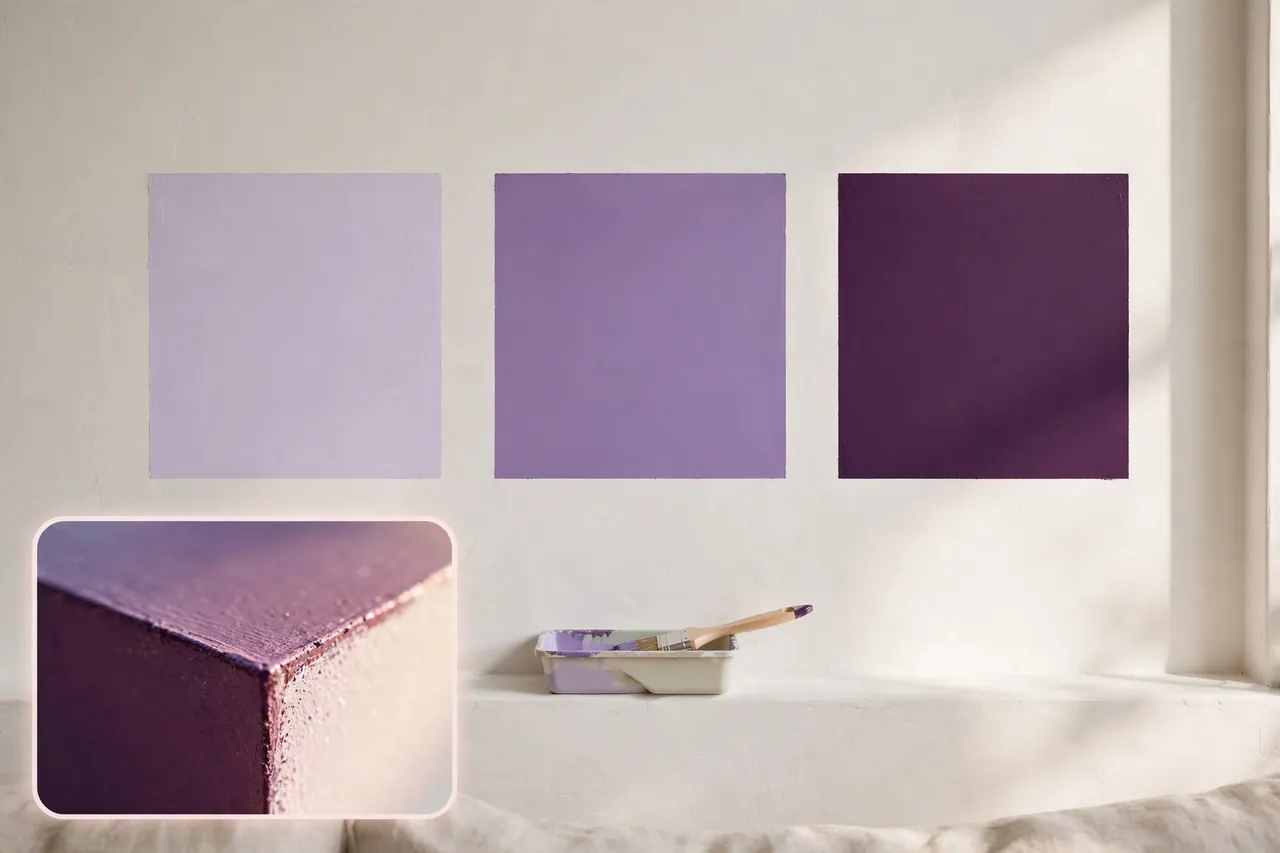
Use the LRV number as your depth check. For a whole room, stay above 60 to keep it bright, between 30 and 60 for a clear but livable color, and below 20 only for an accent wall or a small, moody room.
| LRV range | What it feels like | Best use |
|---|---|---|
| 60–80 | Barely-there, airy, almost neutral | Whole bedroom, bathroom, small room |
| 30–60 | Clearly purple, still bright | Whole living room, home office, nursery |
| 10–30 | Rich, deep, dramatic | Accent wall, dining room, library |
| Below 10 | Near-black, velvety, moody | One feature wall, powder room, media room |
Finally, sample like you mean it. Buy sample pots of your top two or three shades, paint large swatches on different walls, and check them in morning, afternoon, and lamplight. Move a piece of poster board painted with the sample around the room if you do not want paint on the wall yet. Never buy the gallon from the chip alone — the chip is two inches wide, and your wall is not.
The Best Purple Paint Colors by Brand
The best purple paint colors come from the three brands most US painters reach for: Benjamin Moore, Sherwin-Williams, and Behr. Each one has purples worth sampling, and the list below names the shade, the code, and where it works, so you can walk into the store with a short list instead of a guess.
Benjamin Moore’s purples are the most tested of the three, and the Opple House guide to Benjamin Moore purple paints puts 15 of them through real rooms. Misty Lilac 2071-70 (LRV 77.95) is the airy one, best in bedrooms and reading nooks. Lavender Mist 2070-60 (LRV 63.19) is a gentle purple with a hint of grey, best in bathrooms and small bedrooms. French Lilac 1403 (LRV 56.14) is a dusty, timeless mid-tone for dining rooms and studies. At the deep end, Shadow 2117-30 (LRV 9.03) is the smoky eggplant that was Benjamin Moore’s Colour of the Year, and Vintage Wine 2116-20 (LRV 8.2) is a muted plum with brown undertones.
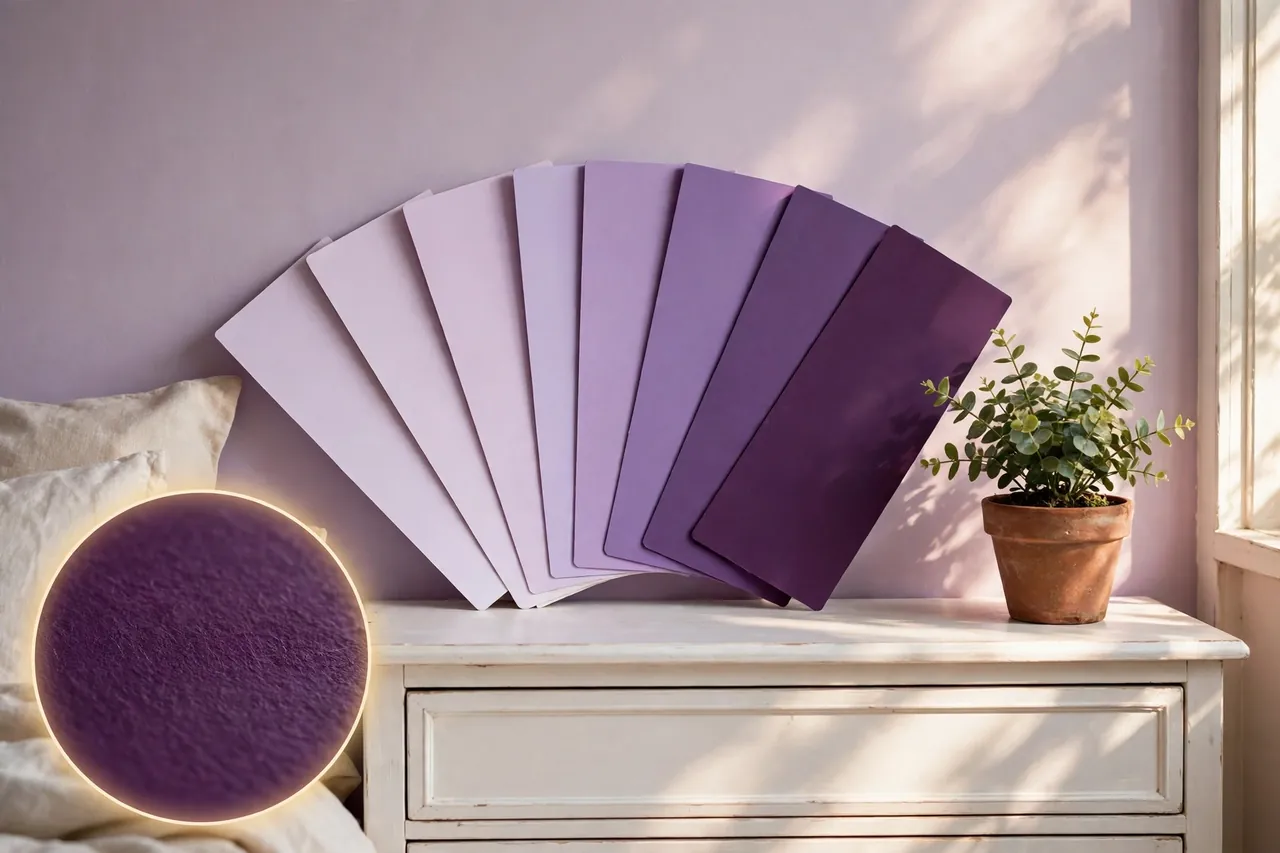
Sherwin-Williams has 64 purples in its deck, and its popular-purples list narrows it fast. Lite Lavender SW 6554 is the barely-there shade for nurseries and elegant living rooms. Wisteria SW 6822 is a brighter lilac for a calm bedroom retreat. Euphoric Lilac SW 6835 (LRV 61) is a soft, warm pastel violet that leans pink, and Novel Lilac SW 6836 (LRV 42) is the classic mid-tone lilac that reads as real purple without going dark. For drama, Expressive Plum SW 6271 is a dark wine purple for a grown-up bedroom or dining room, and Brave Purple SW 6823 (LRV 29) is a deep jewel tone best on an accent wall. Sherwin-Williams’ purple paint colours page shows the full range, light to dark, with LRV values for every shade.
Behr, sold at Home Depot, is the budget-friendly third option, and its purples lean bolder. Twinberry MQ1-14 is a rich jewel tone that turns a living or dining room into a statement, and Foxglove is the softer lilac in the same family. Behr’s Marquee line carries a one-coat-hide promise, which matters with purple, because dark purples usually need two coats to cover evenly — a one-coat claim that holds up saves a whole extra day of painting.
Do not mix brands on the same wall. Each brand mixes its purples from its own base and pigment system, so a Benjamin Moore lavender and a Sherwin-Williams lavender with the same name will dry differently. Pick one brand, buy all your gallons from it, and keep the leftover paint for touch-ups.
Purple Wall Paint by Room
Purple wall paint earns its place room by room, because each room asks for a different mood. The bedroom wants calm, the living room wants warmth, the dining room wants drama, and the bathroom wants a spa feeling. Match the shade to the job, and the color stops fighting the room.
In the bedroom, go pale and warm. Misty Lilac, Lavender Mist, or Sherwin-Williams Lite Lavender turn a bedroom into a restful retreat, especially with white bedding and light wood. A deep purple behind the bed as a single accent wall works too, but keep the other three walls pale so the room still feels like a place to sleep. Once the walls are done, our guide to how to organize your bedroom helps you set the room up around the new color, and bedroom shelving ideas show where shelves sit best against a purple wall.
In the living room, use a mid-tone purple on one wall and neutrals everywhere else. French Lilac or Wild Orchid 2072-40 (LRV 25.18) behind the sofa anchors the seating area without darkening the whole room, and it pairs well with cream sofas, brass lamps, and warm wood. If the sofa faces the fireplace, a plum accent wall makes the hearth the second focal point instead of competing with it — our fireplace renovation ideas show how to balance the two. Finish the room with a rug that picks up the wall color; our Tumble Rugs vs Ruggable comparison covers the washable rugs that survive a living room.
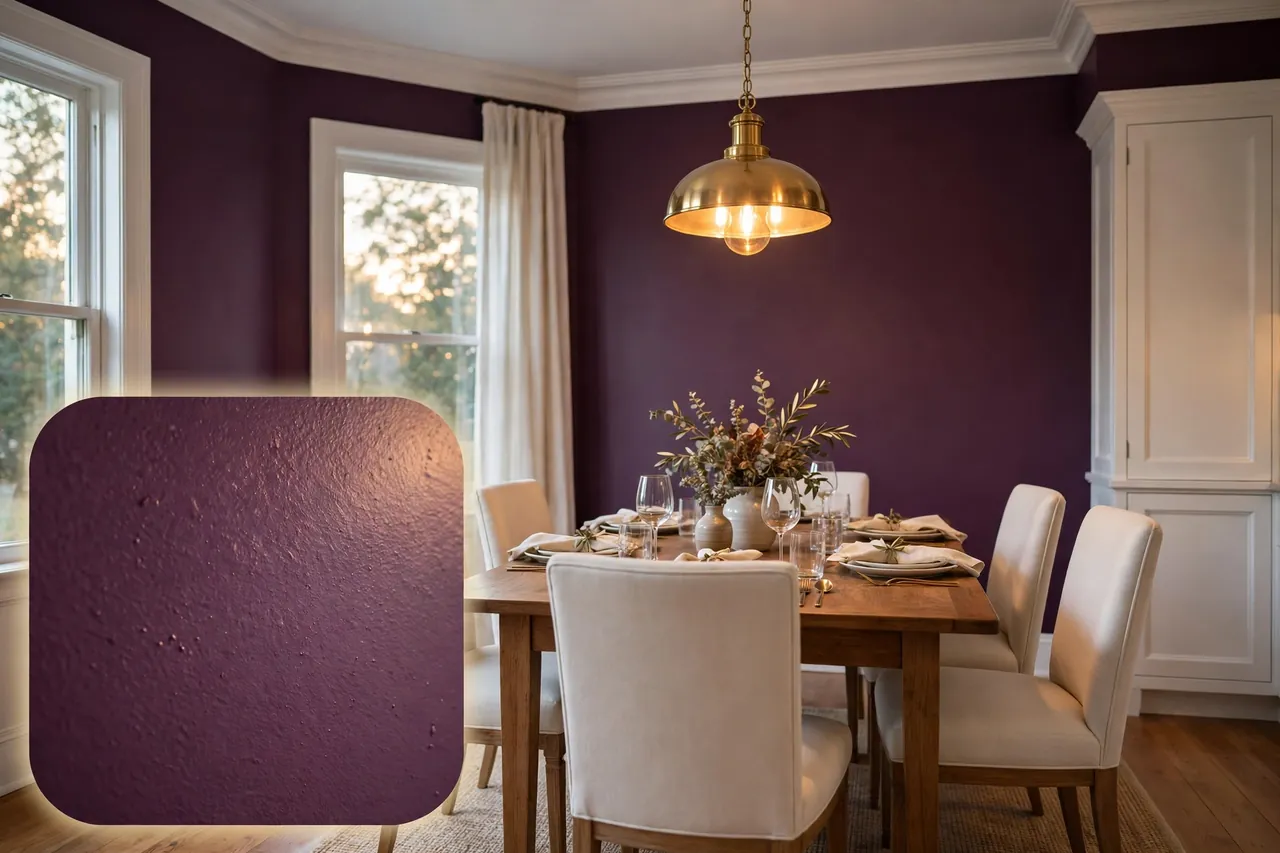
In the dining room, go bold. Vintage Wine, Expressive Plum, or Passion Plum 2073-30 (LRV 11.83) make evening meals feel special, and dark purple looks better under warm lamplight than almost any other color. Paint all four walls if the room has a window; if it is windowless, paint three walls pale and let the plum own the fourth.
In the bathroom and powder room, pale purple is a quiet win. Lavender Mist or Touch of Gray 2116-60 (LRV 68.78) feel clean and spa-like next to white tile and chrome, and a powder room is the safest place to try a bold purple like Exotic Purple 2071-10 (LRV 5.46) — the room is small, the visit is short, and the drama is the point. Use a satin or semi-gloss sheen here, because bathroom walls must survive steam and splashes.
Kids’ rooms and home offices take the bright purples adults avoid. Purple Lotus 2072-30 (LRV 10.25) sparks energy in a creative space, and a soft lilac keeps a nursery calm without going pink. In a home office, a mid-tone purple behind the desk reads as confident on video calls.
Small rooms deserve a special note. A light purple with blue undertones can make a small room feel larger, because cool colors visually push walls back — but only with decent natural light. In a dark, windowless room the trick fails, and a pale warm purple is the safer pick. Our guide to best storage ideas for small rooms helps you plan what else the room must hold once the color is on the walls.
What Does Purple Wall Paint Cost?
Purple wall paint costs the same as any other color in the same paint line, so the bill depends on the brand and line you pick. A standard 12-by-12-foot bedroom has about 380 square feet of wall, which takes roughly two gallons for two coats, so most single rooms land between $115 and $215 in paint alone.
Behr Marquee, the one-coat line at Home Depot, costs $56.98 per gallon in eggshell, checked on homedepot.com on November 12, 2026, with satin at $59.98 per gallon. Sherwin-Williams Emerald Interior, the premium line, listed at $101.49 to $106.49 per gallon on sherwin-williams.com when checked October 1, 2026, before the brand’s frequent 30 to 40 percent off sales, which can drop it to roughly $66 to $69 per gallon. Benjamin Moore Regal Select listed at $71.99 per gallon in flat and $80.99 in other sheens at Aboff’s Paints, an authorized dealer, when checked September 2026. All three are US list prices before tax, and Sherwin-Williams prices vary by store.
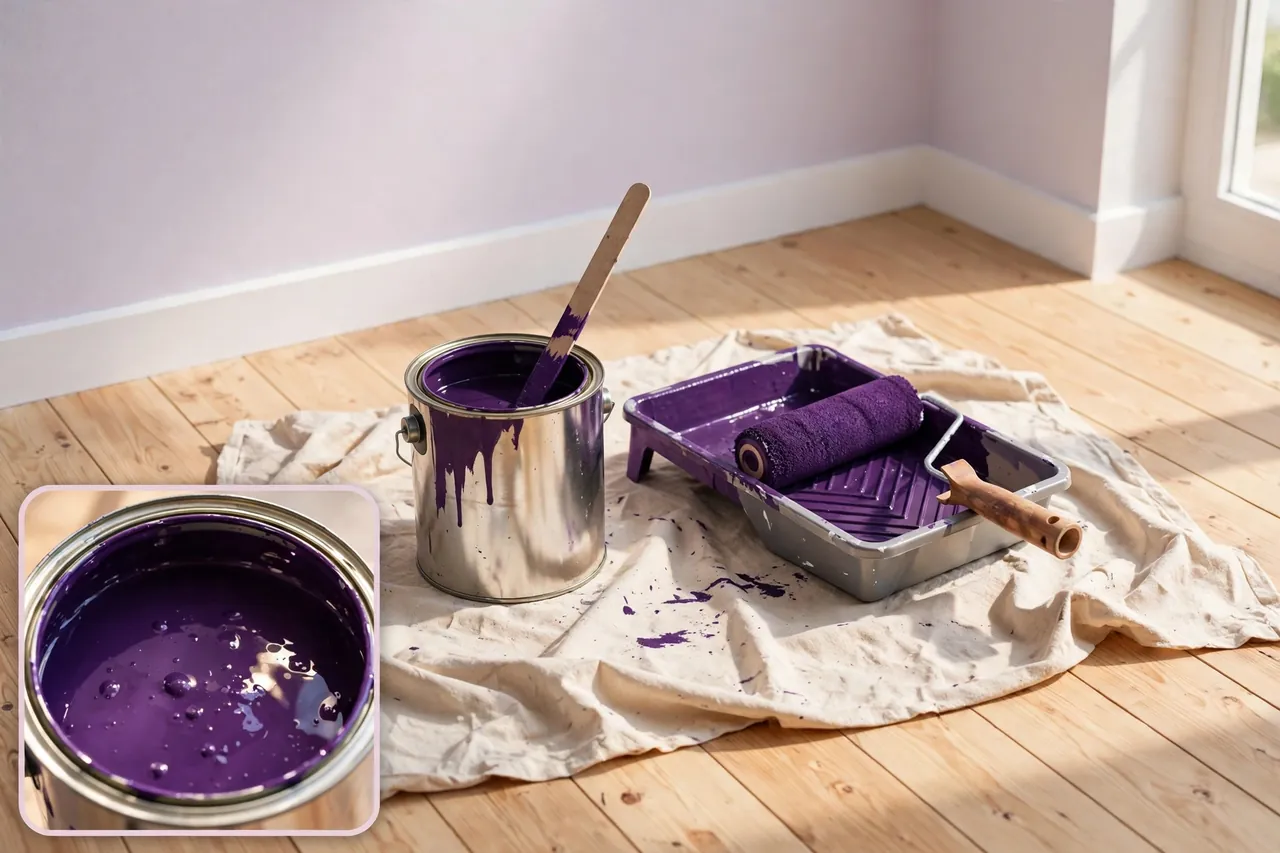
| Paint line | Price per gallon | Coverage per gallon |
|---|---|---|
| Behr Marquee (eggshell) | $56.98 | One-coat hide, up to 400 sq ft |
| Behr Marquee (satin) | $59.98 | One-coat hide, up to 400 sq ft |
| Sherwin-Williams Emerald Interior | $101.49–$106.49 list | 350–400 sq ft |
| Benjamin Moore Regal Select | $71.99 flat; $80.99 other sheens | 350–400 sq ft |
Budget for the extras, because paint is only part of the job. A gallon of primer runs about $25 to $35, a roller kit about $20, painter’s tape about $8 a roll, and sample pots about $5 to $7 each. Dark purples over a light wall almost always need a tinted primer — ask the store to tint it grey, not white — or the old color will ghost through and force a third coat.
The cheapest way to buy premium paint is to wait for a sale. Sherwin-Williams runs 30 to 40 percent off events roughly every four to six weeks, around Memorial Day, July 4th, Labor Day, and Black Friday, and Emerald during one of those sales costs less than Regal Select at full price. Benjamin Moore rarely runs public sales, so Marquee at $56.98 is the value pick for a single room, and Emerald on sale is the value pick for a whole house.
How to Paint a Purple Wall Without Streaks
Paint a purple wall without streaks by prepping the wall, tinting the primer, and rolling in a steady W pattern with two full coats. Purple is one of the hardest colors to paint evenly, because its pigments are strong and every thin spot shows as a lighter patch, so the prep matters more than the brand.
Start by cleaning the walls. Wash them with warm water and a little dish soap, rinse, and let them dry fully — dust and grease stop paint sticking, and purple shows every missed spot. Our deep cleaning house checklist walks through a whole-room clean before you start. Fill nail holes with spackle, sand them smooth when dry, and wipe the dust off with a damp cloth.
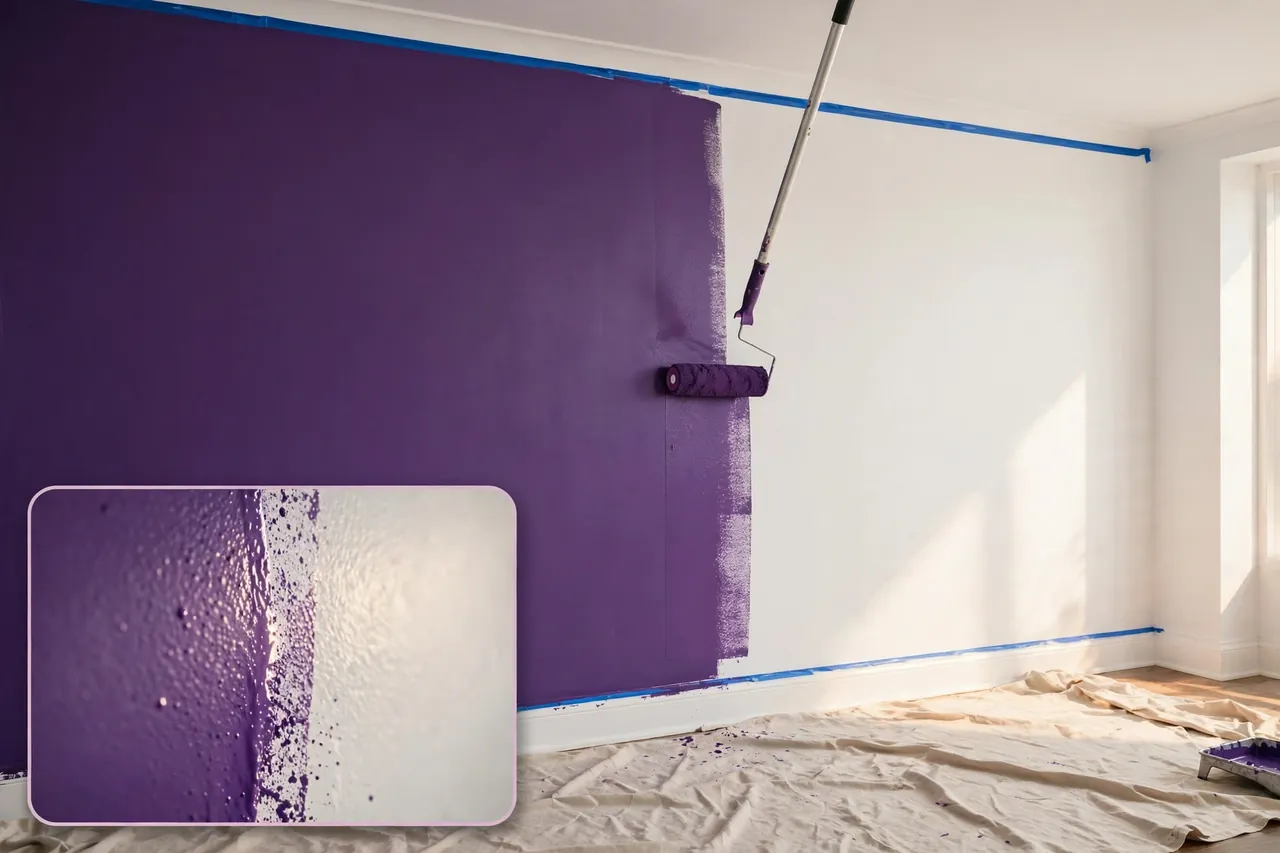
Prime with a tinted primer. Ask the paint store to tint the primer grey for a dark purple, or to a pale lavender for a light one; a white primer under a dark purple forces an extra coat. One coat of primer is enough on a previously painted wall in good shape, but new drywall or a patched wall needs two.
Cut in the edges first with a 2-inch angled brush, then roll the wall while the cut-in edge is still wet, so the two blend instead of leaving a picture-frame line. Roll in a W pattern, about 3 feet wide at a time, and keep a wet edge — never let one section dry before the next starts, or you will see lap marks. Use a 3/8-inch nap roller for smooth walls and a 1/2-inch nap for lightly textured walls.
Let the first coat dry fully — usually 2 to 4 hours — then roll the second coat the same way. Two coats are the rule for purple, even with a one-coat-hide paint, because the second coat evens the color and kills the streaks the first coat leaves behind. Check the wall from the side with a work light before you call it done; raking light shows thin spots your eyes miss head-on.
Pick the right sheen while you are at it. Flat hides wall flaws but marks easily, eggshell is the sweet spot for bedrooms and living rooms, satin survives kitchens and bathrooms, and semi-gloss belongs on trim, not walls. Dark purples look richer in eggshell or satin, because flat dark paint can look chalky under bright light.
What Colors Go With Purple Walls?
White trim is the safest partner for purple walls, and Benjamin Moore’s White Dove OC-17 is the trim color most designers reach for — its soft warmth suits light and dark purples without looking stark. Bright white works too, but it draws a hard line that can make a deep purple feel louder.
For furniture and accents, follow the undertone. Warm purples with red in them pair with gold, brass, warm wood, and cream fabrics. Cool purples with blue in them pair with silver, chrome, black, and cool greys. Soft greens like Pale Smoke 2106-60, warm beiges like Manchester Tan HC-81, and light blues like Breath of Fresh Air 806 all sit comfortably next to most purples, which is why they show up in nearly every purple room that works.
Metals do the heavy lifting. Gold and brass hardware warms a plum dining room, chrome and nickel cool a lavender bathroom, and matte black accents ground a purple living room so it reads as grown-up rather than sweet. Avoid bright yellow or orange in large doses — the contrast fights the wall instead of supporting it.
Purple Wall Paint Mistakes to Avoid
The biggest purple wall paint mistake is skipping the sample and buying the gallon from the chip. The chip lies: it is small, it is printed, and it sits under store lights, not your room’s light. A $6 sample pot and two days of looking beats a $60 gallon and a weekend of repainting, every single time.
The second mistake is painting all four walls dark in a room with no light. A deep purple needs a big window or warm lamps to come alive; in a dim room it turns muddy and shrinks the space. If the room is dark, paint one wall deep purple and keep the rest pale — you get the drama without the cave.
The third mistake is the wrong sheen in the wrong room. Flat paint in a bathroom peels and stains, and semi-gloss on a bumpy living room wall shows every dent. Match the sheen to the room’s abuse: satin for wet rooms, eggshell for living spaces, flat only where hands never touch the wall.
The fourth mistake is forgetting the ceiling. A white ceiling over dark purple walls looks fine, but a pale lavender ceiling — the same purple mixed 50 percent lighter — makes the room feel finished instead of boxed in. It costs one extra quart.
The last mistake is rushing the second coat. Purple’s strong pigments need the full dry time between coats, and rolling the second coat onto a tacky first coat pulls the paint off in patches. Wait the full 2 to 4 hours the can asks for, even when the wall looks dry after one.
A short safety note before you start: interior latex paint gives off fumes while it dries, so open windows and run a fan, and keep the room ventilated until the smell is gone. Work from a steady step ladder, never a chair, and keep paint and tools away from small children and pets until the walls are dry.
Related Guides
Paint is only the first step in the room. Plan the rest with our best storage ideas for small rooms if the room is tight, our how to organize your bedroom and bedroom shelving ideas if the purple went in a bedroom, and our Tumble Rugs vs Ruggable comparison for the rug that ties the new walls together. Clean first with our deep cleaning house checklist, and if the wall faces the hearth, our fireplace renovation ideas help the purple and the fireplace share the room.
Frequently Asked Questions
Can purple paint make small rooms look bigger?
Yes, light purples with blue undertones can make a small room feel larger, because cool colors visually push the walls back. Use shades like Misty Lilac or Dreamy Cloud in a small room with plenty of natural light. In a dark, windowless room the trick fails, so pick a pale warm purple instead.
How do I choose between warm and cool purple tones?
Look at your furniture and the direction your room faces. North-facing rooms benefit from warm purples like Spring Iris, while south-facing rooms can handle cooler purples like Purple Rain. Match the undertone to the light, and check a large swatch at different times of day before you commit.
Will purple walls make my room too feminine?
Not at all. Deeper purples like Shadow or Vintage Wine have a masculine edge that works in any space. Pair them with leather, metal, or dark wood for a more gender-neutral look, and keep the trim soft white instead of bright white to avoid a sweet, sugary feeling.
What white trim color works best with purple walls?
Benjamin Moore’s White Dove (OC-17) is the go-to trim color for most purples. Its soft warmth complements both light and dark purple tones without looking stark, and it keeps the contrast gentle. Bright white trim works too, but it draws a harder line against deep purples.
How can I test purple paint without painting the entire walls?
Paint large poster boards with your samples and move them around the room at different times of day. This shows you how the color looks in morning light, afternoon light, and lamplight without committing to walls. Test at least two shades side by side so the undertone difference is obvious.
Start with a sample pot, not a gallon. Paint two big swatches, watch them for two days, and let the room’s light pick the shade — then buy the paint, prime with a tint, and roll two full coats.


