
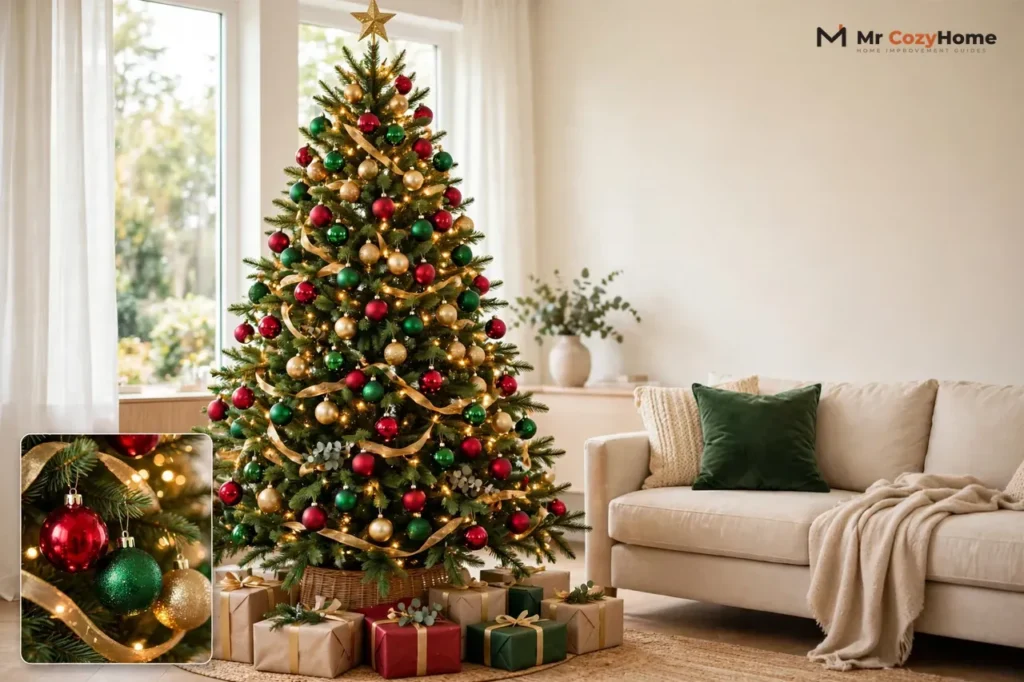
Colourful Christmas tree decorations look best when you pick two or three main colours and one metal, then repeat those colours all over the tree instead of scattering every colour you own. Start with lights, hang your largest ornaments deep in the branches, and place each colour in a loose triangle: one high, one in the middle on the other side, and one low. That simple pattern turns a busy tree into a tree that looks planned, and it works whether you love bold rainbow colour or a calmer, restrained palette.
In this guide, you will choose a scheme that suits your room, learn how to place ornaments by colour so no side looks heavy, and fix the mistakes that make a bright tree look messy. You do not need new ornaments to get a better result. You mostly need a plan, a little editing, and a final step back to check your work.
Start With a Colour Scheme, Not a Box of Ornaments
Most trees look chaotic for one reason: every ornament in the house ends up on the branches. A colour scheme stops that. It gives you a rule for what goes on the tree and what stays in the box this year, and that rule makes every later choice easier.
Pick your scheme before you open a single box. Hold a few ornaments against your sofa, your rug, and your wall colour in daylight. If they fight with the room, they will fight with the tree too. The tree does not live alone, so its colours should get along with the room around it.
Use the 60-30-10 Rule for Tree Colour
Designers often use a simple ratio to keep colour balanced: about 60 percent of your ornaments in your main colour, about 30 percent in a second colour, and about 10 percent in an accent or metal. Wayfair’s guide to colorful Christmas tree ideas shows the same thinking in practice, with most of its schemes built on two or three colours plus a metallic touch.
Try it with real numbers. If you hang 60 ornaments, aim for roughly 36 in your main colour, 18 in your second colour, and 6 in your accent metal. You do not need to count each one. Just sort your ornaments into piles first, and let the biggest pile set the look.
The metal matters more than people think. Gold warms up red, pink, and jewel tones. Silver cools down blue, white, and purple. Pick one metal as your main accent, and let the other one appear only in tiny touches, or the tree starts to look split in two.
Let Your Room Pick the Palette
Look at the largest colour in the room first. A red sofa, a navy accent wall, or warm wood floors already set the tone, so your tree should echo one of those colours rather than compete with it. A tree that repeats a colour from the room feels like it belongs there.
Neutral rooms give you the most freedom. White, beige, and gray walls can carry bold brights, deep jewel tones, or soft pastels without a fight. Strong rooms need more care: if your room already has a loud pattern or a bold wall colour, choose a calmer tree palette and let one bright accent do the talking.
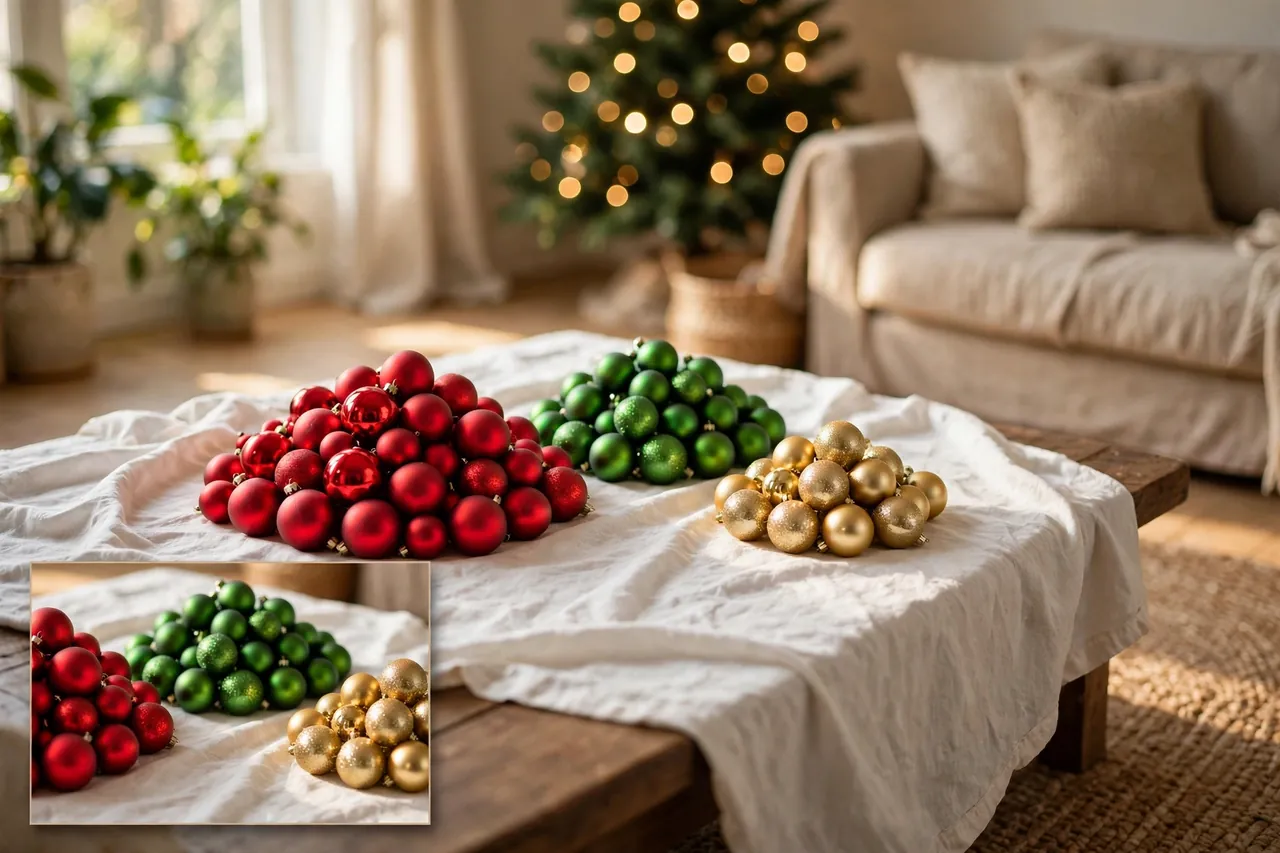
💡 Practical Home Tip: Before you buy anything new, lay your ornaments on a white sheet in daylight and sort them by colour. You will often find you already own a full scheme hiding inside a mixed box, and the sheet shows you exactly which colour you are short of.
7 Colourful Christmas Tree Schemes That Always Work
These seven schemes cover the range most homes need, from classic to playful. Each one names the colours, the metal that ties it together, and the room where it shines. Use one as written, or swap a single colour to make it yours.
Classic red, green, and gold never fails, because it matches the tree itself and reads as Christmas from across the room. Jewel tones feel richer and more grown-up, while candy pastels suit bright, modern rooms and homes with kids. Coastal blues calm a busy room down, and a full rainbow tree turns a white or flocked tree into a party.
Colour schemes at a glance
| Scheme | Main colours | Best metal | Best room |
|---|---|---|---|
| Classic Christmas | Red, green | Gold | Warm living rooms |
| Jewel tones | Purple, blue, magenta | Silver or gold | Formal living rooms |
| Candy pastels | Pink, pale blue, soft yellow | Silver | Bright, modern rooms |
| Coastal blues | Teal, navy, aqua | Silver | Light, airy rooms |
| Red and pink | Red, pink | Gold | Cozy family rooms |
| Rainbow brights | Red, orange, yellow, green, blue, purple | Gold | Playrooms, kids’ rooms |
| Mixed metallics | Gold, silver, champagne | Both, used evenly | Neutral, elegant rooms |
Notice how each scheme stays tight. Even the rainbow tree works because it follows an order, with colours grouped or repeated in a pattern, not thrown on at random. Colored Christmas tree decorations look joyful when they follow a pattern, and they look messy when they do not. That difference is the whole secret.
If you love a scheme but own the wrong shades, do not rush to replace everything. Mix finishes instead of buying new colours: matte, shiny, and glitter versions of the same colour add depth without adding a new hue. The English Home’s guide to choosing a Christmas tree colour scheme makes the same point, noting how tonal reds and mixed finishes give a single-colour scheme a whole new dimension.
Bright vs Restrained: How Much Colour Is Too Much?
Bright and restrained trees both work, but they work in different rooms. A bright tree needs space around it. A restrained tree needs texture to stay interesting. The mistake is putting a loud tree in a loud room, or a flat tree in a plain room, and wondering why neither looks right.
Go bright when the room is simple and the tree is the star. White walls, plain furniture, and a tree that everyone sees from the door can carry rainbow brights, candy colours, or bold red and blue. Keep the rest of the room calm, and let the tree do the shouting.
Go restrained when the room already has a lot going on. Choose two colours instead of five, lean on one metal, and add interest through texture: velvet baubles, wooden ornaments, frosted glass, and ribbon. A restrained tree still counts as colorful Christmas tree decor, because depth and shine read as colour even when the palette stays small.
Ask yourself one question before you decide: do you want guests to notice the tree first, or the room first? If the answer is the tree, go bright. If the answer is the room, go restrained and let the tree blend in. Either answer is right, as long as you choose it on purpose.
How to Place Ornaments by Colour, Step by Step
Placement matters as much as palette. The same ornaments can look calm or chaotic depending on where each colour lands. Follow this order, and step back often to check your work from across the room.
Before you plug in any lights, check every string for worn cords, loose bulbs, or broken plugs, and throw out any damaged string instead of using it. Never use lit candles on a tree, and keep the tree away from fireplaces, radiators, and heat vents while you work.
- String the lights first, working from the top down and weaving them inside the branches, not just around the outside. Lights set the glow that every colour will sit in.
- Hang your largest ornaments next, deep inside the branches near the trunk. Place each colour in a loose triangle: one high, one at mid-height on the opposite side, and one low.
- Add your medium ornaments in the middle of the branches, filling the gaps between the large ones. Repeat each colour in threes or fives, since odd groups look more natural than even rows.
- Place small and special ornaments on the outer branch tips where guests can see them, especially at eye level. Keep treasured pieces out of reach of small hands and pets if they are fragile.
- Weave ribbon or garland through the tree after the ornaments, not before, so it ties the colours together instead of hiding them. Our guide to hanging garland on a Christmas tree walks through the spiral and zigzag methods step by step.
- Add the topper last, and pick one that matches your metal: a gold star for a gold tree, a silver star for a silver tree. A topper in a clashing colour undoes the whole scheme.
- Step back at least 8 to 10 feet, squint slightly, and look for heavy patches, bare patches, and colours that bunch on one side. Move a few ornaments, not dozens, and check again.
Work around the tree as you go, not just from the front. A tree that looks perfect from the sofa and bare from the doorway will disappoint someone. Turn it a quarter turn after each round, or walk around it, and fill the side you keep forgetting.
Match the Colour to the Room and the Light
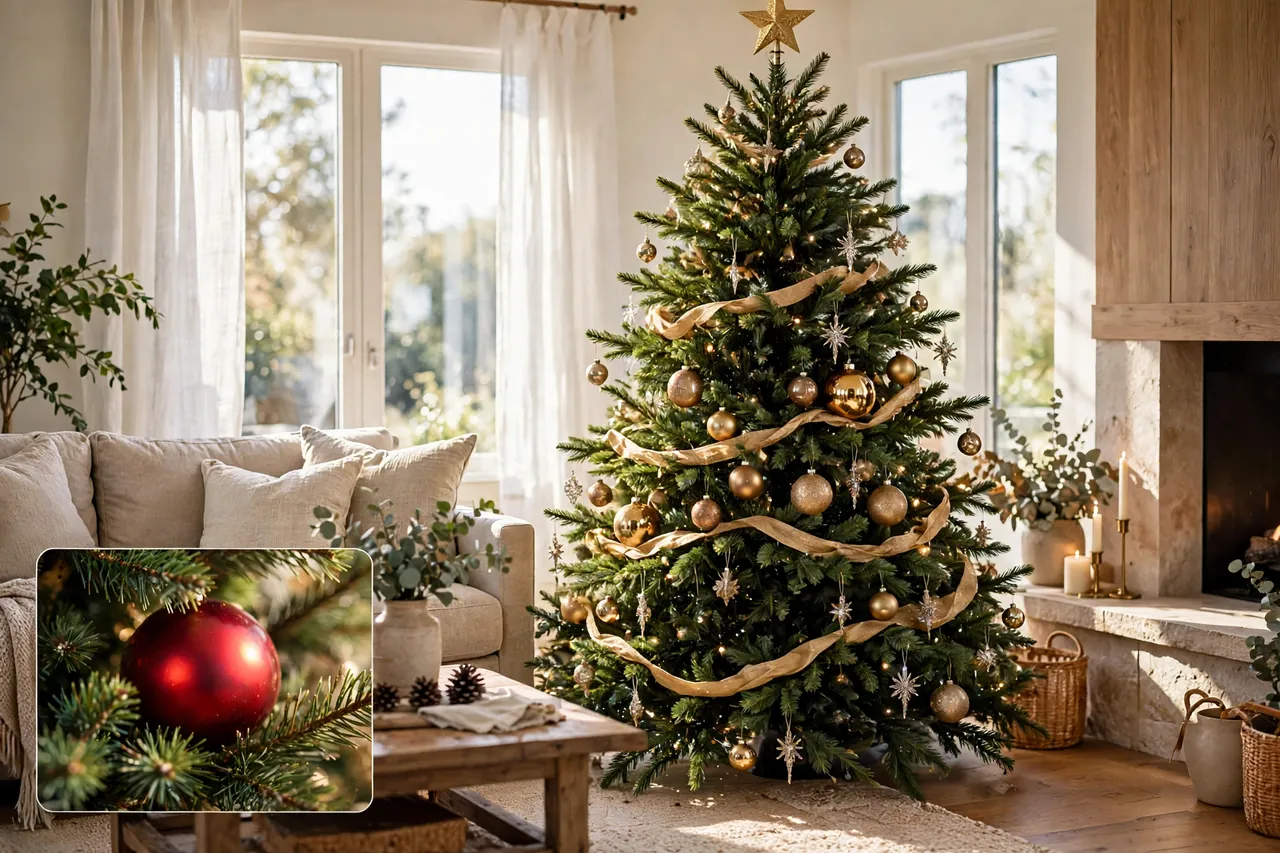
Colour changes with light, so a scheme that looks great in the store can look dull or loud at home. Test your palette in the room’s real light, in the evening with the tree lights on, before you commit to it.
Dark Rooms and Evening Light
Dark rooms swallow colour. Deep greens, navy, and burgundy can vanish into shadow, so lean on lighter brights, metallics, and warm white lights that bounce off shiny surfaces. Gold, champagne, and bright red hold up best after dark, while matte black and dark brown ornaments tend to disappear.
If your tree stands near a fireplace, echo the mantel colours on the tree so the two displays feel like one scene. Our guide to fireplace Christmas decorations shows how to match a mantel to the tree without repeating the same ornaments twice.
Bright Rooms and Daylight
Bright rooms do the opposite: they wash pale colours out. Pastels can look faded in strong daylight, so pair them with one deeper colour, like navy or deep pink, to anchor the scheme. Bold brights and jewel tones thrive here, because daylight shows their true colour.
Watch out for coloured walls in daylight too. A green tree against a green wall needs contrast, so add gold, red, or white ornaments that stand out from the background. The tree should pop against its backdrop, not melt into it.
Small Rooms and Small Trees
Small rooms reward restraint. A tabletop or slim tree carries fewer ornaments, so each colour shows more, and a rainbow scheme can overwhelm a small space fast. Choose two colours and one metal, use smaller ornaments, and let the tree skirt finish the look: our Christmas tree skirt ideas guide covers colours and sizes that ground a small tree instead of crowding it.
Apartment dwellers face the same choice on a smaller scale. If floor space is tight, a wall tree still deserves a real colour scheme, and our guide to Christmas tree wall decor shows space-saving trees that still feel like Christmas. Our apartment Christmas decor guide covers the rest of the room, so the tree and the space work together.
Lights: The Colour Choice Most People Get Wrong
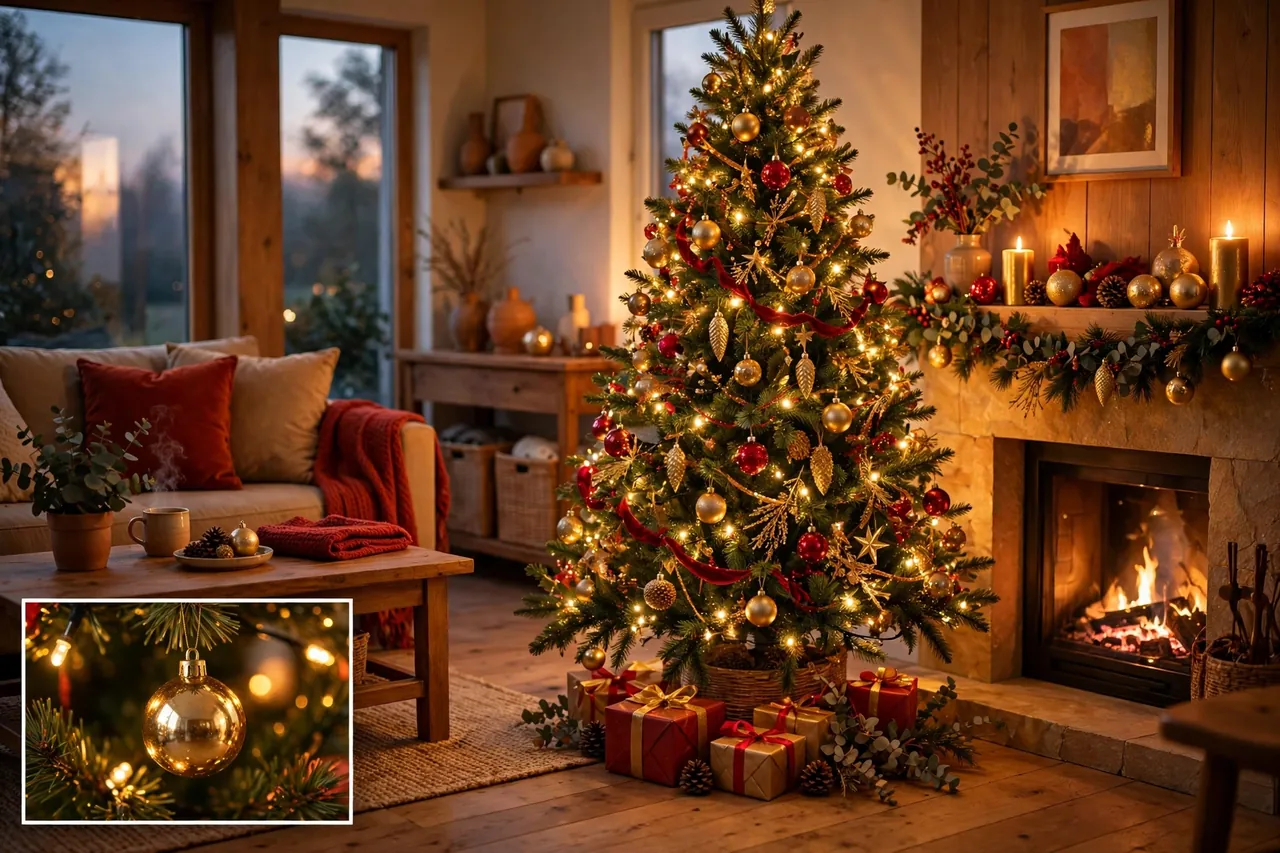
Lights are a colour too, and they change every ornament on the tree. Warm white lights make reds, golds, and wood tones glow, and they flatter most living rooms. Cool white lights suit silver, blue, and white schemes, but they can turn warm colours muddy. Multicolour lights add their own rainbow, so they pair best with ornaments that echo the light colours.
Here is the rule that saves most trees: if you use multicolour lights, you can use more ornament colours, because the lights already set a rainbow mood. If you use white lights, keep your ornaments to two or three colours, or the tree loses its focus. Decide on lights first, then buy ornaments to match them, not the other way around.
Check the light colour at night before you finish. Turn the room lights off, switch the tree on, and look at it from your usual seat. Colours that looked perfect in daylight can shift under tree lights, and a quick swap now beats a full redo later. If you plan your own displays, our DIY Christmas lighting guide and our guide to lighted Christmas decorations cover the types and choices in more depth.
How Many Ornaments Does Your Tree Actually Need?
People often ask how many ornaments a tree needs, and the honest answer is that it depends on the tree’s height, the ornaments’ size, and how full you like the look. Use this table as a starting point, then adjust by eye: a sparse, intentional tree can look richer than a crowded one.
Ornament counts by tree size
| Tree height | Light look | Full look | Tip |
|---|---|---|---|
| 4 feet | About 30 | About 50 | Use small ornaments |
| 6 feet | About 50 | About 80 | Mix medium and large |
| 7.5 feet | About 70 | About 110 | Place large ones deep |
| 9 feet | About 90 | About 140 | Add ribbon for fullness |
Count by visual weight, not just by number. Five large ornaments can carry more colour than twenty tiny ones, so a tree with big statement pieces needs fewer ornaments overall. If your tree still looks thin after hanging everything, add ribbon, picks, or a fuller skirt before you buy more baubles: our bow decor guide and our ribbon-tying guide show how bows and ribbon fill gaps and repeat your colours at the same time.
Colour Mistakes and Easy Fixes
Almost every disappointing tree suffers from one of five fixable mistakes. Check your tree against this list during your final step-back, and fix the one that matches before you call it done.
Common colour problems and fixes
| Problem you see | Likely cause | Quick fix |
|---|---|---|
| One side looks heavier | One colour bunched together | Move three ornaments of that colour to the light side |
| Tree looks messy, not joyful | Too many colours, no ratio | Remove one full colour and re-check |
| Colours look dull at night | Wrong light colour for the palette | Switch to warm white or multicolour lights |
| Tree looks flat | One finish only, all matte or all shiny | Mix matte, shiny, and glitter finishes |
| Top looks bare, bottom looks crowded | Large ornaments hung too low | Move two large pieces higher and spread them out |
The most common fix is also the simplest: take ornaments off. A tree with one colour too many looks better the moment that colour leaves, and you can always save the removed ornaments for next year’s scheme. Editing feels hard in the moment, but it is what separates a decorated tree from a tree that just has things on it.

Keep the Colour Safe Around Lights and Heat
Colour should never come at the cost of safety. The National Fire Protection Association (NFPA) advises homeowners to keep trees at least three feet from heat sources, to use lights labeled by a recognized testing laboratory, and to always turn tree lights off before leaving home or going to bed, as reported in the Connecticut fire safety guidance carrying NFPA’s holiday tips. Keep the tree clear of exits, water a real tree daily, and remove a dried-out tree promptly instead of leaving it up.
Check light strings before you hang them, and follow the maker’s instructions for how many strands you may connect. Replace any string with worn cords or loose bulbs, and never drape lights or garlands over a heat vent. These checks take five minutes, and they protect everything the colours are meant to celebrate.
Related Guides
If you are still building your display, these guides pick up where this one leaves off. Learn how to hang garland on a Christmas tree for a full, even look, finish the base with Christmas tree skirt ideas, and match the room with fireplace Christmas decorations. Small-space readers can try Christmas tree wall decor or the full apartment Christmas decor guide, and ribbon lovers will like the bow decor guide and the ribbon-tying guide.
Frequently Asked Questions
How many colors should you have on a Christmas tree?
Two or three main colours plus one metal works best for most trees. That mix looks planned without looking plain, and it leaves room for one accent colour if you want it. White lights pair well with two or three colours, while multicolour lights can carry three or four, since the lights already set a rainbow mood.
What color ornaments look best with colored lights?
Ornaments in the same colours as your lights look best, because they echo the glow instead of fighting it. If your lights mix red, green, blue, and gold, choose ornaments in those same colours and keep the mix balanced. Avoid adding a brand-new colour the lights do not include, since it tends to stand out awkwardly.
How many ornaments do I actually need for a 6-foot tree?
A 6-foot tree usually needs about 50 ornaments for a light look and about 80 for a full look, depending on ornament size. Large ornaments carry more visual weight, so a tree with big statement pieces needs fewer overall. Start with the light number, step back, and add more only where you see gaps.
Can I add gold or silver accents to a red and black tree?
Yes, you can, as long as you use the metal sparingly. A few gold-trimmed red baubles or a silver-edged star add sparkle without breaking the red and black theme. Keep the metal to about 10 percent of the tree, and choose one metal rather than both, so the accent reads as a highlight, not a third colour.
Can I make a real tree look fuller without more ornaments?
Yes, you can fill a real tree’s natural gaps without buying more ornaments. Tuck fresh greenery, like cedar or pine sprigs, into thin spots, and layer your lighting so the inner branches glow. Ribbon, picks, and a fuller tree skirt also add fullness, and warm white lights help texture stand out.
Disclaimer: This guide shares general decorating ideas, not professional safety or electrical advice. Always follow the maker’s instructions for your lights and tree, and ask a qualified professional if you are unsure about wiring, damaged cords, or safe placement near heat sources.
Your next step is simple: pick one scheme from the table, sort your ornaments into colour piles, and hang your largest pieces in triangles tonight. You will see the difference before you finish the first round, and your tree will finally look the way you pictured it.


