
Remote control window blinds are window blinds with a small motor in the headrail. You press a button on a remote, and the motor raises, lowers, or tilts the blind for you. No cords, no reaching across furniture, and no climbing to reach a high window.
Buy them when you want easy control over light and privacy, safer cord-free windows, or blinds that open and close on a schedule. Start with the power source, then pick the blind type that fits your room. This guide walks you through both choices, step by step.
How Remote Control Window Blinds Work
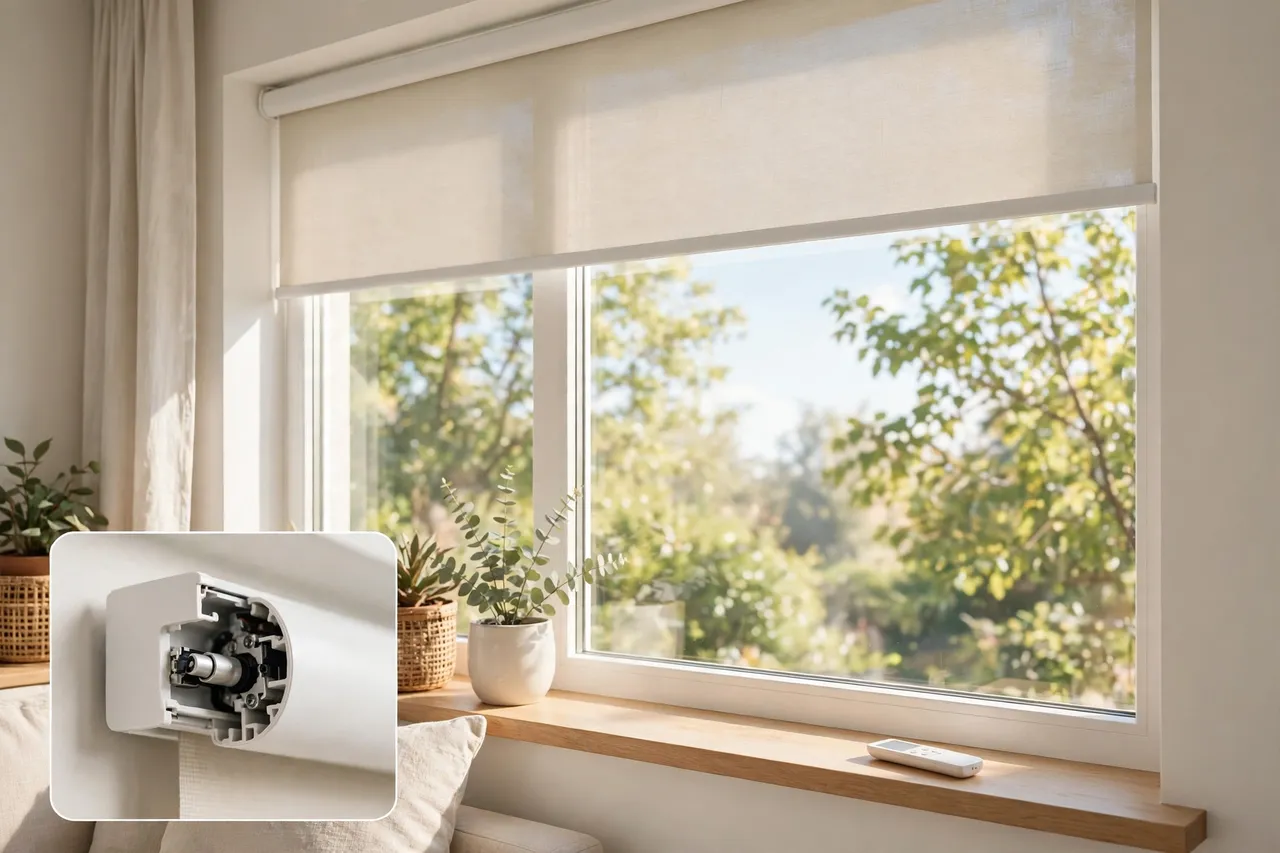
A small electric motor sits inside the headrail, the bar at the top of the blind. When you press a button, the remote sends a wireless signal to the motor. The motor then lifts the fabric, lowers the shade, or tilts the slats.
Most remotes use radio signals, so you do not need to point the remote at the blind. You can run one blind, a group of blinds, or every blind in a room from a single remote. Many systems also let you set a favorite position, so the blind stops at the same spot each time.
What the Remote Actually Controls
A basic remote does three things: raise, lower, and stop. A multi-channel remote does more. Each channel controls one blind or one group, so you can run the bedroom blinds on channel one and the living room blinds on channel two. Some remotes also control tilt, which angles the slats to soften light without fully closing the blind.
Check how many channels the remote has before you order. A single-channel remote runs one blind or one group together. If you want to control blinds one by one, you need a multi-channel remote.
What a Motor Does That a Cord Cannot
A motor moves every blind to the exact same position, every time. Pull cords cannot do that. A motor also removes the cord completely, which makes the window safer for children and pets. The U.S. Consumer Product Safety Commission treats window coverings with hazardous cords as a substantial product hazard, and its guidance states that stock window coverings must be cordless, have short cords of 8 inches or less, or have inaccessible cords. A motorized blind meets the cordless option by design.
The 5 Types of Remote Control Window Blinds

Pick the blind type first, then add the motor. Each type handles light and privacy in its own way, and each suits different rooms. Here is how they compare.
| Blind type | Best for | Light control |
|---|---|---|
| Roller | Living rooms, bedrooms, offices | Open or closed; blackout fabrics available |
| Cellular | Bedrooms, cold or hot rooms | Soft filtered light; best insulation |
| Venetian | Kitchens, offices, bathrooms | Tilt slats for fine control |
| Roman | Living rooms, bedrooms | Soft folds; light filtering or blackout |
| Vertical | Sliding doors, wide windows | Slides sideways; tilts for glare control |
Roller Blinds
Roller blinds are a single sheet of fabric that rolls up onto a tube. They give you the cleanest look and the widest choice of fabrics, from sheer to full blackout. They work well in almost any room, and they are often the cheapest motorized option. Choose roller blinds when you want a simple, modern window with strong blackout choices for the bedroom.
Cellular Shades
Cellular shades, also called honeycomb shades, fold into rows of air pockets that trap air against the glass. Those pockets act like insulation. The U.S. Department of Energy reports that in lab modeling, tightly fitted cellular shades cut heating energy by up to 20 percent and total heating and cooling energy by up to 15 percent, compared with bare windows. Those are modeled results, not a promised bill cut, but they make cellular shades the smart pick for drafty rooms and big energy bills.
Venetian Blinds
Venetian blinds use horizontal slats that tilt. Tilt gives you the finest light control of any type: angle the slats up to block glare, angle them down to keep your view, or close them flat for privacy. Motorized Venetian blinds tilt and lift by remote. They suit kitchens and home offices, where glare on a screen is the daily problem.
Roman Shades
Roman shades fold into soft, flat pleats as they rise. They look tailored and warm, so they suit living rooms and bedrooms where style matters. Motorized Roman shades need a stronger motor than roller shades because the fabric folds are heavier, so check the weight limit before you order. Blackout linings are available for bedrooms.
Vertical Blinds
Vertical blinds hang in tall strips that slide sideways and tilt. They are the right choice for sliding glass doors and very wide windows, where a side-to-side blind makes more sense than one that lifts up. A motor slides the strips open and tilts them for you, which beats wrestling a long cord across a patio door.
Battery vs Hardwired vs Solar: Choose Your Power First
Power is the first decision, because you cannot easily change it later. Most motors are built for one power type only. Pick the power source that fits your home, then shop for blinds that use it.
Battery Power
Battery blinds run on a rechargeable lithium-ion battery hidden in the headrail. You mount the brackets, snap in the headrail, charge the battery, and you are done. No wiring, no electrician, and no holes in finished walls. That makes battery power the best choice for existing homes, renters, and one or two windows at a time.
A single charge typically lasts several months. With light daily use, many rechargeable shades run six to twelve months between charges, and heavy use shortens that window. Budget Blinds notes the same range in its motorized shade guide: about six months to a year per charge with light daily use. You recharge with a USB cable, which takes a few hours. Plan the charging spot before you order: can you reach the charging port on a high window without a ladder?
Battery blinds keep working in a power outage, because the battery sits inside the blind. That is a real advantage if your area loses power often.
Hardwired Power
Hardwired blinds connect straight to your home wiring. They never need charging, and the motor has more torque, so it handles very large or heavy blinds with ease. Several blinds on one circuit also move in near-perfect sync, which looks sharp on a wide wall of windows.
The trade-off is installation. A licensed electrician must run low-voltage wiring to each window, which means open walls in a finished home. Hardwired power suits new builds and major remodels, where the wiring goes in before the drywall. Hardwired blinds stop working in a power outage, because they draw power from the house.
Solar Power
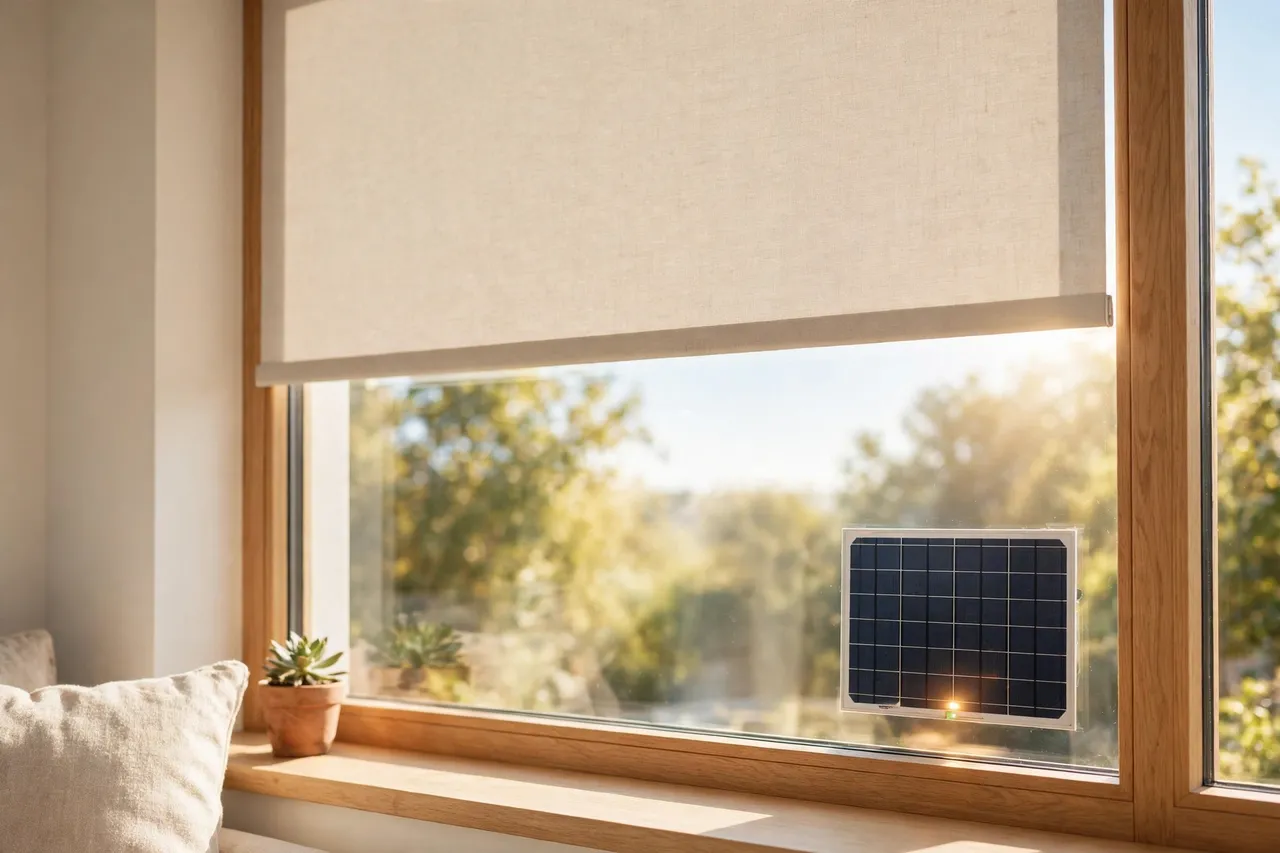
Solar blinds are battery blinds with a small solar panel that sticks to the glass and trickle-charges the battery. On a sunny window, the panel can stretch the time between hand charges to almost nothing. Solar suits south- and west-facing windows that get strong daylight. It does not suit shaded windows or north-facing rooms, where the panel barely charges. Treat solar as a battery helper, not a separate power system.
| Power type | Best for | Main trade-off |
|---|---|---|
| Battery | Existing homes, renters, few windows | Recharge every 6 to 12 months |
| Hardwired | New builds, remodels, large blinds | Needs an electrician and open walls |
| Solar-assisted | Sunny windows, hard-to-reach blinds | Needs strong daylight to help |
How to Control Them: Remote, App, Voice, Schedules, and Sensors
A remote is only the starting point. Most motorized blinds offer four layers of control, and each layer needs the right hardware. Confirm what each layer needs before you buy, because a remote-only blind cannot gain app control later without a hub.
Remote Control
The handheld remote is the simplest control. It works without the internet and without a phone, so guests and kids can use it too. Keep a remote in each room where the blinds live, and keep one spare. Check whether the remote is included in the price or sold separately, because some sellers charge extra for it.
App Control
App control lets you run the blinds from your phone, from anywhere with internet. Most systems need a hub or bridge, a small box that connects the blinds to your Wi-Fi. The hub is often a separate purchase, so add its price to your budget. Through the app you can group blinds by room, set favorite positions, and check the battery level on two-way motors.
Voice Control
Voice control runs through Alexa, Google Home, or Apple HomeKit, and it usually needs the same hub as the app. Say the room name and the command, such as “Alexa, close the bedroom blinds.” Before you order, confirm the exact motor and hub work with your voice platform. A hub from one brand will not always work with another brand’s blinds.
Schedules and Sensors
Schedules are where motorized blinds earn their keep. Set the bedroom blinds to open at sunrise, lower the west-facing blinds before the hot afternoon sun, and close every blind at night. Some hubs add sunrise and sunset timing, so the schedule shifts with the seasons instead of a fixed clock time.
Light and temperature sensors take it further. A light sensor closes the blinds when the sun hits the window, and a temperature sensor can close them to keep a room cool. Sensors usually come from the same brand as the hub, so check compatibility first. And keep the remote as a backup: voice and app control fail when the Wi-Fi drops, but the remote still works.
Retrofit Motor Kits vs New Motorized Blinds
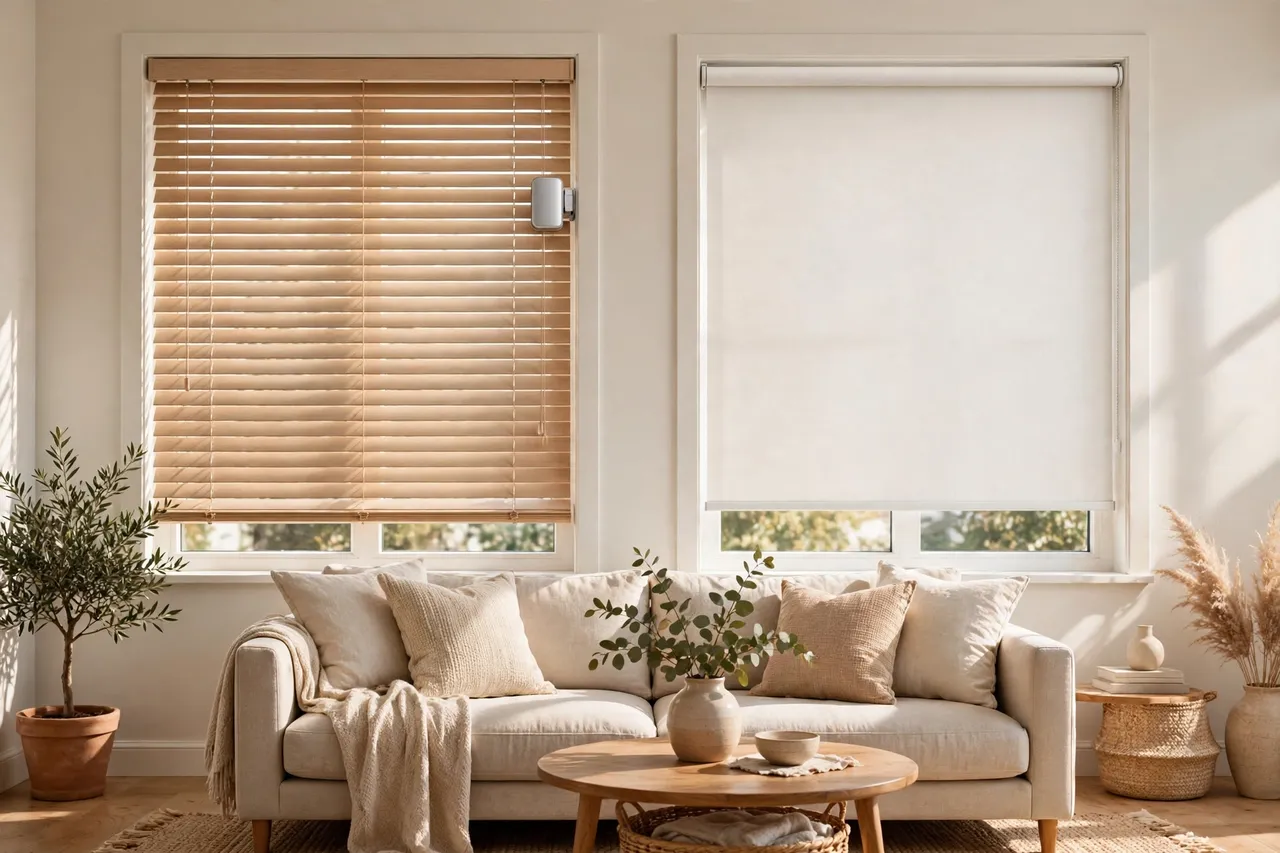
You have two ways to get remote control blinds. You can motorize the blinds you already own, or you can buy new blinds with the motor built in. The right choice depends on your current blinds and your budget.
Retrofit Motor Kits
A retrofit kit clips a small motor onto your existing blinds. The best-known type is the tilt motor for Venetian blinds: it turns the tilt wand for you, so the slats open and close by remote or app. It cannot raise or lower the blind, only tilt it. Other kits drive a bead chain on roller shades.
Retrofit kits are the cheapest way in. Options start under $100 for a single tilt motor, and they install in minutes with no tools on many blinds. They are the best choice for renters, because you can remove the motor when you move and leave the blinds as they were. They are also the best choice when your current blinds are in good shape and you only want remote tilt.
Check three things before you buy a kit: the blind type it fits, the slat width it accepts, and whether it needs a hub for app and voice control. Many kits need the brand’s hub for anything beyond the remote.
New Motorized Blinds
New motorized blinds come with the motor built into the headrail and the fabric made to order for your window. You get full lift and tilt, a clean look with no add-on box, and a motor matched to the weight of the blind. CNET tested 10 smart shades hands-on and named SmartWings the best overall pick for its wide choice of custom sizes and quiet motors, with the SwitchBot Blind Tilt as the best retrofit for existing Venetian blinds. Lutron Serena earned praise for the quietest motor in the test, with a premium price to match.
Buy new when your old blinds are worn out, when you need blackout or cellular fabric, or when you want full lift control on every window. The motor, fabric, and warranty arrive as one system, so nothing has to fit a stranger’s bracket.
How to Measure Your Windows for Remote Control Blinds

Motorized blinds are usually made to order, so a wrong measurement wastes weeks and money. Measure twice, write down every number, and order one window first if you are unsure. Follow these steps.
- Decide inside mount or outside mount. Inside mount fits the blind inside the window frame for a clean look. Outside mount hangs the blind on the wall above the frame, which covers the frame and blocks more light at the edges.
- Measure the width in three places: top, middle, and bottom of the opening. For an inside mount, order the smallest of the three numbers. For an outside mount, add 3 to 4 inches to cover the frame.
- Measure the height in three places: left, center, and right. For an inside mount, order the longest of the three numbers. For an outside mount, measure from where the top of the blind will sit to where the bottom should end.
- Measure the frame depth. The headrail and motor need room inside the frame, so check the depth against the product specs. If the frame is too shallow, switch to an outside mount.
- Check for obstacles. Handles, cranks, alarms, and trim can block the blind. Note anything that sticks out into the frame.
- Write down the width, height, and mount type for each window, and label each one by room. Order the trickiest window first to confirm the fit before you order the rest.
What to Check Before You Buy
Run through this checklist before you pay. Each item prevents a common, expensive mistake.
- Compatibility: does the exact motor and hub work with Alexa, Google Home, or HomeKit, whichever you use?
- Remote and hub: are the remote and the hub included, or sold separately? Add both to the total price.
- Power: battery, hardwired, or solar? Can you reach the charging port without a ladder?
- Size and weight limits: does the motor lift your blind size and fabric weight? Check the maximum width in the specs.
- Noise: ask for the motor noise level. Quieter motors cost more, and they matter in a bedroom.
- Favorite position and limits: can you set upper and lower stop points, so the blind stops where you want it?
- Power outage: will the blind still work when the power is out? Battery blinds will; hardwired blinds will not.
- Warranty: how long does the motor warranty last, and does it cover the battery? Premium brands often cover motors for five years or more.
- Returns: can you return a custom-size blind if the measurement is wrong? Many sellers charge a restocking fee on custom orders.
- Child safety: is the blind fully cordless, with no loop or chain within reach?
How Much Do Remote Control Window Blinds Cost?
Motorized blinds cost more than manual blinds, and the range is wide. Use these verified ranges to set your budget, and get a quote for your exact window size before you order.
Angi’s cost guide, updated October 31, 2026, puts the national average at $500 per window installed, with most homeowners spending $400 to $2,500 per window depending on size, material, and motor type. Small windows sit at the low end, and extra-large windows reach the high end.
Affordable Blinds, in its guide updated September 28, 2026, lists a typical range of $200 to $1,000 for a single motorized shade, with a light-filtering roller shade from $183. Its own product ranges run $219 to $482 for motorized zebra shades and $232 to $538 for a motorized Roman shade, with the final price set by window size. Prices checked November 8, 2026.
Three costs hide outside the sticker price. First, the hub: many systems need a hub for app and voice control, often $50 to $150 as a one-time purchase. Second, installation: DIY costs nothing, while professional installation typically runs $50 to $150 per window. Third, hardwired power: an electrician adds $100 to $300 or more per window in wiring labor. Add all three before you compare two quotes.
Retrofit kits are the budget route. A single tilt motor for existing Venetian blinds starts under $100, and it needs no new fabric and no installer. Start with one window, test the kit for a week, and then decide whether to motorize the rest of the house.
Common Mistakes to Avoid
Most bad motorized blind purchases come from the same few mistakes. Dodge them and the blinds will work for years.
Do not order the hub last. Buy the remote, the hub, and the blinds together, from one system, so everything pairs on day one. Mixing brands is the top cause of “it worked in the store but not at home.”
Do not skip the weight check. A heavy blackout fabric on a wide window needs a stronger motor. If the motor strains, the battery drains fast and the blind stops short.
Do not measure once. Measure the width and height in three places each, and order the smallest width for an inside mount. A blind that is a quarter inch too wide will not fit.
Do not forget the charging plan. A battery blind on a tall stairwell window is a ladder job every few months. Add a solar panel there, or choose a hardwired motor during a remodel.
Do not assume voice control is included. A remote-only blind needs a hub for Alexa, Google Home, or HomeKit. Read the product page for the words “hub required” before you order.
Are Remote Control Window Blinds Worth It?
They are worth it when the window is hard to reach, when you adjust the blinds every day, or when you want schedules that run without you. They pay off fastest on tall windows, sliding doors, bedrooms where you want blackout on a timer, and homes with kids or pets where cords are a hazard.
They are not worth it for every window. A small window you open once a day does not need a motor. Neither does a rental where you cannot mount hardware. Start with the two or three windows you touch most, live with them for a month, and then decide about the rest.
Your best first buy is a battery-powered roller or cellular blind with a remote, from a brand that sells the matching hub for later. You get remote control on day one, and you can add app control, voice control, and schedules later without replacing the blind. Hire a licensed electrician for any hardwired work, and keep the remote where everyone in the house can reach it.
One honest note: motorized blinds add electronics to a simple product, so they can fail in ways a manual blind cannot. A dead battery, a lost remote, or a hub that drops off Wi-Fi will leave the blind stuck until you fix it. Keep the remote charged and paired, and keep a manual way to reach the blind if you can.
Frequently Asked Questions
How long do rechargeable batteries last in motorized blinds?
Rechargeable lithium-ion batteries typically last several months between charges, depending on how often you move the blinds. Light use can stretch to six to twelve months per charge, while heavy daily use means charging every few months. You recharge with a USB cable, which takes a few hours.
Are motorized shades worth it?
Yes, for most buyers who use their blinds daily. Motorized shades add easy remote control, schedules that save energy, better security when you are away, and cord-free safety for kids and pets. They cost more than manual shades, so start with the windows you adjust most and add more later.
What are the disadvantages of motorized blinds?
Motorized blinds cost more to buy and install than manual blinds. They depend on power and technology, so a dead battery or a failed hub can leave a blind stuck. Installation can be complex, especially for hardwired models, and repairs cost more than a simple cord fix.
How long do motorized shades last?
Most motorized blinds last about 5 to 10 years with normal care. The motor usually outlives the battery: rechargeable batteries need a charge every few months and a replacement after a few years, while hardwired motors keep going with almost no upkeep. Heavy daily use shortens both.
Can battery-powered blinds be converted to hardwired later?
Generally, no. Motors are built for one power type, so a battery motor cannot switch to hardwired power later. Choose the power source before you order, because the two systems are not interchangeable. If you may want hardwired power one day, plan the wiring during a remodel.
Are motorized blinds cord-free and child safe?
Yes. Motorized blinds run without operating cords, so there is no loop a child or pet can reach. That makes them one of the safest window treatments for homes with young children. The CPSC also requires new window coverings to be cordless or to have short or inaccessible cords.
Start with one window, measure it twice, and pick battery power unless you are building or remodeling. Once that first blind runs smoothly on its remote, the rest of the house is an easy decision.


