
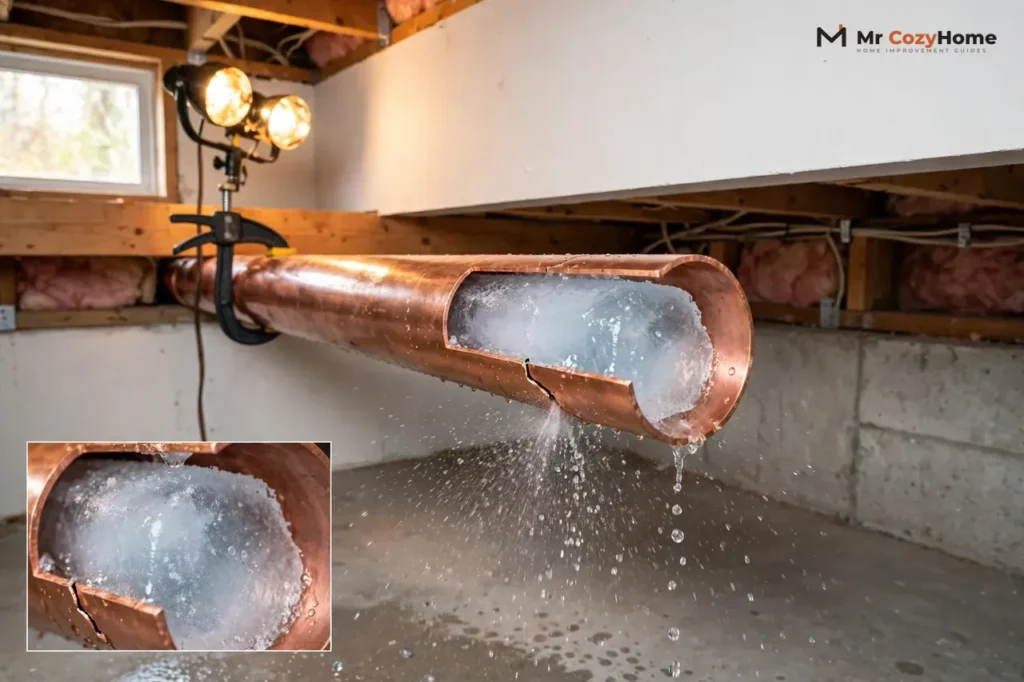
When pipes freeze, the water inside them turns to ice, and that ice takes up about 9% more space than the water did. The ice forms a solid plug that blocks the pipe, and pressure builds up behind that plug until the pipe cracks or bursts. The worst part is that you often see no leak at all while the pipe is frozen, because the ice itself plugs the break. The flood usually arrives later, when the ice thaws and water rushes through the crack.
That is the short version. The full story matters, because a frozen pipe is not one single event. It is a chain of events, and each link in the chain decides whether you end up with no damage, a small crack, or a burst pipe that soaks your home. This guide walks through that chain, step by step, so you know what is happening inside your walls right now and what to watch for next.
What Happens Inside a Frozen Pipe, Step by Step
A frozen pipe goes through the same stages almost every time. Once you know the stages, the rest of the story makes sense, including why some frozen pipes burst and others thaw without a scratch.
First, the Water Turns to Ice
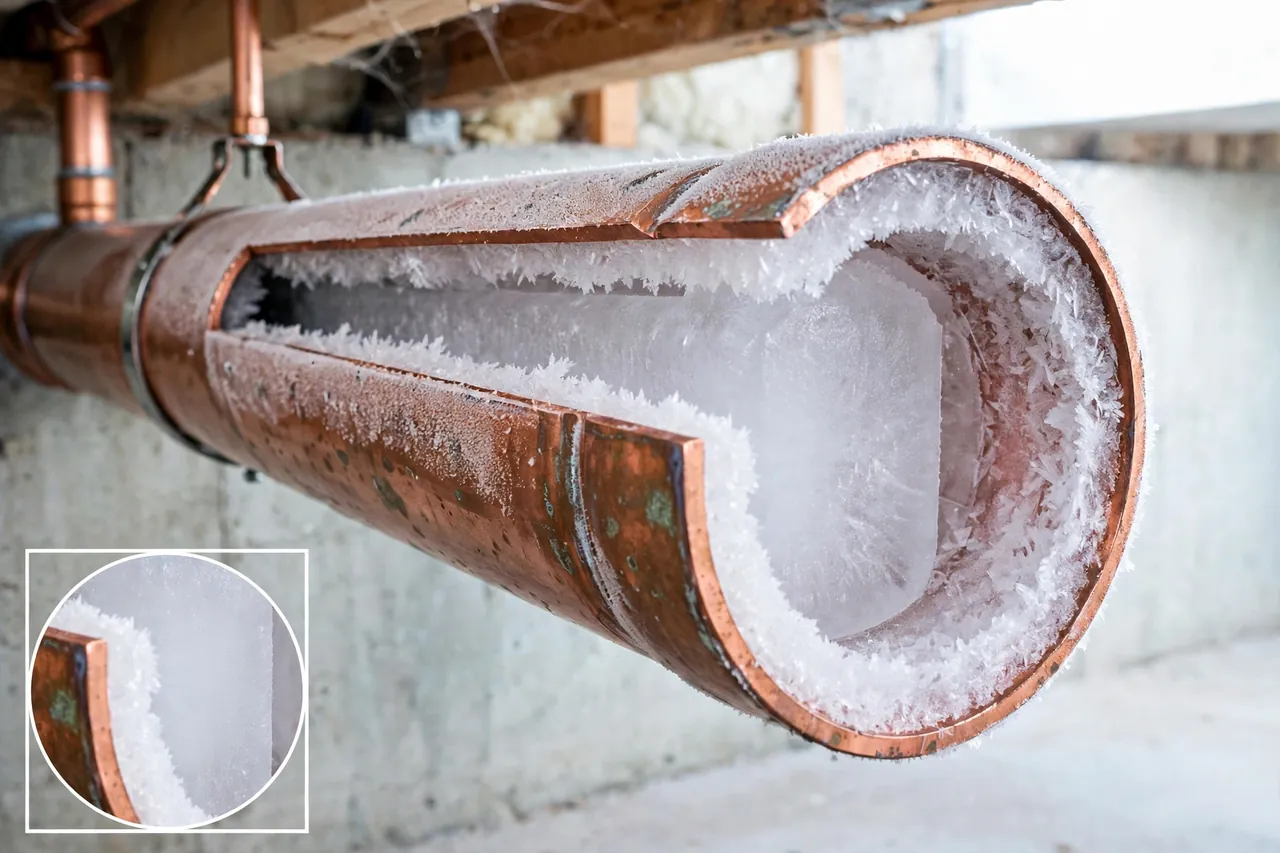
Water starts to freeze when the water inside the pipe drops to 32 degrees Fahrenheit. Ice crystals form along the coldest part of the pipe wall first, usually where the pipe sits against an outside wall or in an unheated space. The crystals grow inward until they meet in the middle and seal the pipe shut. That solid block of ice is called an ice plug, and it stops water from flowing past it.
At this point, you may notice that a faucet gives you only a trickle, or nothing at all. The water has not gone anywhere. It is simply stuck behind the plug. If the pipe is visible, you may see frost on the outside of it, or a slight bulge where the ice is pressing outward.
Then the Ice Plug Traps Water Behind It
Here is the part most people miss. The ice plug does not just block the pipe. It seals off a section of still-liquid water between the plug and the nearest closed faucet. That trapped water has nowhere to go. As more water freezes, the growing ice pushes against the trapped water like a slow piston.
Water barely compresses at all, so the pressure in that sealed section climbs fast. The American Red Cross puts it plainly: water expands as it freezes, and this expansion puts tremendous pressure on whatever contains it, including metal or plastic pipes, and no matter the strength of a container, expanding water can cause pipes to break. That pressure is the real danger, not the cold itself.
Finally, Something Gives Way
Every pipe has a weakest point. It may be a joint, an elbow, a spot where the pipe wall has thinned with age, or a section that froze last. When the pressure passes what that weak point can hold, the pipe splits open. The split can be a hairline crack you can barely see, or a long tear along the pipe. Either way, the pipe has failed, even though you may not know it yet.
While the pipe stays frozen, the ice plug often seals the split shut, so nothing leaks. That is why a frozen pipe can look harmless for hours or days. The damage stays hidden until the thaw. When the thaw comes, here is how to unfreeze frozen pipes before the damage spreads.
Why Do Pipes Burst?
Pipes burst because of pressure, not because ice pushes directly on the pipe wall. This surprises most homeowners, and it explains a lot about where bursts happen.
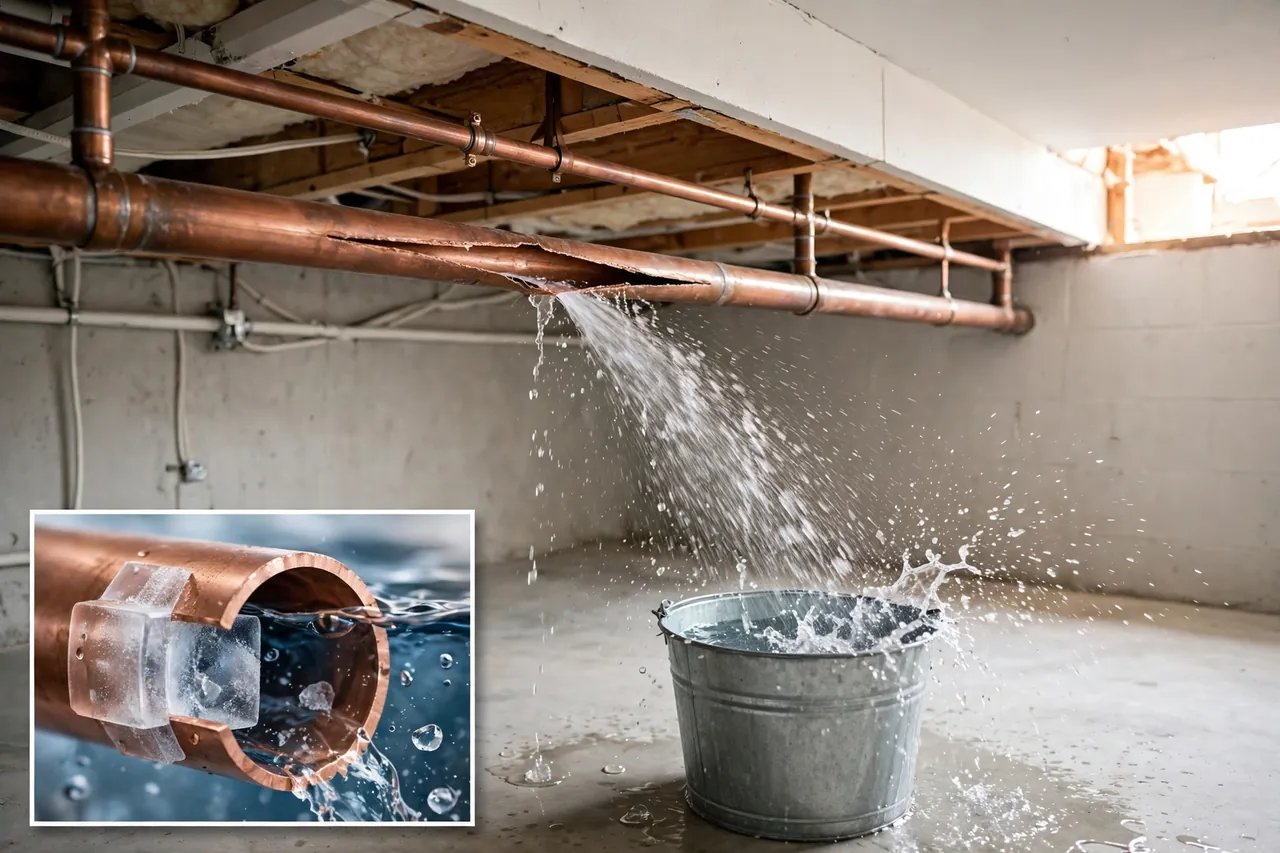
When water freezes, it expands by about 9%. That alone is usually not enough to split a sound pipe. The burst comes from the trapped water between the ice plug and a closed faucet. As the ice grows, it squeezes that trapped water, and the pressure shoots up. Richard Trethewey, the plumbing and heating expert at This Old House, explains that the pressure downstream of the ice can reach 25,000 PSI, which is more than enough to split copper pipe wide open. Normal household water pressure sits around 40 to 80 PSI, so the pressure inside a frozen pipe can climb hundreds of times higher than what the pipe was built to carry.
This is also why an open faucet can save a pipe. If a faucet stays open, the trapped water has somewhere to go, and the pressure cannot build. The Lakeway Municipal Utility District makes the same point in its frozen-pipe guidance: what causes burst pipes is the build-up of pressure in the lines, and opening the faucets helps release that pressure once the pipes thaw. A pipe that is open on one end cannot pressurize, and a pipe that cannot pressurize will not burst.
So when someone asks why pipes burst, the honest answer has two parts. Ice expansion starts the problem, and trapped-water pressure finishes it. Remove either part, and the pipe usually survives.
Do Frozen Pipes Always Burst?
No, frozen pipes do not always burst. Many frozen pipes thaw with no damage at all, especially when a faucet was left open so pressure could escape. But you cannot count on a lucky outcome, because whether a pipe bursts depends on several things working together, and you cannot see most of them from outside the wall.
The pipe material matters a lot. Rigid copper and older galvanized steel give very little, so pressure finds their weak point fast. PEX, the flexible plastic tubing used in many newer homes, can stretch a little and absorb some of the expansion, so it survives freezes more often. Even so, no material is immune. PEX can still split at a fitting, and a frozen PEX line can still fail if the pressure climbs high enough.
How long the pipe stays frozen matters too. A short overnight freeze may form only a thin ice plug, while a pipe frozen for days builds a longer plug and traps more water under pressure. The colder it gets, the faster that pressure climbs. Old pipes, corroded pipes, and pipes with weak joints fail sooner than new, sound ones. And a pipe that froze and survived once may carry tiny stress cracks from that freeze, which makes the next freeze more dangerous.
The safest way to think about it is this: a frozen pipe is a pipe at risk, not a pipe already ruined. Treat every frozen pipe as an emergency, even if it has not burst yet, because you cannot tell from the outside whether the pipe wall has already cracked.
Burst, Crack, or No Damage: What Decides It?
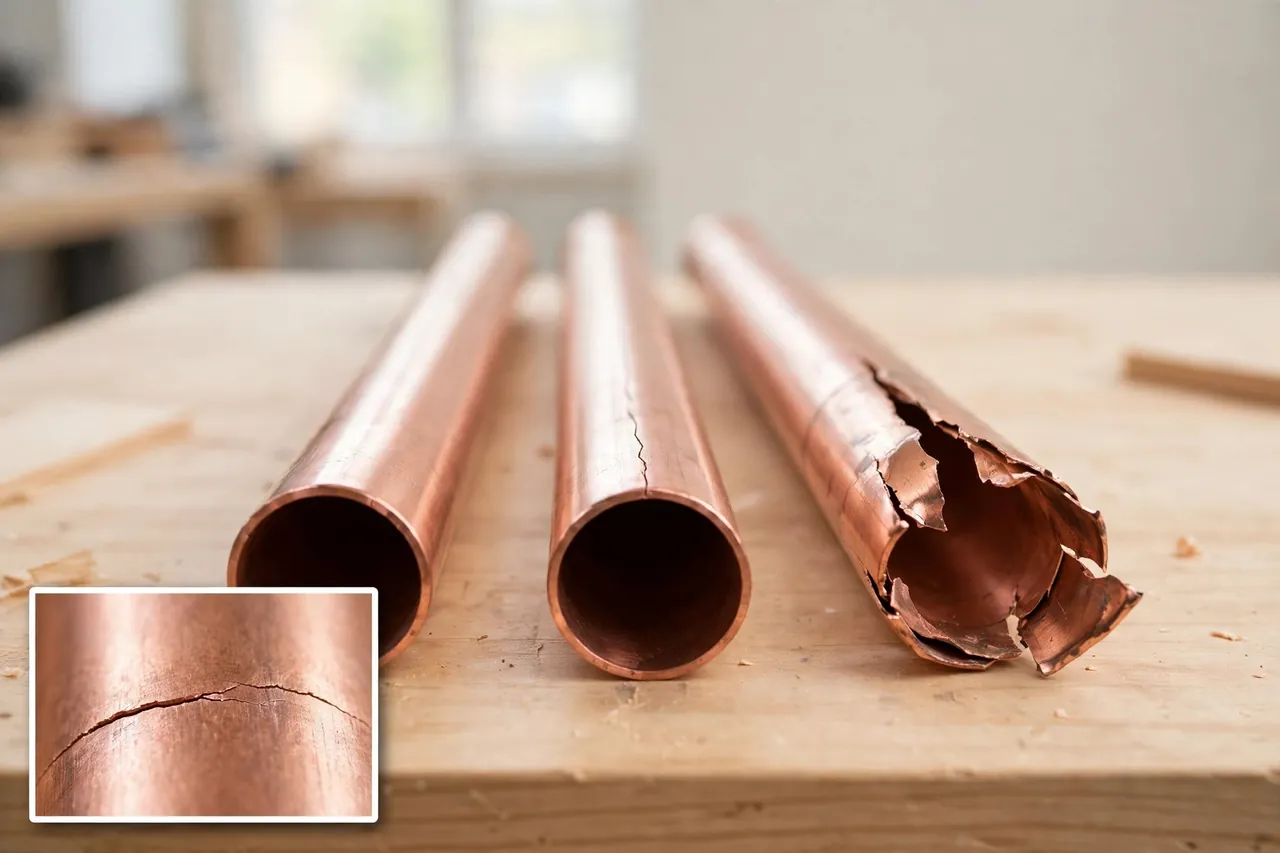
Not every frozen pipe ends the same way. There are really three outcomes, and knowing them helps you judge what you are dealing with after a thaw.
| Outcome | What happens | What you notice |
|---|---|---|
| No damage | The ice thaws, pressure escapes, and the pipe holds. | Water flow returns to normal, and no leak appears. |
| Crack or small split | Pressure opens a hairline crack, often at a joint or weak spot. | A slow drip or damp patch shows up, sometimes days later. |
| Full burst | The pipe wall tears open under peak pressure. | Water sprays or pours out as soon as the ice thaws. |
A crack is the sneakiest outcome. A hairline split may leak only a few drops an hour, and if the pipe sits inside a wall or above a ceiling, that slow leak can soak insulation and drywall for days before anyone sees a stain. By the time a damp patch appears on the ceiling, the damage behind it may already be wide.
A full burst is the loudest outcome, and in some ways the kindest, because you find it fast. Water pours out under full household pressure, and you know within minutes that something is wrong. The damage can still be severe, but at least the leak does not hide for a week.
No damage is the outcome everyone hopes for, and it is more common than people think. A short freeze, an open faucet, a flexible PEX line, and a sound pipe can all add up to a pipe that simply thaws and carries on. The trouble is that you cannot confirm this outcome until the pipe has fully thawed and you have checked every faucet and every visible joint for leaks.
Where Bursts Happen and Why There
A burst rarely happens at the exact spot where the ice formed. That fact confuses a lot of homeowners who find a split pipe feet away from the frozen section. The reason is simple: the burst happens where the pressure is highest, and that is usually downstream of the ice plug, at the weakest point in the trapped section.
Joints and elbows fail first. A joint is a connection between two pieces of pipe, and it is almost always weaker than a straight run. An elbow, the bend in a pipe, takes extra stress when pressure surges around the turn. This Old House expert Richard Trethewey notes that the elbow is a very popular place for a freeze, and it deserves extra insulation for exactly that reason.
Bursts also favor the last place to freeze. As ice grows along a pipe, the final stretch of liquid water gets squeezed into a smaller and smaller space, so the pressure peaks there. An insulated section in the middle of an otherwise bare pipe can become that last-freezing spot, which is one reason spotty insulation can backfire.
Hidden pipes burst in the worst places. A pipe inside an exterior wall, above a finished ceiling, or under a floor can split and leak for hours before anyone notices. Water runs downhill and spreads sideways through insulation and drywall, so the wet patch you eventually see may sit far from the actual break. That is why a burst in a hidden pipe often causes more damage than a burst in a pipe you can see.
Which Pipes Are Most at Risk?
Some pipes freeze far sooner than others, and the pattern is the same in almost every home. The American Red Cross lists the pipes that freeze most often, and the list is a good map of where to look first when cold weather hits.
- Outdoor hose bibs, swimming pool supply lines, and sprinkler lines, because they sit fully exposed to the cold.
- Water supply pipes in unheated interior areas, such as basements, crawl spaces, attics, and garages.
- Pipes inside kitchen and bathroom cabinets, especially cabinets on outside walls, where cold air sneaks in behind the sink.
- Pipes that run against exterior walls with little or no insulation, where the wall itself stays near outdoor temperature.
Outdoor lines deserve special attention because they freeze first and burst with the least warning. A hose left attached to an outdoor faucet traps water in the faucet and the pipe behind it, and a single hard overnight freeze can split either one. The Lakeway Municipal Utility District warns that an above-ground backflow device on an irrigation system should be expected to break if it freezes, so knowing where to shut it off matters before the cold arrives.
Hot water lines can freeze too, and they sometimes freeze before cold lines do. Hot water holds less dissolved air, and the way it cools can let ice form faster in some conditions. Either way, do not assume a pipe is safe just because it carries hot water. Both hot and cold lines in a cold spot need the same protection.
One more risk factor is easy to miss: a small draft. A gap around a pipe where it passes through a wall, a cracked basement window, or an unsealed rim joist can aim a stream of freezing air straight at one short section of pipe. That section can freeze solid while the rest of the line stays fine, which is why sealing drafts near pipes matters as much as insulating the pipes themselves.
What Damage Follows a Burst Pipe?
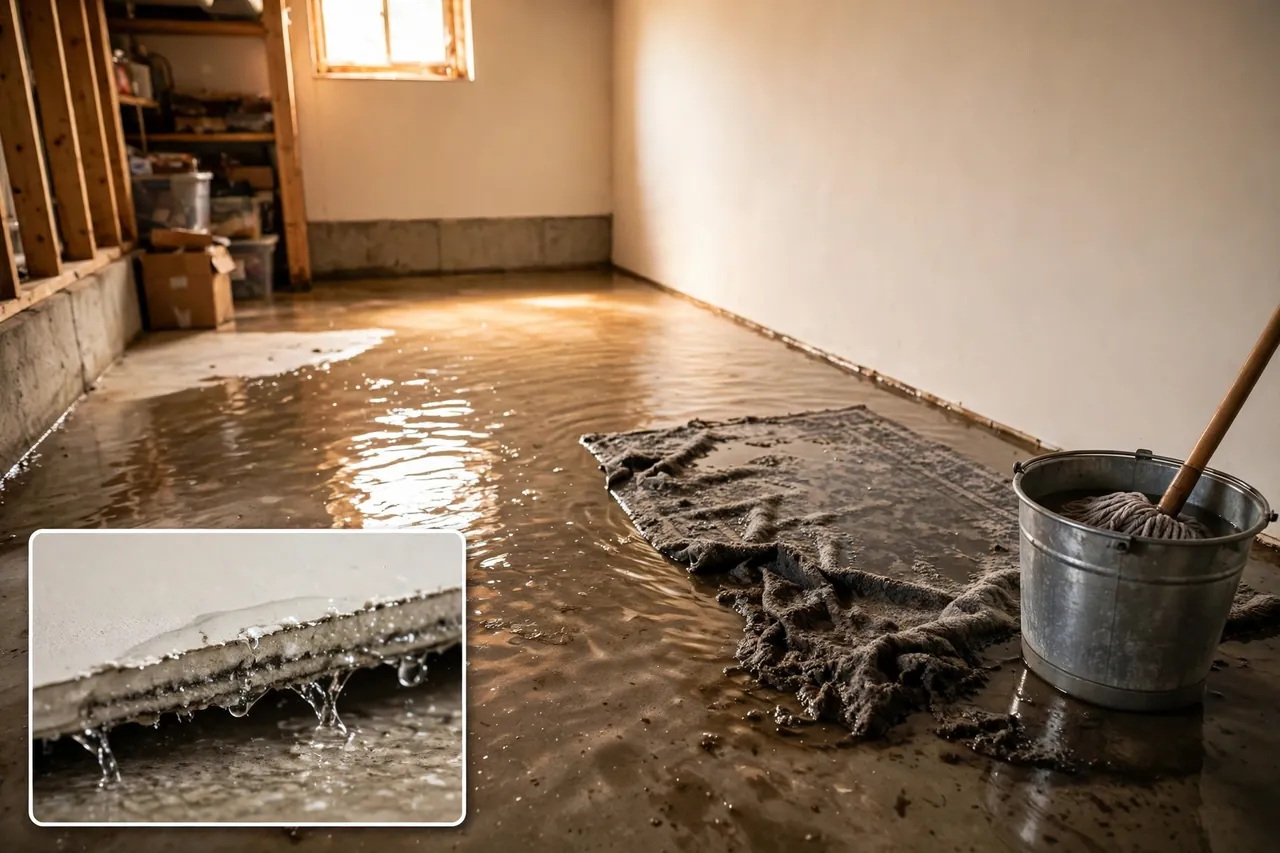
A burst pipe does not just make a puddle. It starts a chain of damage that spreads through the house, and the longer the water runs, the longer that chain grows.
Water Spreads Fast and Far
A small split can release hundreds of gallons of water into a home in a short time. The Insurance Institute for Business and Home Safety reports that even a one-eighth-inch crack in a pipe can release up to 250 gallons of water per day. Water runs to the lowest point, soaks into flooring, wicks up into drywall, and spreads through insulation far beyond the spot you can see. A burst on an upper floor can soak the ceiling below, then the floor below that, all from one break.
Furniture, rugs, electronics, and stored belongings soak through fast. Wood floors can cup and warp, and once they dry in that shape, they often need sanding or replacement. Drywall softens and crumbles, and wet insulation loses its ability to insulate, so it usually has to come out and be replaced.
Mold Follows Standing Water
Where water sits, mold follows. Damp drywall, wood, and insulation give mold the food and moisture it needs, and growth can start within a day or two if wet material stays wet. The U.S. Environmental Protection Agency advises drying water-damaged areas within 24 to 48 hours to prevent mold growth. That is why drying matters as much as stopping the leak. A burst pipe fixed in an hour can still turn into a mold job if the wet wall behind it never dries out. If you can smell a musty odor after a leak, or you see dark spots spreading on a wall or ceiling, get the area checked by a professional before you seal it back up.
The Structure Itself Can Suffer
Most burst pipes damage finishes first, but a bad or hidden leak can reach deeper. Soaked framing can weaken over time, subflooring can swell and rot, and water that pools against a foundation can find its way into cracks. Ceilings are a special risk: a waterlogged ceiling can sag and, in the worst case, collapse under the weight of the water it holds. If a ceiling bulges or sags after a leak above it, stay out from under it and call a professional.
There is also a quieter kind of damage. A pipe that froze and cracked but did not burst outright can leak slowly for weeks, rotting wood and feeding mold the whole time. That slow leak is often the most expensive outcome of all, because it runs the longest before anyone finds it.
The Flood Often Arrives at Thaw, Not at the Freeze
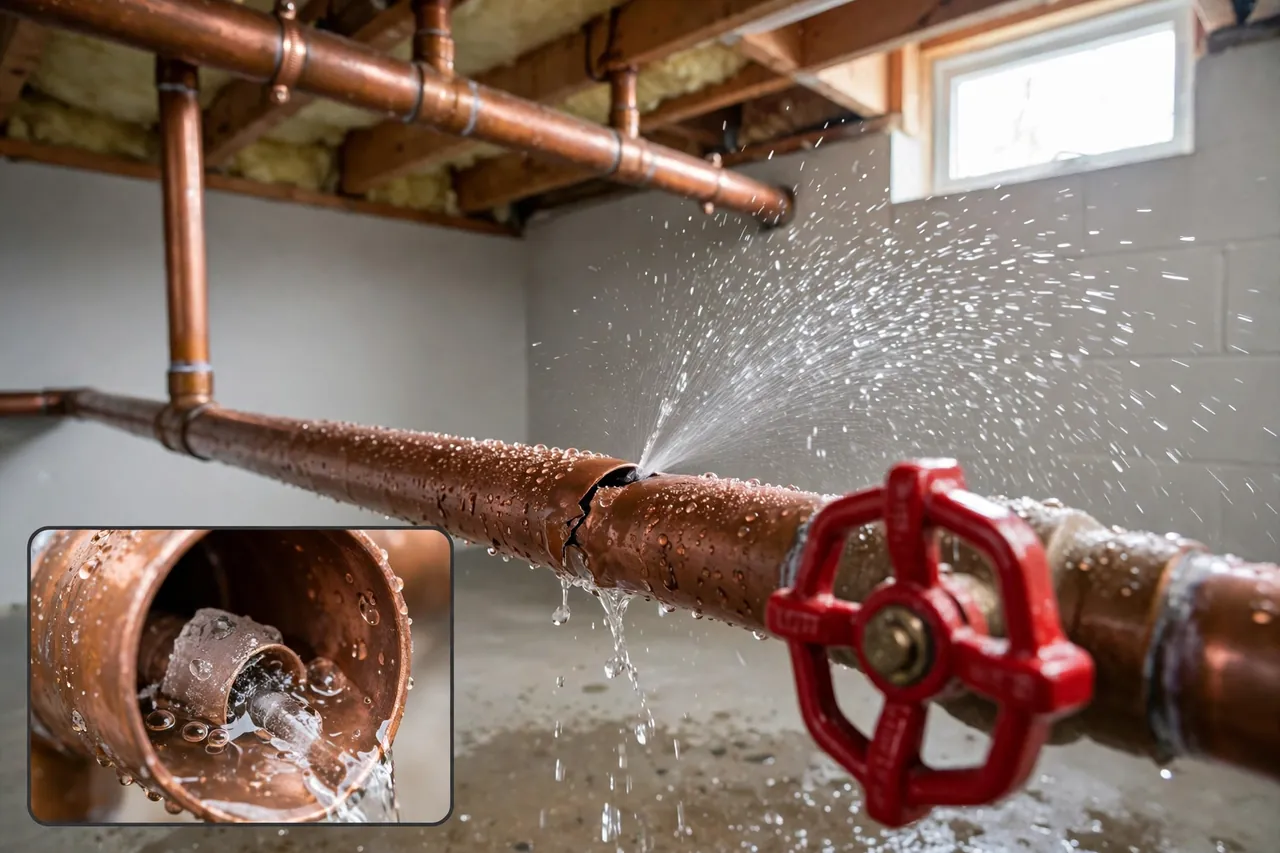
This is the fact that catches the most homeowners off guard. The pipe usually splits while it is frozen, but the flood waits for the thaw. While the pipe is frozen, the ice plug seals the split, so nothing leaks. The moment the ice melts, full water pressure returns through the crack, and the flood begins.
That timing matters for two reasons. First, the flood often starts when nobody is watching, such as overnight as temperatures rise, or while the family is out during the day. Second, many people relax when the cold snap ends, thinking the danger has passed, when the danger is actually just beginning. This Old House expert Richard Trethewey says it well: the exciting day is not the day it freezes, it is the day it thaws, when you can end up with water pouring into your basement.
That is why the thaw is the moment to watch. If you know a pipe froze, stay near the house as temperatures rise, keep an eye on ceilings and walls, and know exactly where your main water shutoff valve is before you need it. If you spot water where it should not be, shut off the main valve first, then call a plumber. If you suspect a pipe froze but you cannot find it, read our guide on how to tell if your pipes are frozen so you know what to check before the thaw. For what comes next, see whether frozen pipes thaw on their own and how long pipes take to unfreeze, so you know when the risky window opens and closes.
What to Do the Moment You Suspect a Freeze
You do not need a full thawing guide to protect your home in the first minutes. A few fast moves can limit the damage a lot, and they all come down to one idea: take the pressure out of the system before the thaw puts it back in.
- Open the faucet served by the frozen pipe, so melting water has somewhere to go and pressure can escape.
- Find your main water shutoff valve now, while nothing is leaking, and make sure it turns.
- If you can reach the frozen section safely, warm it gently with a hair dryer or towels soaked in hot water, and keep the faucet open while you work.
- Watch for leaks as the pipe thaws, and be ready to shut off the main valve at the first sign of water.
- If you cannot find the frozen section, or the pipe will not thaw, call a licensed plumber instead of forcing it.
Before you warm any pipe, read this warning carefully, because it decides whether your thaw stays safe. Never use a blowtorch, a kerosene or propane heater, a charcoal stove, or any open flame to thaw a pipe. An open flame can start a house fire, melt a plastic pipe, or heat one spot so fast that the pipe cracks. The American Red Cross gives the same warning, and the Lakeway Municipal Utility District repeats it: heat the pipe slowly and gently, or do not heat it at all and call a plumber. A frozen pipe is a plumbing problem, but a house fire is a disaster.
One more caution belongs here. If water has reached electrical outlets, appliances, or your breaker panel, stay away from the water and switch off power to the area only if you can do so safely from a dry place. If you cannot, leave the house and call for help. Water and electricity together are far more dangerous than a wet floor.
How Much Damage Can One Burst Pipe Cause?
The bill for a burst pipe has two parts: fixing the pipe, and fixing everything the water touched. The pipe repair is usually the smaller part. The water damage is where the money goes.
National insurance data gives a sense of scale. The Insurance Information Institute reports, via This Old House’s summary of its data, that water damage and freezing made up 22.6% of all homeowners insurance claims from 2019 to 2023, second only to wind and hail, and the average claim for water damage and freezing was $15,400 over that same period. About one in 67 insured homes files a water damage or freezing claim in a year. Those are averages, not promises: a small burst caught in minutes may cost far less, while a hidden burst that runs overnight can cost far more.
What pushes a bill up is time. Water that runs for ten minutes soaks a room. Water that runs all night soaks a floor. Water that leaks unseen for a week can mean new drywall, new flooring, new insulation, and mold cleanup. That is why finding your shutoff valve before winter is worth more than any repair skill. Every minute of running water adds damage, and the valve is the one thing that stops it.
Will Insurance Cover the Damage?
Most standard homeowners policies cover sudden and accidental water damage from a burst pipe, but the details vary, and a few common gaps catch people out. Policies usually pay for the damage the water caused, such as ruined floors and walls, but they often do not pay to repair or replace the failed pipe itself. Damage from a slow leak that went on for weeks, or from a pipe that froze because the heat was turned off, is often not covered.
The Lakeway Municipal Utility District advises homeowners to document everything from the moment they notice the problem, including the time, every step taken, and photos of the damage, because an insurer wants to see that reasonable steps were taken to prevent the problem. Some policies require the home to be kept heated, often at 55 degrees Fahrenheit or higher, so check your own policy before winter, not after a burst. If a pipe has burst, call your insurer early and ask what they need from you.
How to Tell If Damage Already Happened
After a freeze, do not assume the all-clear just because water flows again. A cracked pipe can hide for days, so give your home a careful check once everything has thawed.
- Watch your water meter. If no water is running in the house but the meter still moves, water is escaping somewhere.
- Look for damp patches, stains, or bubbling paint on ceilings and walls, especially below bathrooms and kitchens.
- Sniff for a musty smell in rooms that were dry before, which can point to wet material hidden behind a wall.
- Check under sinks and around the water heater for drips, puddles, or damp insulation.
- Listen for hissing or running water when every faucet is off.
- Watch for a sudden jump in your water bill, which can be the first sign of a slow hidden leak.
A water leak detector can catch the next leak before you do. A Wi-Fi water leak detector placed near the water heater or under a sink sends an alert to your phone the moment it senses water, and flood sensors in a basement or crawl space do the same job where a burst would pool first. They cannot stop a pipe from freezing, but they can turn an overnight flood into a ten-minute cleanup.
Related Guides
If a pipe in your home has frozen, these guides pick up where this one leaves off. Learn how to tell if your pipes are frozen before the thaw, find out whether frozen pipes thaw on their own, and check how long pipes take to unfreeze so you know how long the risky window lasts. A Wi-Fi water leak detector can also warn you the moment a thawed pipe starts leaking.
Frequently Asked Questions
Do frozen pipes always burst?
No. Many frozen pipes thaw with no damage, especially when a faucet was open so pressure could escape. The risk rises with rigid pipes like copper, long freezes, very cold temperatures, and old or weak joints. Because you cannot see inside the pipe, treat every frozen pipe as an emergency until it has fully thawed and you have checked for leaks.
What happens when pipes freeze?
The water inside turns to ice and expands by about 9%, forming a solid plug that blocks the pipe. Pressure then builds in the trapped water between the plug and the nearest closed faucet. That pressure can crack or burst the pipe, often away from the ice itself, and the leak usually appears when the ice thaws.
What happens if you get a burst pipe?
Water escapes under full household pressure and soaks floors, walls, ceilings, and belongings, often spreading far beyond the break. Mold can start in damp material within a day or two. Shut off the main water valve right away, move valuables out of the water, and call a licensed plumber.
Will my insurance cover the damage?
Most standard policies cover sudden and accidental water damage from a burst pipe, but they often do not pay to fix the pipe itself. Claims can be denied for slow leaks, neglect, or a home left unheated. Document everything with photos and notes, and check your policy for any heat-maintenance requirement before winter arrives.
Can my sewer lines freeze too?
It is rare, because sewer lines are not pressurized and usually sit below the frost line. It can still happen in extreme cold, and foul odors from drains can be a warning sign that ice is blocking a drain line. If you suspect a frozen sewer line, call a plumber rather than trying to thaw it yourself.
Freezing weather tests every weak spot in a home’s plumbing, but the damage is rarely a mystery once you know the chain: ice, pressure, a crack, and then the thaw. Walk your home before the next cold snap, find your main shutoff valve, and check the coldest corners for bare pipes. If a pipe does freeze, keep a faucet open, warm it gently or call a plumber, and watch closely as it thaws. That is the moment that decides whether a freeze stays a scare or becomes a flood.
Disclaimer: This guide explains what happens when pipes freeze so you can spot trouble early. It is general home information, not plumbing advice for your specific home. If a pipe has burst, water has reached wiring or appliances, or you cannot find or safely reach the frozen section, shut off your water and call a licensed plumber right away.


