
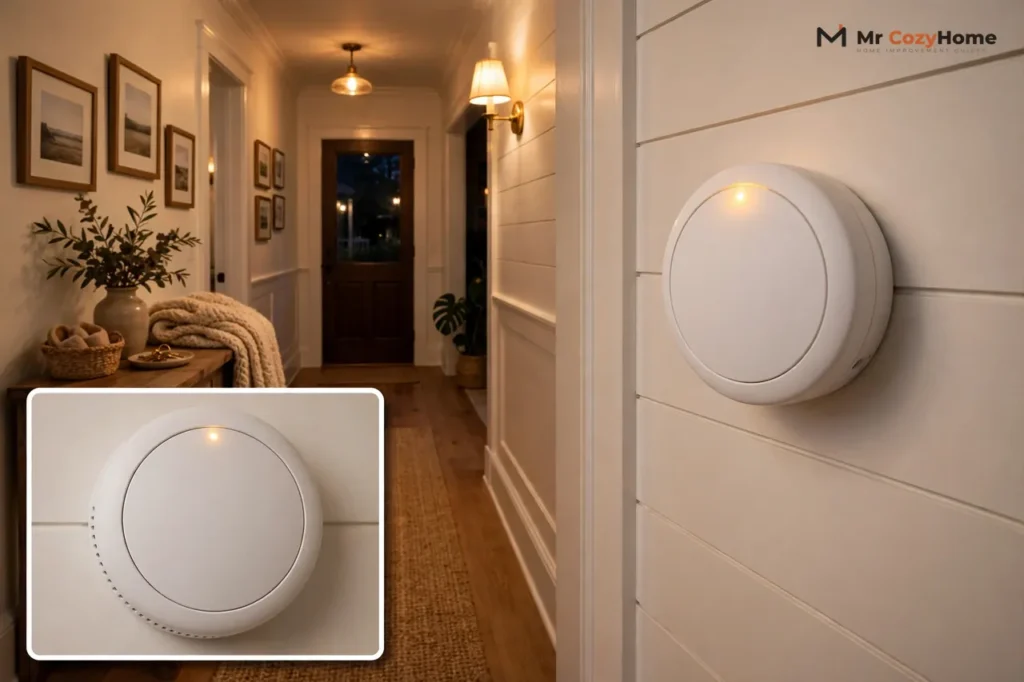
A carbon monoxide alarm sounds like four loud, fast beeps, then a short pause, then four loud beeps again — and it keeps repeating until the danger clears. That four-beep pattern is the sound that means carbon monoxide may be in your home. Learn it now, because in the middle of the night you will not have time to look it up.
If you hear that pattern right now, get everyone outside into fresh air and call 911 from outside. Do not stay inside to check the stove, open windows, or find the source first. The beeps alone cannot tell you how much gas is in the air, only that the level is dangerous.
The Short Answer: Four Loud Beeps, a Pause, Then Four Again
A carbon monoxide alarm sounds like four loud beeps in a row, a short pause, and then four loud beeps again. The pattern repeats without stopping. Kidde describes its alarm pattern as four short beeps, five seconds of silence, and then four short beeps again, and First Alert describes the same sound as four loud beeps in a repeating pattern.
The sound is loud on purpose. First Alert rates its alarm horn at 85 decibels, which is loud enough to wake a sleeping person. Kidde uses the same kind of loud horn on its alarms. The beeps are sharp and fast, not slow and musical, and they do not fade away on their own.
Here is the part that trips people up: your alarm makes other sounds too. A single soft chirp once a minute is not the emergency alarm, and five chirps in a row is not the emergency alarm either. Only the loud four-beep pattern means carbon monoxide. The rest of this guide teaches you to tell each sound apart in seconds.
Every Sound Your CO Alarm Can Make
Your alarm speaks in patterns, and each pattern is a different message. Count the beeps, then check the pause between them. This table covers the sounds you are most likely to hear on a Kidde or First Alert alarm, the two brands in most American homes.
Table: Every sound your carbon monoxide alarm can make, what it means, and what to do.
| Sound | What it means | What to do |
| 4 loud beeps, pause, repeat | Carbon monoxide detected | Leave now, call 911 from outside |
| 3 loud beeps, pause, repeat | Smoke or fire | Leave now, call 911 from outside |
| 1 short chirp every 60 seconds | Low battery | Replace the battery today |
| 1 chirp every 30 seconds (Kidde) | End of life or fault | Replace the alarm |
| 5 chirps every minute (First Alert) | End of life | Replace the whole alarm |
| 3 chirps every minute (First Alert) | Fault | Replace the alarm |
| 1 long, continuous squeal (Kidde) | Tamper warning or fault | Check the plug, then call support |
| Voice says “Warning! Carbon Monoxide!” | CO detected (combo alarm) | Leave now, call 911 from outside |
Keep this table in mind as you read the sections below. Each row gets its own plain-English explanation, with the exact timing and the brand differences that matter.
The Full Alarm: Four Beeps Means Carbon Monoxide
When your alarm senses a dangerous level of carbon monoxide, it sounds four short beeps, goes quiet for about five seconds, and then sounds four short beeps again. Kidde states this pattern on its support page for beeping and chirping alarms, and First Alert states the same four-beep repeating pattern on its alarm-sounds support page. The two brands agree because the pattern is an industry standard, not a brand choice.
Fire safety pros call this the Temporal-4 pattern, or T4 for short. The “4” stands for the four beeps. Its partner, the smoke alarm pattern, is Temporal-3, or T3, with three beeps. The National Fire Protection Association built its “Learn the Sounds of Fire Safety” campaign around this exact split: three beeps means smoke, four beeps means carbon monoxide.
The alarm also flashes a red light in time with the beeps, so you get a visual clue along with the sound. If your alarm has a digital display, it may show a number while it sounds. That number is the carbon monoxide level in parts per million. A steady number on the display with the four-beep pattern is still an alarm, so treat it the same way: get out.
One more thing to know: the alarm does not sound the moment a tiny trace of gas appears. It waits until the level and the time together cross a danger line. That is why you should never assume a quiet alarm means zero gas in the air. It means the level has not yet reached the point where the alarm must sound.
If the four-beep pattern starts, follow the steps in our guide on what to do if your carbon monoxide alarm goes off. The short version is simple: get everyone out, call 911 from outside, and stay out until firefighters say it is safe.
The Smoke Alarm Sound: Three Beeps, Not Four
A smoke alarm sounds like three loud beeps, a pause, and then three loud beeps again. First Alert describes it as three loud beeps in a repeating pattern at 85 decibels, the same volume as its carbon monoxide alarm. The only difference is the count: three for smoke, four for carbon monoxide.
This is where most confusion starts. Many homes have combination alarms that detect both smoke and carbon monoxide in one unit. When a combination alarm sounds, you have to count the beeps before you know which danger you face. Three beeps means smoke or fire. Four beeps means carbon monoxide. Both mean get out and call 911, so do not stand in the hallway trying to decide which one is worse.
Some combination alarms help you out with a voice. On the Kidde combination alarm, the fire pattern is three long beeps followed by the spoken words “FIRE! FIRE!” and the carbon monoxide pattern is four short beeps followed by “WARNING! CARBON MONOXIDE!” The voice removes all doubt, which is a real help at 3 a.m. when you are half asleep.
If you are not sure whether the unit on your ceiling is a smoke alarm, a CO alarm, or both, look at the label on its front or back. It will say smoke, carbon monoxide, or both. Our guide on do smoke detectors detect carbon monoxide explains the difference between the two devices in full. Not sure which detector to buy? See our best carbon monoxide detector guide.
The Low-Battery Chirp: One Short Chirp Every Minute
The sound most people actually hear is not the alarm at all. It is a single short chirp about once every minute, with long stretches of silence in between. That chirp means the battery is low and needs to be replaced. Both Kidde and First Alert use one chirp every 60 seconds for a low battery.
Notice how different this is from the emergency alarm. The alarm is four loud beeps close together, repeating every few seconds. The low-battery chirp is one soft, short sound, once a minute. It is easy to hear at night because the house is quiet, and it is easy to mistake for something else, like a dying smoke alarm in another room or a toy with a weak battery.
Here is how to pin it down. Stand still and count. If you hear one chirp, then silence for about a minute, then one chirp again, it is a maintenance sound, not an emergency. Walk toward the sound until you find the unit that chirps. Then check the light: many alarms blink a small light in time with the chirp.
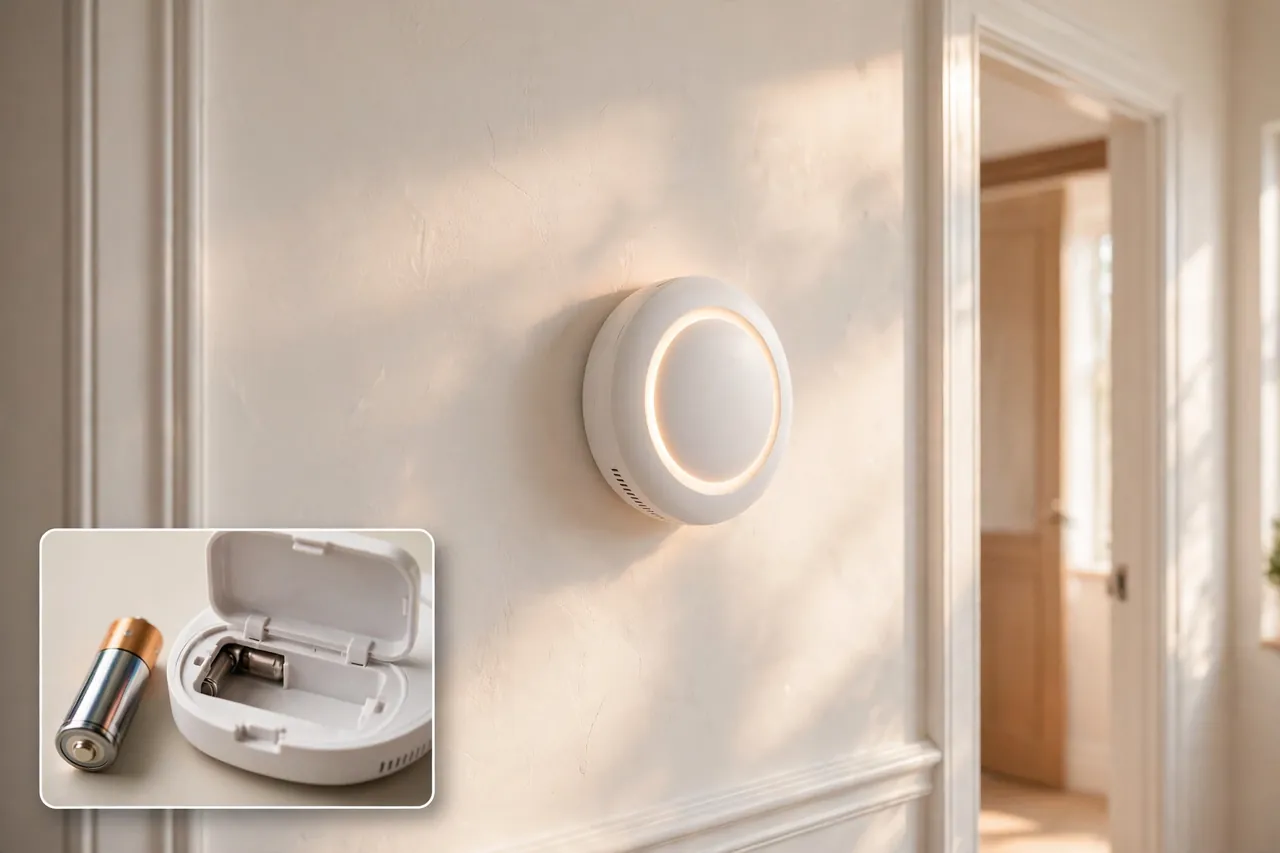
Replace the battery the same day you hear the chirp. A CO alarm with a dead battery cannot protect you, and the chirp will not stop on its own. If your alarm has a sealed battery that you cannot replace, a low-battery chirp means the whole unit is near the end of its life, so plan to replace it, not the battery.
One warning: if the chirp keeps going after you put in a fresh battery, that is not a battery problem anymore. Kidde says a chirp that continues after a battery change can mean the alarm has reached the end of its life or has a fault, and the unit needs to be replaced.
The End-of-Life Signal: When the Alarm Itself Is Done
A carbon monoxide alarm does not last forever. The sensor inside wears out over time, and when it does, the alarm tells you with an end-of-life signal. This is where Kidde and First Alert part ways, so the brand on your wall matters.
On a Kidde alarm, the end-of-life warning is a chirp every 30 seconds, starting seven years after the alarm was first powered up. Kidde is blunt about what this means: the chirp will not stop until you switch the unit off, and the alarm cannot detect carbon monoxide once it enters end-of-life mode. Replace it right away.
On a First Alert alarm, the end-of-life warning is five chirps every minute. The First Alert CO605 manual and the SMICO100-AC combination alarm manual both list five chirps every minute as the end-of-life signal, with five green light flashes to match. Some First Alert models with a display show the word “End” instead of, or along with, the chirps.
Notice the trap here. A chirp every 30 seconds on a Kidde and five chirps every minute on a First Alert both mean the same thing: the sensor is worn out and the whole unit must go. A new battery will not fix it. Pressing the silence button only buys you a little time: First Alert lets you quiet the end-of-life chirp for up to two days, and Kidde lets you silence it for 24 hours at a time on its sealed-battery models, but after 30 days that silence feature stops working. Either way, the fix is a new alarm, not a new battery.
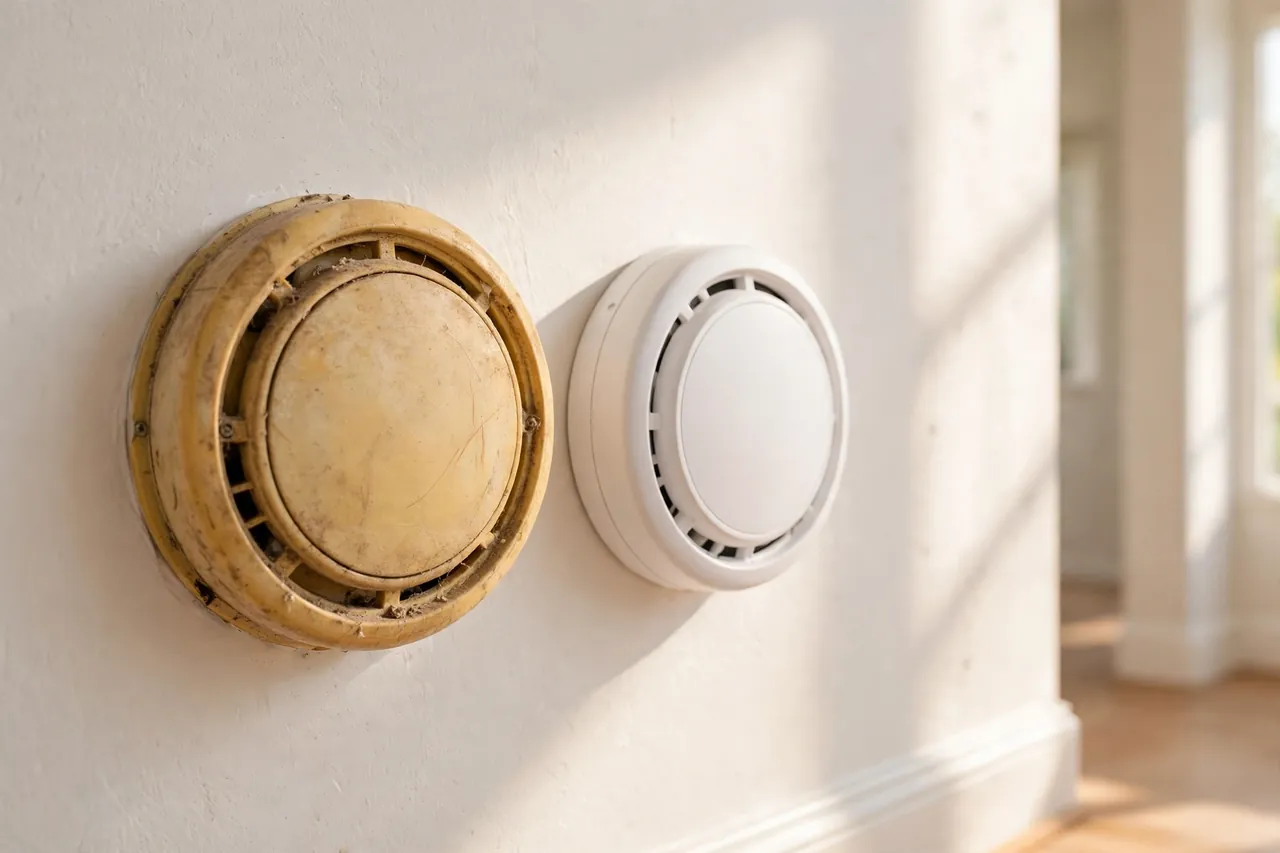
Check the date on the back of your alarm. It carries a manufacture date or a replace-by date. Kidde hints that if you installed your alarms five to seven years ago, it is time for new ones. If yours is past that age and it chirps in one of these patterns, do not troubleshoot it. Replace it.
Other Sounds: Malfunction Chirps, Voice Alerts, and the Test Sound
Not every sound fits the four big patterns, so here are the rest, with the brand detail that keeps you from guessing.
What does three chirps every minute mean?
On a First Alert alarm, three chirps every minute is the malfunction signal. The sensor or the electronics inside have failed, and the alarm may not warn you in a real emergency. First Alert pairs this sound with three green flashes of the power light about once a minute. Kidde uses a different signal for a fault: on many Kidde models, one chirp every 30 seconds can also mean a malfunction, and Kidde tells you to call its product support line at 1-800-880-6788 when that happens. When the chirp pattern does not match the low-battery or end-of-life pattern for your brand, treat it as a fault and replace the unit.
What does a long, continuous squeal mean?
Kidde lists one long, continuous squeal as a tamper warning or a fault. On a plug-in model, it can mean the unit has come loose from the outlet or someone unplugged it. Push it firmly back into the outlet and see if the sound stops. If it keeps squealing, Kidde says to call product support, because the unit itself may have failed.
What does the alarm sound like when you test it?
Pressing the test button plays the real alarm pattern on purpose, so you can learn the sound while you are calm. On a First Alert combination alarm, the test plays three beeps, a pause, and three beeps for smoke, then four beeps, a pause, and four beeps for carbon monoxide. On a Kidde CO alarm, the test plays four loud pulses, a pause, four loud pulses, and then a single beep. Test once a month, and test after you change a battery, so you know the horn still works.
Do some alarms talk instead of just beeping?
Yes. Many newer combination alarms add a voice to the beeps, as the Kidde combination alarm does with “FIRE! FIRE!” and “WARNING! CARBON MONOXIDE!” Some First Alert models also speak or show words on a display. A voice does not change the meaning of the beeps. It just makes the message harder to miss, which is the whole point.
Kidde vs. First Alert: Do They Sound Different?
For the sound that matters most, no. Both brands use the same four-beep emergency pattern for carbon monoxide and the same three-beep pattern for smoke. Both sound their horns at 85 decibels. If you learn the four-beep pattern, it works in any home, on either brand.
The differences show up in the maintenance sounds, and that is where people get confused. Kidde signals end of life with a chirp every 30 seconds, while First Alert signals it with five chirps every minute. Kidde signals a fault with a chirp every 30 seconds on many models, while First Alert signals a fault with three chirps every minute. Same message, different rhythm.
The fix is simple: read the label on the back of your own alarm. It lists the sounds and the replace-by date for that exact model. If you threw the manual away, search the brand and model number online and pull up the manual. Two minutes with the manual beats an hour of guessing at 2 a.m.
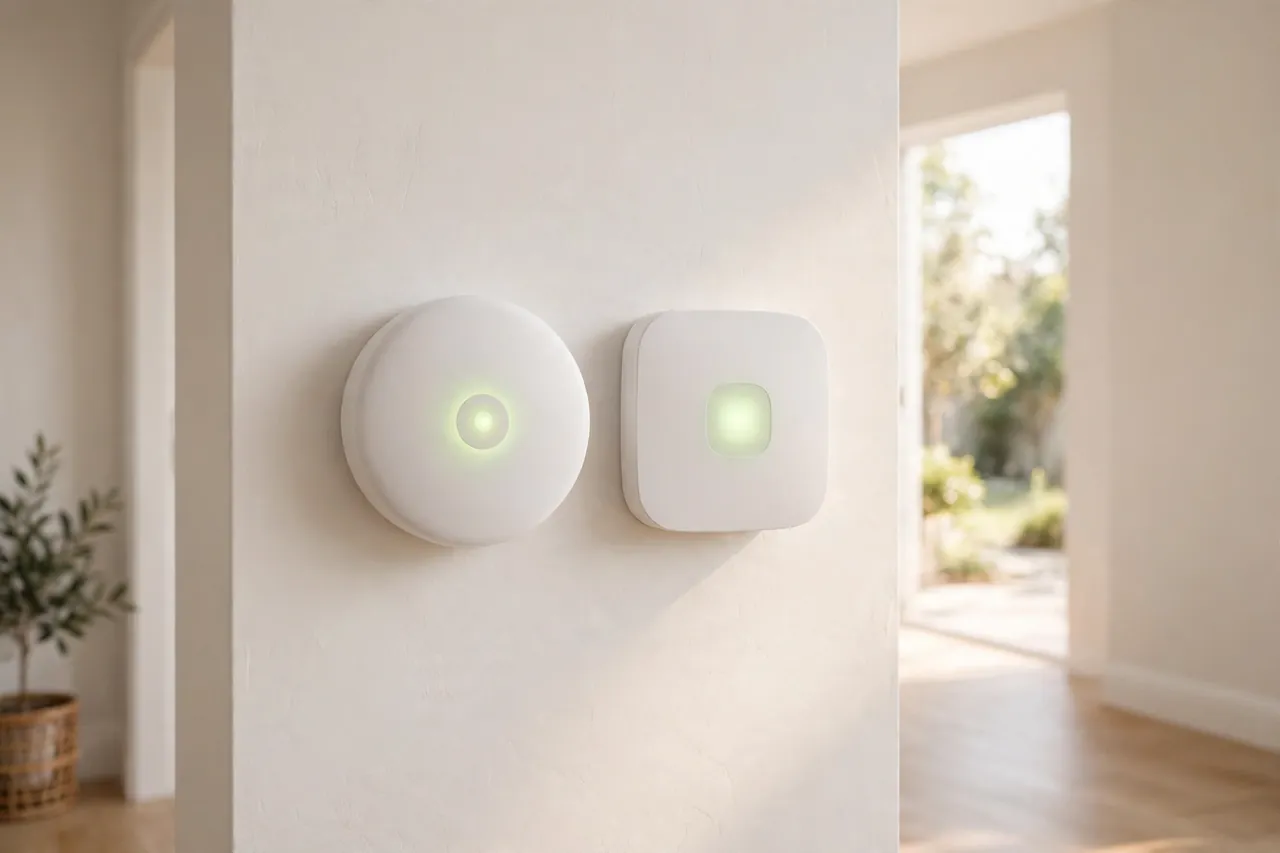
How to Hear the Sound Safely: Test Your Alarm
The best time to learn the sound is now, while nothing is wrong. A monthly test takes less than a minute, and it teaches your whole family the sound at the same time.
- Tell everyone in the house that you are about to test the alarm, so no one panics.
- Press and hold the test button on the front of the alarm until the horn sounds.
- Listen for the full pattern: four loud beeps, a pause, and four loud beeps again on a CO alarm, or three beeps then four beeps on a combination alarm.
- Check that the red light flashes in time with the beeps and that the sound is loud and clear.
- Let the test finish on its own. Do not pull the battery or unplug the unit to stop it.
If the horn sounds weak, muffled, or not at all, replace the battery first and test again. If it still sounds weak, replace the whole alarm. A quiet alarm is a broken alarm, and a broken alarm cannot wake you.
Never test an alarm with real smoke or gas from a stove or a car exhaust. The test button exists so you never have to do that. It plays the same horn pattern the real alarm uses, with none of the risk.
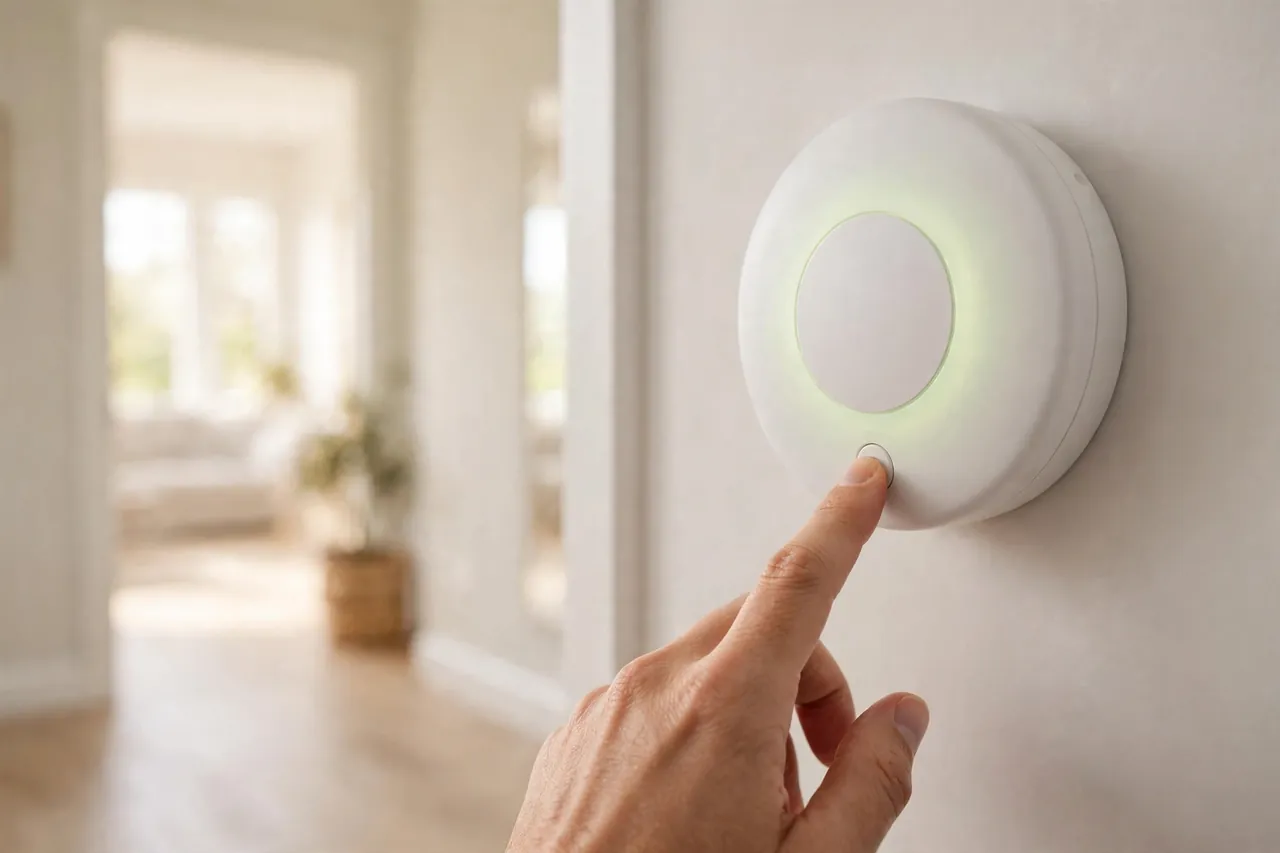
What to Do the Second You Hear the Four-Beep Alarm
Count first, then move. Four loud beeps, a pause, and four loud beeps again is the emergency pattern. Get everyone, including pets, out into fresh air right away. Call 911 or your fire department from outside the house, not from inside. Stay outside until firefighters tell you it is safe to go back in.
Do not open windows to air the house out first. Do not hunt for the source of the gas. Do not press the silence button and go back to bed. Carbon monoxide has no smell and no color, so you cannot judge the danger by looking around or sniffing the air. When the alarm sounds its full pattern, believe it.
Our full step-by-step guide on what to do if your carbon monoxide alarm goes off walks through the whole response, including what to tell the 911 dispatcher and what happens when firefighters arrive. Read it now, while you are calm, so you do not have to read it during an emergency.
Quick Sound Check: Name That Beep
Use this checklist the next time a sound wakes you up. Work from the top down and stop at the first match.
- Four loud beeps, pause, repeat: carbon monoxide emergency. Leave and call 911 from outside.
- Three loud beeps, pause, repeat: smoke or fire. Leave and call 911 from outside.
- One short chirp every minute: low battery. Replace the battery today.
- Chirp every 30 seconds on a Kidde, or five chirps a minute on a First Alert: end of life. Replace the whole alarm.
- Three chirps a minute on a First Alert: fault. Replace the alarm.
- One long squeal on a Kidde: check the plug, then call Kidde support at 1-800-880-6788.
- Not sure, or the pattern matches nothing here: treat it as an emergency, get out, and call 911.
When in doubt, getting out is always the right call. Firefighters would rather check a false alarm than find a family that waited too long.
Related Guides
Do Smoke Detectors Detect Carbon Monoxide? · What to Do If Your Carbon Monoxide Alarm Goes Off · Does CO Rise or Fall? The Science and Where to Put Your Detector
Frequently Asked Questions
What does it sound like when a carbon monoxide detector goes off?
It sounds like four loud, fast beeps, a short pause, and then four loud beeps again, repeating without stopping. Kidde describes the pause as five seconds of silence, and First Alert describes the same four-beep repeating pattern at 85 decibels. If you hear it, get outside into fresh air and call 911 from outside.
What sound does a First Alert carbon monoxide detector make?
A First Alert carbon monoxide alarm makes four loud beeps in a repeating pattern when it detects dangerous CO levels. Its horn sounds at 85 decibels. One chirp every minute means a low battery, three chirps every minute means a fault, and five chirps every minute means the alarm has reached the end of its life.
Can a low battery sound like a real carbon monoxide alarm?
No. A low battery is one short, soft chirp about once every minute, with long silences between chirps. A real alarm is four loud beeps close together, repeating every few seconds. The two sounds are easy to tell apart once you count the beeps and the gap between them.
Why is my carbon monoxide alarm beeping?
It is beeping for one of four reasons: it has detected carbon monoxide, its battery is low, it has reached the end of its life, or it has a fault. Count the beeps and the timing. Four loud beeps mean danger, one chirp a minute means a low battery, and a steady chirp pattern that survives a new battery means the unit must be replaced.
When should I worry about a carbon monoxide detector?
Worry right away if you hear the four-beep alarm pattern, or if anyone in the house has a headache, dizziness, nausea, or confusion while an alarm sounds. Get outside and call 911 from fresh air. A single chirp once a minute is not an emergency, but fix it the same day by replacing the battery.
A Short Safety Note
This guide explains alarm sounds so you can tell them apart, but it cannot replace your alarm’s own manual or the advice of your local fire department. Homes, alarm models, and local rules vary, so check the manual for your exact model and call a qualified technician or your fire department when you are unsure. If your alarm ever sounds its full four-beep pattern, leave the house and call 911 from outside. Do not stay inside to investigate.
The Sound to Remember
Four beeps means carbon monoxide. Three beeps means smoke. One chirp a minute means a low battery. That is the whole system in three short lines, and it is worth teaching to everyone in your home, including kids old enough to understand it.
Go test your alarm today. Press the button, listen to the pattern, and check the date on the back. A one-minute test now is the cheapest safety check in your whole house.


