
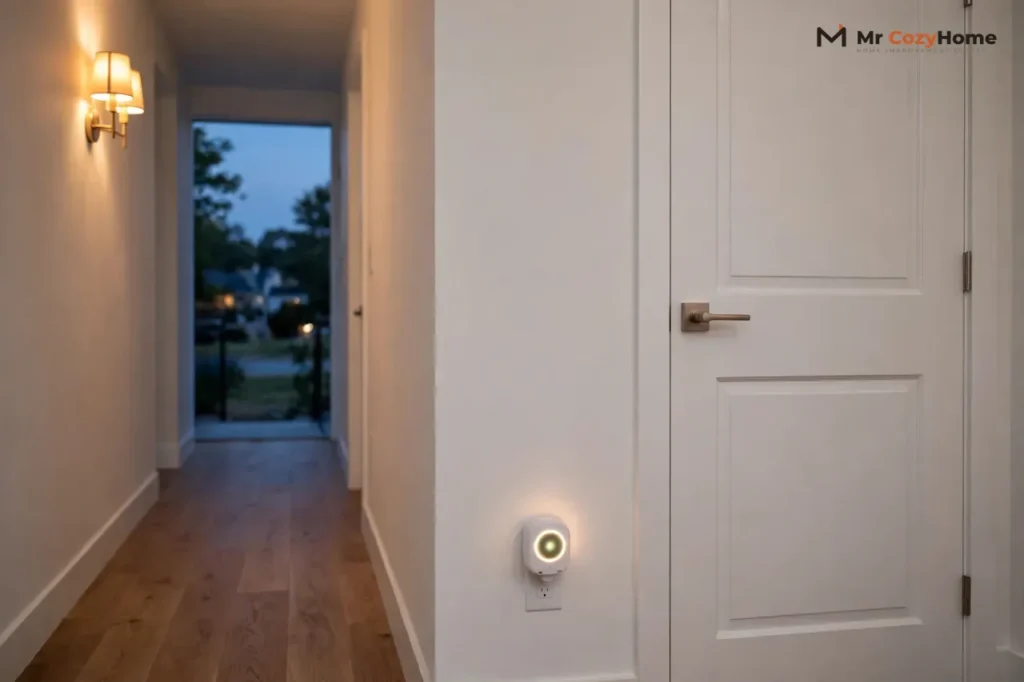
The best carbon monoxide detector for most homes is the Kidde COPD plug-in alarm, about $44. It has an electrochemical sensor, a backlit display that shows live CO levels, and AA battery backup, and it meets the newest UL 2034 5th Edition standard. The Centers for Disease Control and Prevention (CDC) reports that more than 400 Americans die each year from unintentional carbon monoxide poisoning not linked to fires — and a working detector is the only warning you get, because the gas has no smell, no color, and no taste.
Before you look at the picks, guess: which detector on this list costs $27, and which one costs $130? The answer is in the table below — and one more thing in this guide matters just as much as the price. In August 2026, the U.S. Consumer Product Safety Commission (CPSC) told Americans to stop using a whole family of cheap detectors because they can fail to sound at all.
What Carbon Monoxide Is — and Why It Kills Without Warning
Carbon monoxide (CO) is a poisonous gas made when fuel does not burn completely. Gas furnaces, water heaters, fireplaces, stoves, and generators all make it, and so does a car running in an attached garage. You cannot see it, smell it, or taste it, so your senses give you no warning at all.
CO harms you by binding to hemoglobin — the part of your blood that carries oxygen — far more readily than oxygen does. Your blood keeps circulating, but it stops carrying what your body needs. That is why the early symptoms feel vague and ordinary: the CDC lists headache, dizziness, weakness, upset stomach, vomiting, chest pain, and confusion, and describes them as “flu-like.” The tell is the pattern: CO causes no fever, it strikes everyone in the house at once, including pets, and it eases when you leave the building and returns when you come home.
The numbers make the stakes plain. The CDC reports that more than 400 Americans die each year from unintentional CO poisoning not linked to fires, more than 100,000 visit an emergency department, and more than 14,000 are hospitalized. Deaths cluster in the cold months, when heating runs and windows stay shut. And the CDC warns that people who are sleeping, drunk, or under the influence of other substances can die from CO poisoning before they have symptoms — which is exactly why the alarm has to do the noticing. That is the whole job of the detector on your hallway wall.
How to Choose the Best Carbon Monoxide Detector
Choosing a carbon monoxide detector comes down to five checks: UL 2034 listing, an electrochemical sensor, the right power source for the spot, a display you can read, and enough units to cover your home. Get those five right and almost any name-brand alarm will protect you; get the first one wrong and nothing else matters.
First, the listing is non-negotiable: buy only a UL 2034-listed CO alarm. The CPSC says so plainly, and the standard is what makes an alarm trustworthy. Under UL 2034, an alarm must sound within 4 to 15 minutes at 400 parts per million (ppm) and within 60 to 240 minutes at 70 ppm, while ignoring a steady 30 ppm so everyday traces do not set it off. In August 2026, the CPSC warned Americans to stop using KH158 gas and CO detectors — 376,974 units sold under 18 brand names — after 91 known failures to alarm. Cheap unlisted detectors are not a bargain; they are the one purchase where a low price can cost everything.
Second, the sensor should be electrochemical. That is the technology in every pick on this list: it measures CO concentration accurately and wears out predictably, so the alarm knows when its own sensor has reached the end of its life and tells you. Third, match the power to the spot. Plug-in alarms with battery backup suit hallways with an outlet; sealed 10-year battery alarms suit spots with no outlet; hardwired alarms with battery backup suit whole-home systems where one alarm triggers them all.
Fourth, a digital display is worth paying a few dollars for. It shows live CO levels in ppm, so you can see a small reading climb before it becomes dangerous, and most displays store the peak level — useful for a technician hunting the source. Fifth, think in units, not in one unit: the CPSC calls for an alarm on every level of your home and outside each sleeping area, so most homes need two to four. A $27 alarm in the right three places beats a $130 alarm in the wrong one place. That math shapes every pick below.
The 7 Best Carbon Monoxide Detectors for 2026
These seven picks cover every home: plug-in, battery, hardwired, smart, and budget. Every one is UL 2034 listed with an electrochemical sensor, and every price below was checked on November 10, 2026. Amazon listing prices move daily, so confirm the price at checkout — the list prices from the manufacturers’ own stores are the stable numbers.
Table: The 7 best carbon monoxide detectors, with prices checked November 10, 2026
| Detector | Best for | Power | Price |
|---|---|---|---|
| Kidde COPD | Most homes | Plug-in, AA backup | About $44 |
| First Alert SC5 | Smart home | Battery or hardwired | $129.99 |
| Kidde 30CUA10-V | Hardwired combo | Hardwired, 10-yr backup | $74.97 |
| Kidde 30CUD10-V | Battery combo | 10-yr sealed battery | $74.97 |
| Kidde Nighthawk KN-COPP-3 | Classic plug-in | Plug-in, 9V backup | About $70 |
| First Alert CO615 | Bedrooms | Plug-in, battery backup | About $73 |
| Kidde COBD | Budget | AA batteries | About $27 |
1. Kidde COPD — Best Overall
The Kidde COPD is the pick for most homes because it does the essentials right at a price that lets you buy three of them. It plugs into any outlet, shows live CO levels on a backlit display, runs on two AA batteries when the power goes out, and meets the newest UL 2034 5th Edition standard. Its rotating plug fits outlets other plugs block, and the 85 dB alarm is loud enough to wake a sleeping house. At about $44 on Amazon, it is the rare case where the best value and the best overall pick are the same unit.
2. First Alert SC5 — Best Smart Detector
The First Alert SC5 is the smart pick, and the right one if you are replacing a Google Nest Protect. Google stopped making Nest Protect in 2025 and pointed buyers to First Alert, and the SC5 uses the exact same mounting bracket, so a swap takes minutes with no new holes. It sends phone alerts through the First Alert app, speaks the danger and the room out loud, and interconnects wirelessly so every alarm sounds together. The battery model (SMCO600NV) lists at $129.99 and the hardwired model at $129.95 on the First Alert store. It is the most expensive pick here, but it is also the only one that warns you when you are not home.
3. Kidde 30CUA10-V — Best Hardwired Smoke and CO Combo
If your home already has hardwired smoke alarms, the Kidde 30CUA10-V replaces one ceiling unit with a combination smoke and CO alarm that wires into the same system. It carries a 10-year backup battery, so it never needs a battery change, and it uses voice alerts that say whether the danger is smoke or carbon monoxide and where it is. When one alarm sounds, they all sound. At $74.97 on Kidde’s own store, it is the cheapest way to add CO coverage to a wired home without a single new wire.
4. Kidde 30CUD10-V — Best Battery Combo, No Wiring Needed
The Kidde 30CUD10-V is the same combination smoke and CO alarm as the pick above, but it runs on a sealed 10-year battery with no wiring at all. That makes it the pick for renters, for rooms with no hardwired alarm, and for anyone who wants a combo unit without calling an electrician. It has the same voice alerts and the same 10-year sealed battery, and it interconnects wirelessly with other Kidde units. It also lists at $74.97 on Kidde’s store.
5. Kidde Nighthawk KN-COPP-3 — Best Classic Plug-In
The Kidde Nighthawk KN-COPP-3 is the long-running classic: a plug-in alarm with a digital display, a 9-volt battery backup, and peak-level memory that stores the highest CO reading it has seen. It has been the default plug-in recommendation for years, and its display is the feature that made digital readouts standard on CO alarms. At about $70 on Amazon it now costs more than the newer COPD, which does the same job for less — so buy the Nighthawk if you already trust it, and buy the COPD if you are starting fresh.
6. First Alert CO615 — Best Plug-In for Bedrooms
The First Alert CO615 is the plug-in pick for bedrooms because it pairs a backlit digital display with a loud 85 dB alarm and a battery backup that keeps it watching through a power cut. The display shows live CO levels at a glance in the dark, and the unit is slim enough to sit in a hallway outlet without blocking the second socket. At about $73 for one, or $128.10 for a three-pack on the First Alert store, it is the simplest way to cover every bedroom hallway in one order.
7. Kidde COBD — Best Budget Detector
The Kidde COBD is the honest budget pick: a battery-powered CO alarm with an electrochemical sensor and an 85 dB alarm for about $27. It has no display and no smart features, but it has the two things that matter — the right sensor and the right listing — and it runs on user-replaceable AA batteries, so you change the battery on your schedule instead of replacing the whole unit. Buy it for a rental apartment, a single room, or as a second unit near a bedroom. A $27 alarm that sounds is worth infinitely more than a $130 alarm you never bought. The one thing it cannot do is show you a reading, so pair it with a display model in the hallway if you want numbers as well as noise.
Where to Put Carbon Monoxide Detectors in Your Home
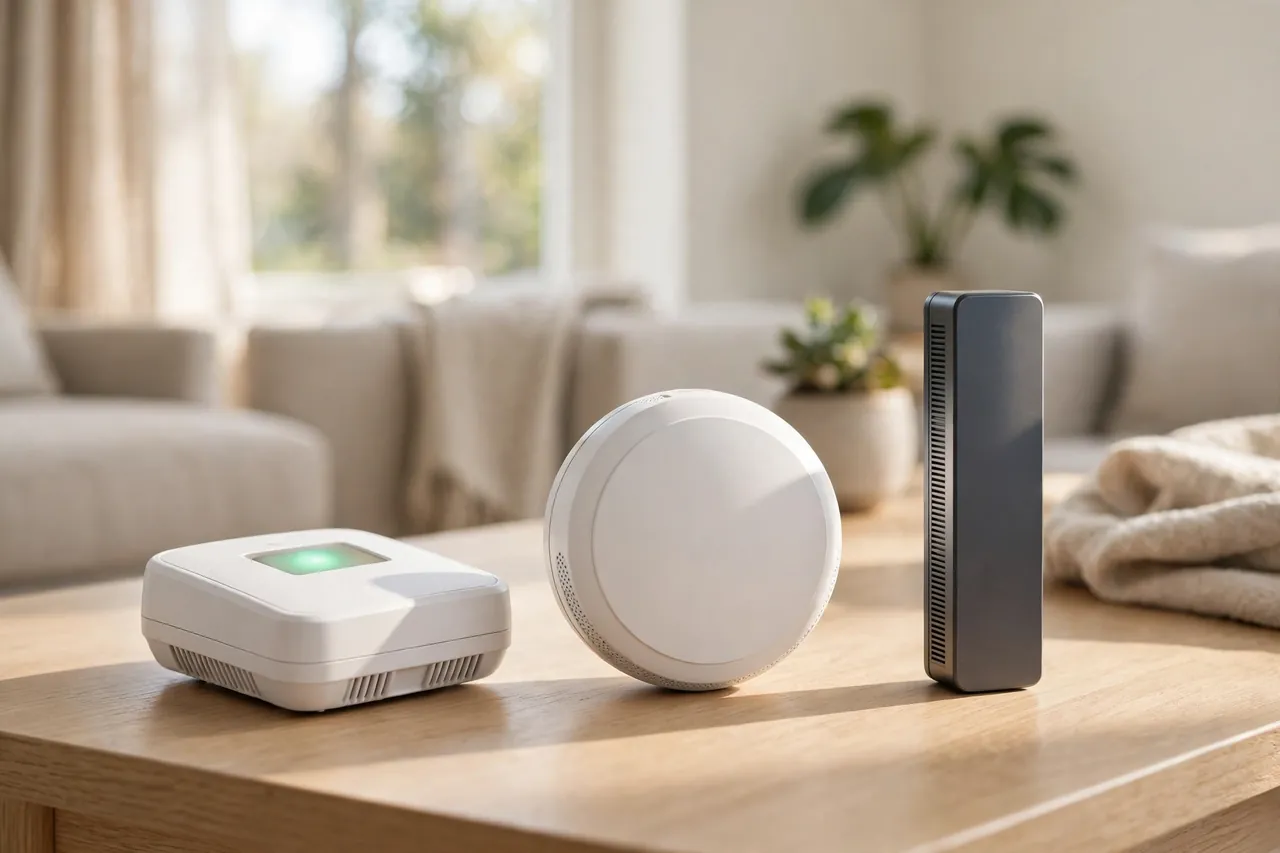
Put a carbon monoxide detector outside each sleeping area and on every level of your home, including the basement. That is the rule the National Fire Protection Association (NFPA) and the CPSC agree on, and it is the minimum — not the ideal. If you buy only one detector, put it in the hallway outside the bedrooms, where it can wake you.
Distance matters as much as location. Keep alarms about 15 feet from fuel-burning appliances — the furnace, water heater, range, and fireplace — because closer can mean nuisance alarms from normal traces of CO. Do not put an alarm in the garage, the furnace room, or a bathroom, and do not put one in an attic or a basement unless that space includes a sleeping area. The CPSC draws that line clearly, and the reason is simple: an alarm where nobody sleeps cannot wake anyone, and an alarm next to a furnace cries wolf until you stop listening to it.
Height follows the manufacturer’s instructions for your model, not a rule of thumb. Carbon monoxide mixes evenly with room air, so there is no magic height — the manual for your alarm tells you where that model works best, and following it is part of using the alarm correctly. The full science behind that, and why the old “CO rises to the ceiling” idea is wrong, is in our guide on whether CO rises or falls. One more placement rule: if your bedrooms sit at opposite ends of a long hallway, or on different floors, each group needs its own alarm. A single alarm in the middle of a 40-foot hallway may not be loud enough to wake everyone, and an alarm that cannot wake you is decoration. The next section covers what the alarm actually sounds like, so you know it the instant you hear it.
Does Carbon Monoxide Rise or Fall?
Carbon monoxide mixes evenly with the air in a room, so it neither pools on the floor nor rises to the ceiling. CO is very slightly lighter than air, but the difference is so small that normal air movement — heating, cooling, people walking through a room — mixes it completely. That is why placement height is not the deciding factor, and why the alarm’s manual, not a rule of thumb, tells you where to mount your model.
The “CO rises” idea comes from confusing carbon monoxide with hot air: warm air from a furnace does rise, and it can carry CO with it, but the gas itself does not float upward on its own. The practical result is the same either way — put the alarm outside the sleeping area and on every level, at the height your manual specifies, and stop worrying about high versus low. Our full guide explains the science of whether CO rises or falls, including why ceiling mounting is fine for some models and wrong for others. What matters far more than height is recognizing the sound, which is next.
What Does a Carbon Monoxide Alarm Sound Like?
A carbon monoxide alarm sounds four quick beeps, a pause, then four beeps again, repeating until the CO clears or you silence it. That four-beep pattern is the standard temporal signal for CO, and it is deliberately different from a smoke alarm’s three-beep pattern, so you can tell the two apart in the dark. Learn the four-beep pattern now, while you are calm, because you do not want to be decoding it at 3 a.m.
A single chirp every 30 to 60 seconds is a different message: low battery or end of life. Check your manual, change the battery if the model takes one, and if the chirp continues, replace the whole alarm — a chirping alarm is telling you its sensor has reached the end of its working life. Our guide on what a carbon monoxide alarm sounds like covers the full pattern, the difference from a smoke alarm, and the chirps. And the pattern only helps if you know what to do when you hear it, which is the next section — the most important one in this guide.
What to Do When Your Carbon Monoxide Alarm Goes Off
When your carbon monoxide alarm sounds, get everyone outside into fresh air immediately and call 911 from outside. Do not open windows first, do not turn appliances off first, and do not go back inside to look for the source. Fresh air first, phone call second, everything else later.
- Get out now. Take everyone, including pets, outside into fresh air. Move quickly and calmly, and do not stop to open windows, turn off the furnace, or grab belongings.
- Call 911 from outside. Tell the dispatcher your CO alarm is sounding. Do not call from inside the house.
- Do not go back inside. Not for a phone, not for a pet you left behind, not to check the furnace. Wait for emergency responders.
- Get medical help for symptoms. If anyone has a headache, dizziness, nausea, confusion, or chest pain, tell the responders. You can also call Poison Control at 1-800-222-1222.
- Do not use fuel-burning appliances again until a qualified technician finds the source. The responders will check CO levels, but only a technician can find and fix a cracked heat exchanger, a blocked vent, or a faulty appliance.
One warning that saves lives: never ignore an alarm because you feel fine. The CDC notes that people who are sleeping or impaired can die from CO poisoning before they have symptoms, and a CO alarm that sounds and is ignored is the same as no alarm at all. If the alarm sounds, treat it as real every single time. Our step-by-step guide covers exactly what to do if your carbon monoxide alarm goes off, including the mistakes people make in the first minute. The next question is one every homeowner asks when they shop: does the smoke detector on the ceiling already do this job?
Do Smoke Detectors Detect Carbon Monoxide?
No, a smoke detector does not detect carbon monoxide. Smoke detectors sense particles in the air from a fire; carbon monoxide is an invisible gas with no particles to sense, so a smoke-only alarm stays silent while CO fills the room. The two hazards need two different sensors, and the NFPA and CPSC both say to install both types of alarm.
That is why combination alarms exist: a combo unit like the Kidde 30CUA10-V or the First Alert SC5 carries a photoelectric smoke sensor and an electrochemical CO sensor in one housing, and tells you which danger it found. A combo unit is the simplest fix if you want both protections without mounting two devices. But a combo is not the only fix — a separate CO alarm beside your smoke alarm works just as well, and it is often cheaper. Our guide answers whether smoke detectors detect carbon monoxide in full, including how to tell whether the alarm on your ceiling is smoke-only or a combo. Either way, the alarm only protects you if it works, which brings us to the monthly habit that takes five minutes.
Testing and Maintenance: The 5-Minute Monthly Habit
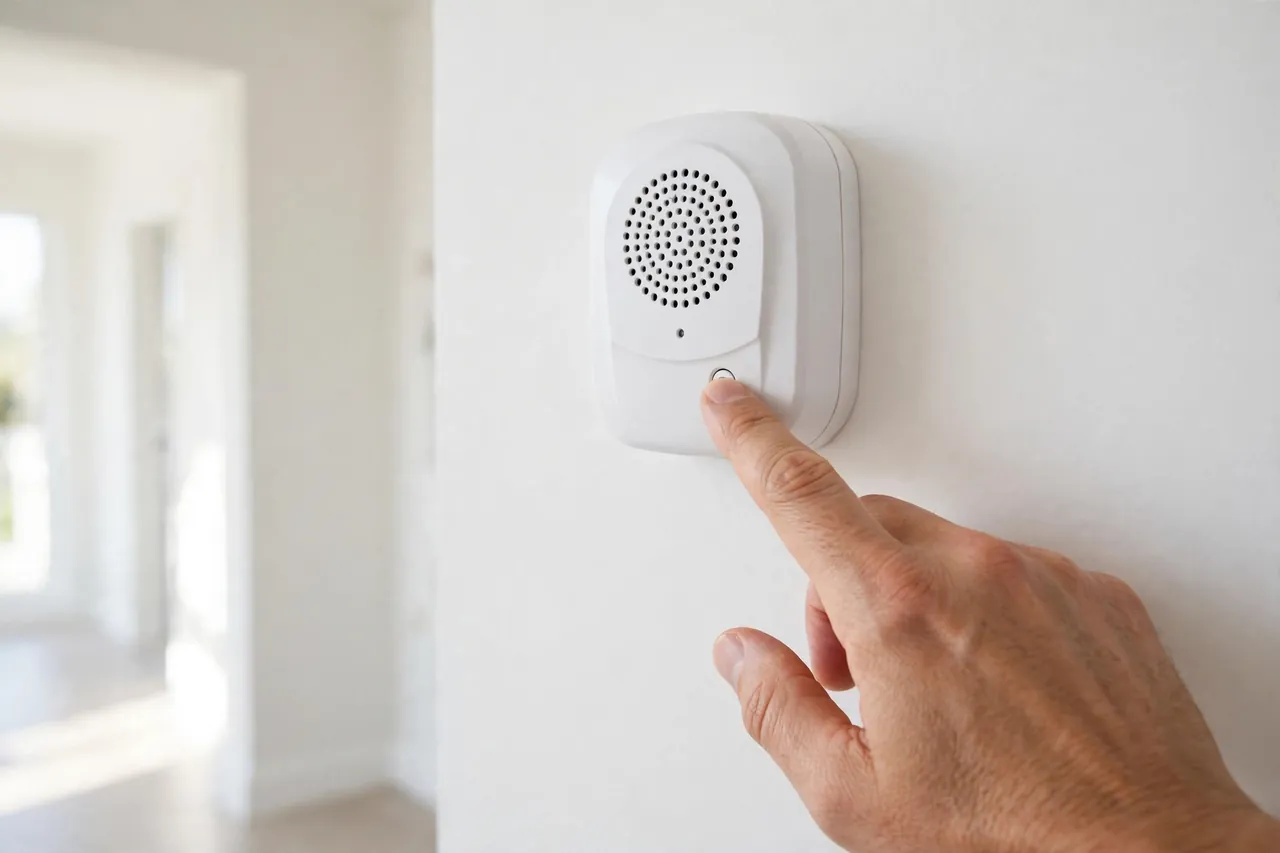
Test every carbon monoxide alarm once a month by pressing the test button until it sounds, and replace the alarm when its sensor reaches the end of its life — usually 7 to 10 years. The NFPA calls for a monthly test, and the CDC says to replace a detector every 5 years if the manufacturer gives no instructions. Write the install date on the back of the unit with a marker, so you never have to guess its age.
Testing takes seconds per alarm, and the monthly habit is the whole maintenance routine: press the test button, listen for the four-beep pattern, and dust the sensor openings with a soft brush or vacuum so dust does not block the sensor. Change replaceable batteries when the alarm chirps, and never paint over an alarm or cover it with a decoration. When the alarm gives its end-of-life signal — a chirp pattern your manual describes — replace the whole unit, not just the battery. A sensor that has worn out cannot be revived, and an expired alarm is a silent one. The cost of replacing every alarm in a house once a decade is less than one emergency room visit, and it is the cheapest safety habit a homeowner has. But even a tested alarm cannot help if you believe the wrong things about it, and the next section tackles those.
What Most People Get Wrong About Carbon Monoxide Detectors
Most people get carbon monoxide wrong in the same few ways, and each wrong idea leaves a gap in their protection. The first is “I would smell it.” You would not — carbon monoxide is odorless, colorless, and tasteless, and no human sense detects it. The second is “my smoke detector covers it.” It does not, as the last section showed: smoke and CO need different sensors. The third is “one detector is enough.” It is not: the CPSC calls for one on every level and outside each sleeping area, because CO on the basement level does not reliably reach a single alarm upstairs in time to wake you.
The fourth wrong idea is “opening a window fixes a leak.” It does not — fresh air dilutes CO, but the source keeps making it, and the only safe move is to leave and call 911. The fifth is “a new furnace means I am safe.” It does not: cracked heat exchangers, blocked vents, and birds’ nests in flues happen in new homes too, and a furnace that was fine last winter can fail this one. The sixth is “the alarm is too sensitive, so I took the battery out.” That is the most dangerous idea of all — an alarm with no battery is a wall decoration, and the CDC’s numbers count the people who learned that too late. If your alarm sounds for no clear reason, call 911 and let responders check; never silence the messenger. With the myths out of the way, one more step turns this guide into a protected home.
Related Guides
Does CO Rise or Fall? The Science and Where to Put Your Detector · Do Smoke Detectors Detect Carbon Monoxide? · What Does a Carbon Monoxide Alarm Sound Like? · What to Do If Your Carbon Monoxide Alarm Goes Off · Home Winterization Checklist: Get Your Whole House Ready Before the First Freeze
Frequently Asked Questions
Where should I place my carbon monoxide detector?
Put a CO detector outside each sleeping area and on every level of your home, including the basement, about 15 feet from fuel-burning appliances. If you buy only one, put it in the hallway outside the bedrooms. Follow your model’s manual for mounting height, and never place an alarm in the garage, furnace room, or bathroom.
What is the best smoke and carbon monoxide detector?
For most homes, the Kidde 30CUD10-V battery combo at $74.97 is the best smoke and carbon monoxide detector: it senses both hazards, needs no wiring, and runs 10 years on a sealed battery. If you have hardwired alarms, the Kidde 30CUA10-V at the same price wires into your existing system. For smart phone alerts, the First Alert SC5 at $129.99 is the pick.
What is the best smart smoke detector after Nest Protect?
The First Alert SC5 is the best smart smoke detector after Nest Protect, because Google stopped making Nest Protect in 2025 and pointed buyers to First Alert. The SC5 uses the same mounting bracket, works with Google Home, sends phone alerts, and speaks the danger and room out loud. It lists at $129.99 for the battery model and $129.95 hardwired.
How long do carbon monoxide alarms last?
Most carbon monoxide alarms last 7 to 10 years before the electrochemical sensor wears out, and the alarm will chirp at the end of its life to tell you. The CDC says to replace a detector every 5 years if the manufacturer gives no instructions. Write the install date on the back of the unit so you always know its age.
Should a carbon monoxide detector be placed high or low?
Neither high nor low matters as much as the manual for your model, because carbon monoxide mixes evenly with room air. Follow the manufacturer’s instructions for mounting height for your specific alarm. The key placement rules are outside each sleeping area, on every level, and about 15 feet from fuel-burning appliances.
Do carbon monoxide detectors expire?
Yes, carbon monoxide detectors expire. The electrochemical sensor degrades over time, and most alarms last 7 to 10 years before they must be replaced. The alarm gives an end-of-life chirp when its sensor is done. Check the manufacture date on the back, and replace the whole unit when it expires — a new battery cannot revive a worn-out sensor.
Disclaimer: This guide is general home-safety information, not medical advice. Carbon monoxide poisoning is a medical emergency: if your alarm sounds or anyone has symptoms such as headache, dizziness, confusion, or chest pain, get outside into fresh air and call 911. Do not re-enter your home until emergency responders say it is safe, and have a qualified technician find and fix the source before using any fuel-burning appliance again. Always follow your alarm manufacturer’s instructions and your local building codes.
Tonight, press the test button on every CO alarm in your home. If one does not sound, or if you have no alarm outside the bedrooms, that is your next purchase: the Kidde COPD costs about $44, less than a takeout dinner for four, and it takes five minutes to plug in. The alarm you test tonight is the one that wakes you up this winter.


