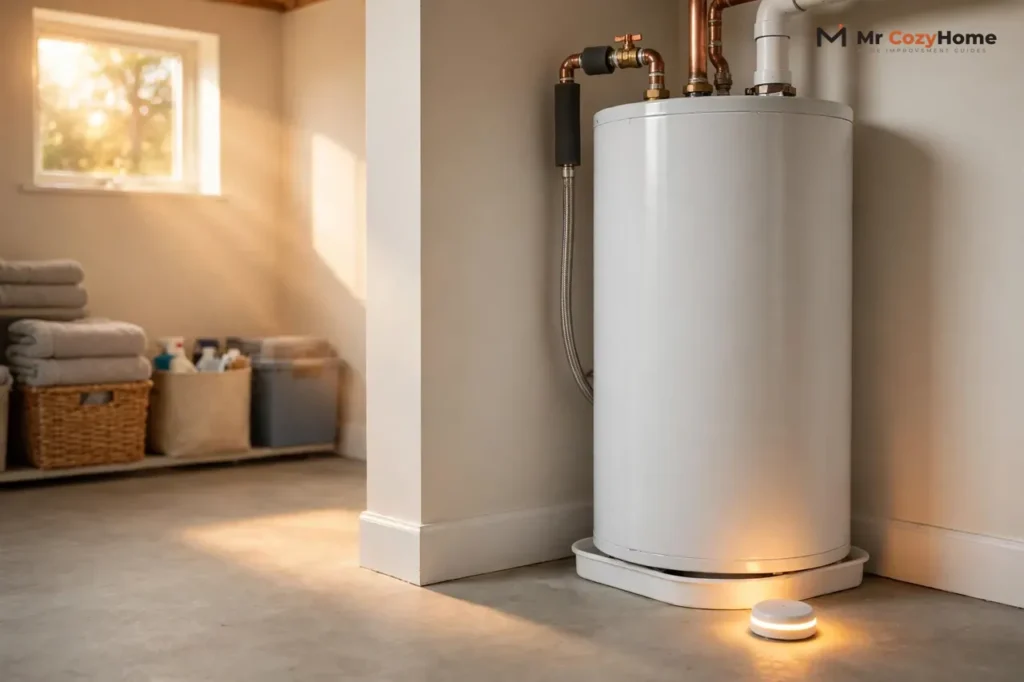
A water heater leak detector is a small sensor that sits on the floor at the base of your water heater and warns you the moment water touches it. Most types sound a loud alarm right there in the room. Some also send an alert to your phone, and the most protective kind shuts off the water supply to the heater on its own. For a heater tucked in a basement, garage, or closet you rarely visit, that early warning is the difference between wiping up a puddle and replacing floors and drywall.
This guide covers the three kinds of protection — alarm, sensor, and automatic shutoff — where to place a detector by your heater, and exactly what to do when it goes off. One safety limit up front: a detector warns you about a leak. It does not fix one. Gas, electrical, and tank work belongs to a qualified plumber, and this guide will show you where that line is.
How a Water Heater Leak Detector Works
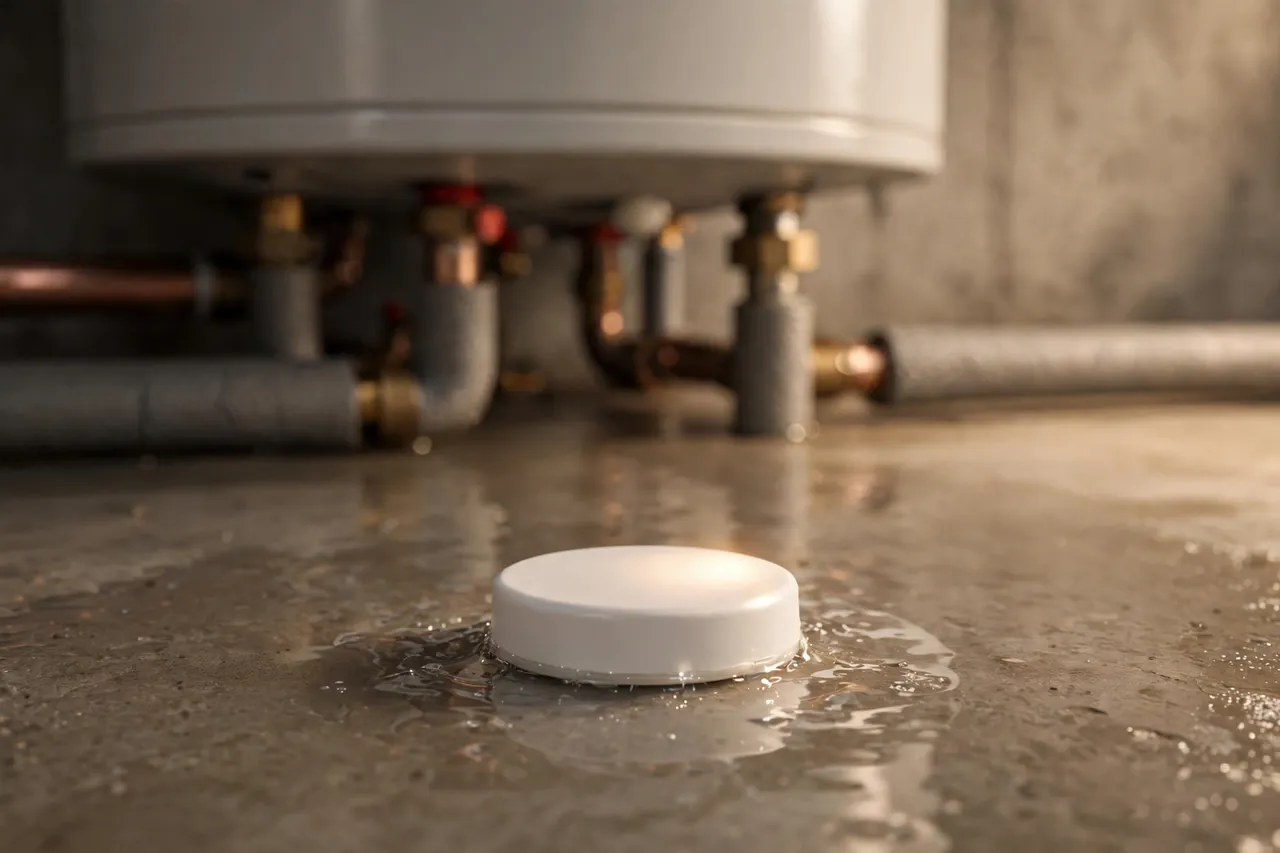
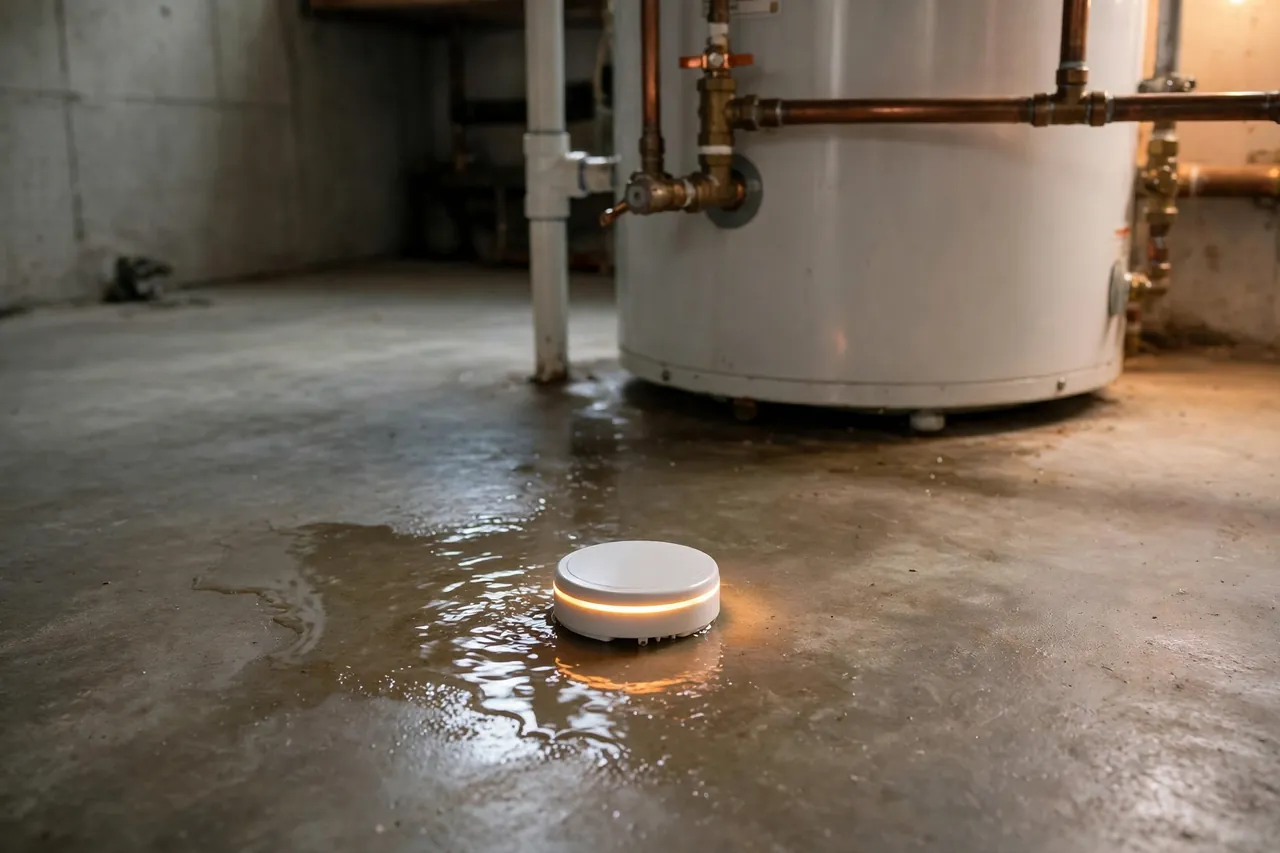
Most water heater leak detectors work in a simple way. Two metal contacts sit on the bottom of the sensor. Dry contacts mean nothing happens. When leaking water touches both contacts, it completes a low-voltage circuit, and the device reacts at once. That reaction is what you are buying: an alarm, a phone alert, a shutoff, or all three.
A water heater leak alarm is the simplest type. It is a battery-powered puck or pad that sits on the floor. When water reaches it, it sounds a loud alarm in the room. It needs no Wi-Fi, no app, and no plumber to install. Its weakness is just as simple: if nobody is home to hear it, the water keeps flowing.
A water heater leak sensor is the same idea with a messenger attached. It still sits on the floor and still detects water through its contacts, but it also sends an alert to your phone through an app or a home hub. That matters most for heaters in places you do not walk past every day, and for anyone who travels. Some sensors use a cable or rope instead of a single puck. The cable lies around the base of the heater, so water touching any point along it triggers the alert, which gives you wider coverage than one small pad.
Built-in detection works differently, because it lives inside the heater itself. Some newer smart water heaters, such as select Rheem models with LeakSense and LeakGuard, carry a sensor rope around the base and a motorized valve on the cold-water inlet. Rheem states that LeakSense detects a leak in as little as 15 seconds, and that LeakGuard’s automatic shutoff limits the water released to no more than 20 ounces. You also get an audible alarm at the heater and an alert in the EcoNet app. Built-in detection only comes with a new heater, so it is a choice you make at replacement time, not an add-on for the heater you already own.
Why Water Heaters Leak in the First Place
A detector is only half the story. Knowing where heater leaks start helps you place the sensor in the right spot and judge how urgent an alert is. Most leaks come from a short list of causes, and age sits at the top of it. Mr. Rooter Plumbing notes that a typical water heater lasts about 10 to 15 years, and that the risk of leaks rises as the tank ages, because corrosion and repeated heating and cooling stress the metal over time.
The tank itself is one source. Sediment builds up inside the tank, the lining wears, and corrosion can eat through the steel. A tank leak is the most serious kind, because it usually cannot be repaired. If the tank itself is confirmed to be leaking, replacement is generally the answer, and that is a plumber’s job.
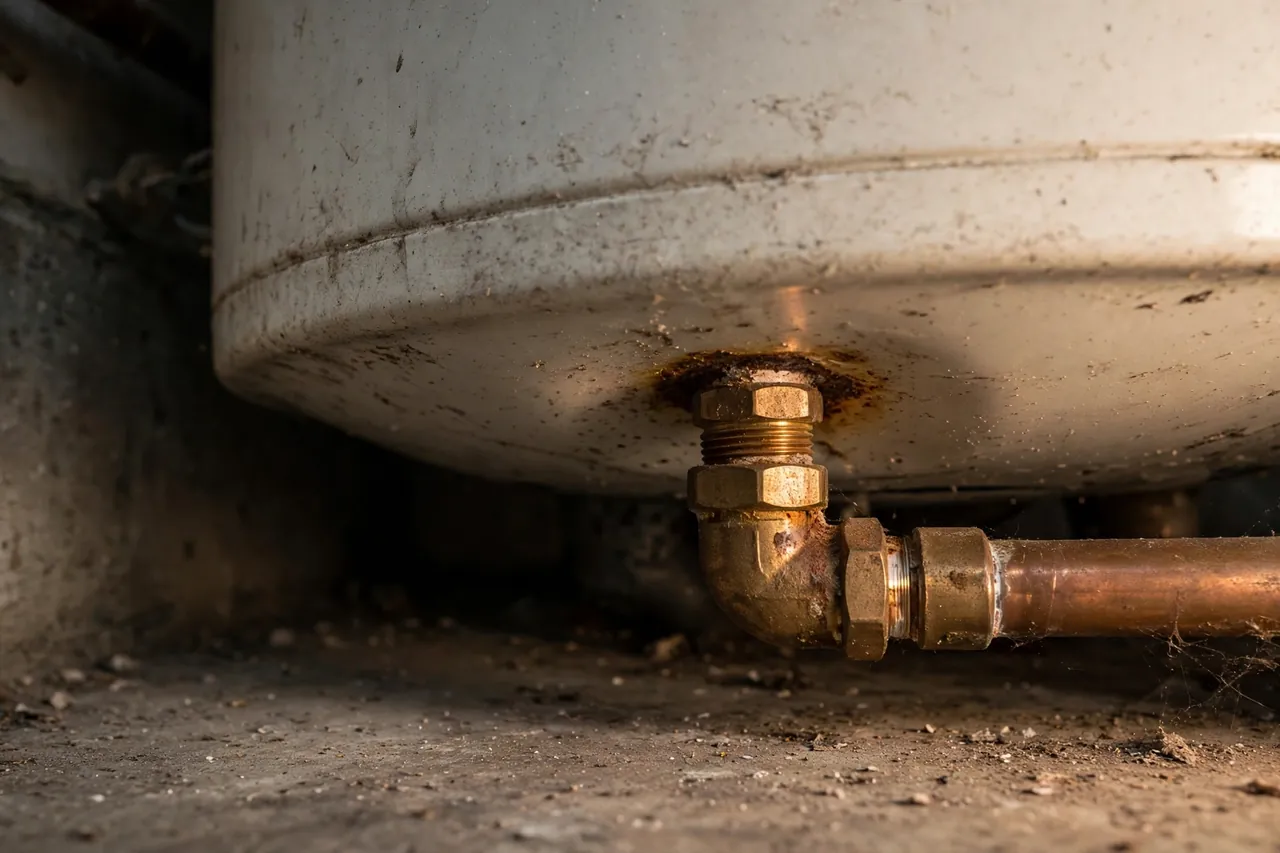
The fittings and valves are the other sources, and they are far more common than a failed tank. The cold-water inlet and hot-water outlet connections on top of the heater can loosen or corrode. The drain valve near the bottom can seep as its washer wears out. The temperature and pressure relief valve, called the T&P valve, can drip when pressure or temperature climbs too high, or when the valve itself wears out. Each of these drips runs down the side of the heater and pools at the base, which is exactly where your sensor should be waiting.
Watch for early signs between sensor checks. Puddles or damp spots around the base are the clearest sign. Rust stains on the tank or fittings point to corrosion. Popping or hissing sounds can mean sediment is building up inside. Less hot water than usual, or a rising water bill with no change in habits, can also mean water is escaping somewhere. A detector catches what your eyes miss, but these signs tell you to look before the alarm ever sounds.
Alarm vs Sensor vs Automatic Shutoff: Which One Do You Need?
All three types detect water the same way, but they do very different things after that. The right choice depends on one question: will someone be home, awake, and close enough to act when water appears?
A local alarm fits a heater in a lived-in part of the home, where someone will hear it day or night. It is the cheapest option and the easiest to install, but it cannot help while you are away or asleep in a far bedroom. A phone-alert sensor fits a heater in a basement, garage, attic, or vacation home, because the alert travels with you. An automatic shutoff fits any heater where a leak could run for hours before anyone notices, because it stops the water instead of only reporting it. It costs more and usually needs a plumber to install the valve, but it is the only type that protects an empty house.
Use the table below as a quick comparison. It is built from the features manufacturers and plumbing guides describe for each type, not from any single product.
Detector types at a glance
| Type | What happens when water is detected | Best for | Watch out for |
|---|---|---|---|
| Local alarm | Loud alarm sounds in the room | Heaters near living areas, where someone is usually home | Useless if nobody hears it; the water keeps flowing |
| Phone-alert sensor | Alarm plus an alert to your phone through an app or hub | Basements, garages, closets, and homes you leave empty | Needs Wi-Fi or a hub signal at the heater’s location |
| Automatic shutoff system | Alarm plus a motorized valve that closes the water supply to the heater | Any heater where a leak could run unnoticed for hours | Higher cost; valve installation usually needs a plumber |
| Built-in detection (new heaters only) | Sensor plus factory-installed shutoff valve, alarm, and app alert | Anyone replacing a heater who wants protection included | Only available on select new models, not as an add-on |
One honest note: no detector prevents a leak. It buys you time. The shutoff type buys the most time, because it acts even when you cannot. For a heater over ten years old, or one sitting above finished rooms, that difference is worth real money.
Where to Place a Water Heater Leak Detector
Placement decides whether your detector earns its keep. Water runs downhill and pools at the lowest point, so the sensor belongs on the floor, not on a shelf or a wall. ADT’s placement guide puts it plainly: place a sensor at the base of a water heater, where water would collect first if a leak occurred.
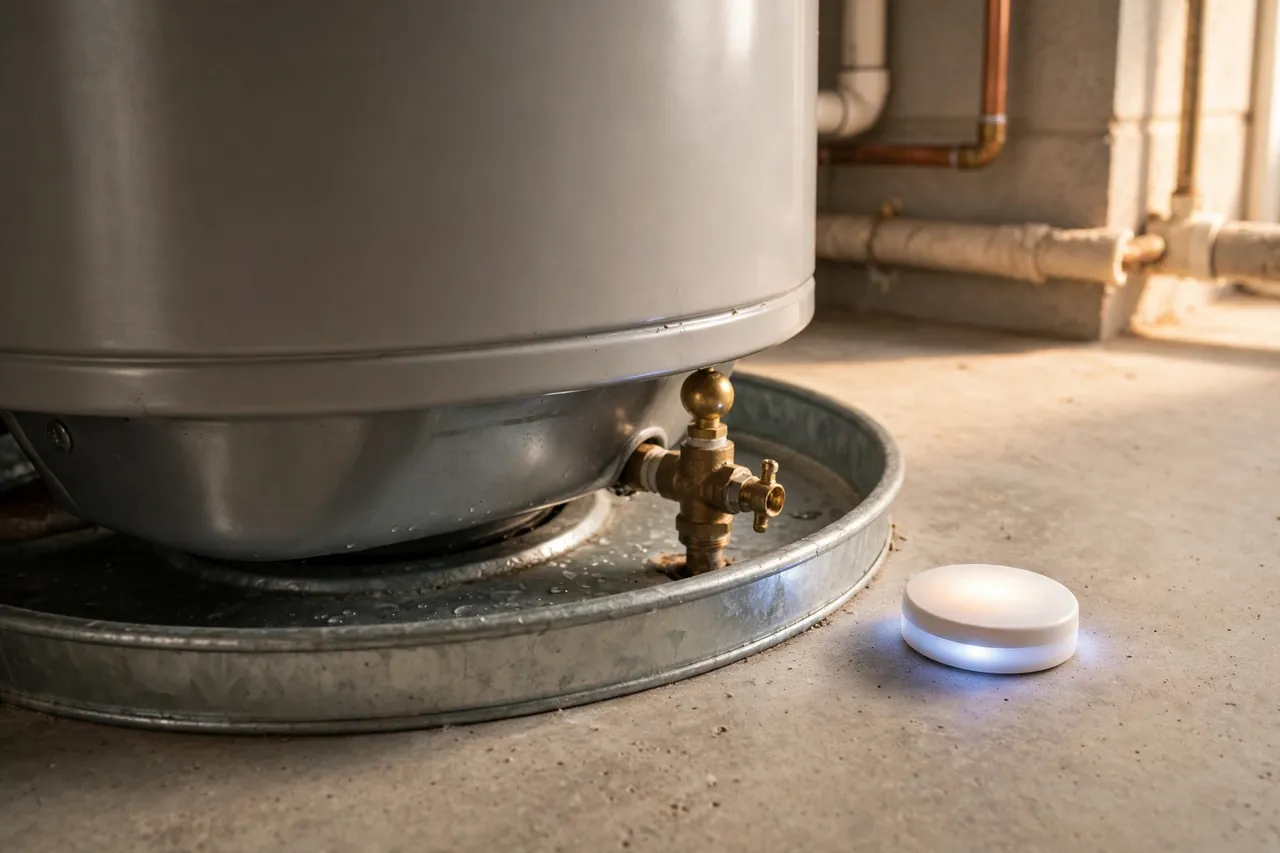
Start with the base itself. Put the sensor flat on the floor beside the heater, on the side where water would run first. If your heater sits in a drain pan, place the sensor inside the pan, along its inner edge, or use a cable sensor looped around the base inside the pan. The pan catches small drips, so a sensor outside the pan may never get wet while water quietly fills the pan and overflows.
Next, cover the two spots that leak most often. Put one sensor near the drain valve, low on the side of the tank, because a seeping drain valve drips straight down. If your heater has a T&P discharge pipe running down the side of the tank, make sure a sensor sits where water from that pipe would land. Many guides also suggest a second sensor on the floor just outside the heater closet or utility area, so you catch water that escapes the immediate area before it reaches carpet or stored boxes.
A few placement mistakes undo good sensors. Do not mount the sensor on the wall above the floor, because water must reach the floor before it can be detected, and by then it has already spread. Do not rest it on the hot-water outlet line or near a steam vent or exhaust, because heat and steam can confuse some sensors or damage them. Do not bury it under boxes or insulation, because you need to reach it to test it and change its battery. And do not rely on a single puck for a large utility room: one sensor guards the heater, not the whole floor.
How to Set One Up and Test It
Most add-on detectors are genuinely easy to install, and that is part of their appeal. A battery puck needs no tools at all. A phone-alert sensor needs a few minutes in its app. A shutoff valve is the exception, and it is the one job on this list to hand to a plumber.
- Pick the spot first, using the placement rules above, and make sure the floor there is dry and clear.
- Set the sensor flat on the floor, contacts down, inside the drain pan if your heater has one.
- Put the batteries in, or plug in the power adapter, and confirm the device powers on the way its manual describes.
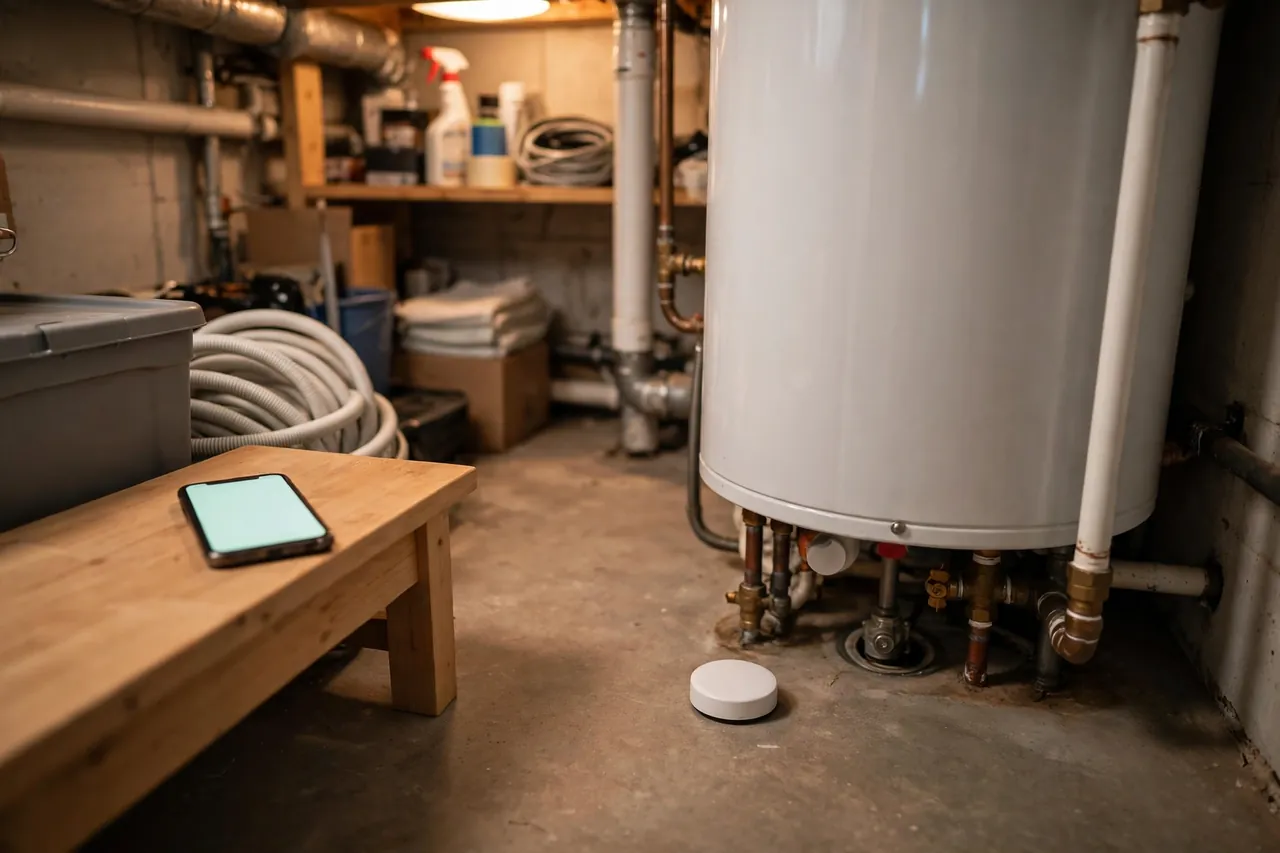
- For a phone-alert sensor, pair it with its app or hub now, while you are standing next to it, and confirm a test alert reaches your phone.
- Test it with water. Put a few drops of water on the sensor contacts, exactly as several setup guides describe, and confirm the alarm sounds and the phone alert arrives. Then dry the contacts fully and put the sensor back.
- For a shutoff system, test the valve too: trigger the sensor and confirm the valve closes and the water to the heater stops. If the valve does not close, call the installer before you rely on it.
Testing is not a one-time job. Check the alarm at least once every three months with the same drops-of-water test, and check the batteries every six to twelve months, following the manufacturer’s guidance for your model. A dead battery turns the best sensor into a paperweight, and heaters leak on their own schedule, not yours. Write the battery date on a small piece of tape on the sensor if it helps you remember.
What to Do When the Alarm Goes Off
An alarm at 2 a.m. is stressful, so decide your steps now, while you are calm. Work through them in order, and stop at any step that is not safe to do.
- Stay out of standing water. If water has reached outlets, cords, or the base of an electric heater, do not step in it and do not touch the electrical panel with wet hands. Call a plumber or, if there is a safety risk, your local emergency number first.
- Find the water. Look at the base of the heater, the drain valve, the top fittings, and the end of the T&P discharge pipe. The lowest wet spot is not always the source, because water runs down the side of the tank, so look upward before you judge.
- Shut off the water to the heater. Find the cold-water shutoff valve on the pipe going into the top of the heater and turn it clockwise until it stops. This stops more water from entering the tank. If you cannot find it or it will not turn, shut off the main water supply to the house instead.
- Turn off the heater’s power or fuel safely. For an electric heater, switch off its breaker, but only from a dry position with dry hands. For a gas heater, do not touch the gas controls unless you are sure how they work and the area is dry and safe; when in doubt, leave it and call a professional.
- Contain what is already out. Move boxes and stored items away from the water, lay towels around the spread, and mop or wet-vacuum the floor so water does not reach walls, floors below, or electrical items.
- Call a plumber and describe what you see: where the water is, whether it is still flowing, and whether the tank, a valve, or a fitting looks like the source. Take photos if you can do so safely, because they help the plumber bring the right parts.
- Do not reset a shutoff system and walk away. After a shutoff valve closes, leave it closed until the leak is found and fixed. Resetting it with the leak still active just starts the flood again.
Two warnings deserve emphasis, because getting them wrong is dangerous. Never cap, plug, or block the T&P relief valve or its discharge pipe. That valve is a safety device that releases water when temperature or pressure climbs too high, and blocking it can turn a leak into a far worse failure. And never drain or flush a leaking heater to hunt for the source yourself. Hot water and pressurized parts can scald and injure, and diagnosis belongs to a qualified plumber.
When to Call a Plumber
A detector tells you something is wrong. It does not tell you whether the fix is small or serious, and that judgment is where a plumber earns their fee. Call one promptly in any of these cases: water keeps coming after you shut off the supply to the heater; the tank itself is wet, rusted through, or confirmed to be leaking; water is coming from the T&P valve or its pipe; the heater is gas-fired and anything about the burner, vent, or gas line seems involved; or you see sparking, tripped breakers, or water near electrical parts.
Also call if you are unsure where the water is coming from. Several different problems look identical from the floor: a fitting above the heater can drip down the jacket, condensation can mimic a small leak, and a nearby appliance or pipe can send water toward the heater. A plumber can tell these apart in minutes, while guessing can waste a weekend and still leave the real leak running.
Age is a useful tiebreaker. If your heater is past ten years and it is leaking, plan for replacement rather than repair, because a tank that has started to fail rarely stops at one small leak. If the heater is young and the leak is at a fitting or a valve, a repair is often quick and far cheaper than a new unit. Either way, the plumber’s first visit is the right place to get that answer.
Choosing the Right Detector for Your Heater
Use this short checklist before you buy, and match the detector to your heater and your habits rather than to the fanciest box on the shelf.
- Heater type: a standard tank heater suits any add-on sensor; a new smart heater may already include built-in detection, so check before you buy a second system.
- Drain pan: if your heater sits in a pan, choose a sensor or cable that fits inside it; if it does not, a floor puck at the base is the starting point.
- Who hears it: if someone is usually home, a local alarm may be enough; if the heater is remote or you travel, get phone alerts.
- Shutoff or not: if a leak could run for hours unnoticed, a shutoff system is worth its higher cost and plumber installation.
- Signal at the spot: a phone-alert sensor needs Wi-Fi or hub signal where the heater sits, so check the signal in the basement or garage before you buy.
- Power and upkeep: battery models need a battery schedule you will actually keep; plug-in models with battery backup keep working through a power cut.
- False alarms: if your utility area is damp or steamy, pick a sensor with slightly raised contacts, which several setup guides note helps avoid false alarms from ordinary condensation.
As a rough cost guide, and not a checked price for any single product, MoneyCrashers reports that Consumer Reports found smart sensor models for under $50, while automatic shutoff valves generally cost several hundred dollars and often need a plumber to install. No specific product price is given in this guide, because prices change often and vary by model; check the current price for the exact model you choose before you buy.
Related Guides
For the full comparison of detection methods, see how leak detection works, and for whole-home floor coverage, our flood sensors guide.
Frequently Asked Questions
How does a hot water heater leak detector work?
Most detectors are moisture sensors that sit on the floor near the heater or inside its drain pan. When water touches the sensor’s contacts, it completes a circuit that triggers an audible alarm, and on smart models it also sends a phone alert. Shutoff systems go one step further and close a valve on the water supply to the heater.
Where should I place a leak detector for a water heater?
Put it flat on the floor at the base of the heater, inside the drain pan if your heater has one, and near the drain valve and the end of the T&P discharge pipe, where leaks first appear. Avoid wall-mounting it above the floor, resting it on hot lines, or burying it under stored items.
Will a leak detector trigger if there is condensation or humidity?
It can, but good placement and design reduce that risk. Many sensors have slightly raised contacts, so ordinary dampness or light condensation does not reach them. If your sensor alarms often with no visible leak, check for condensation sources, move it to a drier spot on the floor, and test it again before assuming it is faulty.
What should I do if my water heater starts leaking?
Stay out of standing water, then shut off the cold-water supply to the heater and, from a dry position, turn off its power or fuel if you can do so safely. Contain the water with towels, move items away from it, and call a plumber. Do not cap the T&P valve, and do not drain the heater yourself to find the leak.
How can I tell if my water heater is leaking?
Look for puddles or damp spots around the base, rust stains on the tank or fittings, popping or hissing sounds, less hot water than usual, or a water bill that rises without a change in habits. A detector catches leaks you cannot see, but these signs are worth checking during any visit to the heater.
When should I call a professional for my water heater leak?
Call a plumber if water keeps flowing after shutoff, if the tank itself is leaking, if water comes from the T&P valve, if gas or electrical parts are involved, or if you cannot find the source. A leaking tank usually means replacement, while a fitting or valve leak is often a quick repair, and a plumber can tell which one you have.
Disclaimer: This guide is general home information, not plumbing advice for your specific heater. Homes, heaters, and local codes vary, and water heaters involve hot water, pressure, gas, and electricity that can injure you if handled wrong. For gas work, electrical work, tank replacement, or any leak you cannot identify or stop safely, call a qualified plumber. If water has reached electrical parts or you feel unsafe at any point, step back and get professional help first.
A water heater leak detector is a small purchase that guards against a very large mess. Pick the type that matches how your home is used, place it where water will reach it first, test it every few months, and know your shutoff steps before you ever need them. Do that, and the next leak will be a story about a puddle you caught, not a flood you discovered.