
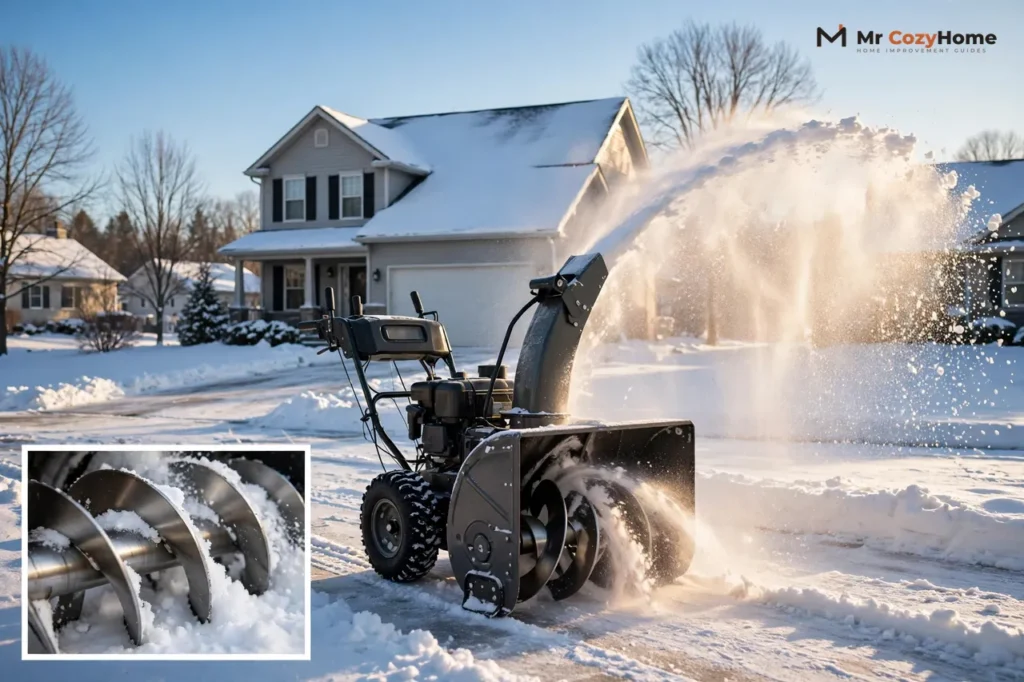
A one stage snow blower vs two stage choice comes down to three things: how deep your snow gets, how big your driveway is, and what surface you clear. If most of your storms drop six inches or less of light snow on a small paved driveway, a single-stage machine clears it fast and costs less. If you get regular storms of eight inches or more, wet heavy snow, a long driveway, or gravel, a two-stage machine is the right tool. Neither one wins for everyone, and this guide shows you exactly which one fits your home.
Before you spend a dollar, picture your worst storm of a normal winter, not the mildest one. A machine that handles your average storm but chokes on your biggest one will leave you shoveling on the coldest morning of the year. Match the machine to the snow you actually get, and the choice gets simple.
The Short Answer: How to Decide in 30 Seconds
Pick a single-stage snow blower when your storms stay under eight inches, your driveway is paved and no longer than about two car lengths, and you want the lightest, cheapest machine that does the job. Pick a two-stage snow blower when your storms often pass eight inches, your snow turns wet and heavy, your driveway is long or gravel, or the town plow leaves a hard pile at the end of your drive. If you are still unsure after reading that, a two-stage machine is the safer bet, because an overpowered machine still clears light snow, while an underpowered one cannot clear deep snow at all.
How a Single-Stage Snow Blower Works
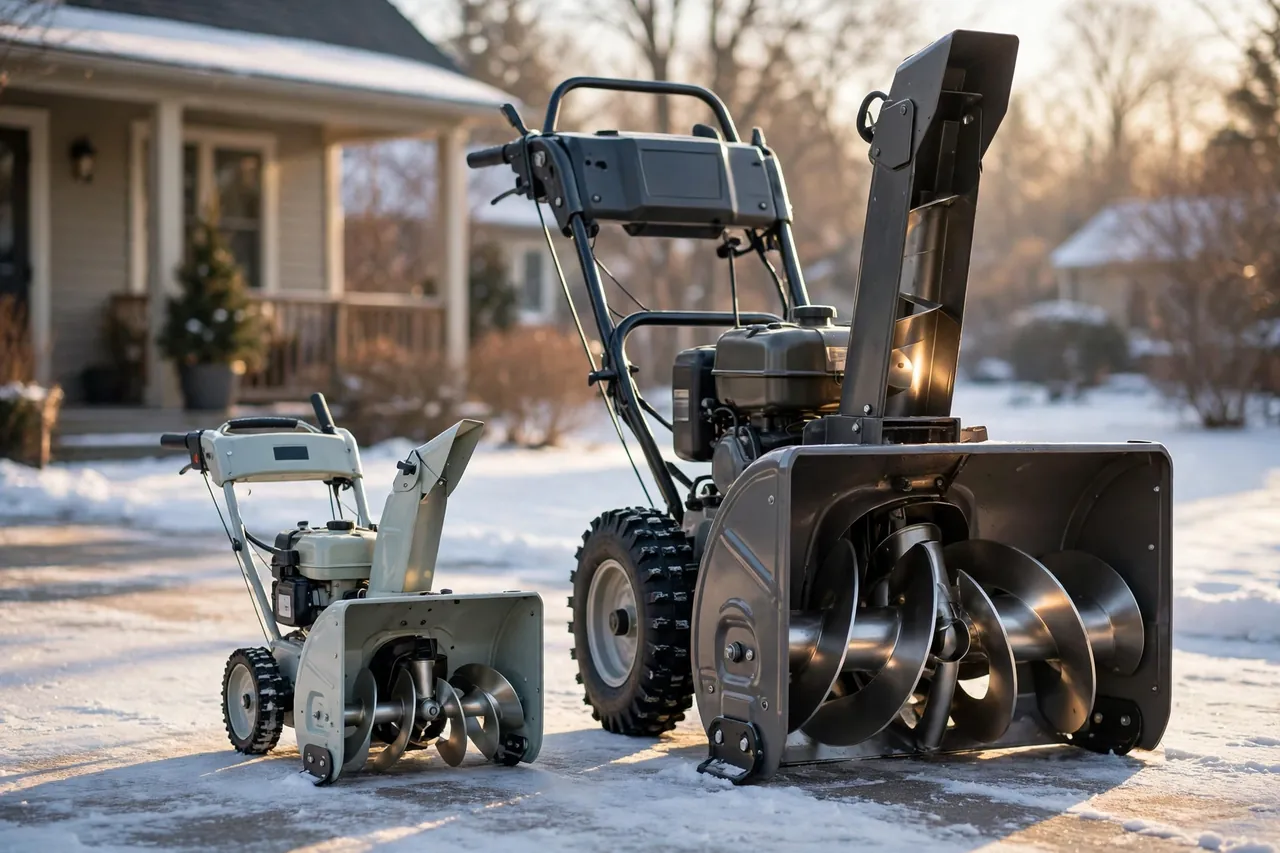
A single-stage snow blower, also called a snow thrower, uses one spinning part to do the whole job. That part is the auger, a curved blade or rubber paddle at the front of the machine. The auger scoops snow off the ground and throws it straight out through the chute in one motion. There is no second step, so the design stays simple, light, and compact.
The auger on a single-stage machine touches the ground as it spins. That contact is why it clears all the way down to bare pavement, and it is also why it suits smooth surfaces only. On gravel, the auger picks up stones and throws them with the snow, which can damage the machine and anything nearby. On rough or uneven pavement, the paddles wear fast and the machine bounces instead of clearing cleanly.
Most single-stage machines are small. Gas models like the Toro Power Clear 721 E clear a 21-inch path, weigh about 84 pounds, and throw snow up to 35 feet, according to Toro’s product page. Battery models are lighter still: Greenworks lists its 60V 22-inch single-stage at a 22-inch clearing width with snow thrown up to 30 feet. You push these machines yourself, though many gas models add a simple self-propel assist that pulls the machine forward as the auger spins.
Single-stage machines shine on light, fluffy snow. They struggle with wet, heavy snow, because the single auger must both gather and throw a much heavier load at the same time. The chute can clog, the machine can bog down, and you may need to clear the same path twice. That is the real limit of the design, not a flaw in one brand or another.
How a Two-Stage Snow Blower Works
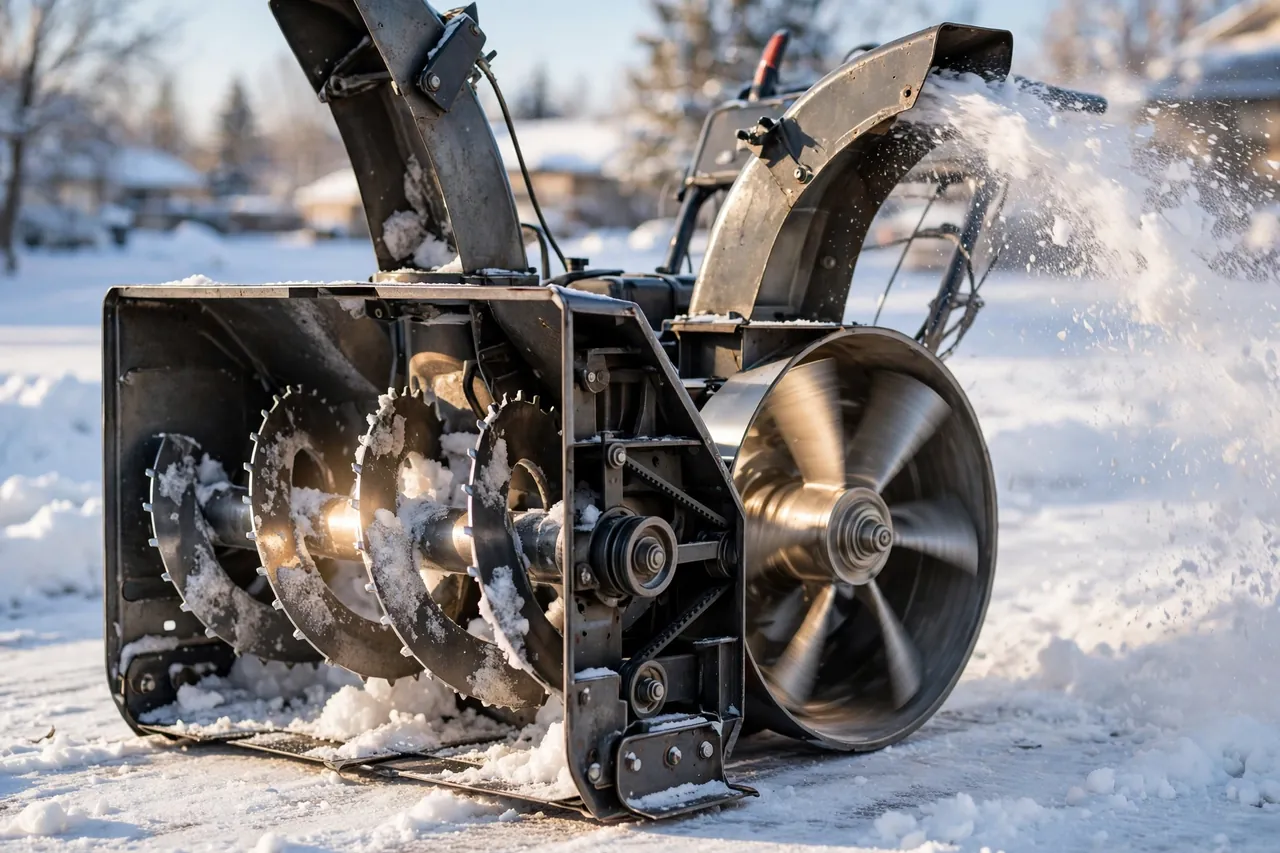
A two-stage snow blower splits the job into two steps, and that split changes everything. In stage one, a steel auger gathers snow and breaks up ice and packed snow. In stage two, a separate high-speed fan called an impeller catches that snow and launches it out through the chute. Because each part does one job, each one does it with far more force.
The steel auger on a two-stage machine does not touch the ground. Adjustable skid shoes hold the housing a little above the surface, so the machine glides over gravel, uneven pavement, and slopes without picking up stones. That is why gravel driveways and two-stage machines go together, and why a single-stage machine should never work a gravel drive.
Two-stage machines are bigger and heavier. The Ariens Deluxe 24, a common mid-size two-stage model, clears a 24-inch path, stands 21 inches tall at the intake, and weighs about 245 pounds, according to the manufacturer’s specifications. The Cub Cadet 2X 26 IntelliPower clears a 26-inch path with a 21-inch intake height. Both throw snow up to 40 to 50 feet, which matters on wide driveways where the snow must travel over tall banks.
Nearly every two-stage machine drives itself. Powered wheels or tracks push the machine forward at speeds you control, and many models add power steering, so turning a 200-plus-pound machine feels easy. You guide it rather than push it, which makes a real difference on a long driveway after a big storm.
One Stage vs Two Stage: Side-by-Side Comparison
Comparison table: single-stage vs two-stage snow blowers at a glance.
| Feature | Single-stage | Two-stage |
|---|---|---|
| How it works | One auger scoops and throws | Auger gathers, impeller throws |
| Snow depth | Up to 6 to 9 inches | Up to 12 to 18 inches |
| Best snow type | Light, fluffy snow | Wet, heavy, packed snow |
| Clearing width | 18 to 22 inches | 24 to 30 inches |
| Throw distance | Up to 25 to 35 feet | Up to 40 to 50 feet |
| Surfaces | Smooth pavement only | Pavement, gravel, slopes |
| Drive | Push, some auger assist | Self-propelled, often power steering |
| Weight | About 30 to 90 pounds | About 170 to 250 pounds |
| Typical price | About $460 to $900 | About $1,450 to $2,200 |
| Storage | Fits a small corner | Needs real garage space |
Read the table as a set of trade-offs, not a scorecard. The two-stage column wins on power, but the single-stage column wins on price, weight, and storage. Your driveway decides which column matters more.
Snow Depth: What Each Type Can Really Handle
Snow depth is the first number to check, because it draws the hardest line between the two types. Cub Cadet’s own buying guide says its single-stage 1X models handle up to six inches of snow on smooth, smaller areas, while its two-stage 2X models handle up to 12 inches. Toro rates its Power Clear 721 E single-stage for an ideal snow depth of nine inches, with a 12.5-inch intake height. Greenworks rates its 60V 22-inch single-stage for up to 10 inches in one pass, and its 60V 24-inch two-stage for up to 18 inches.
Those numbers describe fresh snow in good conditions. Wet snow changes the math. A foot of wet, heavy snow weighs far more than a foot of dry powder, and it clogs a single-stage chute much sooner. If your region gets wet coastal snow or heavy spring storms, treat the single-stage depth limit as closer to six inches, even when the spec sheet says nine or ten.
Drifts and plow piles are a separate problem. The town plow leaves a dense, icy ridge at the end of your driveway after every storm, and that ridge is often a foot tall and packed hard. A single-stage machine bounces off it or clogs on it. A two-stage machine chews through it with its steel auger and impeller. If you clear that end-of-driveway pile every storm, that alone can justify the two-stage upgrade.
A good rule of thumb: look at your last three winters. If a storm over eight inches hits more than once or twice a season, buy the two-stage. If you cannot remember the last time snow passed six inches, the single-stage will serve you well for years.
Driveway Size and Surface: The Other Half of the Choice
Driveway size decides how long the job takes, and width decides how many passes you make. A 21-inch single-stage machine needs three or four passes across a standard two-car driveway, while a 28-inch two-stage machine often finishes it in two. On a short driveway that difference costs five minutes. On a driveway 60 feet long or more, it can cost half an hour, and that time adds up across a whole winter.
Toro lists its Power Clear 721 E single-stage as suited to driveways of up to nine car spaces, which sounds generous, but the machine still clears only 21 inches per pass and you still push it yourself. Cub Cadet rates its two-stage 2X 24 for driveways of up to 12 parking spaces. Greenworks rates its 60V 22-inch single-stage for large driveways of 10 or more cars, and its two-stage for extra-large driveways. These ratings help, but your own driveway length matters more than any car count on a box.
Surface type can settle the choice by itself. Gravel, crushed stone, and rough or broken pavement rule out a single-stage machine completely, because the auger touches the ground and throws stones. A two-stage machine floats on its skid shoes and clears gravel safely. Slopes point the same way: a heavy self-propelled two-stage machine with tracks or good tires climbs a slope under control, while a light single-stage machine can slide or stall on ice.
Decks and walkways deserve a note too. A single-stage machine is light enough to use on a deck or a narrow walkway, and its rubber paddles will not gouge wood or pavers. A two-stage machine is too heavy and too wide for most decks. Some homeowners with a big driveway and a wood deck end up keeping a small single-stage or a shovel for the deck, even after buying a two-stage machine for the drive.
What Each Type Costs: Real Prices Checked on 5 Nov 2026
Price is where the two types split most clearly, so here are real US prices from manufacturer and retailer pages, checked on 5 Nov 2026. Prices change with sales and stock, so treat these as the going rates on that date, not a promise of what you will pay tomorrow.
Single-stage prices
The Toro Power Clear 721 E, a 21-inch gas single-stage with electric start and a 212cc engine, lists at $799 on Toro’s own site. The recoil-start version, the Power Clear 721 R-C, also lists at $799, while the top single-stage model, the 721 QZE, lists at $899. Cub Cadet’s 1X 21-inch single-stage starts at $899 MSRP on Cub Cadet’s site, with a 208cc engine and a 13-inch intake height. On the battery side, Greenworks lists its 60V 20-inch single-stage kit at $463.99, marked down from $579.99, on its own store. So a good single-stage machine costs roughly $460 to $900, depending on gas or battery power and on the features you pick.
Two-stage prices
Two-stage machines start higher and climb fast. The Ariens Deluxe 24, a 24-inch two-stage with a 254cc engine, lists at $1,449 at a US dealer. The Cub Cadet 2X EFI 30, a 30-inch two-stage with a 357cc fuel-injected engine and a 23-inch intake height, lists at $2,199.99 at Tractor Supply. Track-drive and premium models climb past $3,000. A realistic budget for a solid mainstream two-stage machine is roughly $1,450 to $2,200, with premium models well above that.
What it costs to run each one
The machine price is only part of the cost. A gas single-stage burns little fuel, about half a gallon per tank on the Toro 721, and needs an oil change and a spark plug once a season. A gas two-stage burns more fuel, needs the same seasonal service, and adds parts that wear out over time, such as belts, shear pins, and gearbox oil. Expect a few dollars per storm in gas for either type, and budget roughly $30 to $60 a year for basic maintenance supplies on a gas machine. These running-cost figures are estimates based on typical parts and fuel use, not quoted prices.
Battery machines flip the running costs. You pay nothing for gas or oil, and maintenance is mostly keeping the battery charged and stored indoors. The cost sits in the battery itself: a spare high-capacity battery can cost $200 or more, and batteries lose capacity after years of use. If you already own tools on the same battery platform, a battery blower costs less to own, because you can share batteries you already have.
Think about total cost over five winters, not just the sticker price. A $799 single-stage that you replace after three winters because it cannot handle your storms costs more than a $1,449 two-stage that still runs strong in year five. Buy the machine your snow needs, and the money usually follows.
Weight, Storage, and Ease of Use
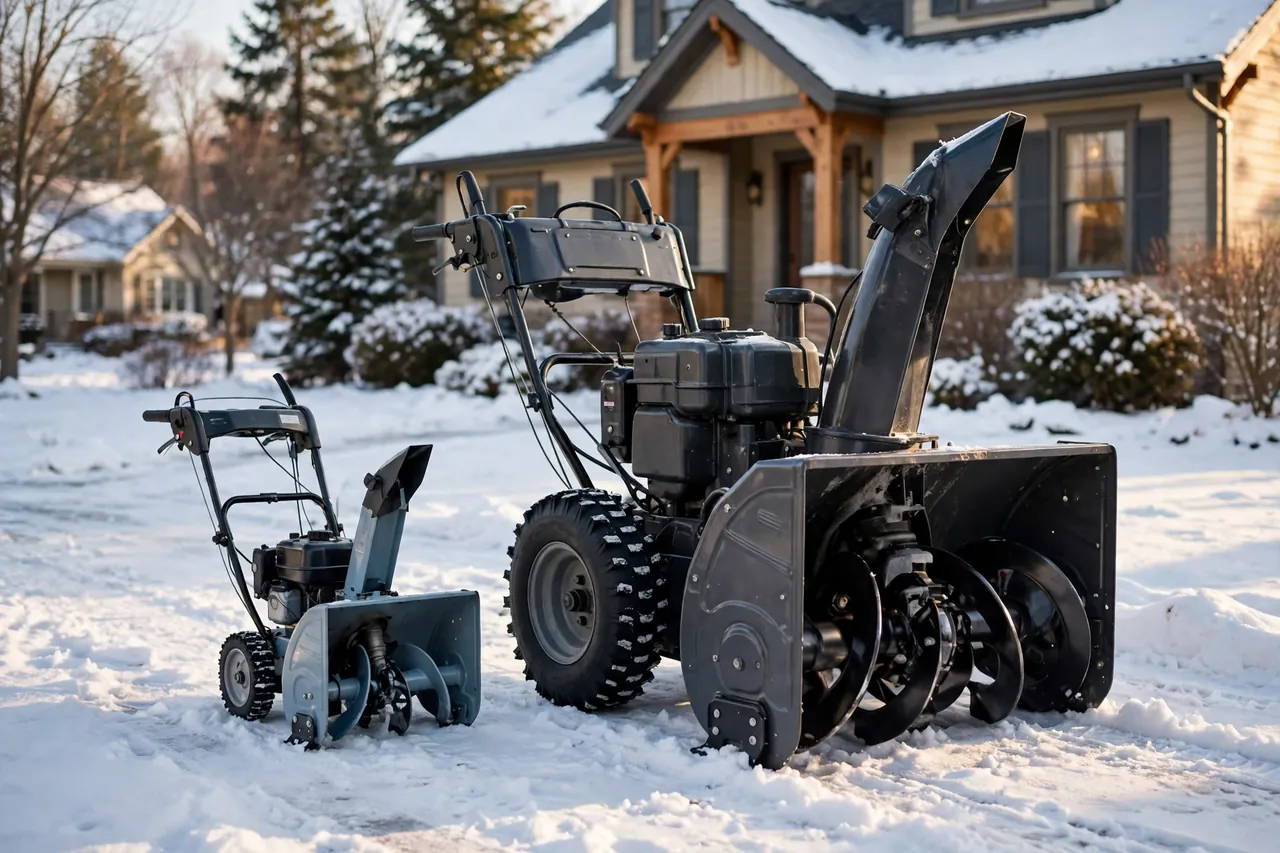
Weight is the difference you feel every time you use the machine. A battery single-stage can weigh under 40 pounds, and even a gas single-stage like the Toro 721 E weighs about 84 pounds. You can lift one into a truck bed or carry it up a step without help. A two-stage machine weighs 170 to 250 pounds, and you will not lift it anywhere. You roll it, and you store it where it sits.
Storage follows weight. A single-stage machine folds its handle down and tucks into a corner of the garage or a shed. Many battery models stand upright against a wall. A two-stage machine needs a real parking spot, roughly the size of a large wheelbarrow, and you need a clear path to roll it out on a snowy morning. Measure your storage space before you buy, and leave room to walk around the machine for fueling and service.
Ease of use cuts both ways. A single-stage machine is simple: pull the starter or push a button, point the chute, and walk. There are few controls to learn and few parts to break. A two-stage machine has more to manage, with drive speeds, chute controls, and sometimes power steering, but the self-propelled drive does the hard pushing for you. On a short flat driveway, the single-stage feels easier. On a long driveway, the two-stage feels easier, because your arms and back do far less work.
Noise matters too, especially if you clear snow early in the morning. Battery single-stage machines run quietly enough that you can talk over them. Gas machines of either type are loud, and two-stage gas machines are the loudest of all, because the engine is bigger. If you clear snow before dawn in a close neighborhood, a battery model is the polite choice.
Which One Should You Buy? A Decision Guide
Work through these five questions in order. The first one that points clearly to a type is your answer.
- How deep is a typical big storm where you live? Under eight inches points to single-stage. Over eight inches points to two-stage.
- Is your driveway gravel, rough, or sloped? Yes points to two-stage, no exceptions.
- How long is your driveway? Under about 40 feet suits a single-stage. Over 60 feet favors a two-stage.
- Does your snow turn wet and heavy, or does the plow leave a hard pile at the end of your drive? Yes points to two-stage.
- Can you lift and store a 200-pound machine? If not, and your snow stays light, a single-stage fits your life better.
Here is how that plays out for common homes. A small paved driveway in a mild snow region, with storms under six inches, calls for a single-stage machine. You save money, save space, and finish the job fast. A two-car paved driveway in a snowy region, with regular eight to 12-inch storms, calls for a 24-inch two-stage machine. A long gravel driveway, a steep driveway, or a region with heavy wet snow calls for a two-stage machine, and a 26 to 28-inch model is worth the step up. A very large rural property with deep drifts calls for a wide two-stage or even a three-stage machine, which is a different decision this guide does not cover.
When you are caught between the two, size up. Homeowners rarely regret buying a little more machine than they needed, but they often regret buying too little. The extra money buys you the worst storm of the winter, not the average one.
Mistakes to Avoid When You Choose
The most common mistake is buying for your average storm instead of your biggest one. A machine that handles a four-inch snowfall beautifully still fails on a 14-inch storm, and that storm will arrive. Check your last three winters and buy for the biggest storm in that stretch.
The second mistake is buying a single-stage machine for a gravel driveway. The auger touches the ground, so it throws stones at your windows, your car, and anyone nearby. It also wears out the paddles fast. If your driveway is gravel, the single-stage option is off the table, whatever the price difference.
The third mistake is judging a machine by clearing width alone. A wide machine with a short intake height still rides up over deep snow, because the snow is taller than the opening. Check intake height next to clearing width: Toro lists 12.5 inches of intake height on its 21-inch single-stage, while the Ariens Deluxe 24 lists 21 inches. That height gap matters more than the width gap in deep snow.
The fourth mistake is forgetting the end-of-driveway pile. The plow ridge is the hardest snow you will clear all winter, and it arrives after every storm. If you cannot clear it with your machine, you will shovel it by hand in the coldest part of the morning. A two-stage machine handles it. A single-stage usually does not.
The fifth mistake is skipping the storage check. A two-stage machine that cannot fit through your garage door or your shed door is useless, however good its specs are. Measure the door, measure the machine, and leave room to walk around it.
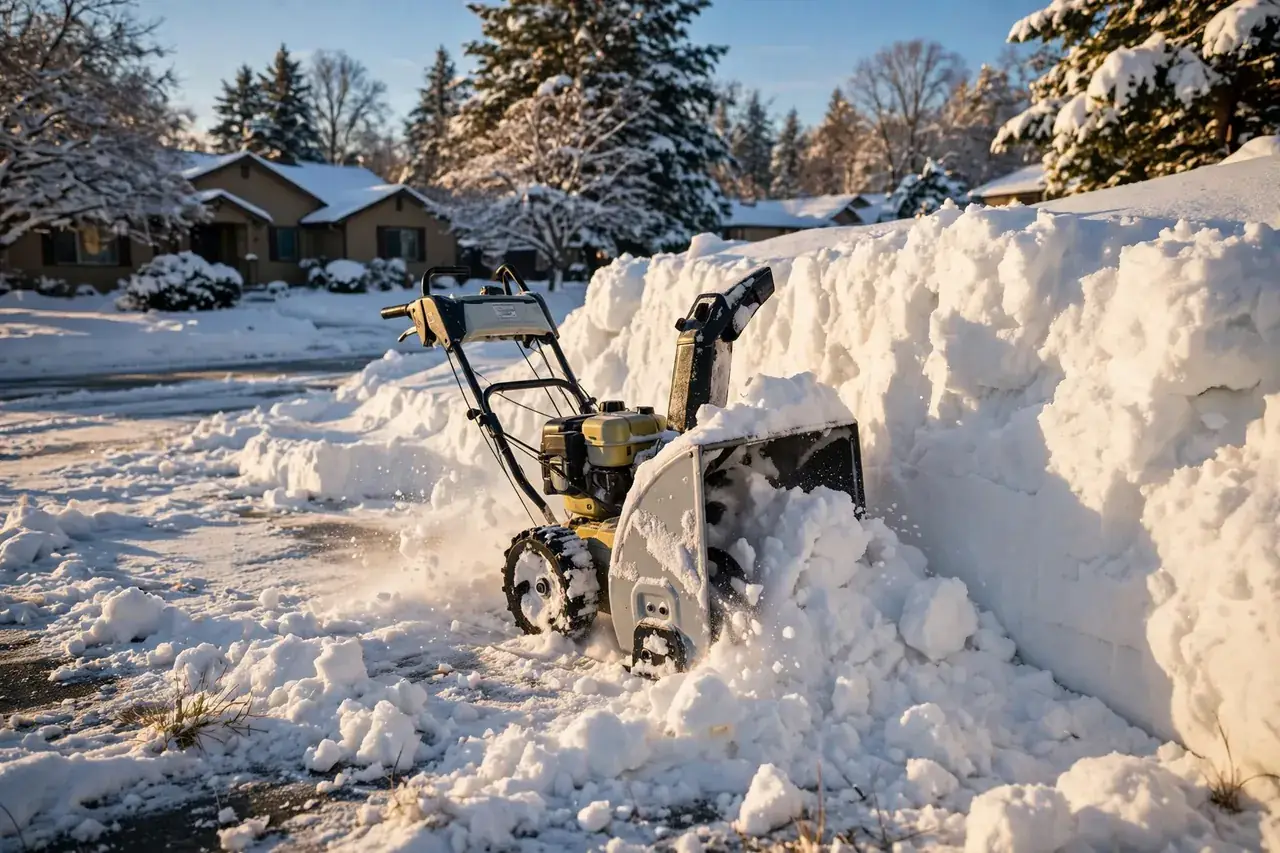
Staying Safe Around the Auger and Chute
Snow blower injuries happen fast, and most of them involve the auger or the impeller. Treat every clog as a serious moment, not a small annoyance, and build the safe habit before your first storm.
Stop the machine first. If snow clogs the chute, turn the engine off, wait until every moving part has fully stopped, and remove the spark plug wire or the battery before you touch anything near the chute. Never reach into the chute or the auger housing with your hand, even when the machine looks off, because stored tension can spin the auger without warning. Use the clearing tool that came with the machine, or a sturdy stick, and stand clear of the chute opening while you work.
Clear clogs only after the machine is fully off and still. Keep your hands, feet, loose clothing, and scarves away from the auger while the engine runs. Keep children and pets indoors while you clear snow, and never let anyone stand in front of the chute. Wear eye protection when you work in icy snow, because a two-stage machine can throw small stones and ice chips a long way.
Fuel safety matters too. Fill a gas machine outdoors with the engine off and cool, wipe up any spill before you start it, and store fuel in an approved container away from the house. Run the machine outside only, never in a closed garage, because exhaust fumes build up fast.
Disclaimer: snow blowers have fast-moving parts that can cause serious injury, and every home, driveway, and storm is different. Follow your machine’s manual for your exact model, and call a qualified repair shop when a problem goes beyond basic care. This guide gives general buying advice, not repair or medical advice.
Related Guides
Once the snow is clear, the next job is the ice underneath it. Read how to melt ice on driveway for safe ways to clear the slick layer a blower leaves behind.
Frequently Asked Questions
What’s the difference between single-stage and two-stage snow blowers?
A single-stage snow blower uses one auger that scoops snow and throws it out through the chute in a single motion. A two-stage snow blower uses an auger to gather snow and a separate impeller to throw it, which gives it more power, a longer throwing distance, and the ability to handle deeper, heavier snow and gravel surfaces.
Is a two-stage snow blower better than a single stage?
For gravel, long driveways, or deep snow, yes. For a small paved driveway with light snow, a single stage is simpler, cheaper, and often faster. “Better” depends on your snow depth, driveway size, and surface, not on the machine alone. Match the machine to your conditions and you get the better result.
What is the difference between a single-stage snow blower, two-stage snow blower and three-stage snow blower?
A single-stage machine has one auger that gathers and throws snow. A two-stage machine adds an impeller that throws the snow farther with more force. A three-stage machine adds an accelerator between the auger and the impeller that breaks up snow even faster. Each extra stage handles deeper, heavier snow, and each one costs more and weighs more.
Can a snowblower handle 20 inches of snow?
A good two-stage machine can, but slowly, and a wide two-stage or three-stage machine handles it far better. A single-stage machine cannot handle 20 inches of snow. Its intake is too short, so it rides up over the drift instead of clearing down to the ground. In very deep snow, clear in layers and take half-width passes.
Are battery-powered snow blowers actually good enough?
For small to mid-size paved driveways in regions with moderate snowfall, yes. Modern battery single-stage models clear up to 10 inches of snow and throw it up to 30 feet, and battery two-stage models now handle deeper snow too. For long driveways, very deep snow, or all-day clearing, gas two-stage machines still hold the edge on runtime and sustained power.
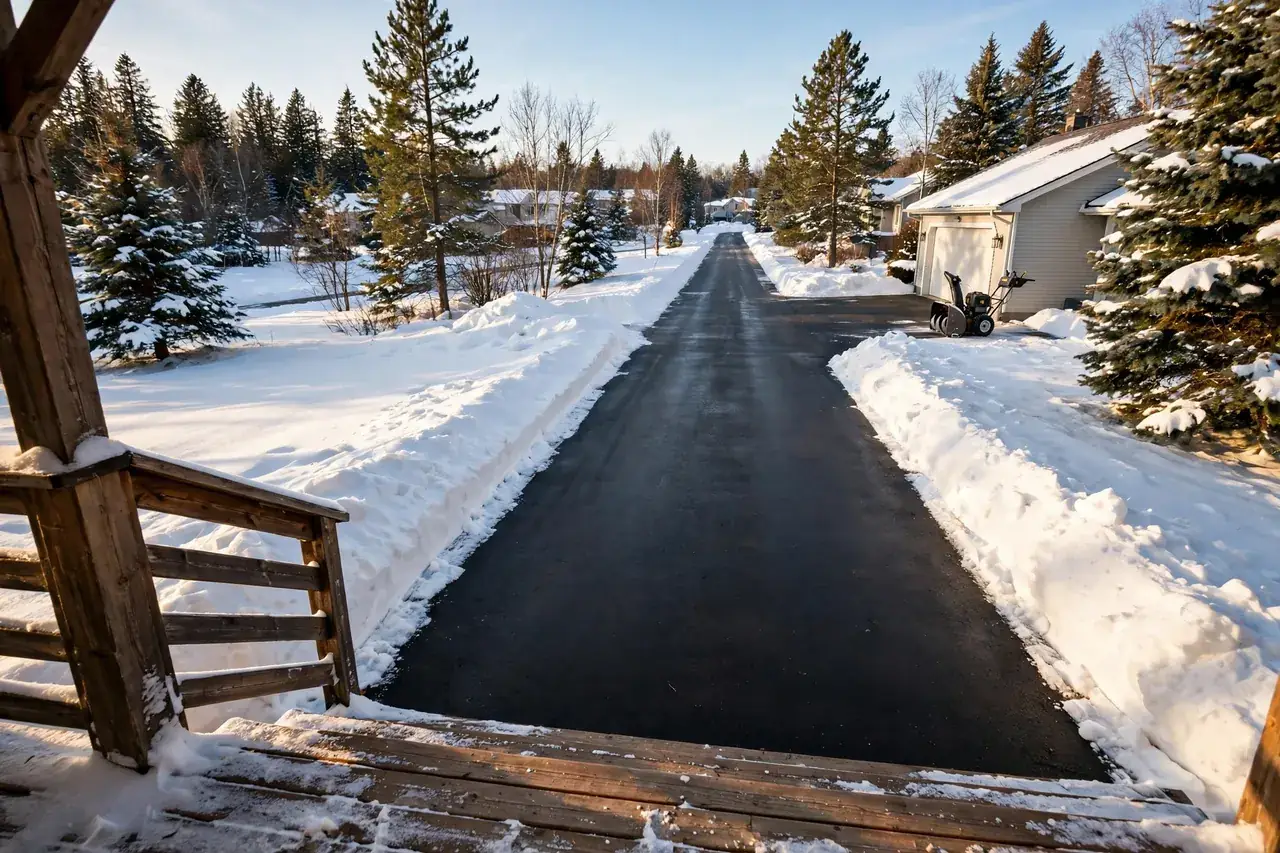
Pick the machine that fits your worst storm, not your easiest one. If your snow stays light and your driveway stays small and paved, a single-stage blower saves you money and space. If your storms run deep, your snow turns heavy, or your driveway is long or gravel, a two-stage blower earns its price every winter. Measure your driveway, check your last three winters, and buy once for the snow you actually get.


