
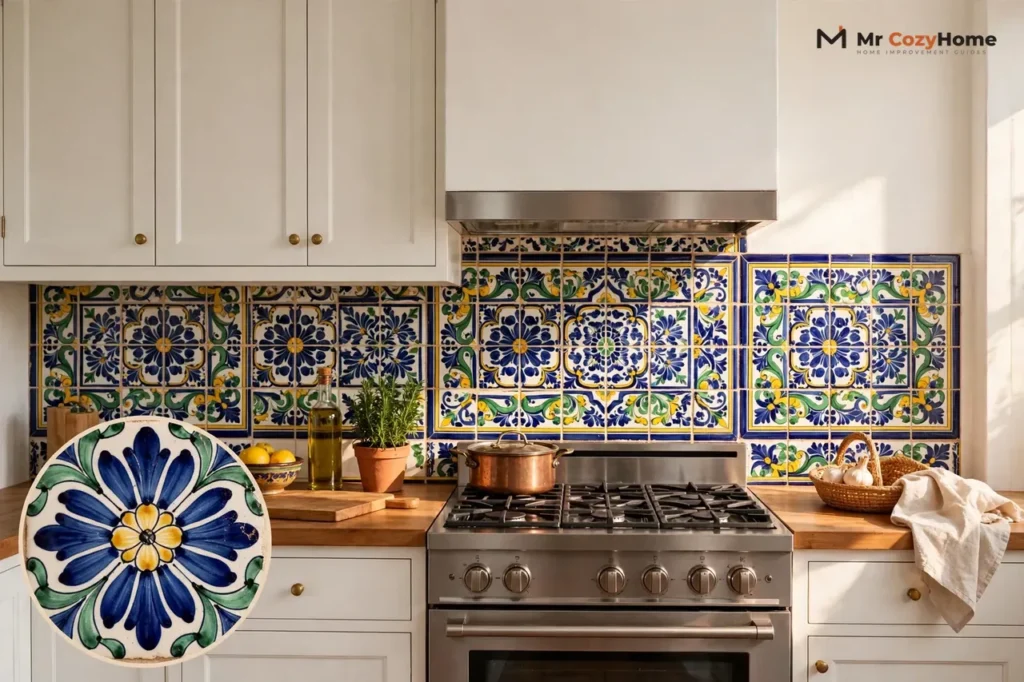
Talavera tile is a hand-painted, tin-glazed ceramic tile from Puebla, Mexico, and the craft behind it is so valued that UNESCO recognized it as Intangible Cultural Heritage in 2019. Each tile is shaped, glazed, and painted by hand, so no two are ever exactly alike. That handmade character is the whole point — and it is also what makes buying the real thing tricky.
One tile in a photo can look identical to another and cost ten times less — and the cheap one is almost never the same tile. Keep reading and you will know which tile is real, what a fair price looks like, and where it works in your home.
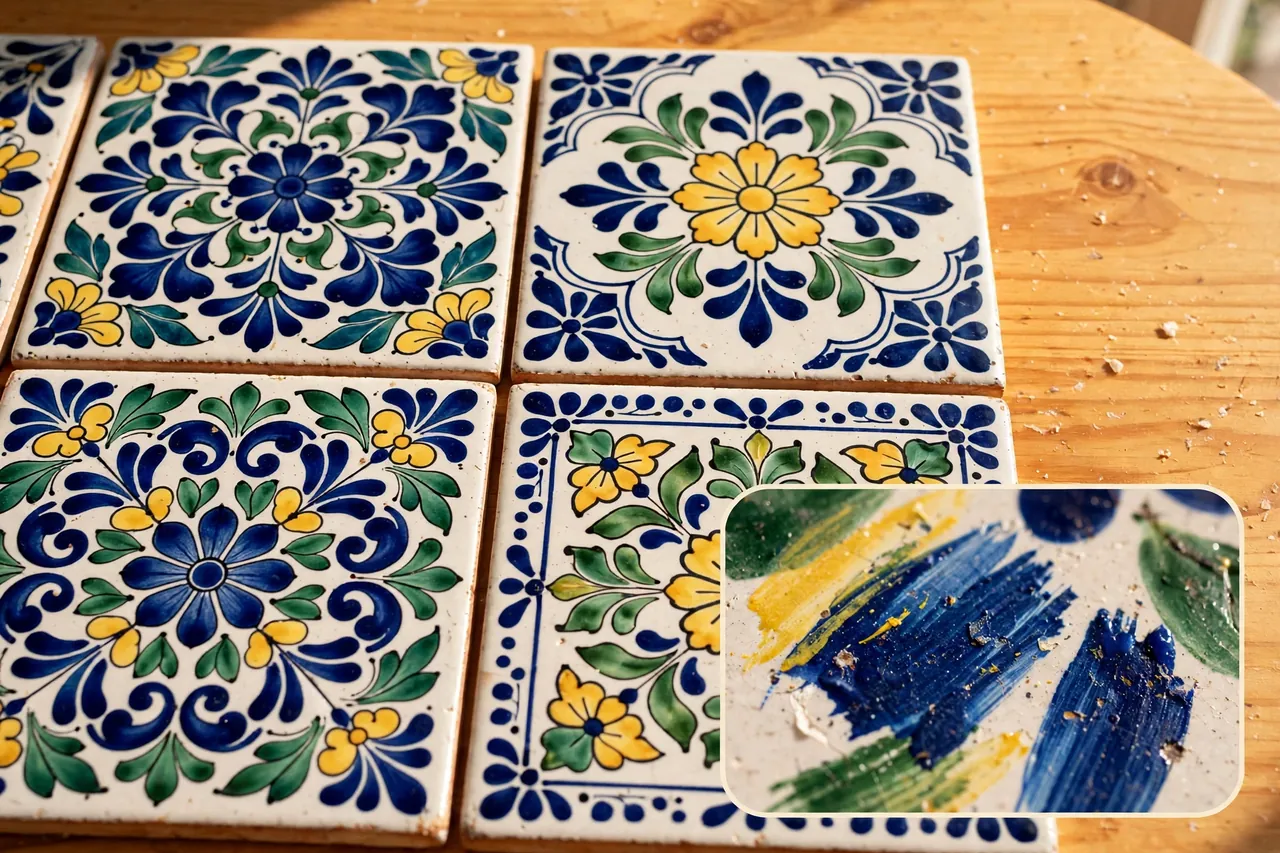
💡 Practical Home Tip: Before you order a full box, buy one single tile first and hold it in the room where it will live. Check the color in daylight and at night, and run your finger over the glaze. A real hand-painted tile shows soft brush marks and tiny variations; a printed copy looks flat and perfect from every angle.
What Is Talavera Tile?
Talavera tile is a hand-painted ceramic tile with a milky-white, tin-glazed base and bold mineral-pigment designs in cobalt blue, yellow, green, and black. It comes from Puebla, Mexico, where Spanish potters brought the tin-glazing technique in the 1500s, and every tile is still shaped, glazed, and painted by hand.
The tile starts as local clay, shaped and fired once into a porous body called bisque. A painter then coats it with a tin-opacified white glaze and paints the design freehand with mineral pigments. A second firing fuses glaze and paint into a hard, glossy surface, with small handmade differences in thickness, edge shape, and brushwork. Those differences are not defects — they are the proof a person made the tile.
Talavera is a type of majolica, the tin-glazed ceramic family that traveled from Moorish Spain to Mexico in the 16th century. The name comes from Talavera de la Reina, the Spanish town that was a center for this pottery, and the craft took root in Puebla because the region had fine clay.
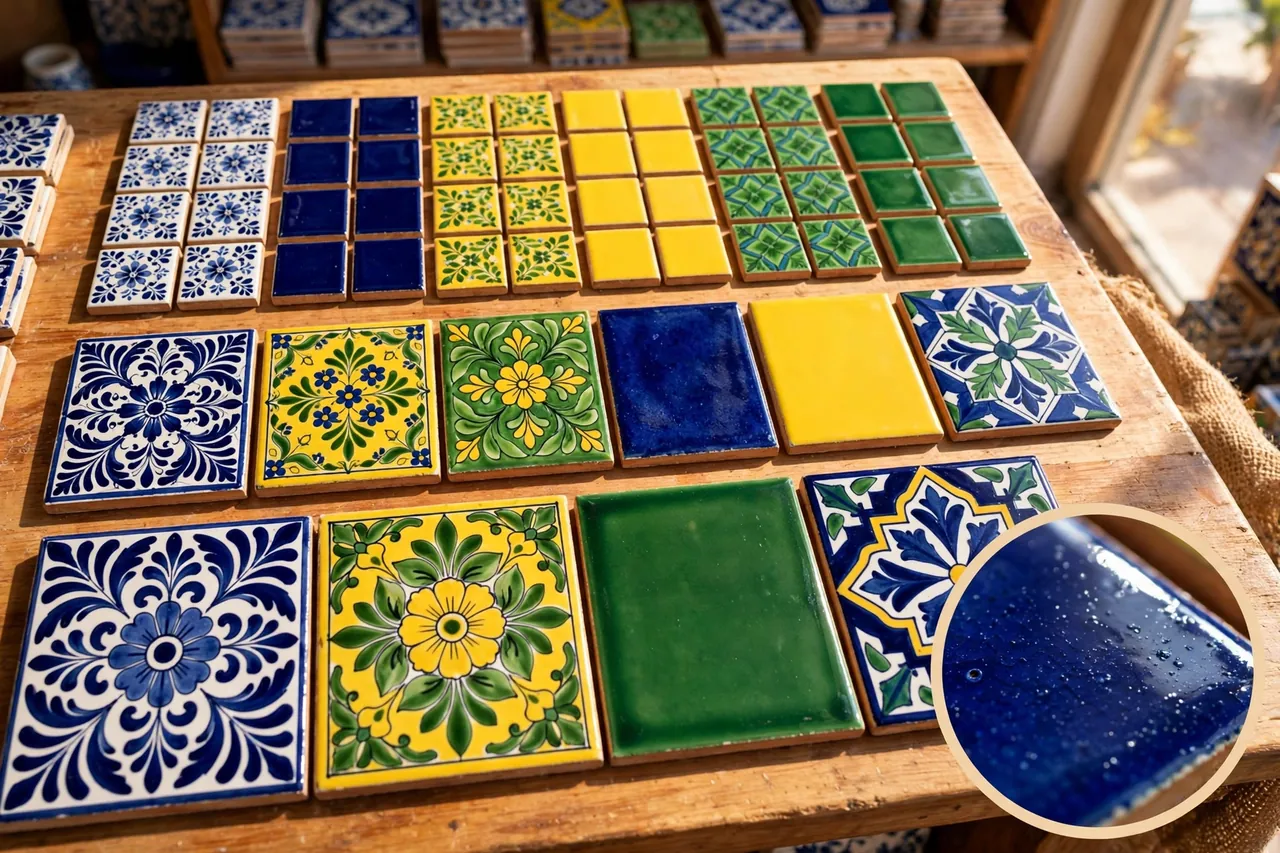
Most Talavera tiles sold in the US are small squares: 4.25 by 4.25 inches is the classic size, with 2-inch, 3-inch, and 6-inch squares also common. You will also find solid-color tiles, border pieces, corner tiles, and large painted murals made from many tiles joined into one picture. The tile is glazed and hard-wearing on walls, but the clay body underneath is softer than modern porcelain, so it suits decoration far better than heavy foot traffic.
Where Talavera Tile Comes From
Talavera tile comes from Puebla, Mexico, where Spanish artisans introduced tin-glazed pottery in the 1500s and local potters turned it into a distinct Mexican craft. Puebla was founded in 1531, its workshops grew around the region’s fine clay, and the craft has been made there for nearly 500 years.
The story starts in Spain, where Moorish potters had perfected tin glazing — a white, opaque surface that bright colors could sit on. Spanish settlers carried it to Puebla, and local potters mixed it with local clay and pigments. Churches, mansions, and fountains across Puebla still wear those tiles today.
The craft earned legal protection in 1995, when Mexico created the Denominación de Origen Talavera, a protected-origin rule modeled on European wine appellations. Only tiles made in designated towns in Puebla and Tlaxcala under strict traditional methods can carry the official seal. In 2019, UNESCO added Talavera craftsmanship to its Intangible Cultural Heritage list.
What Makes Real Talavera Different From a Fake?
Real Talavera is handmade in Puebla or Tlaxcala from local clay, hand-painted with mineral pigments in at most six traditional colors, fired twice, and certified by the Consejo Regulador de la Talavera. A fake is usually screen-printed or machine-made elsewhere, and it looks too perfect: identical tiles, flat color, and no brush marks at all.
First, look at the paint. Real Talavera shows visible brushstrokes and slight variation tile to tile; a printed tile repeats the same pattern exactly, down to the last dot. Second, look at the back: handmade clay is rough and uneven, factory tile is smooth and uniform. Third, check the colors. Authentic Talavera uses only six mineral pigments, so a tile in hot pink or turquoise is Talavera-style, not Talavera.
Fourth, ask for the certificate. Certified pieces carry the workshop’s signature, a workshop stamp, and the official hologram seal of the Consejo Regulador de la Talavera. Fewer than two dozen workshops hold full certification. If a seller cannot name the workshop or show the seal, treat the tile as Talavera-style and pay a Talavera-style price.
Price is the last clue, and it is a blunt one. Rustico Tile, a US importer, puts handmade Talavera at $18 to $58 per square foot depending on shape, size, and design, and notes that a price that seems too good to be true usually means a reproduction. A single 4.25-inch tile for under a dollar is not a bargain — it is a different product. That said, not every Talavera-style tile is a bad buy. A printed ceramic tile in a Talavera pattern can look lovely as a backsplash and cost far less, as long as you know what you are buying and pay accordingly.
Where to Use Talavera Tile in Your Home
Talavera tile works best on walls and decorative surfaces: kitchen backsplashes, bathroom walls, stair risers, fireplace surrounds, and outdoor wall accents in mild climates. It is a poor choice for high-traffic floors, inside swimming pools, and anywhere temperatures drop below freezing.
The kitchen backsplash is the classic spot. A band of patterned Talavera behind the stove turns a plain kitchen into a room with a story, and the glossy glaze wipes clean with a damp cloth. Keep it to an accent — covering more than about 30 percent of a visible wall with a busy pattern leaves it no plain space to breathe.
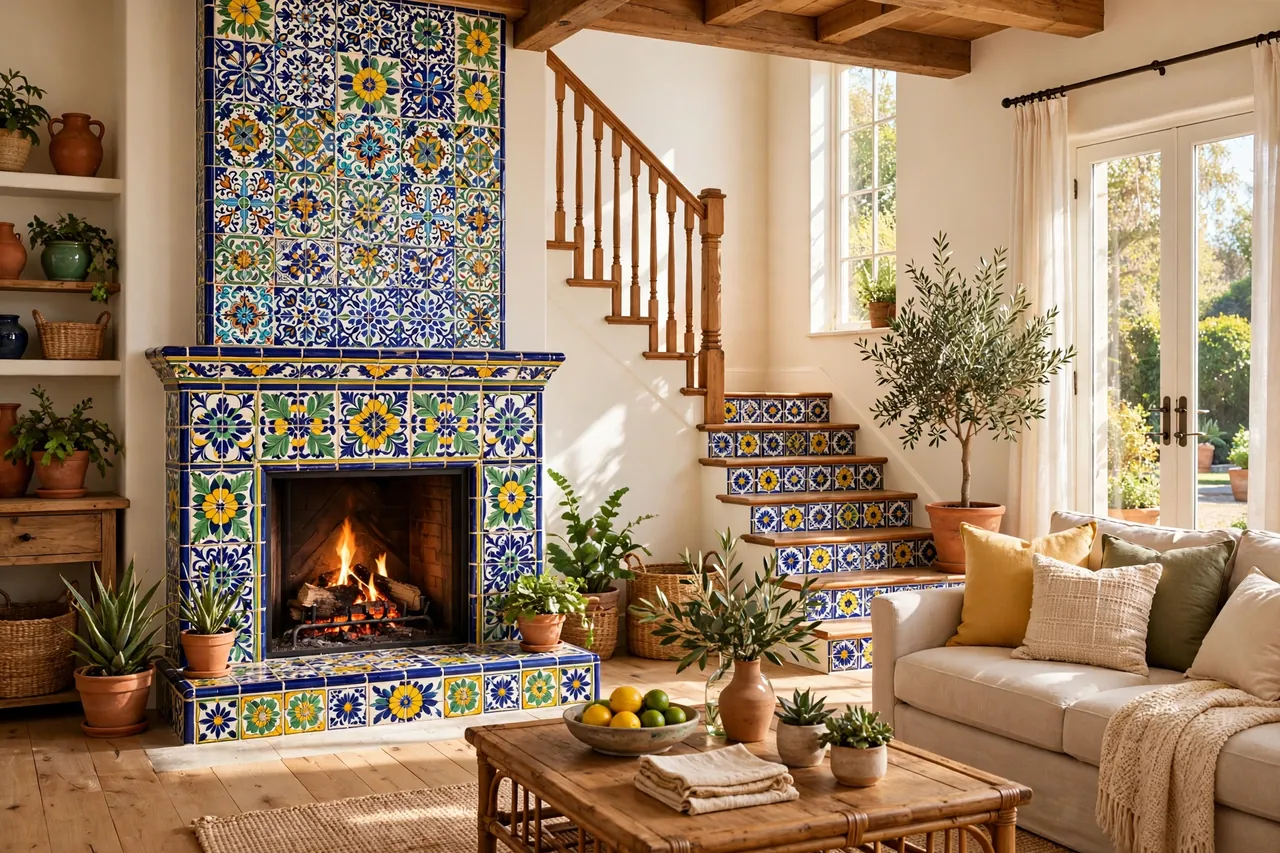
Bathrooms suit Talavera too, on walls and around a mirror, where the glaze handles steam and splashes. Stair risers are another favorite: a different pattern on each step turns a staircase into folk art, and risers take no foot traffic. Fireplace surrounds are a natural fit as well. If your fireplace needs repair work first, our guide to repairing a fireplace shows what to fix before any tile goes on, and our fireplace renovation ideas show how tile can finish the surround.
| Spot | Verdict | Why |
|---|---|---|
| Kitchen backsplash | Best use | Glossy glaze wipes clean; no foot traffic |
| Bathroom walls | Great | Glaze resists steam and splashes |
| Stair risers | Great | Decorative only; no wear at all |
| Fireplace surround | Great | Vertical surface; handles heat |
| Patio walls, mild climates | Good | Glazed and weather-resistant if sealed |
| High-traffic floors | Avoid | Soft clay body chips and wears |
| Inside pools | Avoid | Pool chemicals attack the clay |
| Freezing climates | Avoid | Not frost-proof; ice cracks the tile |
Outdoors, the rules are narrower. Talavera can go on patio walls and garden accent walls in places that never freeze. La Hacienda Tile, a US retailer, warns that its tiles are not frost-proof and should not sit in pools, where cleaning chemicals degrade the clay. Fine Crafts Imports gives the same limit: limited outdoor use, not below 40 degrees Fahrenheit, and never inside a pool.
What Most People Get Wrong About Talavera Tile
Most people get Talavera wrong in three ways: they think every colorful Mexican tile is Talavera, they think the glaze means the tile needs no care, and they think it is tough enough for any floor. Each belief leads to a purchase the buyer regrets.
First, Talavera is not a synonym for Mexican tile. Saltillo is the other famous Mexican tile, and it is the opposite in almost every way: unglazed terracotta in warm earth tones, soft and porous, made for rustic floors. Talavera is glazed, hand-painted, and decorative; Saltillo is unglazed and made to walk on. They need different care — Saltillo must be sealed again and again, while Talavera’s glaze does most of the protecting.
Second, the glaze does not make the tile invincible. The clay body underneath is soft earthenware, and the glaze can craze — develop a fine network of hairline cracks — over time. Crazing is normal, and collectors even look for it, but it means the tile is not a fit for a floor that takes daily foot traffic. Third, the cheapest tile in the search results is rarely Talavera at all: if the price is a fraction of the handmade range, you are looking at a printed copy.
Here is the problem with that advice: it is easy to nod at and hard to follow in a shop full of beautiful tile. The next section gives you the actual numbers, so you can judge a price on the spot.
How Much Does Talavera Tile Cost?
Handmade Talavera tile costs roughly $18 to $58 per square foot for the tile alone, according to US importer Rustico Tile, while simpler decorative tiles run about $2 to $10 per square foot. Installation adds $5 to $15 per square foot. Prices checked November 11, 2026.
The wide range comes from the tile itself. A plain solid-color 4.25-inch tile is the cheapest handmade piece; a complex hand-painted pattern in a large size costs far more, because a painter’s time is the main cost. Retail prices show the same spread. La Fuente, a US Talavera retailer, lists a 4.25-inch patterned tile at $3.11 on sale (regular $3.45) for one tile, $2.43 per tile in a box of 90, and a 6.25-inch tile at $8.05 on sale, or $5.98 per tile in a box of 40. Casa Tile lists decorative Talavera at $1.75 for a 3-inch tile, $2.15 for a 4.25-inch tile, and $6.75 for a 6-inch tile, with solid-color tiles cheaper still at $0.80 for a 2-inch tile and $3.95 for a 6-inch tile.
| Tile | Price | Source |
|---|---|---|
| Patterned 4.25-inch, single | $3.11 sale ($3.45 regular) | La Fuente |
| Patterned 4.25-inch, box of 90 | $2.43 per tile | La Fuente |
| Patterned 6.25-inch, single | $8.05 sale ($8.95 regular) | La Fuente |
| Decorative 3-inch / 4.25-inch / 6-inch | $1.75 / $2.15 / $6.75 | Casa Tile |
| Solid color 2-inch / 6-inch | $0.80 / $3.95 | Casa Tile |
| Handmade Talavera, per sq ft | $18–$58 | Rustico Tile |
| Tile only, per sq ft (simpler stock) | $5–$10 | Crafting With Concrete |
Guess which number surprises buyers most: the installed price. Oakwood Remodel, a Sacramento remodeler, puts a hand-painted Talavera backsplash at $25 to $45 per square foot installed, and $35 to $90 per square foot for accent areas. The tile is only part of that bill — the rest is a skilled installer, because handmade tiles vary in thickness and need a tiler who can level them by eye. Our guide to hiring a tiler explains what that labor should cost and what to check before you pay a deposit. Installation alone for Mexican tile floors runs $5 to $15 per square foot, according to Crafting With Concrete, before the tile itself.
Budget for waste, too. Order 10 to 15 percent more tile than the area measures, because handmade tiles vary, cuts eat into the count, and a few pieces always arrive chipped. Spare tiles from the same batch matter more here than with factory tile: the next batch will be painted by a different hand, and the color will not match. But the numbers said something else about the cheapest option. A printed tile at a dollar each is not a failed purchase if you wanted a printed tile — it is only a failure if you paid a handmade price for it.
How to Buy Talavera Tile Without Getting a Fake
Buy real Talavera by checking four things before you pay: the paint shows brush marks and varies tile to tile, the back is rough handmade clay, the seller names a certified Puebla workshop, and the price sits in the handmade range. If any one of those fails, treat the tile as Talavera-style and pay accordingly.
Start with the seller, not the tile. A trustworthy seller names the workshop, the town where it was made, and the certification behind it. Ask directly: which workshop made this tile, and can you show the Consejo Regulador seal? A seller who waves the question away is selling a look, not a craft.
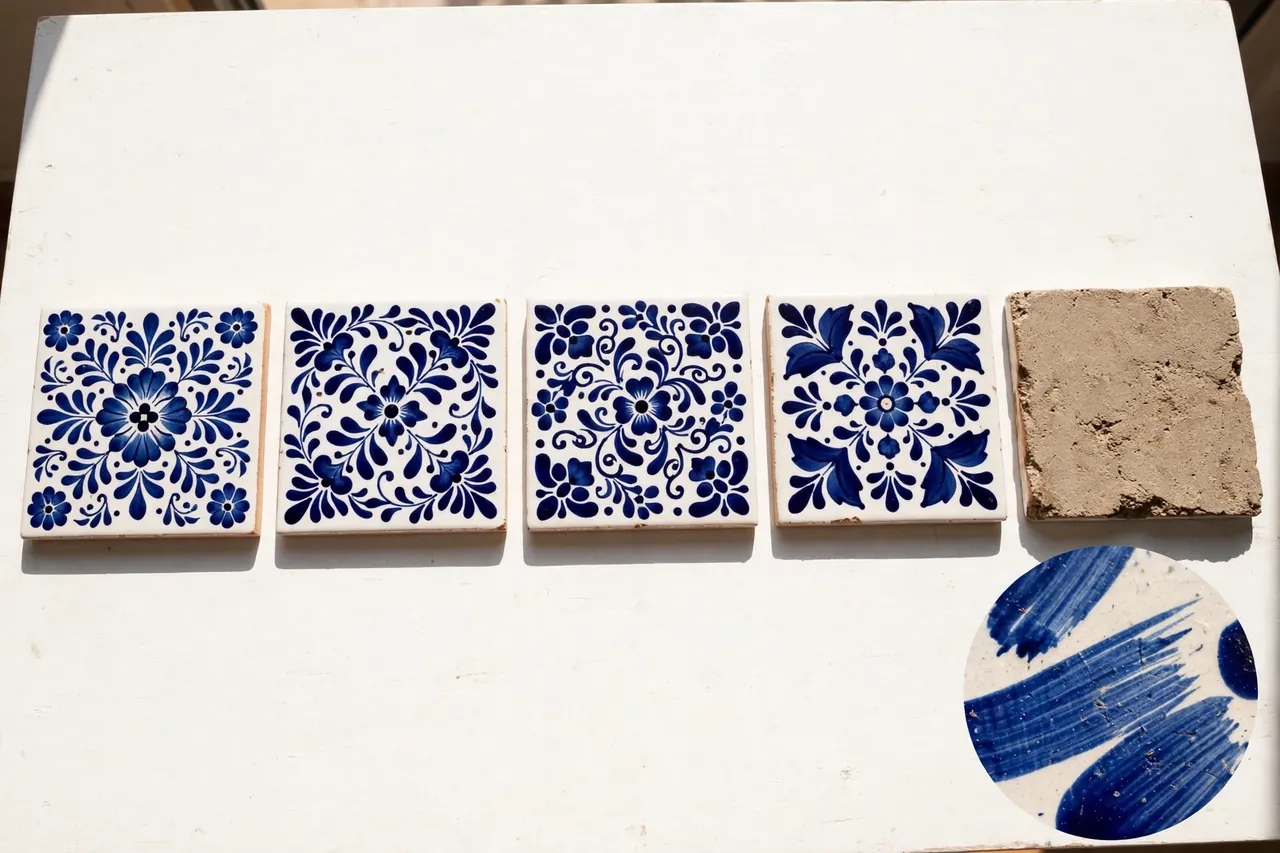
Then inspect the tile itself. Lay five tiles side by side: real hand-painted tiles differ slightly in color and line weight, while printed tiles repeat perfectly. Run a finger over the surface — real brushwork feels slightly raised under the glaze, a print feels flat. Flip a tile over: handmade clay is rough and uneven, factory tile is smooth and stamped.
Follow these steps in order when you shop, and keep the list on your phone in the store.
- Ask for the workshop name and the certification seal. No name and no seal means Talavera-style, whatever the tag says.
- Compare five tiles side by side. Identical patterns mean a print, not a painting.
- Check the back of a tile. Rough, uneven clay is handmade; smooth and stamped is factory-made.
- Count the colors. More than the six traditional mineral pigments means a modern or printed design.
- Order a single tile first. Check it in your room’s light before you order the box.
- Order 10 to 15 percent extra. Handmade tiles vary, cuts waste pieces, and the next batch will not match.
Where you buy matters as much as what you buy. Specialist importers such as La Fuente and Casa Tile sell named Talavera lines with per-tile prices listed. General marketplaces mix real tile, Talavera-style tile, and copies in the same search results, so read the listing — not just the headline — before you order. That fixes the buying question, but the tile still has to go on the wall.
How to Install Talavera Tile
Install Talavera tile like any ceramic wall tile, with three handmade-tile extras: dry-lay the whole pattern first, back-butter each tile because handmade backs are uneven, and keep grout joints at least 1/8 inch wide. Use a polymer-modified thin-set, let it cure 24 to 48 hours before grouting, and hire a pro for showers and large areas.
Start by dry-laying the pattern on a table or the floor. Handmade tiles vary in size and shade, so sort them first: put the most alike tiles together, spread the darkest and lightest ones evenly, and plan where the cut tiles will fall. This prevents the two most common complaints — a patch of dark tiles in one corner, and a cut tile in the middle of the pattern.
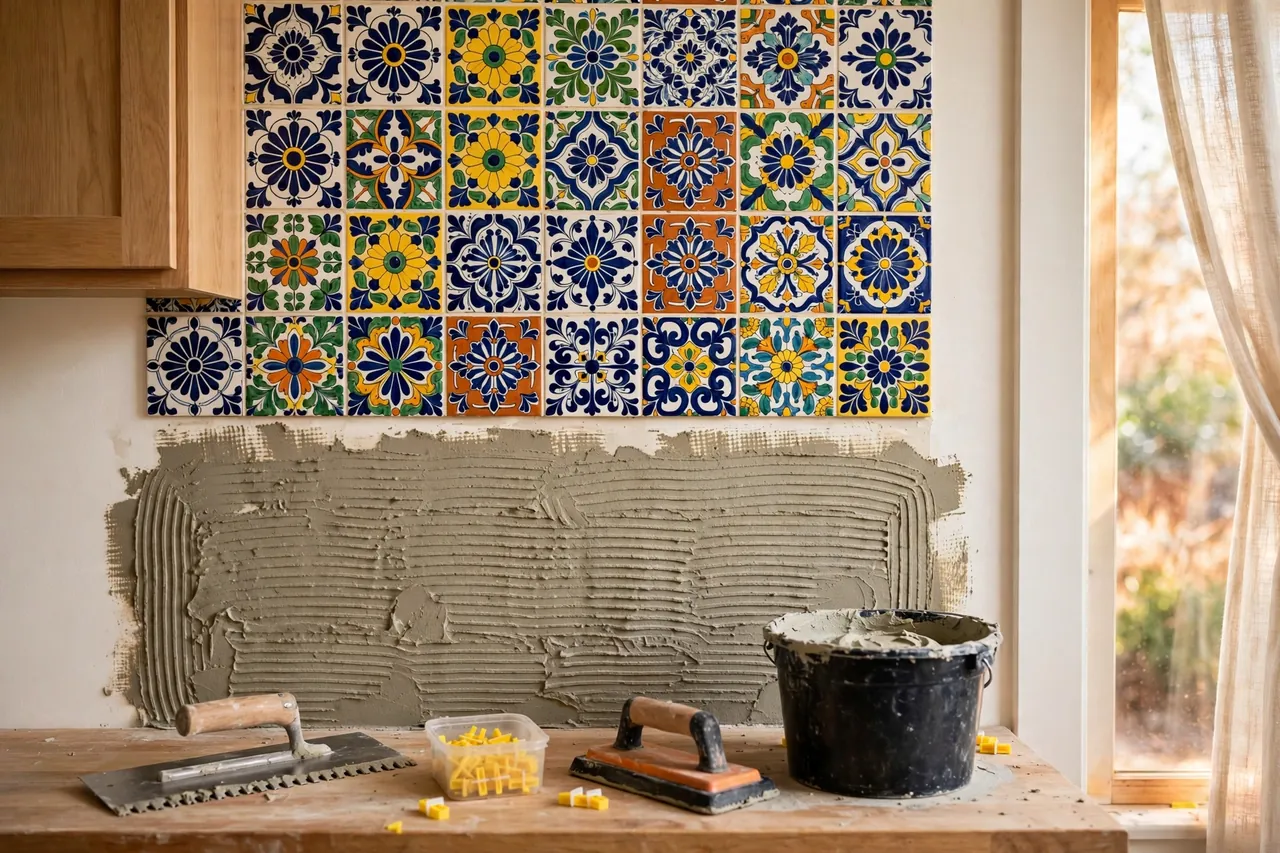
Prep the surface next. The wall or floor must be flat, dry, and sound, with cement backer board behind any wet-area tile. Spread polymer-modified thin-set with a notched trowel, and back-butter each tile — spread a thin coat on its back as well — because handmade backs are slightly cupped, and back-buttering gives full contact. Press each tile in with a slight twist, use spacers to hold joints at 1/8 inch or wider, and check the level often.
Let the thin-set cure 24 to 48 hours before grouting, because Talavera’s porous body absorbs moisture slowly. Use unsanded grout on walls and sanded grout on floors or wet areas, and seal the grout lines after about 72 hours. For hiring a tile pro, see our guide to hiring a tiler, and for a grout color that flatters a busy pattern, our Laticrete grout colors guide walks through matching grout to tile. A tiler who has set handmade tile before is worth the premium: leveling uneven tiles by eye is a skill.
How to Seal and Care for Talavera Tile
Seal the grout lines, not the glazed tile face: authentic Talavera’s double-fired tin glaze is already non-porous, so sealer belongs on the grout joints only. Clean with mild pH-neutral soap and a soft cloth, wipe spills quickly, and reseal the grout about once a year. Never use bleach, acids, or abrasive pads on the glaze.
Sealing is the step sellers argue about, so here is the honest split. The glazed face of real Talavera needs no sealer — the glaze is the seal, and adding a coat can trap moisture and leave a milky haze. The grout lines are different: cement grout is porous, so seal it after it cures, about 72 hours after grouting, with a penetrating sealer. When in doubt, seal the grout and leave the glazed face alone.
Daily care is simple. Wipe the tile with mild soap and water and a soft cloth, and wipe up spills fast — especially wine, coffee, lemon juice, and vinegar, which can stain grout and etch glaze if left sitting. Never use bleach, acidic cleaners, or abrasive pads; they dull the glaze over time. Test the seal once a year by sprinkling water on the grout: if it beads up, the seal is good, and if it soaks in, it is time to reseal. A tube of silicone caulk where tile meets a tub or countertop keeps water out of the joint — our best exterior caulk guide explains which sealant suits each edge.
One caution before you reach for a strong cleaner: sealers and heavy-duty cleaners give off fumes, so open a window, wear gloves, and test any strong product on one hidden joint first. If the glaze crazes — that fine network of hairline cracks — do not panic: it is normal for handmade Talavera. The tile will age, the colors will soften slightly, and that patina is part of what you paid for.
Related Guides
Talavera work touches several trades at once. If you are hiring the installer, read our guide to hiring a tiler first — it covers costs, quotes, and the checks that catch a bad hire. For the grout that frames a busy Talavera pattern, our Laticrete grout colors guide shows how to pick a shade that flatters the tile instead of fighting it. If the tile goes around a fireplace, see our fireplace renovation ideas and our guide to repairing a fireplace before you tile. And once the dust settles, our deep cleaning house checklist walks you room by room through the cleanup.
Frequently Asked Questions
Can I use Mexican talavera tiles outdoors?
Yes, with limits. Talavera works on patio walls, courtyard walls, and garden accents in mild climates that never freeze. It is not frost-proof, so ice can chip or crack it, and it should not sit inside pools, where cleaning chemicals degrade the clay. Use it above the waterline or around a pool, never submerged.
Do I need to seal Talavera tiles?
No, not the glazed face. Authentic Talavera’s double-fired tin glaze is non-porous, so sealing the tile itself traps moisture and can cause hazing. Seal only the grout lines, after about 72 hours, and reseal them about once a year. Unglazed terracotta tiles are different — those do need sealing.
What is the difference between Talavera and Saltillo tiles?
Talavera is a glazed, hand-painted ceramic tile known for bold color and pattern, while Saltillo is an unglazed, porous terracotta tile known for warm, rustic texture. Talavera suits decorative walls and backsplashes; Saltillo suits floors and needs sealing far more often.
Can I use this tile for a backsplash?
Yes, a kitchen backsplash is one of the best uses for Talavera tile. The glossy glaze resists heat, steam, and splashes, and it wipes clean with a damp cloth. Keep the pattern to an accent band or a single feature wall so the busy design has plain space around it.
How do I care for Mexican tiles?
Clean glazed Talavera with mild pH-neutral soap and water and a soft cloth, and wipe spills up quickly. Avoid bleach, acids, and abrasive pads, which dull the glaze. Test the grout seal yearly with a drop of water — if it soaks in, reseal the grout lines.
Your next step is simple: order one tile, hold it in your room’s light, and check the brush marks, the rough clay back, and the workshop name. If all three check out, order the box with 10 to 15 percent extra, and hire a tiler who has set handmade tile before. No two tiles are ever alike — yours will be the only one like it.


