
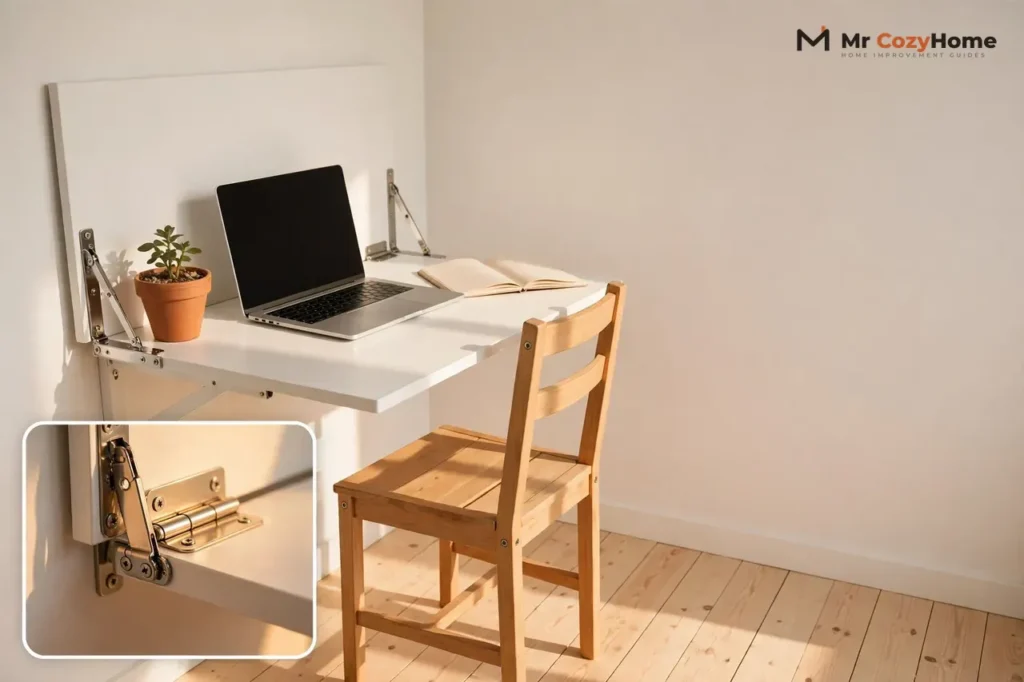
A fold up desk is a real work surface that folds flat against the wall when you finish — the Woodfold 300N closes to just 1.5 inches deep, and the IKEA NORBERG with storage costs $109.99, checked November 10, 2026. You open it, work at a normal desk height, and fold it away in seconds, so a bedroom, hallway, or studio corner becomes an office only while you need one.
That sounds simple, and the folding part is. The part that trips people up is the wall: a fold up desk hangs its whole load on screws and brackets, so the wrong anchors can drop your laptop on the floor. One item on this list voids most warranties — and it is in the comparison table below.
💡 Practical Home Tip: Before you buy anything, tape the open size of the desk on your wall and floor with painter’s tape, put your chair in place, and sit down. If your knees hit the wall or you cannot push the chair back, the desk is the wrong size — and tape is cheaper than a return.
What Is a Fold Up Desk, Really?
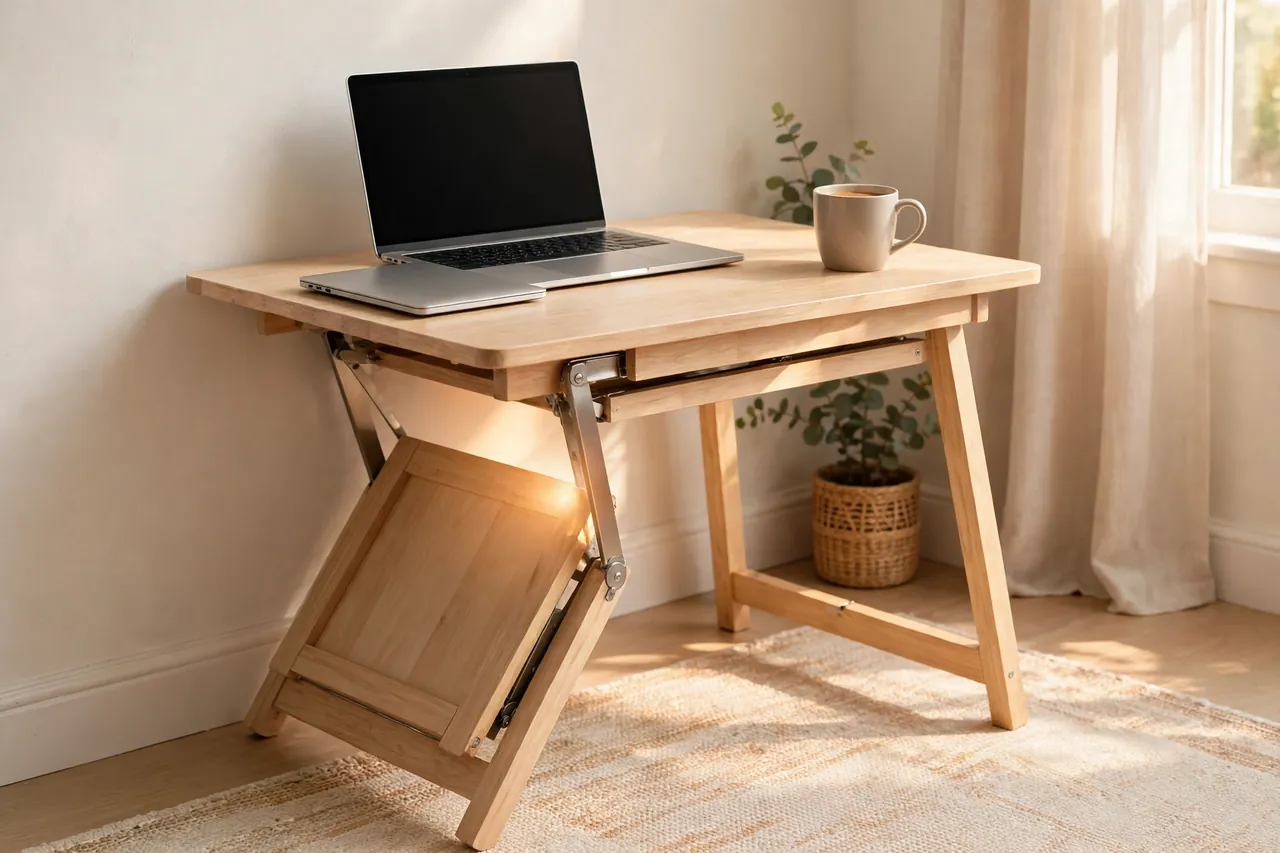
A fold up desk is a desk that folds away when you do not need it, so it gives you a work surface without taking floor space all day. Most types mount on the wall and fold down on hinges; others stand on folding legs you collapse and lean against a wall.
People mix up three names for the same idea. A fold-down desk drops its front panel down from a wall cabinet. A drop-leaf table, like the IKEA NORBERG, folds its leaf up on a wall bracket. A Murphy desk is a fold-down desk built into a cabinet. They all fold up, but they mount, hold weight, and cost very differently — and that difference decides which one fits your room.
A fold up desk works best for laptop work, writing, homework, and bill paying. It can serve a full workday too, but only with a strong bracket, a deep surface, and a real chair.
The 3 Types of Fold Up Desk — Which One Fits Your Room?
There are three types of fold up desk: a wall-mounted fold-down desk, a fold-out cabinet or secretary desk, and a portable folding-leg desk. The wall-mounted type saves the most space, the cabinet type hides your clutter, and the portable type needs no drilling at all.
Wall-Mounted Fold-Down Desk
This is the classic fold up desk. A board hinges to the wall, folding brackets hold it level, and it folds flat when you finish. Open, it is usually 14 to 20 inches deep. Closed, it sticks out only a few inches. It suits bedrooms, hallways, and studio apartments where the floor must stay clear.
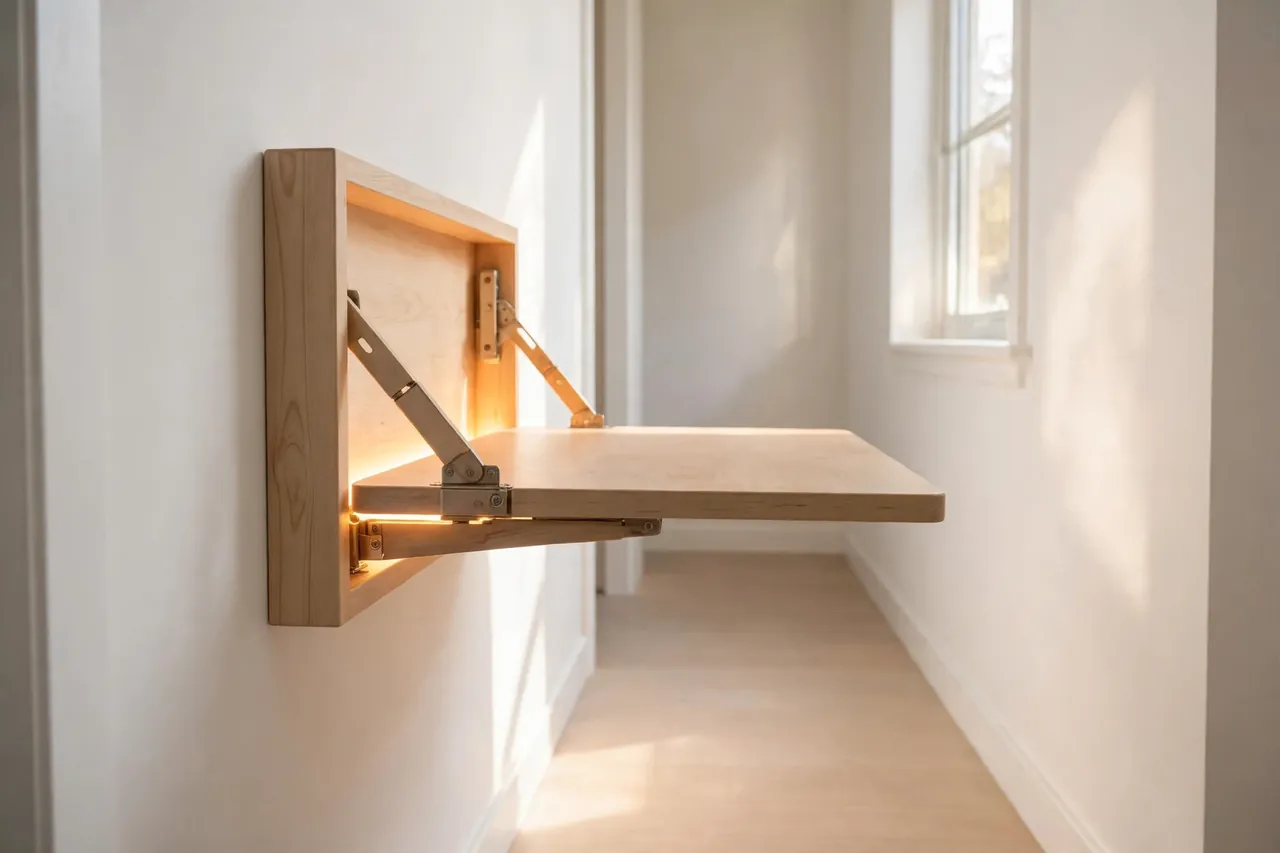
The catch is the load: a wall-mounted desk holds only what its brackets, screws, and wall can carry together. Light models hold a laptop and a few books; stronger ones hold a monitor too. Treat the listing’s weight rating as a ceiling, not a goal.
Fold-Out Cabinet and Secretary Desk
A cabinet desk looks like a shallow wall cabinet when it is closed. You open the front, and the door drops down to become the desk. Shelves and cubbies inside hold books, chargers, and notebooks, so everything you need is right there when the desk opens.
Cabinet desks hide clutter best, and kids’ homework stations love them. The trade-off is a light load: the Costway fold-down wall cabinet desk rates its desktop at only 11 pounds, per a published weight-capacity chart. That is a laptop and a notebook — not a monitor and a printer.
Portable Folding-Leg Desk
A portable desk stands on legs that fold flat under the top. You unfold it where you want to work, fold it when you finish, and slide it behind a door or under a bed. No screws, no studs, no landlord permission needed.
Portable desks carry more weight than wall-hung ones because their legs stand on the floor. They still need floor space while open, and a storage spot when folded — a fair trade for renters and people who move their workspace around the house.
Table: The 3 types of fold up desk compared (prices and ratings checked November 10, 2026)
| Type | Best for | Open size | Weight it holds | Price |
|---|---|---|---|---|
| Wall-mounted fold-down | Small rooms, daily laptop work | 14–20 in deep | 20–50 lb typical; up to 150 lb on strong models | From $109.99 (IKEA NORBERG with storage) |
| Fold-out cabinet | Homework, hiding clutter | 14–18 in deep | About 11 lb on the desktop (Costway) | From $185 (Woodfold 300N) |
| Portable folding-leg | Renters, moving workspaces | Full desk size | More than wall-hung types; check the listing | Varies widely; compare current listings |
Guess which type fails most often? It is not the cheapest one. The next section shows the mistake that brings desks down — and it has nothing to do with the desk itself.
What Most People Get Wrong About Fold Up Desks
Most people get fold up desks wrong in one way: they trust the number on the box. A weight rating describes the desk’s brackets or desktop, not your wall. A bracket rated for 100 pounds still falls if its screws sit in bare drywall. The weakest link — bracket, screw, or wall — sets the real limit.
The second mistake is reading the wrong number. Some listings rate the desktop, shelves, and drawers separately, and some never say which part the number covers. A desk listing 11 pounds for its desktop and 11 pounds for its shelf holds 11 pounds where you type, not 22.
The third mistake is drywall math. Anchor makers print lab failure loads — the point where the anchor breaks in a test. Toggler advises using no more than one quarter of those printed figures in real use, per a published weight-capacity chart from The Plywood. A 100-pound anchor gives you about 25 pounds of honest working load. That fixes the symptom, but the part that actually fails is the screw pulling out — and the next section shows how to stop it.
How Much Does a Fold Up Desk Cost?
A fold up desk costs from $109.99 to $185 for the two verified US models in this guide, checked November 10, 2026. Portable folding-leg desks vary widely and need a fresh price check, and installation costs nothing if you mount it yourself.
The cheapest honest starting point is the IKEA NORBERG wall-mount drop-leaf table with storage, at $109.99 on IKEA US, where it is marked “last chance” — so it may sell out. IKEA lists the white 25 1/4 x 23 5/8 inch model at that price, and IKEA says to fix it so the top sits at about 74 cm (29 inches) and to use fasteners suited to your wall material. The plain NORBERG without storage costs less in other countries, but no current US price for it was verified, so it is not quoted here.
The step up is the Woodfold Wall-Mounted Fold-Down Desk, Model 300N, at $185.00 from Ask Ergo Works. It is 18 inches wide, folds flat to 1.5 inches deep, and tilts to two angle positions, 63° and 68°, which suits reading and laptop work.
The Houseables 48×16 wall mounted desk lists a maximum weight recommendation of 150 pounds on Amazon, but its price was not available at check time, so no price is given here. Check the retailer page on the day you buy — prices change fast, and “last chance” labels mean stock can vanish.
- Budget pick: IKEA NORBERG with storage — $109.99, IKEA US, “last chance” (November 10, 2026).
- Sturdier pick: Woodfold 300N — $185.00, Ask Ergo Works (November 10, 2026).
- Heavy-load pick: look for a steel-bracket model rated 100 pounds or more — and mount it into studs.
- Extra costs: a stud finder, a level, toggle bolts, and a drill bit if you do not own them.
Price tells you what the desk costs. It never tells you what your wall can hold — and that is the question the next section answers.
How to Mount a Wall-Mounted Fold Up Desk Safely
Mount a wall-mounted fold up desk by finding the studs, marking the height, drilling into solid framing, and testing the brackets with your body weight before you put a laptop on it. The whole job takes about an hour with a drill, a level, and a stud finder. Rushing the stud step is how desks end up on the floor.
Here is the part most guides skip: a fold up desk is a lever. Weight on the front edge pulls the top screws straight out of the wall. That is why drywall anchors alone fail even when their numbers look big enough — only a screw sunk into solid wood resists that pull.
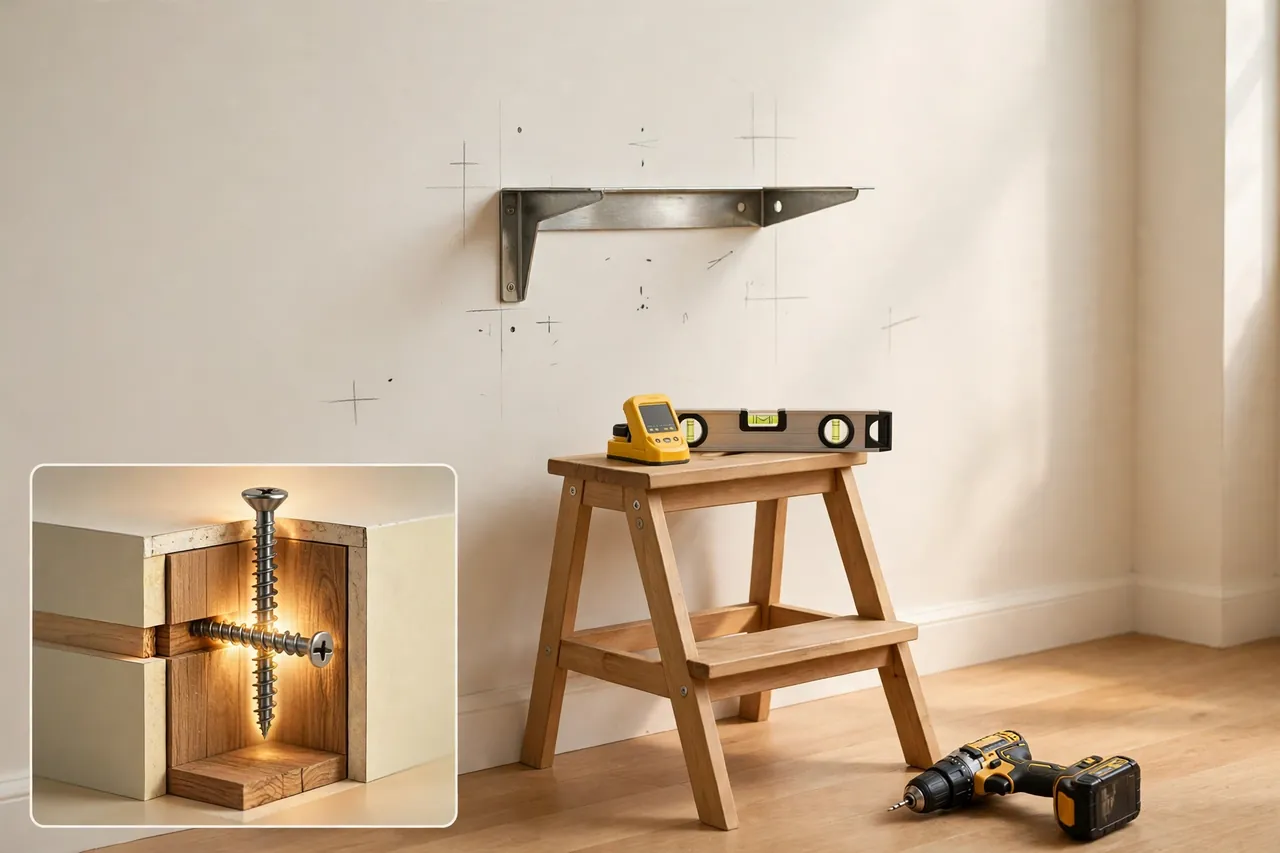
Caution first: stop and check for wires and pipes before you drill. Stud finders with AC detection help, but they are not perfect. If the wall is near a kitchen, a bathroom, or an electrical panel, or you feel unsure at any point, hire a handyman for this one job. A wrong hole in a pipe costs far more than the install.
- Find the studs with a stud finder and mark their centers with painter’s tape. Studs usually sit 16 or 24 inches apart, according to the installation guide from EngineerFix — if your finder shows nothing at those spacings, your wall may use metal studs or plaster, and you need different hardware.
- Mark the desk height on the wall. For sitting, set the open surface at 29 to 30 inches from the floor, the same as a standard desk. For standing work, set it at your standing elbow height, usually 38 to 50 inches. Test the height with your chair before you drill.
- Hold the desk’s wall bracket against the marks and check it with a level. Mark every screw hole, and make sure at least two screws land in studs — one stud is not enough for a loaded desk.
- Drill pilot holes, then drive the screws into the studs. Where a hole misses a stud, use a toggle bolt or molly bolt rated for the load, never a plain plastic anchor. EngineerFix recommends toggle or molly bolts over plastic anchors for exactly this reason.
- Attach the folding brackets and the desktop, then open and close the desk five times. It should move smoothly and lock level. If it sags, sticks, or clicks, stop and recheck the bracket screws before you load it.
- Test it empty, then with books. Press down firmly on the front edge with both hands and watch the wall. Any gap opening between the bracket and the wall means the fasteners are pulling out — take the load off and refasten into a stud.
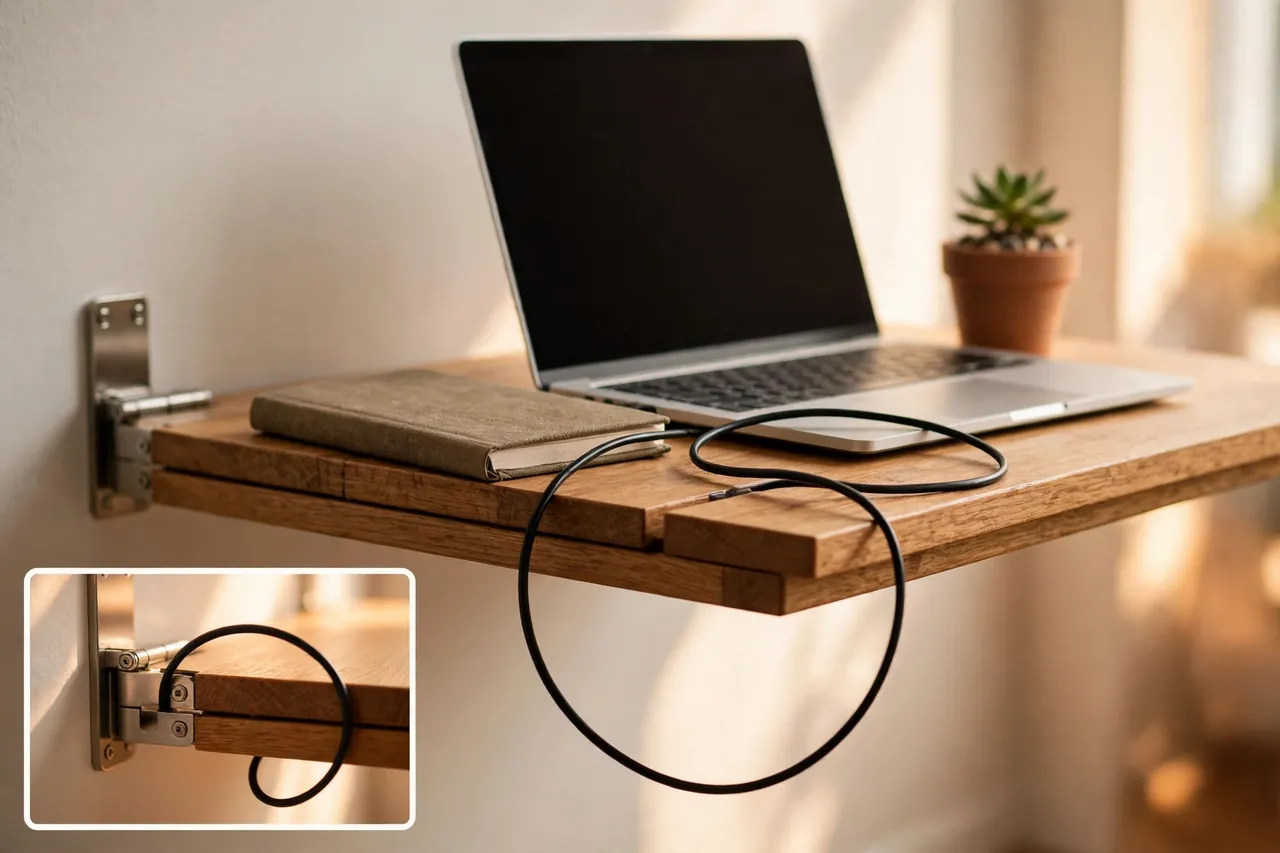
Two details save most installs. Keep cables in a loose loop that clears the hinges through the whole fold, so the desk never pinches a charger cord. Add a small shelf above the desk for books and a lamp, so the desktop stays clear for work — our guide to bedroom shelving ideas that add storage without crowding your room shows shelf styles that pair well with a wall desk, and the wall-mounting steps in our floating shelves DIY guide use the same stud-finding method. The Plywood’s floating desk weight capacity chart explains why a bracket rating is not a wall rating.
How to Pick the Right Size for a Small Room
Pick a fold up desk 36 to 48 inches wide and 16 to 20 inches deep for a small room, with 30 inches of clear space behind the chair so you can push back and stand up. That size holds a laptop, a notebook, and a mug without crowding you.
Depth matters more than width. A desk 14 inches deep fits a laptop, but a monitor base, a notebook, and your wrists will fight for room; 20 inches fits a laptop and a notebook side by side. Go deeper only if the open desk still leaves a clear walkway.
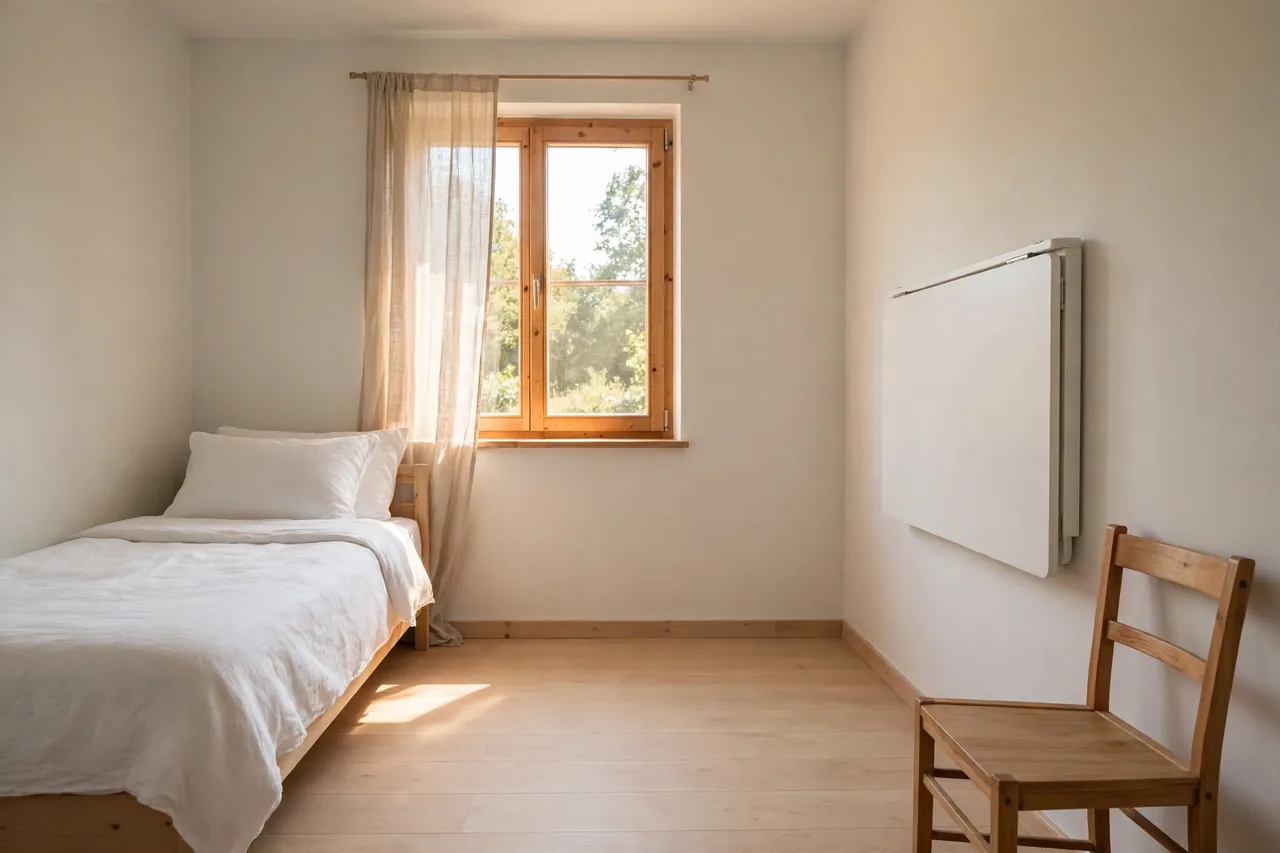
Height is the second measurement. A sitting desk works at 29 to 30 inches. A standing desk works at your elbow height. A desk mounted at counter height suits neither, so test with your own chair instead of copying a neighbor’s shelf. If the room must hold both work and sleep, pair the desk with the storage plan in our guide to the best storage ideas for small rooms — it is the single most useful next read once your desk size is set, because a desk without a home for your gear ends up buried under it.
Renters: How to Get a Fold Up Desk Without Drilling
Renters can use a fold up desk without drilling by choosing a portable folding-leg desk, a freestanding fold-out desk, or a clamp-on desk that grips a table or shelf. None of these touch the wall, so none of them risk your deposit. A portable desk is the simplest choice: unfold it, work, fold it, and slide it behind a door.
If your heart is set on a wall-mounted desk, ask your landlord in writing first. Some allow small holes if you fill and paint them when you leave; most will not allow a loaded desk on drywall. Get the answer before you buy, not after you drill. If your bedroom doubles as your office, our guide to organizing a bedroom so it stays that way shows how to give the desk a permanent home without cluttering the room.
Adhesive strips and suction mounts are not an option for a desk — they hold pictures, not levers with a laptop on the front edge. A clamp-on desk that grips a sturdy table works, but test the clamp on your actual furniture first. If your laundry area needs a work surface too, our guide to a shelf above the washer and dryer shows how a wall-mounted shelf earns its keep when the landlord allows it.
Living With It: What Wears Out First
Hinges and folding brackets wear out first, followed by screws loosening in the wall and the desktop edge chipping where hands grip it daily. A desk folded twice a day cycles its hinges more than 700 times a year, so cheap stamped-steel hinges loosen and sag long before the desktop fails.
Buy for the hinge, not the finish. Steel folding brackets 2 to 3 mm thick outlast thin stamped sheet metal, and a soft-close hinge stops the desk from slamming. Check the hinge screws every few months — a loose hinge puts sideways force on the bracket and shortens its life.
Daily habits matter too. Fold the desk up when you finish so the room gets its floor back. Keep heavy items off the front edge, where leverage is worst, and liquids away from MDF desktops, which swell when wet. Plywood and solid wood tops handle spills better but weigh more, so the bracket rating matters even more.
Related Guides
These MrCozyHome guides solve the next problems a fold up desk creates — storage for your gear, shelves above the desk, and a tidy room around it.
- Best Storage Ideas for Small Rooms — where your gear lives when the desk folds away.
- How to Organize a Bedroom So It Stays That Way — a clutter-free home for a bedroom desk.
- Bedroom Shelving Ideas That Add Storage Without Crowding Your Room — shelves that pair with a wall-mounted desk.
- Floating Shelves for Your Laundry Room: A Beginner’s DIY Guide — the same stud-finding method, step by step.
- Shelf Above Washer and Dryer: How to Choose, Install, and Use It Safely — another wall-mounted surface, same safety thinking.
Frequently Asked Questions
What are the space-saving benefits of using a wall-mounted folding desk?
A wall-mounted folding desk frees floor space by folding flat against the wall when you are done — typically cutting its footprint by 70 to 100 percent depending on open depth. A Woodfold 300N, for example, closes to 1.5 inches deep. You get a real work surface only while you work, and the room back the rest of the day.
How do you install a wall-mounted folding desk safely and securely?
Find the studs with a stud finder and mount the main brackets into studs or solid blocking, never drywall alone. Use hardware rated for at least 1.5 to 2 times your planned load, check the level before final tightening, and test with books before a laptop goes on it.
What are the best features to look for in a fold-down desk with storage?
Look for built-in shelves or cubbies that sit inside the cabinet, a desktop deep enough for your laptop, steel folding brackets, and a soft-close hinge. Check the weight rating for the desktop itself, not the whole unit, and make sure the folded depth still clears your walkway. Storage helps only if the desk still folds flat.
How stable and ergonomic can a fold-down desk really be?
Very stable, if the build is right: sturdy metal fittings, a desktop at least 18 mm thick, and a working height of 72 to 75 cm (about 29 inches) give solid everyday ergonomics for 4 to 6 hours of home office use. Weak hinges, a thin top, or drywall-only mounting are what make a fold-down desk wobble.
What is the best desk for a tiny apartment?
A wall-mounted floating desk or a fold-down desk is usually the best choice, because both leave the floor free and fold or blend into the wall when you are done. Pick the fold-down type if you need the surface to vanish, and the floating type if you want a permanent shelf-like desk. Either way, mount into studs.
Disclaimer: Homes, walls, and budgets vary, and this guide cannot see your wall. If your wall is plaster, metal studs, or tile, or you find wiring or pipes while drilling, stop and get qualified help. The prices and ratings here were checked November 10, 2026, and they can change — confirm them on the retailer’s page before you buy.
Start with the tape test tonight. Mark the desk on your wall, sit in your chair, and see if the size fits your body before it fits your budget. Then buy the desk your wall can actually hold, mount it into studs, and fold it away at the end of the day — your room will feel bigger by tomorrow morning, and your laptop will still be on the desk, not under it.


