
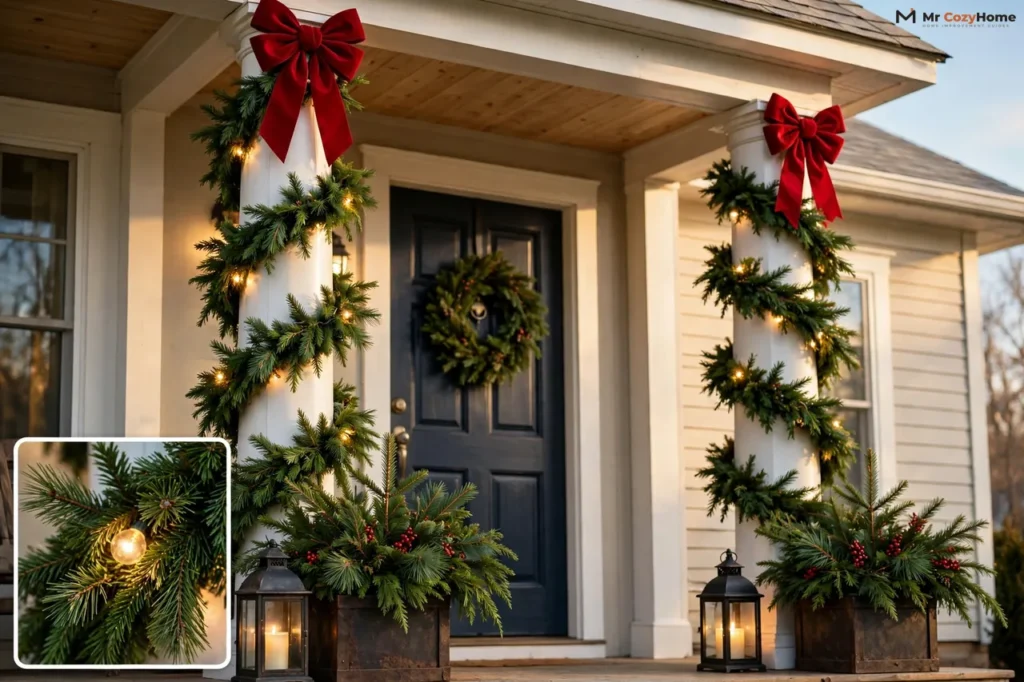
Christmas decorations for columns turn plain porch posts into the warmest part of your entry. Wrap each column in garland and lights, add a big bow or a wreath, and finish the base with a planter or a lantern. That simple formula works on brick, wood, vinyl, and stone columns, and you can attach everything without drilling holes or leaving marks.
In this guide, you will learn how to measure a column, wrap it in a neat spiral, pick damage-free fasteners for your column material, and style the base so the whole porch looks finished. You need only basic supplies, a sturdy ladder, and about an hour for a pair of columns.
Start With Your Columns, Not the Decor
Every column decor plan starts with the columns themselves. Two porches rarely match, so a quick check now saves a second trip to the store later. Look at each column, note what it is made of, and measure it before you buy a single strand of garland.
Measure Each Column Before You Buy Anything
Measure the height of each column from the base to the top trim. Then wrap a tape measure around the column to find its girth, which is the distance around it. Write both numbers down for every column, because porch columns often differ by an inch or two.
Use those numbers to judge how much garland and light you need. A tight spiral wrap needs roughly twice the column height in garland, because each turn travels around the column as well as upward. A looser spiral with gaps between turns needs less, but it also shows more bare column. Buy one extra strand if you can, since running short halfway up the last column is the most common frustration in this project.
Also measure the distance from each column to the nearest outdoor outlet. That distance tells you what length of outdoor extension cord you need, and it keeps cords from stretching across the walkway where guests could trip.
Match the Look to Your Column Shape
Round columns take a smooth, even spiral, and the garland curves around them with no corners to fight. Square columns need a slightly different touch: let the garland fold gently over each corner instead of forcing a tight curve, and use a fuller garland so the corners do not poke through bare spots. Tapered columns, which grow narrower toward the top, look best when you keep the spacing between turns steady and let the spiral narrow naturally as you climb.
Short, wide porch posts suit a chunky garland and one bold bow, because a thin strand can look lost on a fat post. Tall, slim columns suit a slimmer garland with lights woven through it, because a heavy garland can overwhelm a narrow post. When every column on the porch matches, decorate them all the same way. Matching columns frame the entry like a pair of bookends, and the porch looks planned rather than patched together.
Wrap Columns in Garland and Lights
The spiral wrap is the classic column look for a reason. It uses the column’s full height, it looks good from the street and from the walkway, and it gives lights and ornaments a natural path to follow. Garland gives the column its fullness, and lights give it its glow after dark.
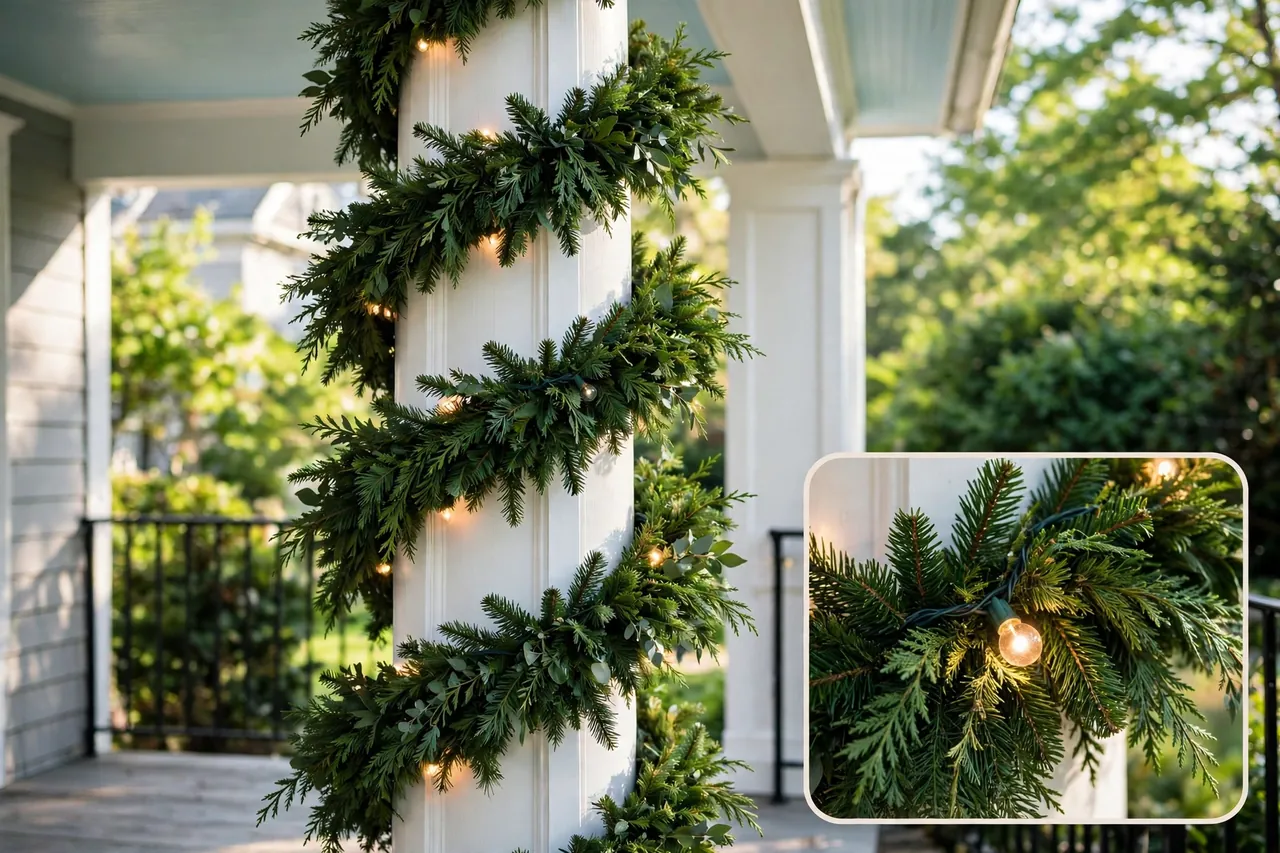
Pick a garland made for outdoor use if your columns stand outside. Outdoor garland resists rain, wind, and sun, so it still looks full in late December. Fresh evergreen garland smells wonderful and looks rich, but it dries out and sheds, so keep it for sheltered porches and plan to put it up closer to Christmas. Faux garland costs more up front, yet you can reuse it for years, which makes it the practical pick for most beginners.
How to Wrap a Column in Garland, Step by Step
- Fasten the top end of the garland at the back of the column, where guests see it least. Use a damage-free fastener that suits your column material, and hide the fastener under the garland itself.
- Wind the garland downward in a steady spiral, and keep the gap between turns even all the way down. Step back after three or four turns and check the spacing from the street view.
- Fluff the garland as you go, and turn its fullest side outward. Tuck the bare spine of the garland against the column so only greenery shows.
- Fasten the garland again near the middle if the column is tall or the porch catches wind. A middle anchor stops the whole spiral from sliding down over time.
- Secure the bottom end at the back of the column base, trim any extra length, and tuck the cut end under the last turn so no bare wire shows.
If your garland looks thin in places, twist a second, lighter strand into the same spiral. Two thin strands often cost less than one thick strand, and they fill gaps without adding much weight. If you want extra texture, tuck pinecones, red berries, or small shatterproof ornaments into the garland after you finish wrapping, and space them evenly so no one section looks crowded.
Add Lights to a Wrapped Column
Lights turn a daytime garland column into an evening showpiece. Test every strand before you climb the ladder, and set aside any strand with cracked sockets, frayed wire, or loose bulbs. Plug the strand in on the ground first, because finding a dead section after you wrap it wastes the whole job.
Wrap lights along the same spiral path as the garland, and weave them just under the outer greenery so the bulbs peek out between branches. Warm white lights give a classic, cozy glow that suits most homes, while cool white lights give a crisp winter look. Keep the spacing even, and carry the same light color and spacing across every column so the porch reads as one display.
For a rough sense of length, a 7-foot column needs a light strand of at least 32 feet when you wrap it in a spiral, according to Angi’s column decorating guide. Measure your own columns rather than trusting that number alone, since a wide column eats up far more strand than a slim one. If you want broader garland ideas beyond columns, our guide to Christmas garland ideas shows styles you can adapt to a column wrap, and our how to hang garland guide covers hanging technique in more depth.
Attach Decor Without Damaging Your Columns
The fastener you choose matters as much as the decor itself. The wrong fastener leaves holes in wood, stains on vinyl, or adhesive stuck to brick. The right fastener holds all season and comes off clean in January. Match the fastener to the column material, and test any adhesive on a small hidden spot first.
Adhesive hooks work best on smooth, clean surfaces such as sealed wood, vinyl, and fiberglass. Clean the spot with rubbing alcohol, press the hook on firmly, and wait about an hour before you hang weight on it, so the bond cures fully. Check the hook’s weight rating against your garland, since a dense garland with lights and ornaments weighs far more than a bare strand. Engineer Fix notes that a standard faux pine garland weighs around 0.3 pounds per linear foot before you add lights and ornaments, so spread the load across several hooks rather than trusting one.
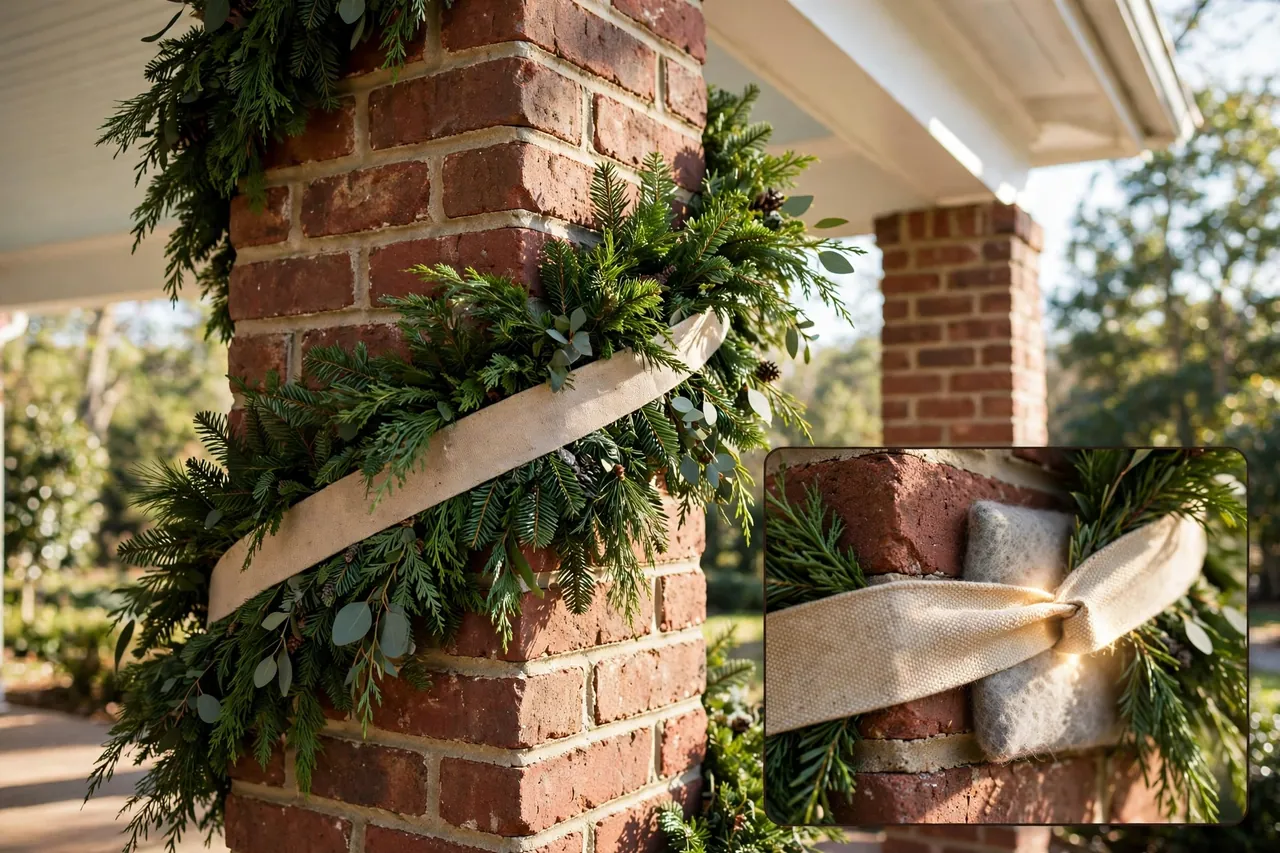
Brick, stone, and rough concrete defeat most adhesives, because the rough surface gives the glue little to grip. For those columns, use brick clips that grip the mortar joints, or wrap a wide ribbon or strap all the way around the column and tie the garland to the strap. The strap method uses tension instead of glue or holes, and it works on any column shape. Never drive nails into brick or stone without proper masonry anchors, and never use plain staples or nails on a column you want to keep flawless. If you must use wire or zip ties, slip a layer of soft felt or fabric under them first so they cannot scratch the finish.
| Column material | Damage-free method | What to avoid |
|---|---|---|
| Brick | Brick clips on mortar joints, or a full wrap strap tied at the back | Nails without masonry anchors, and adhesive hooks on rough brick |
| Wood | Adhesive hooks on sealed wood, or soft ties around the column | Staples and nails in painted or finished wood |
| Vinyl | Adhesive hooks on a clean, smooth surface, or a wrap strap | Screws through vinyl, and wire pulled tight against the surface |
| Stone | Wrap straps, or clips made for stone and masonry joints | Drilling into stone, and adhesives on rough or dusty stone |
| Fiberglass | Removable adhesive hooks, or soft ties around the column | Nails and staples that puncture the smooth shell |
Put every fastener at the back of the column when you can, and cover the rest with a bow or a pinecone cluster. Hidden fasteners make the whole column look effortless, and they keep guests from noticing how the magic stays up.
Add a Bow or Wreath to a Column
A bow or a wreath gives a wrapped column its finishing touch. It marks the top or the middle of the column, hides a fastener, and adds a pop of color that reads clearly from the street. Choose weatherproof ribbon and bows for outdoor columns, since plain fabric bows fade fast in sun and rain.
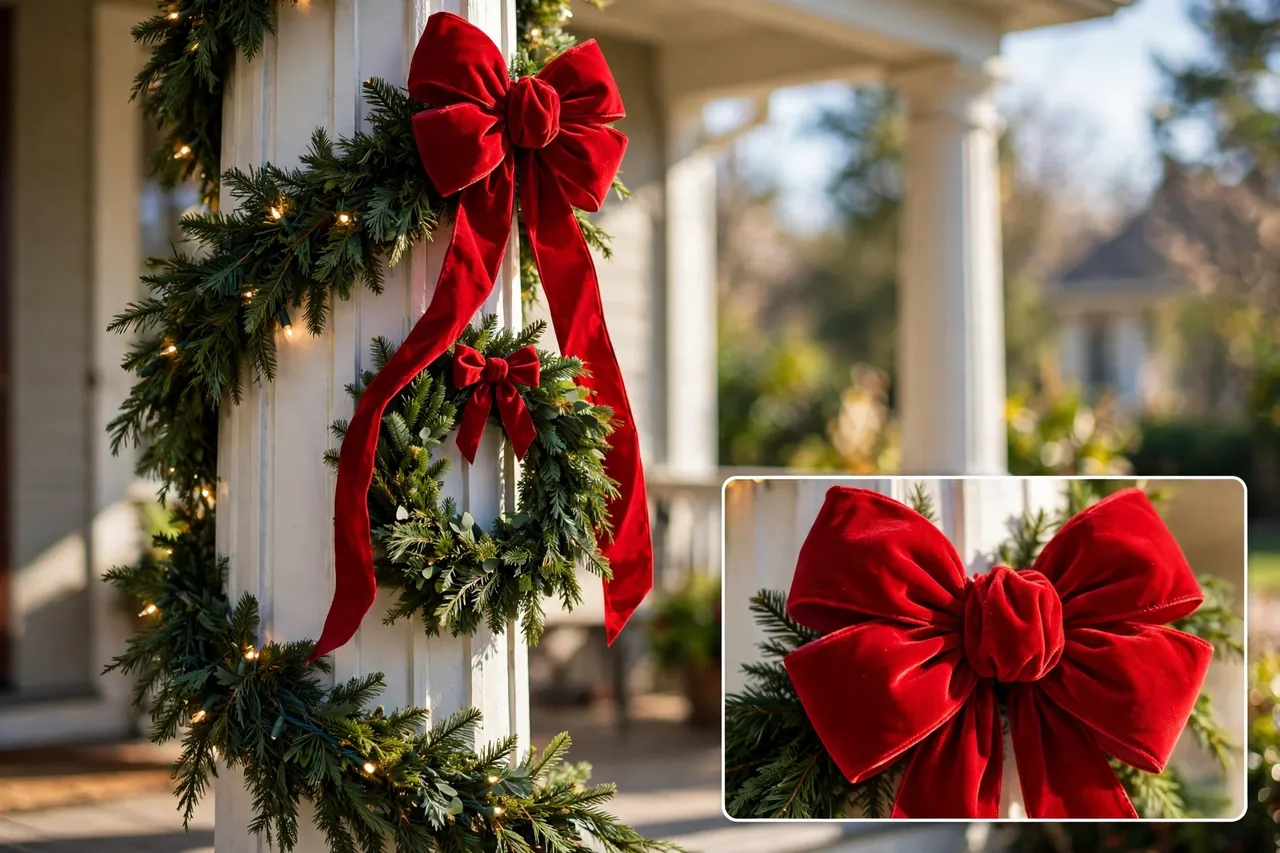
Hang one large bow near the top of each column for a classic look, and match the bow color across all columns. Red velvet suits a traditional porch, gold suits an elegant porch, and plaid suits a rustic porch. Tie the bow to the garland itself rather than to the column, so you never need a new hole or hook. Let the bow tails hang down the garland a little, and fluff the loops until the bow looks full from the front.
A wreath on a column works best as a single accent, not a row of wreaths stacked up the post. Hang one wreath at eye level or just above the middle of the column, using the same damage-free fastener you used for the garland. A plain evergreen wreath with a small bow blends with a garland wrap, while a wreath packed with ornaments can fight the garland for attention. If you love bows, our guide to bow decor for Christmas shows bow styles you can pair with a column wrap.
Style the Base of Each Column
Most people decorate the column and forget the ground around it, yet the base is where the eye lands first from the walkway. A styled base grounds the column, hides cord ends and fasteners, and ties the column into the rest of the porch. Keep the walkway clear, and never block the path with a wide planter.
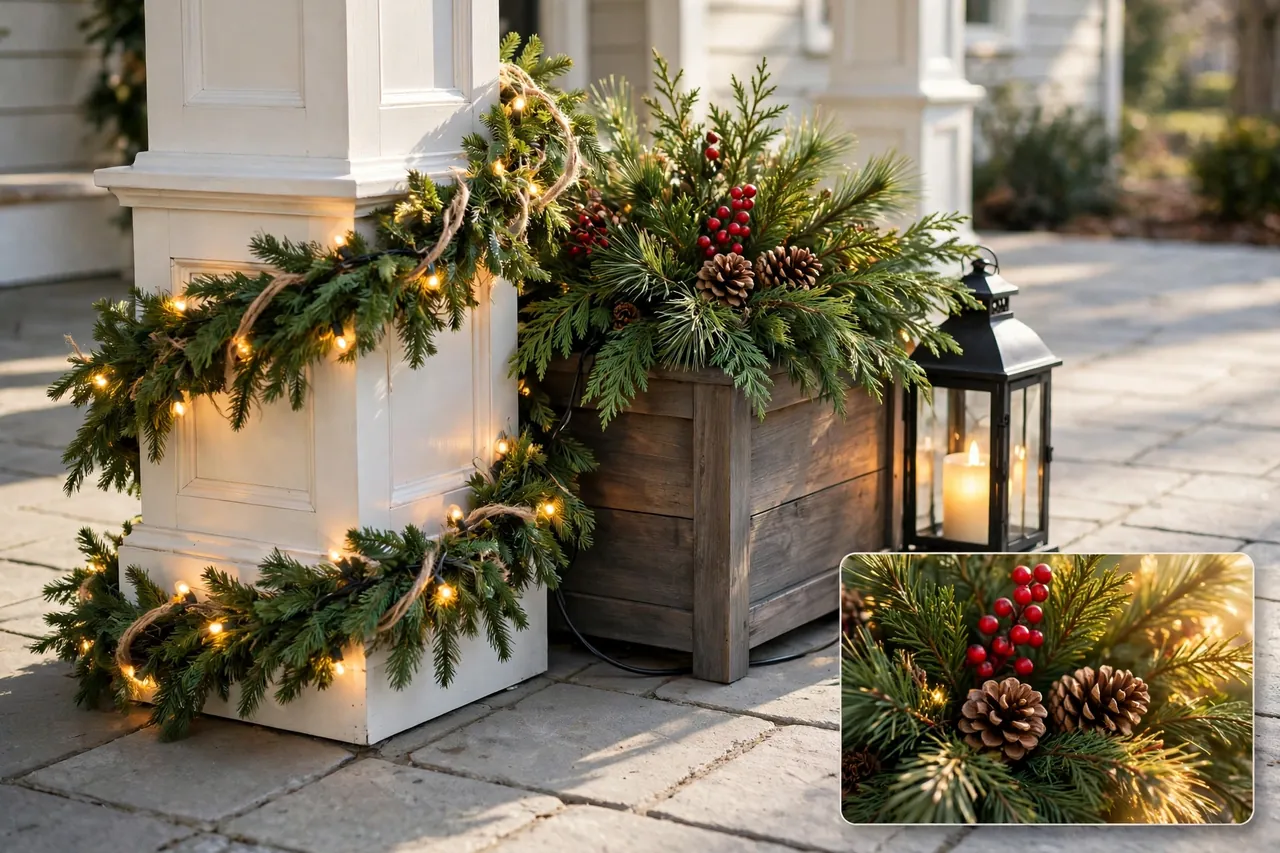
Set a planter beside each column base, and fill it with evergreen branches, red berries, and a few pinecones. Match the planters on both sides of the entry, and keep them small enough that guests pass with ease. A planter also gives you a place to hide the bottom fastener and the cord that runs from the column lights to the outlet.
Lanterns make a second strong base accent. Place one lantern beside each column, and use a battery candle or a solar light inside it rather than a real flame. Real flames and dry garland never belong together, and wind can tip a lantern on an open porch. If you want more porch-wide ideas around the entry, our Christmas patio decorating ideas and outdoor Christmas window decorations guides help the columns match the rest of the porch.
Light Columns Safely Outdoors
Outdoor column lights need outdoor-rated gear and a little caution. Use only lights labeled for outdoor use, and check the label before you buy, since indoor lights cannot handle rain and cold. Plug outdoor lights into an outlet protected by a ground fault circuit interrupter, called a GFCI, which cuts power fast if water reaches the circuit. The U.S. Consumer Product Safety Commission advises exactly that: outdoor electric lights should plug into GFCI-protected circuits, and you should use only lights tested by a recognized testing lab.
Run cords along the back of the column base and under a cord cover where they cross a walkway. Never pinch a cord in a door or window, and never staple through a cord, since both moves can damage the wire inside. Put the lights on a timer so they switch off when you go to bed, and switch them off when you leave the house.
Use a sturdy ladder for the top of tall columns, and set it on level ground with a helper holding it when you can. Keep three points of contact on the ladder at all times, and never lean sideways to reach around a column. If a column top sits beyond your safe reach, hire a handyperson for that part rather than stretching from the top rung.
Column Looks That Work for Every Porch
Once you know how to wrap and fasten, the fun part starts: picking a look. These Christmas column decorations work best when you keep one color palette across all columns, and let the rest of the porch echo it. A single palette looks calm and planned, while three competing palettes look noisy from the street.
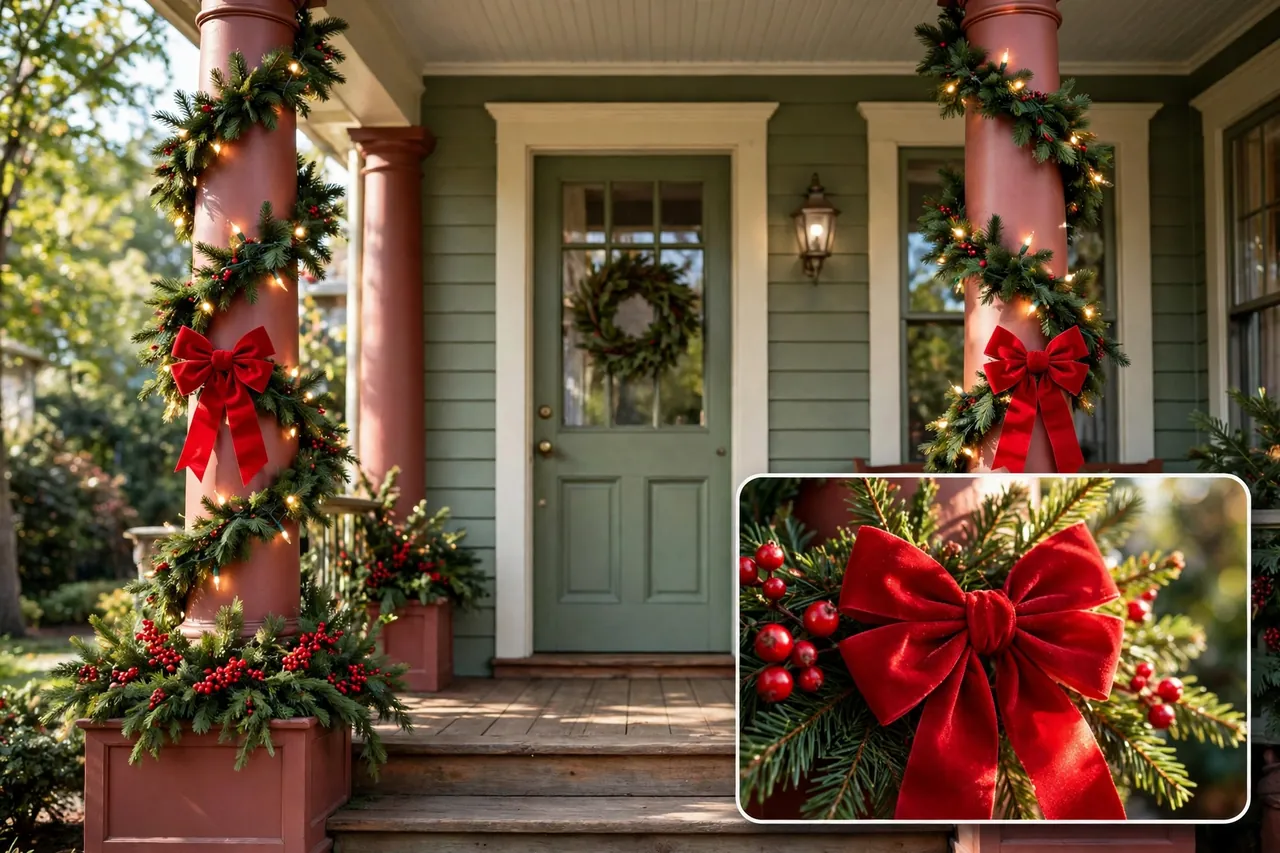
Classic red and green never fails on a traditional home. Pair deep green garland with warm white lights, red bows, and red berries at the base. Winter white suits a modern home: use frosted garland, cool white lights, silver ornaments, and white planters. Rustic farmhouse suits a wood-sided home: use plain cedar garland, warm lights, burlap bows, and pinecones with no shine. Candy cane columns make a playful statement: alternate red and white ribbon or lights in a steady spiral, and keep the rest of the porch simple so the columns stay the stars.
Match the column look to your door decor, not just to itself. If your door wears a bold wreath, keep the column bows smaller so the door still leads the eye. If your door stays simple, let the columns carry more color. For a porch with a contest in mind, our door decorating contest ideas can help the columns and the door win together.
Take Column Decor Down and Store It
Take column decor down soon after the holidays, before winter weather glues adhesive and grime to the surface. Pull adhesive hooks off slowly, following the maker’s removal steps, and wipe each column with a damp cloth to catch sap, dust, or residue. Check wood columns for scratches and vinyl columns for stains while the season’s marks are still fresh.
Coil light strands loosely and label each coil with its column, so next year you grab the right length without guessing. Store garland in a breathable bag or a long box so it keeps its shape, and store bows in a lidded bin with dividers so they do not crush. Label one bin per porch side, and you will cut next year’s setup time in half.
Related Guides
If you want to build out the whole entry around your columns, these guides pair well with this one: Christmas garland ideas for more garland styles, how to hang garland for hanging technique, bow decor for Christmas for bow styles, and outdoor Christmas window decorations for the windows beside your columns.
Frequently Asked Questions
How do you hang Christmas garland on columns?
Start at the top of the column and secure one end of the garland with a hook, clip, or tie that suits your column material. Wind the garland tightly downward in a steady spiral, add a middle fastener on tall columns, and secure the bottom end before you trim any extra length.
How do you wrap columns to look like candy canes?
Use alternating weatherproof ribbons or light strands in red and white, and wrap them around the column at a slight angle from top to bottom. Keep the stripes even and the spacing steady, and keep the rest of the porch simple so the candy cane columns stand out.
How many feet of lights do you need to wrap a column?
For a 7-foot-tall column, choose a light strand at least 32 feet long, as Angi advises in its column guide. Measure your own column height and girth first, since a wide column needs far more strand than a slim one, and add the distance to your nearest outlet.
How do you hang garland on columns without damage?
Match the fastener to the material: adhesive hooks suit smooth vinyl, sealed wood, and fiberglass, while brick clips or a full wrap strap suit brick and stone. Clean smooth surfaces first, wait for adhesive to cure, and never drive nails into brick, stone, or finished wood.
Can I wrap a column that is not perfectly round?
Yes. On square columns, let the garland fold gently over each corner and use a fuller garland so corners do not poke through. Keep the spiral steady across each flat face, and treat corners as gentle turns rather than forcing a tight curve.
Enjoy Your Entry All Season
Columns give you the tallest, most visible decorating surface on the porch, and a simple garland spiral with lights, one bow, and a styled base makes the whole entry feel welcoming. Measure first, fasten with care for your column material, and check the lights once after a windy night. Then step back to the street, enjoy the glow, and welcome your guests through an entry that looks like Christmas.
Disclaimer: homes, columns, and weather conditions vary, so test fasteners and adhesives on a hidden spot first and follow the maker’s instructions for every product. For electrical work beyond a standard outdoor outlet, such as adding a GFCI circuit, hire a qualified electrician. If a column top sits beyond your safe ladder reach, ask a professional for help rather than taking a risk.


