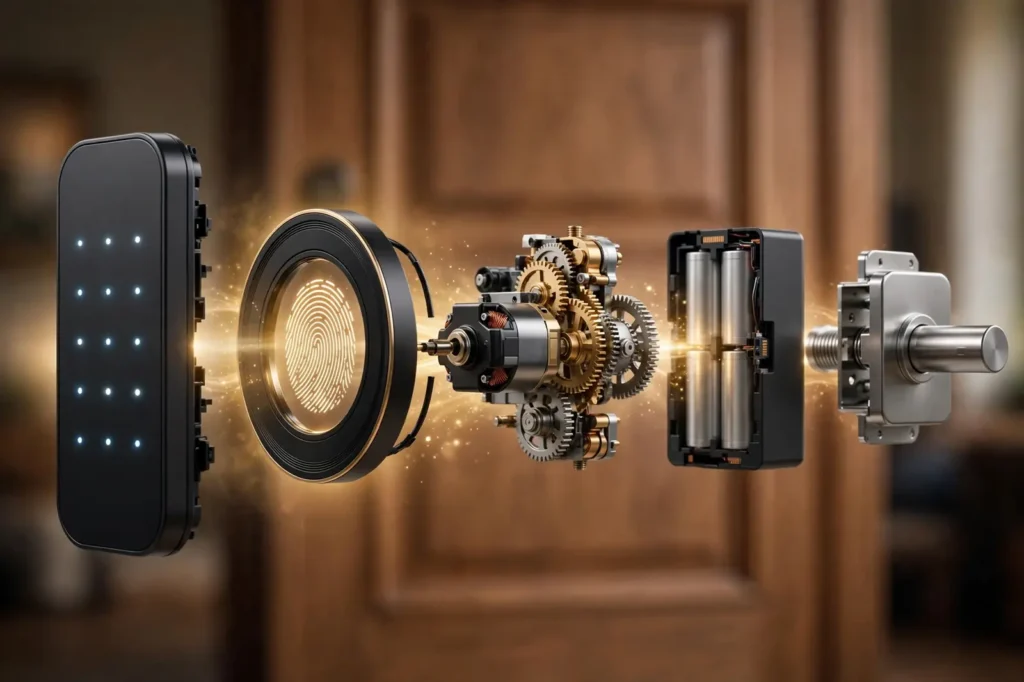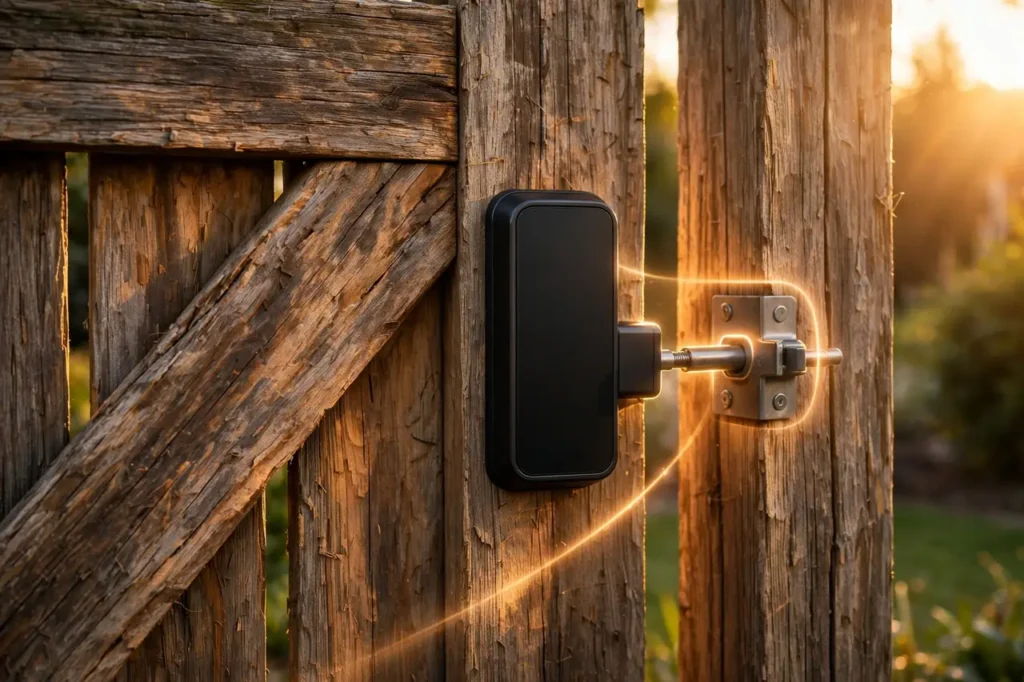
A smart gate lock is a lock built for a gate that lives outside full time, so you can open it with a code, a phone, or a fingerprint instead of a key. Here is the honest part most listings skip: very few true smart gate locks exist. Most “smart locks” are house door locks, and a gate defeats them fast, because both halves of the lock sit in the weather and the gate itself never stops moving.
Four routes actually work on a yard, side, or driveway pedestrian gate. You can buy a purpose-built smart gate lock, adapt a weather-rated smart deadbolt, hang a smart padlock, or skip electronics and fit a mechanical double-sided keypad lock. This guide explains what makes gate duty different, then prices each route with prices checked on October 19, 2026.
First, a Smart Gate Lock Is Not a Gate Opener
These two products get mixed up in search results, and they do different jobs. A gate opener is a motor. It swings or slides the gate open and shut, and it is made mostly for vehicle driveway gates from brands such as Mighty Mule, LiftMaster, and Ghost Controls.
A gate lock does not move anything. It keeps a closed gate shut and controls who gets through. An opener by itself is not a strong lock, and a lock by itself will never swing your gate.
This article is about locks for pedestrian gates, the ones people walk through: side gates, yard gates, pool gates, and the walk gate beside a driveway. If what you really need is a lock for the house door itself, start with our smart key lock guide instead.
Why a Gate Is Harder on a Lock Than a Door
A front door is a kind place to work. One side of the lock faces the street, and the other side sits in your hallway. A gate offers no hallway. Everything below follows from that one fact.
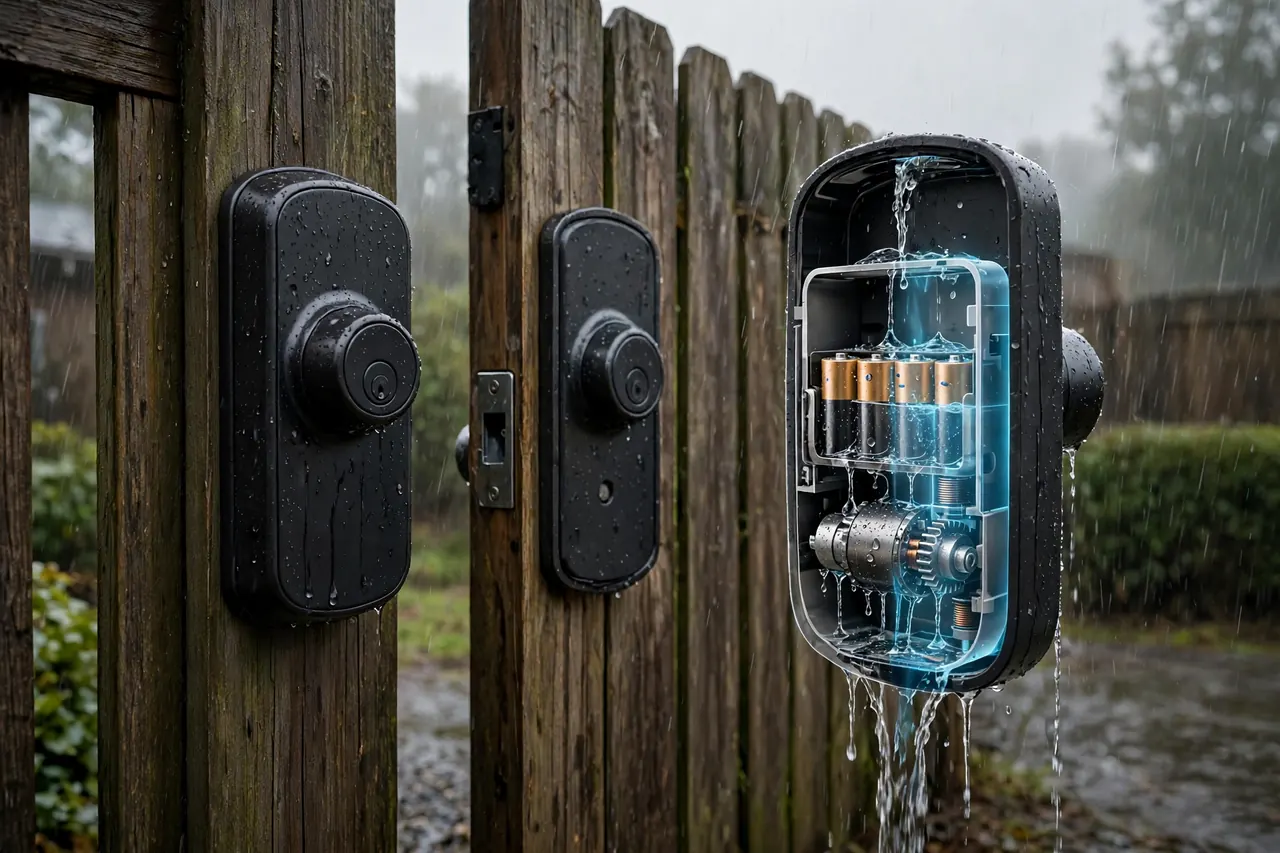
Both halves of a gate lock live outdoors
On a house door, only the outside half of a smart lock is weather-sealed. The inside half holds the batteries and motor, and it is built for indoor air. On a gate, that “inside” half gets rained on too, and water in the battery and motor housing is what kills door locks outdoors.
This is not just locksmith opinion. Schlage’s owner, Allegion, states in its support pages that it does not recommend using its keypad locks on a gate or fence, and that installing one on a gate voids the warranty. Phoenix locksmith Acme Locksmith reports the same failure pattern from the field: the unsealed inside half is the part that dies.
IP ratings, in plain words
Outdoor locks carry an IP code, two numbers that rate dust and water protection. The first number covers dust and runs from 0 to 6. The second covers water and runs from 0 to 9. An X means that side was not rated.
Common IP ratings on gate hardware, and what they mean outside
| Rating | Dust side | Water side | What it means on a gate |
|---|---|---|---|
| IP65 | Dust-tight (6) | Water jets (5) | Shrugs off rain and hose spray. Treat this as the minimum for a powered gate lock. |
| IP67 | Dust-tight (6) | Immersion, 1 m of water for 30 minutes (7) | Survives being dunked, so a flooded gate line will not kill it. |
| IPX7 | Not rated (X) | Immersion, 1 m of water for 30 minutes (7) | The water rating is real; dust protection simply was not part of the rating. |
| No IP rating | Not rated | Not rated | Treat it as indoor hardware, whatever the product photos show. |
One caution: a rating covers the sealed lock unit. It does not rescue a door lock whose indoor-side housing was never sealed at all, which is why gate boxes and weather covers exist for adapted locks.
A gate needs control from both sides
A house door mostly keeps people out. A yard gate also has to let people back in, including guests, kids, and anyone already inside the yard. So gate locks are often double-sided, with a keypad or handle on both faces.
The safety rule is simple: a gate must never trap anyone. If your gate sits on a path people would use to leave in an emergency, the inside must open freely, with no code and no key. Many owners choose a lock with a code on the street side and a plain free-turning lever on the yard side for exactly this reason. Check your local rules before you fit a lock that needs a code to exit.
Pool gates have their own strict rules. The U.S. Consumer Product Safety Commission’s pool barrier guidelines call for gates that are self-closing and self-latching, that open outward away from the pool, and that keep the latch release at least 54 inches from the bottom of the gate, or shielded on the pool side. A smart lock never replaces those basics.
Gates move, sag, and swell
Doors hang in frames that barely move. Gates sag on their hinges a little more every year. Wood gates swell in wet months and shrink in dry ones, and metal gates grow and shrink with heat and cold.
A deadbolt needs its bolt and its strike hole to line up closely, so a sagging gate makes a good deadbolt jam. A latch-style lock forgives far more movement, because the latch slides into its keeper across a wider target. If your gate already needs a lift to close, fix the hinges and bracing first. No lock, smart or not, works well on a gate that does not close square.
The Smart Gate Lock Options That Actually Exist
Strip away the door locks wearing gate costumes, and the real choices are short. Here they are side by side, with the baseline mechanical lock included so you can judge the smart premium honestly.
Gate lock routes compared: type, weather protection, power, and price checked on October 19, 2026
| Option | Type | Weather protection | Power | Price |
|---|---|---|---|---|
| EcoNet Bulldog GateLock | Purpose-built smart latch lock | Weatherproof build; no IP number published | 4 × AA, up to 2 years (maker’s claim) | CA$411 at EcoNet Controls |
| ULTRALOQ U-Bolt Pro WiFi | Smart deadbolt adapted to a gate | IP65 | AA batteries | $179.99 at U-tec |
| igloohome Padlock 2 | Smart padlock | IPX7 | Rechargeable, up to 9 months per charge | $184.99 at the igloohome US store |
| Lockey 2835DC | Mechanical double-sided keypad lock | Weather-resistant, marine-grade finishes | None | $375.48 at GoKeyless |
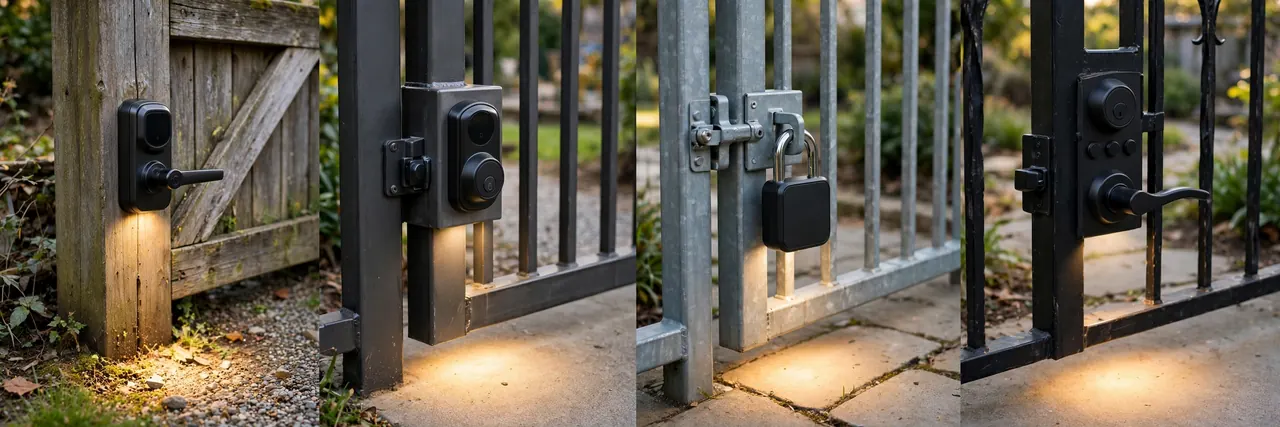
Purpose-built: EcoNet Bulldog Matter GateLock
The Bulldog GateLock from EcoNet Controls is the rare product designed for gates first. It is a latch-style lock that replaces your existing gate latch, and EcoNet lists it for wood gates, metal gates including round tube frames, and vinyl gates. A keypad is included for code entry, and the lock is Matter certified, so it joins Apple Home, Google Home, Alexa, and SmartThings.
Matter runs over Thread here, which is gentle on batteries, and EcoNet claims up to two years from its four AA batteries. The catch is that Thread needs a border router you may already own, such as an Apple TV 4K, a HomePod mini, a SmartThings Station, or an Echo (4th gen). Without one, you still have the keypad, but the app control has nothing to talk to.
Be clear-eyed about the trade-offs. EcoNet describes the lock as rugged and weatherproof but did not publish an IP rating on its product page when we checked on October 19, 2026. The maker is Canadian, and its own store showed CA$411 pricing, with an 8 to 10 week lead time shown that day. U.S. buyers should confirm the final total at checkout.
A weather-rated smart deadbolt, adapted: ULTRALOQ U-Bolt Pro WiFi
The U-Bolt Pro WiFi is a fingerprint smart deadbolt with a keypad, app control, and a normal key backup, and its lock carries an IP65 rating. It costs $179.99 at U-tec, checked on October 19, 2026. Locksmiths name it as the door lock most often adapted to gates, and we cover it among the door picks in our guide to the best smart deadbolt.
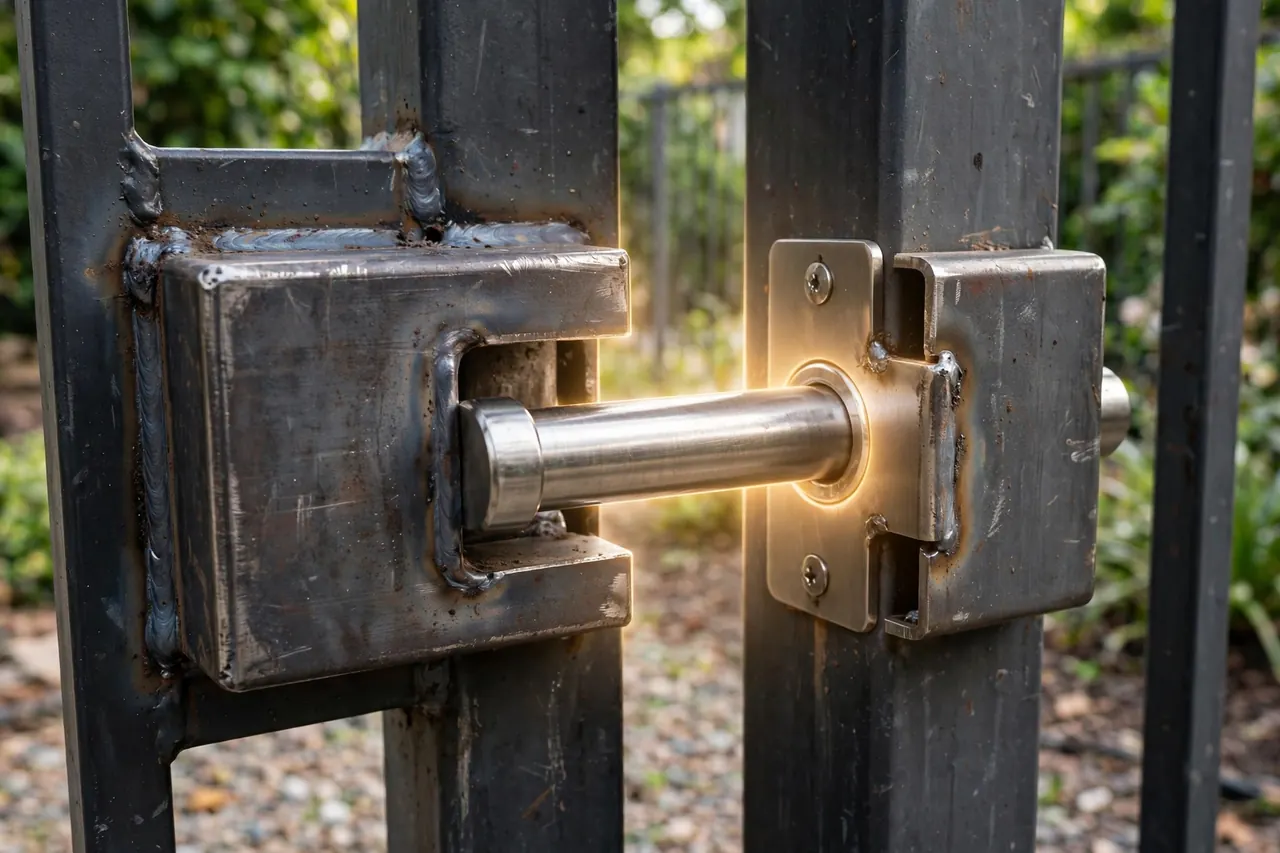
Adapting is the key word. This is still a door deadbolt, so a metal gate needs a gate box, a steel housing welded or bolted to the gate that gives the lock a standard 2-3/8 inch backset to sit in. The housing on the yard side was not built to be rained on, so plan on a weather cover over it. Your home Wi-Fi also has to reach the gate with a usable signal, or the smart features sulk. A micro-USB port on the bottom gives emergency power if the batteries die while you are outside.
The smart padlock route: igloohome Padlock 2
If your gate closes with a chain or a hasp, a smart padlock changes nothing about the gate and still removes the keys. The igloohome Padlock 2 is rated IPX7, runs up to nine months per charge, and costs $184.99 at igloohome’s US store, checked on October 19, 2026. A longer shackle version is sold for awkward hasps.
Its best trick suits gates perfectly. The igloohome app creates time-limited PIN codes that work at the lock with no Wi-Fi and no phone signal at the gate, so a gardener or delivery driver can use a one-time code while you are away. Bluetooth handles setup and logs when your phone is near.
The limits are just as clear. A padlock does not latch your gate shut behind you, and the chain or hasp becomes the weak link, not the lock. If people forget to refit a padlock, the gate is open. Owners who need the gate to lock itself every time should choose a latch lock instead.
The Honest Baseline: A Mechanical Double-Sided Keypad Lock
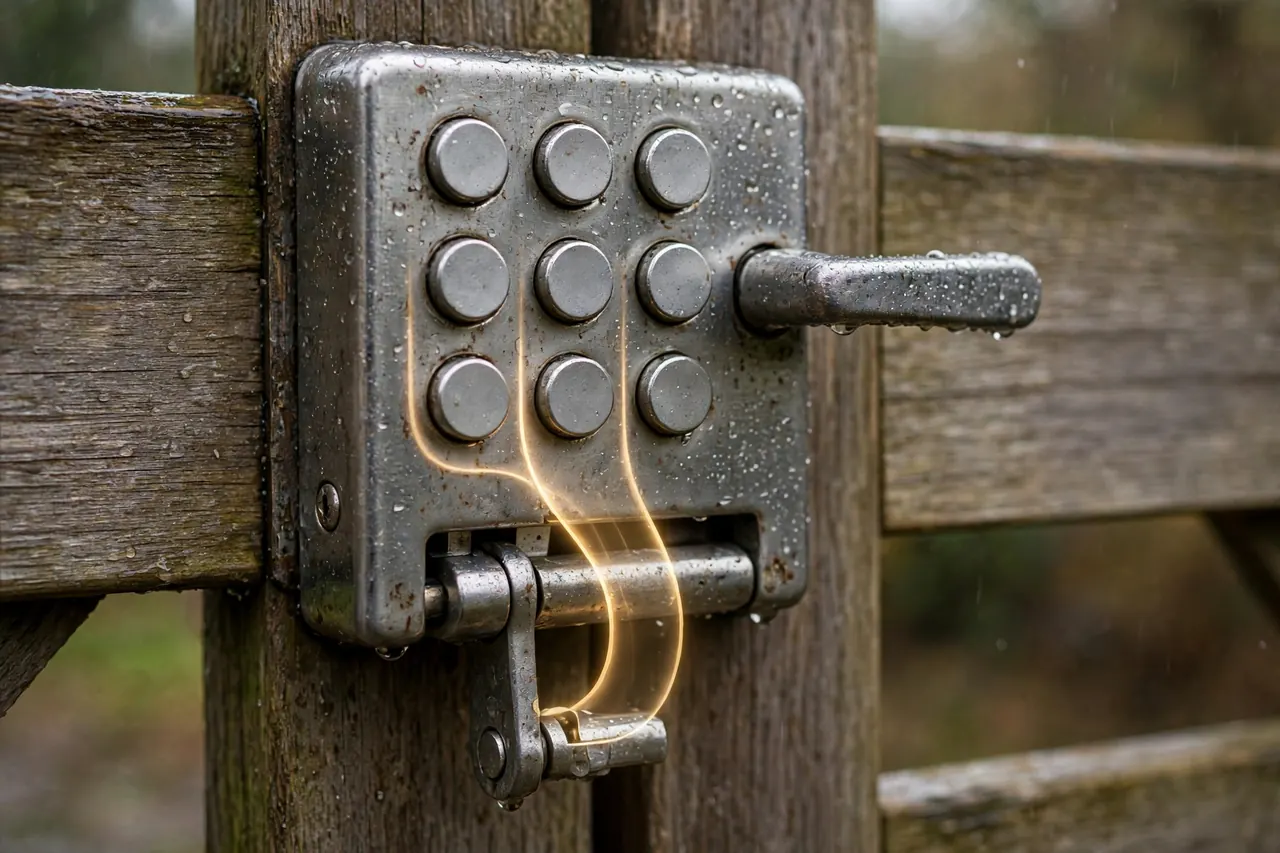
Before you pay for apps and radios, meet the lock gate specialists reach for most: a mechanical keypad lock with no batteries at all. Buttons push a mechanical code chamber, the gate latches itself as it closes, and weather has almost nothing to attack.
The Lockey 2835 is the standard example. One code on the outside, a free-turning lever on the inside, a passage mode for parties, and marine-grade finishes for wet climates. It costs $238.98 at GoKeyless, checked on October 19, 2026. If you want a code on both sides, the double-combination 2835DC costs $375.48 at GoKeyless, and each side can carry its own code.
What you give up is remote control. Codes change at the lock, not from your phone, and there is no log of who came through. What you gain is a lock that cannot die in a cold snap, which is why Acme Locksmith calls mechanical keyless the better, lower-maintenance choice for most gates. Choose smart when you truly need remote codes, schedules, or entry logs, for example at a rental. Choose mechanical when you just want to stop carrying a key.
Power Outdoors: Batteries, Heat, Cold, and Solar
Every battery claim on every box assumes mild weather and average use. Real gates live at the far edge of both. Summer heat ages battery cells faster, and deep cold cuts the power an alkaline cell can deliver, so a lock that tested fine in October can sulk in January.
Radio choice matters as much as weather. Wi-Fi is the hungry radio, and a Wi-Fi deadbolt at a far gate will want fresh batteries far more often than a Thread or Bluetooth lock. The Bulldog’s two-year claim and the Padlock 2’s nine months both come from low-power radios doing very little work between uses.
Have a dead-battery plan before you need one. The U-Bolt Pro keeps a physical key and a micro-USB emergency power port. The Padlock 2 can be jump-started over USB-C with a power bank. The mechanical Lockey simply has no battery to die.
💡 Practical Home Tip: Swap gate lock batteries on a schedule, not on a warning. Fresh cells in early fall, before the first cold snap, prevent most winter lockouts. Write the swap date on a small piece of tape inside the battery cover, and keep the lock’s backup key somewhere that is not behind the locked gate.
Solar deserves one honest paragraph. Solar charging is real on driveway opener systems, which already run on a 12-volt battery a panel can top up. On pedestrian gate locks it is not a standard feature, and we could not verify a solar smart gate lock from an established maker. If your gate is far from the house, low-power radios and a battery routine beat a novelty solar panel.
Match the Lock to Your Gate
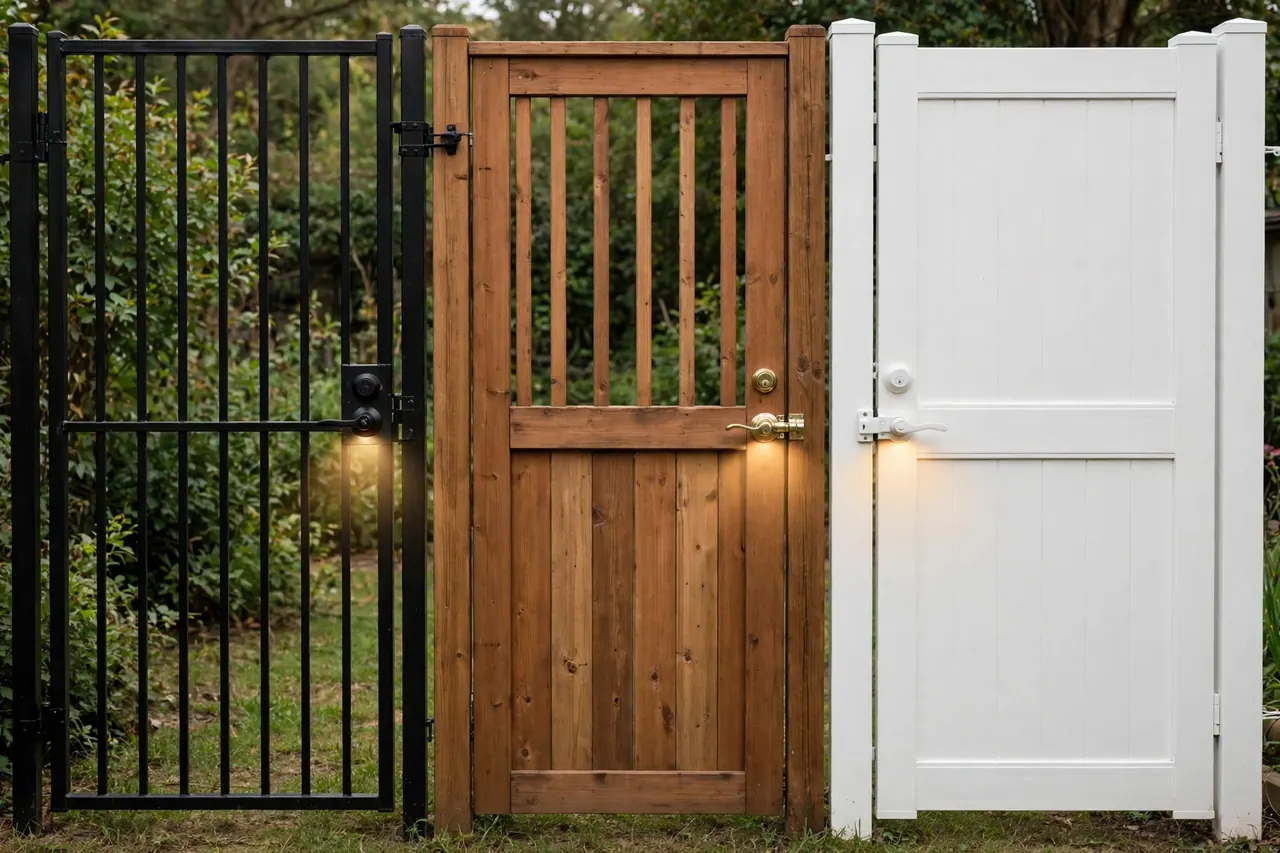
The right lock depends first on what your gate is made of, because that decides how anything can attach.
- Metal tube gates: the frame is strong but thin. Deadbolts need a gate box welded or bolted on. Surface-mount latch locks, like the Bulldog or the Lockey with its gate adapter, bolt on without welding.
- Wood gates: the easiest to fit. Most latch locks and deadbolts mount with screws, as long as the wood thickness falls in the lock’s range. The Lockey 2835, for example, fits gates from 1-3/16 to 2 inches thick, with an extension kit for thicker gates. Check for rot around the latch area before you trust new screws.
- Vinyl gates: the rails are hollow and crush if you over-tighten bolts. Use adapter plates that spread the load, never weld, and mount into the gate’s reinforced frame members where the maker directs.
Then decide latch or deadbolt. A latch lock closes and secures itself every time the gate swings shut, which is what pool gates and busy side gates need. A deadbolt holds harder once thrown, but someone has to throw it, or the gate is only pretending to be locked. For strength ratings and deadbolt grades explained in plain words, see our guide to the best door locks for home.
Finally, measure the gate gap, the space between the gate and its post. The lock’s keeper has to meet the bolt or latch across that real gap, in summer and winter, not just on fitting day.
Installation Notes: Gate Boxes, Adapters, and Alignment
Most gate lock installs follow the same order, and the lock itself is the last step, not the first.
- Fix the gate first. Tighten or replace sagging hinges, add a diagonal brace to a wooden gate that has dropped, and confirm the gate swings shut and latches by hand, every time.
- Choose the mounting. A surface-mount latch lock screws straight on. A deadbolt on a metal gate needs a gate box at a standard 2-3/8 inch backset. Welding a box is a job for a welder or fence contractor for most owners; bolt-on boxes and Lockey’s gate adapter exist for vinyl and ornamental gates precisely so no welding is needed.
- Caution before you drill: mark the strike position with the gate closed and latched by hand, then open it to drill. A strike fitted to an open, sagging gate will miss the bolt the first time the gate settles.
- Fit the lock, then the keeper. Work from the lock outward, and leave the keeper screws slightly loose until the latch or bolt lands cleanly ten closes in a row.
- Test both sides before setting codes. Enter and exit the way a guest would. Confirm the inside exit works with no code if your gate is an exit path.
- Pair smart features at the gate. Stand where the lock lives and confirm your phone, Wi-Fi, or Thread signal is strong there before final tightening. A lock paired at the kitchen table may never be heard from again at the far fence.
Mistakes That Ruin Gate Locks
- Bolt a front-door smart lock to a gate. The indoor half takes on rain, the lock dies early, and makers like Schlage treat the warranty as void.
- Lock people in. A code required to exit turns a yard gate into a trap on the one day someone needs to leave fast.
- Blame the lock for a hinge problem. Most “faulty lock” calls on gates end with hinge screws and a brace. Fix the sag first.
- Fit a deadbolt to a self-closing pool gate. If nobody throws the bolt, the pool barrier is open. Pool gates need self-latching hardware.
- Skip the dead-battery plan. No key, no jump port knowledge, and a locked gate between you and the house is a bad evening.
- Ignore signal range. Wi-Fi and Thread both fade with distance and walls. A smart lock out of range is just an expensive keypad.
- Hang a premium padlock on a bargain hasp. The chain and hasp are the security. The padlock only holds them together.
Frequently Asked Questions
Can I install my keypad lock on a gate or fence?
Not a house keypad lock. Schlage’s owner, Allegion, answers this exact question in its support pages: it does not recommend its keypad locks on gates or fences, because the indoor side is not weather-sealed, and the installation voids the warranty. Use hardware built for gates instead, like the locks in this guide.
Can I install a digital lock on an existing metal gate?
Yes, in most cases. A surface-mount latch lock bolts straight onto a tube frame. A deadbolt needs a gate box welded or bolted to the gate so the lock has a standard backset and a flat seat. Measure the frame width, the gate thickness, and the gate gap before ordering, because those three numbers decide which mounts will fit.
Are digital locks for metal gates waterproof?
Only the ones with a real rating. Look for an IP code on the lock itself: IP65 handles rain and spray, and IP67 or IPX7 survives immersion. A lock with no IP rating should be treated as indoor hardware, even in a photo of it mounted on a gate. Remember the rating covers the lock unit, not a door lock’s unsealed indoor housing.
What happens if the battery dies?
It depends on the lock, so learn yours before it happens. The ULTRALOQ U-Bolt Pro still takes its physical key and has a micro-USB emergency power port. The igloohome Padlock 2 can be jump-started over USB-C from a power bank. A mechanical keypad lock has no battery at all. Keep the backup key somewhere you can reach without opening the gate.
Do digital locks work in freezing temperatures?
The electronics in outdoor-rated locks are built for cold, but batteries are the weak point. Alkaline cells deliver much less power in deep cold, so locks slow down or stop on the coldest mornings. Fresh batteries before winter solve most of it, and locks with low-power radios, like Thread and Bluetooth models, ride through cold snaps better than Wi-Fi models.
How long do batteries last in outdoor smart locks?
It ranges widely by radio and use. EcoNet claims up to two years for its Thread-based Bulldog GateLock, igloohome rates the Padlock 2 at up to nine months per charge, and Wi-Fi deadbolts are the shortest-lived of the group. Heat, cold, a weak signal, and a busy gate all shorten those numbers, so treat maker claims as best cases.
A short disclaimer: gate security, pool barriers, and exit rules are set by local codes that vary by city and state, and this guide is general information, not code advice for your property. Prices were checked on October 19, 2026 and change often. For pool gates, welded gate boxes, or any gate on an exit route, a local fence contractor or locksmith can confirm your setup meets the rules where you live.
The Bottom Line
For most homes, the smart gate lock decision is really a weather decision. If you need app control and codes that change from your phone, the purpose-built Bulldog GateLock and the smart padlock route are the honest smart options, and a weather-rated deadbolt in a gate box is the workable middle path. If you only want to retire the key, a mechanical double-sided keypad lock will likely outlive every electronic on this page.
Your next step takes five minutes: measure your gate’s thickness and gap, decide whether the inside must open freely, and check your phone signal standing at the gate. Those three answers pick the right route from this guide for you.