
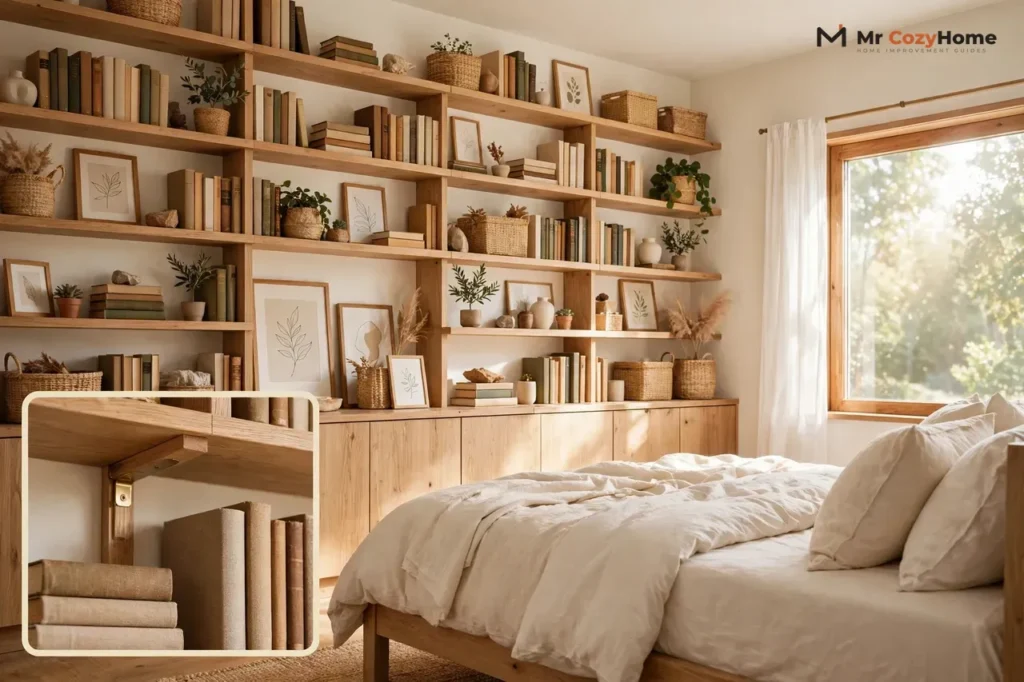
Bedroom shelving ideas work best when you match the shelf to the wall you actually have and the things you actually reach for. For most bedrooms, that means floating shelves or a built-in unit for books and display, a headboard wall or bedside ledge for nighttime essentials, and corner, alcove, above-door, or closet-adjacent shelves for space you would otherwise waste. Start with one wall, measure it, and pick the lightest option that still holds what you plan to put on it.
This guide walks you through each idea in plain terms. You will learn where each type shines, how deep it should be, how much weight it can safely hold, and how to style it so it looks calm instead of cluttered. No big remodel is required for most of these ideas, and several of them suit renters too.
Start With What You Need to Store
Before you buy or build anything, sort your bedroom things into three groups. First, daily items: the book you read now, your phone charger, glasses, and a glass of water. Second, regular items: the rest of your books, folded sweaters, and baskets of small things. Third, display items: framed photos, a small plant, and pieces that simply make you smile.
Daily items belong at hand height, close to the bed or desk. Regular items can live higher or farther away. Display items work best where you see them but do not need to grab them every day. When you sort first, you stop buying shelves for things you never use, and you stop cramming daily items onto a high shelf you cannot reach.
Next, measure the wall. Note its width, the height of the headboard or desk below it, and any outlets, vents, light switches, or door swings in the way. A shelf that spans about two-thirds of the furniture below it usually looks balanced. A shelf that runs wall to wall can look great in a wide room, but it can feel heavy in a narrow one.
Floating Shelves: The Lightest Look for Small Bedrooms
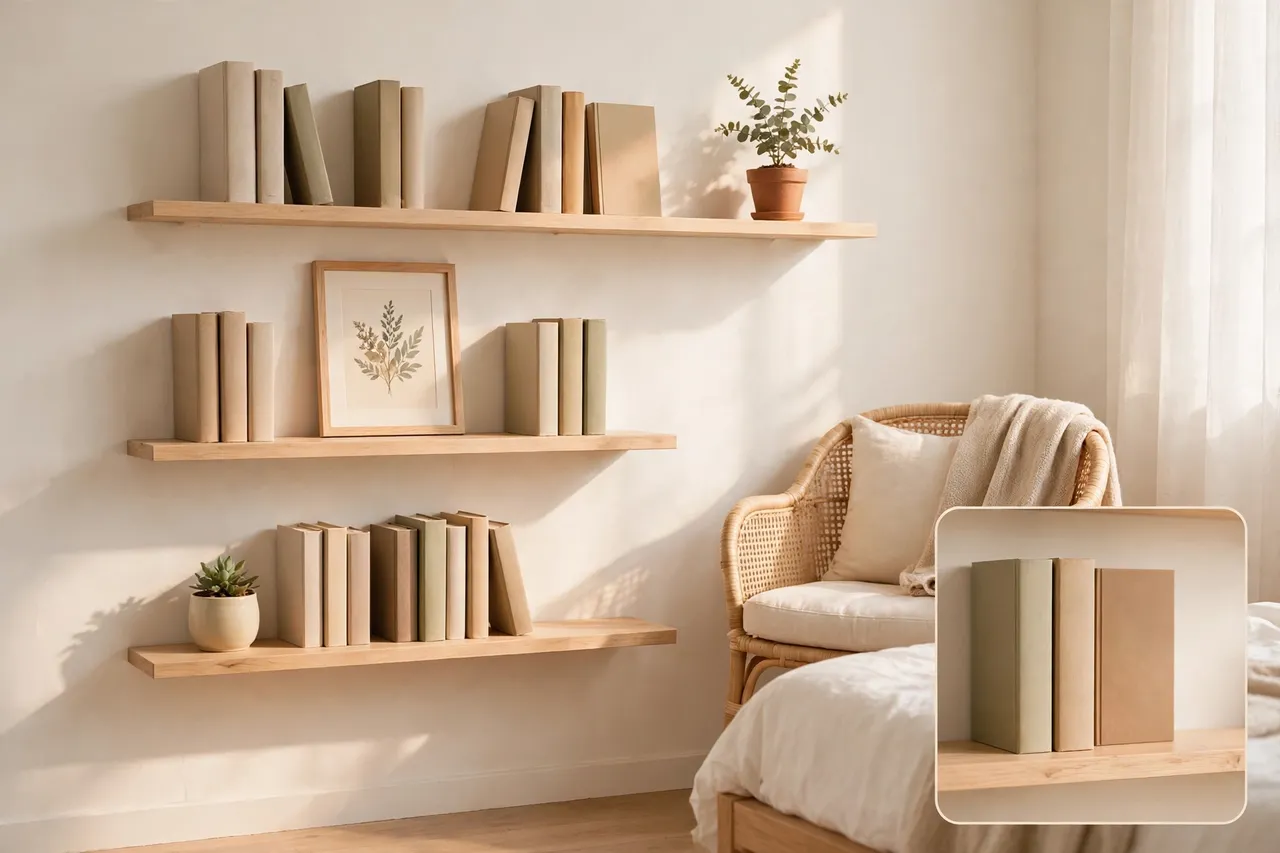
Floating shelves hide their brackets, so they look clean and simple. They keep the floor clear, leave the wall visible, and suit small bedrooms better than a bulky bookcase. A run of two or three floating shelves beside a reading chair, above a desk, or along a side wall can hold current reads and a few favorite objects without changing the feel of the room.
Depth matters more than length. A shelf 8 to 10 inches deep holds paperbacks and standard novels well, while hardcovers sit more securely at 10 to 12 inches. Shallow ledges 6 to 8 inches deep suit paperbacks, small novels, and display pieces, but they do not suit a row of heavy hardcovers. Measure your tallest and widest books before you order, and leave a little extra depth so books do not stick out past the edge.
Spacing matters too. Leave 10 to 12 inches between shelves for novels and 14 to 16 inches where tall books live. That gap also leaves room for a small plant or a framed photo to break up a long row of spines. If you plan to add a lamp or a vase, measure that object as well, not just the books.
Built-In Shelving: A Custom Wall That Feels Like Part of the Room
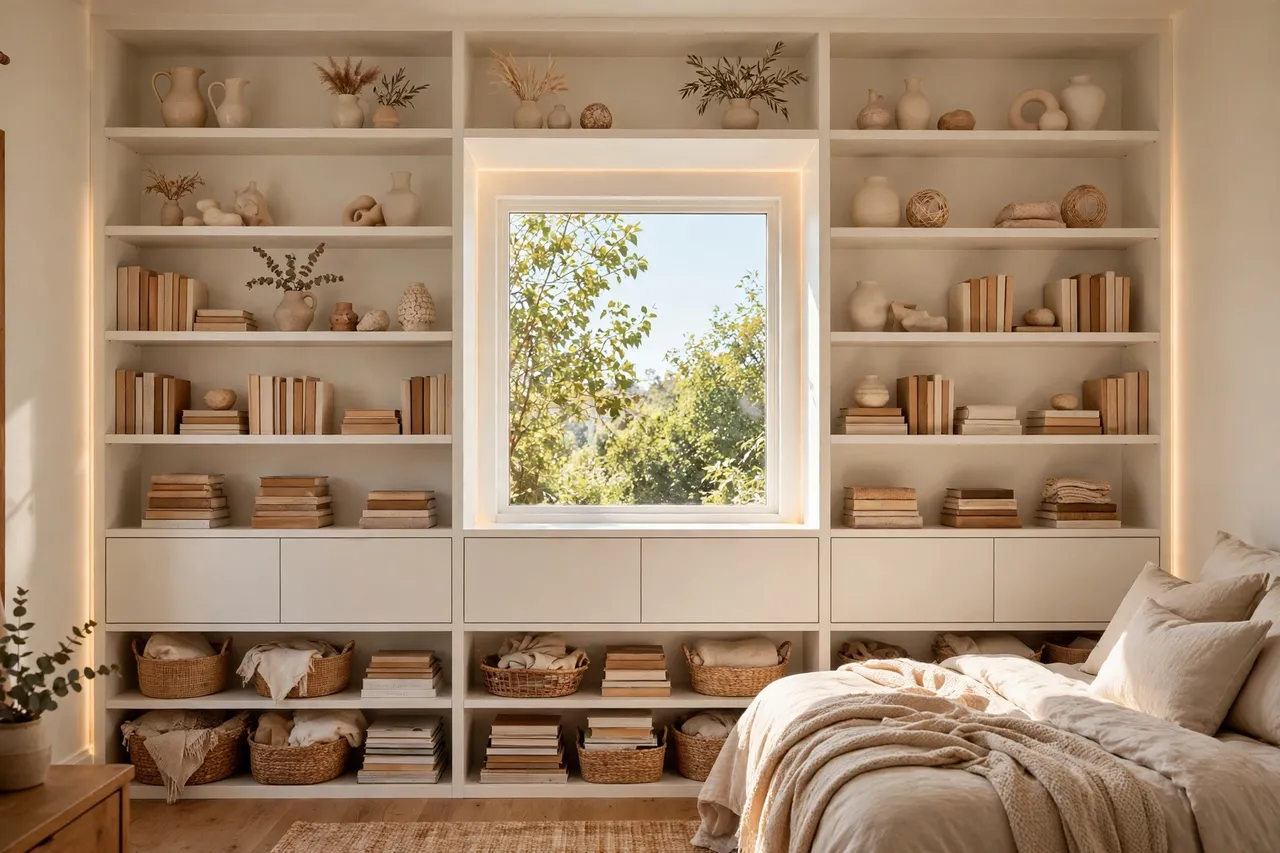
Built-in shelving fills a whole wall or frames a window, a desk, or a bed with storage that looks planned rather than added. Floor-to-ceiling built-ins draw the eye upward and make a ceiling feel taller. They also remove the awkward gaps that often show between freestanding pieces and the wall.
Paint built-ins the same color as the walls for a calm, seamless look, or pick a contrasting stain when you want the shelving wall to act as a feature. Either choice works, but the seamless option usually suits a small bedroom better, because it adds storage without adding visual weight.
Built-ins reward a mix of open and closed storage. Use open shelves for books and display, and add cabinets or baskets low down for things you want hidden, such as chargers, notebooks, and spare bedding. Put heavy books low, everyday reads at hand height, and light or rarely used items up high. Anchor any tall unit firmly to the wall, and keep a small step stool nearby for the top shelves instead of climbing on furniture.
Alcove Shelving: Turn an Awkward Nook Into Useful Storage
Many bedrooms have an alcove, a recess beside a chimney breast, or a shallow nook that fits no standard furniture. Alcove shelving turns that dead space into a feature. Because a carpenter or a careful DIYer cuts the shelves to fit, you lose no inches to gaps, and the shelves sit flush with the surrounding wall.
Alcoves suit a reading nook especially well. A low shelf can hold books at seat height, a middle shelf can hold a lamp and a notebook, and upper shelves can hold display pieces. If the alcove sits beside a desk, use it for reference books and work supplies instead, so your desk stays clear.
Before you build, check the alcove for depth. A shallow alcove suits paperbacks and display, while a deeper alcove can hold folded clothes or baskets. Add adjustable shelves where you can, because book sizes change over time, and one fixed layout rarely fits a growing collection for long.
Headboard-Wall Shelving: Storage Right Where You Sleep
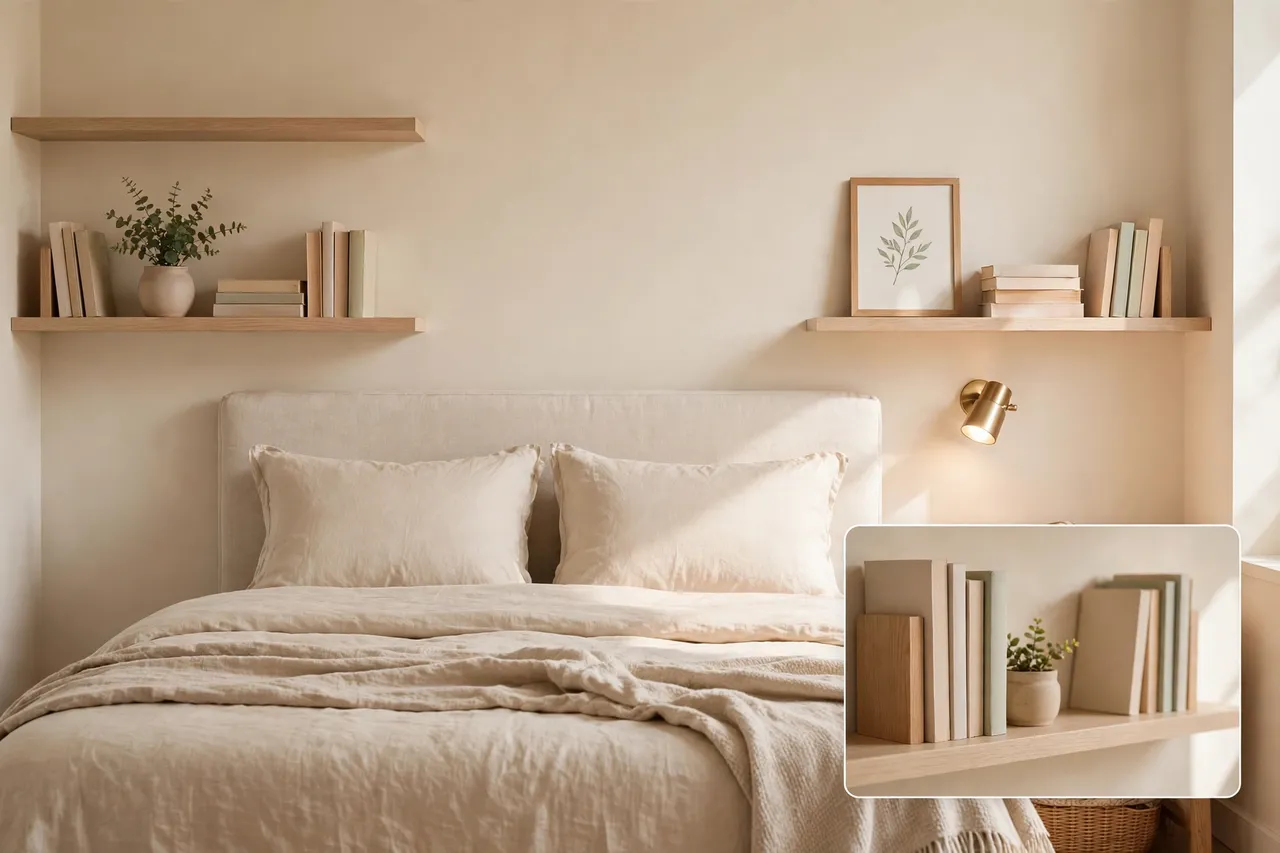
A headboard wall with shelves replaces a separate bookcase and, in a tight room, sometimes replaces a nightstand too. Books, a reading light, glasses, and a glass of water sit right where you need them at night, and the shelf wall gives the bed a finished, intentional look.
Safety comes first on this wall. Keep the shelves shallow, about 8 to 10 inches deep, and store only light items above the bed, such as paperbacks, a small plant in a light pot, or a framed print. Never store heavy hardcovers, glass objects, or anything breakable directly above where you sleep. Add a small lip or bookends at each end so books cannot slide off if someone bumps the bed.
For reading light, a small wall-mounted lamp beside the bed usually beats a light fixed to the shelf itself, because shelf lights can glare when you lie down. Aim the light at the pages, not at your eyes, and keep the headboard shelves partly empty. A headboard crammed full of books feels busy right where you try to rest, while a little empty space feels calm.
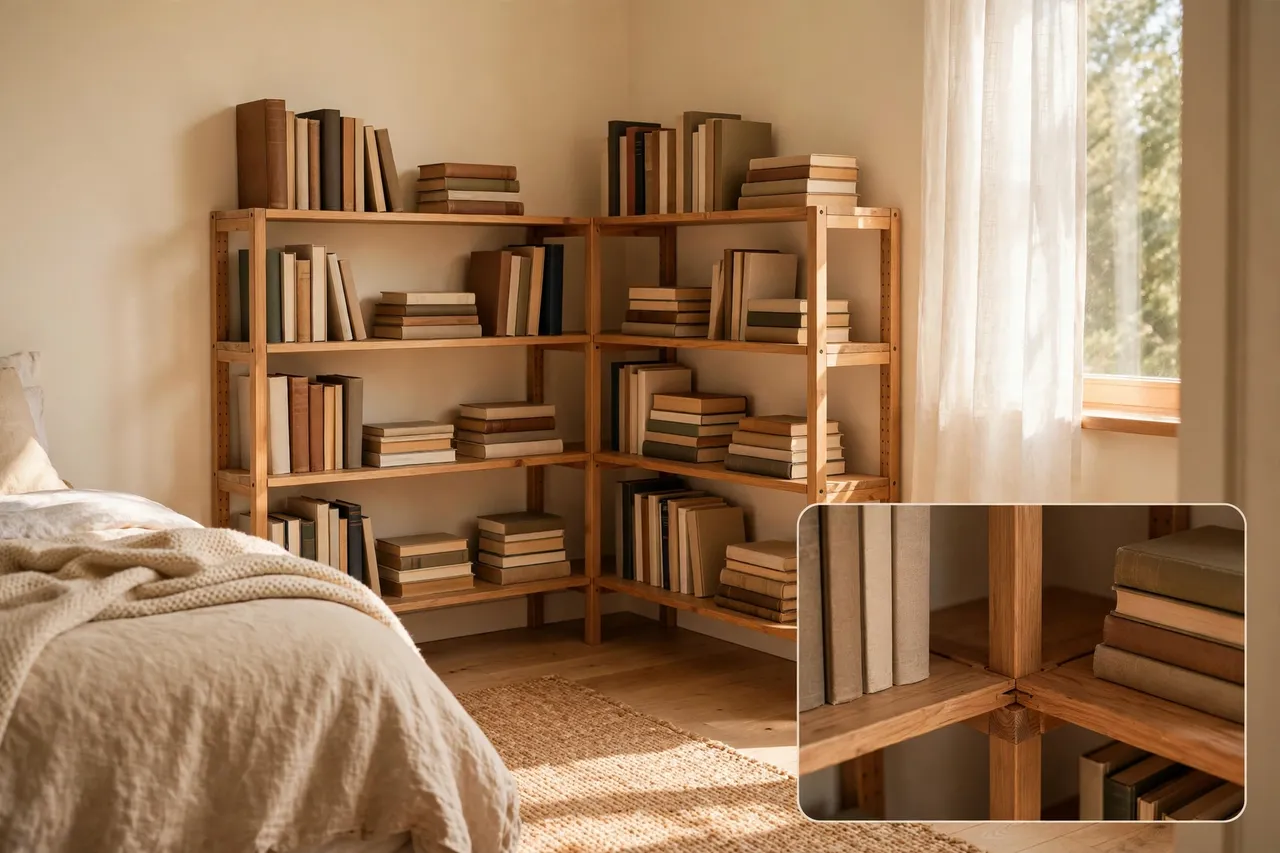
Corner Shelving: Use the Angle Everyone Ignores
Corners rank among the most wasted spots in a bedroom. A triangular or L-shaped corner unit tucks into the angle, holds a surprising number of books, and leaves the main walls free for the bed, a wardrobe, or a desk. Corner shelves suit narrow bedrooms especially well, because a full bookcase along a wall would crowd the walkway.
Measure the corner before you shop, because corners rarely sit perfectly square. Leave at least 30 inches of clear walkway in front of the unit so you can reach the books without squeezing past the bed. A unit 12 to 14 inches deep on each side holds most books, and adjustable shelves help when one unit must serve both tall hardcovers and small paperbacks.
For a lighter look, try floating corner ledges at staggered heights. Vary the heights by 12 to 15 inches between ledges so books of different sizes fit and the corner reads as a design feature rather than a stack of shelves. Anchor a tall corner unit to at least one wall, since a loaded corner shelf can tip forward when someone bumps it.
Above-Door and Closet-Adjacent Shelving: Storage Hiding in Plain Sight
The wall above a bedroom door often sits empty, yet it can hold a single long shelf for light, rarely used items, such as spare blankets in a soft basket, seasonal decor, or a row of display books. Keep this shelf high, shallow, and light, and reserve it for things you reach for a few times a year, not every night.
Closet-adjacent shelving works the same way. A narrow column of shelves beside the closet door can hold folded sweaters, bags, shoes in boxes, or accessories that never quite fit inside the closet. It also stops the closet door area from becoming a dumping ground, because each item gains a visible home.
Use closed baskets or matching boxes on these high or side shelves. They hide visual clutter, protect items from dust, and make the shelf read as one tidy block instead of a row of loose odds and ends. Label the boxes when you share a bedroom, so everyone puts things back in the right place.
Small-Bedroom Shelving: Tall, Narrow, and Off the Floor
Small bedrooms reward tall and narrow choices. A tall, narrow unit takes little floor space, uses the full wall height, and stores more than a short, wide bookcase. Ladder shelves work the same way: they lean against the wall, grow shallower toward the top, and keep the room feeling airy because you can see through the open frame.
On a ladder shelf, put heavy books on the bottom shelves, where the shelf runs deepest and most stable, and lighter decor up top. A typical ladder shelf runs about 24 inches wide at the base and narrows toward the top, with depths from about 8 inches at the top to 12 inches at the bottom. Add a small anti-tip strap, even when the maker says the shelf needs no wall fixing, because a bumped shelf in a small room can still shift.
Freestanding cube shelves offer another flexible option. Standard cubes measure about 13 to 15 inches square, which fits most novels and paperbacks, but tall hardcovers may need a cube turned on its side or a unit with one larger compartment. Mix open cubes for display books with fabric boxes for chargers, notebooks, and small items that otherwise scatter across the room.
Renter-Friendly Shelving: Storage Without Losing Your Deposit
Renters can still enjoy bedroom shelving, but the method matters as much as the shelf. Freestanding bookcases, ladder shelves, leaning shelves, and cube units need no holes at all, and they move with you. A tall narrow bookcase or a leaning ladder shelf often gives a rental bedroom all the storage it needs.
For light items, adhesive hanging products can help, but only within their printed ratings. For example, manufacturer 3M states that its Command small wire hooks hold up to 0.5 pounds each, and it warns users not to hang items over beds. That warning matters: use adhesive hooks for light things on a side wall, such as a small frame or a lightweight organizer, and never use them to hold a shelf or anything heavy above a bed. Always read the rating on the exact product you buy, because ratings vary widely by size.
Before you drill anything in a rental, read your lease and ask your landlord in writing when the rules stay unclear. Many landlords allow small screw holes that you fill and touch up when you move out, while others forbid them. A short written answer now saves a deposit dispute later. When drilling stays off the table, choose furniture-based shelving and keep wall-mounted ideas for a home you own.
How Much Weight Can Bedroom Shelves Hold?
The wall fixing decides the limit far more than the shelf board does. A thick solid wood shelf mounted only to drywall anchors will fail sooner than a thinner shelf mounted directly into two wall studs. So match the bracket and the fixing to the load first, then pick a shelf that looks good.
Manufacturer Shelfology explains that a properly installed floating shelf can hold about 45 to 50 pounds for every wall stud its bracket attaches to, so a shelf fixed to two studs can safely support roughly 100 pounds. The same guide stresses that more screws into more studs or solid blocking mean higher capacity, and it warns that fastening a heavy-duty bracket into drywall alone is a bad idea. Always check the rating for your exact shelf and bracket, because designs vary, and treat the printed rating as a ceiling, not a target.
Use the table below as a quick guide, then confirm the rating on your own hardware before you load a shelf.
Table: Shelf weight guide by mounting method
| Mounting method | Rough safe load | Best bedroom use |
|---|---|---|
| Into two wall studs | About 100 pounds | Rows of books |
| Into one wall stud | About 45 to 50 pounds | Books and light decor |
| Heavy-duty drywall anchors | Light to moderate load | Small plants, frames |
| Adhesive hooks only | Check the package rating | Very light items only |
Keep heavy books low, test a new shelf by pressing down firmly before you trust it with anything valuable, and never load a shelf to its full rated limit when it sits above a bed or a seat. A small safety margin protects both the shelf and the person below it.
How to Hang Floating Shelves in Six Steps
Follow these steps in order, and do not rush the measuring stage. Most floating shelf failures come from missed studs or rushed marking, not from the shelf itself.
- Find the studs with a stud finder, mark each stud center with a pencil, and pick a shelf length that reaches at least two studs when you plan to hold books.
- Hold the shelf or its bracket against the wall, check it with a level, and mark every screw hole before you drill anything.
- Drill pilot holes at the marked stud points, and use screws rated for wood studs rather than drywall screws alone.
- Where no stud exists, use heavy-duty wall anchors rated for your actual load, and follow the anchor maker’s instructions exactly.
- Slide the shelf onto its bracket or rods, check it with a level again, and tighten any set screws the maker supplies.
- Press down firmly on the shelf, load the lightest items first, and recheck the level after a day before you add heavy books.
If the shelf tilts, sags, or pulls away from the wall at any stage, stop and unload it. A shelf that moves under a light load will not improve under a full load. Re-check the stud marks, upgrade the anchors, or move the shelf to a stronger spot on the wall.
How to Style Bedroom Shelves Without Clutter
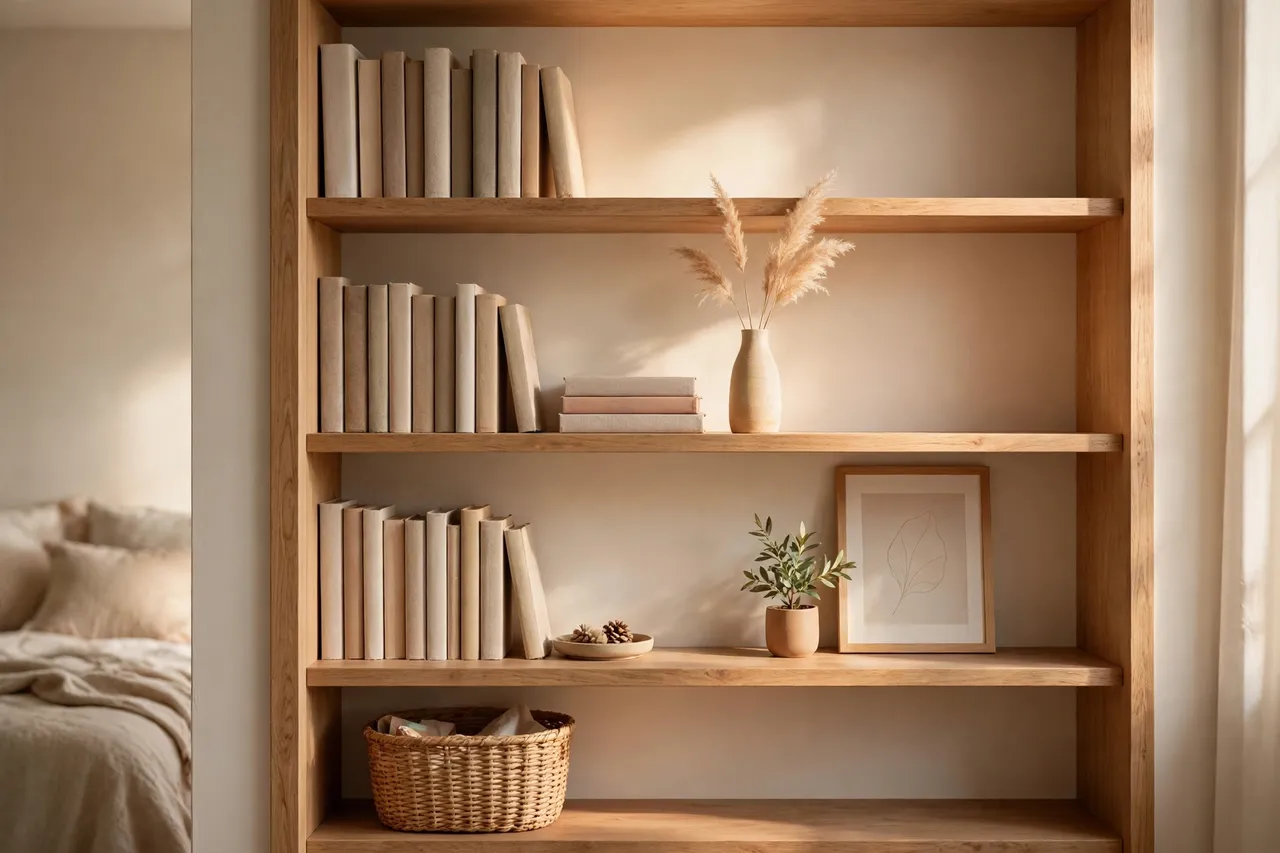
Styling starts with editing, not shopping. Take everything off the shelves, clean them, and start from a blank surface. Then place the largest items first: rows of books, a basket, or a framed print. Next, add medium items, such as a small plant or a vase. Finally, fill the remaining gaps with one or two small objects per shelf, not five.
Mix vertical rows with a few horizontal stacks, and leave some shelves partly empty. Empty space lets the eye rest, and it keeps a full shelf wall from reading as one solid block. Vary heights and shapes, too: pair a tall vase with a low stack of books, or lean a framed print behind a small plant.
Keep one color thread through the display. That thread could be warm wood tones, soft neutrals, or one accent color repeated in small amounts. When every object shouts a different color, the shelf looks busy even when it holds few things. When the colors agree, even a full shelf looks calm.
Hide small clutter in baskets or boxes on the lowest shelves. Chargers, notebooks, and other small bedroom items look tidy inside a matching box, and they stay easy to grab. Put everyday reads at hand height, heavy books low, and display pieces where you see them most.
Common Shelving Mistakes to Avoid
First, do not hang a heavy shelf above a bed. Even a well-fixed shelf can feel unsettling overhead, and a falling book or frame can hurt. Keep over-bed shelves shallow and light, and move heavy storage to a side wall.
Second, do not skip the stud finder. Drywall alone cannot carry a row of hardcovers, no matter how strong the shelf looks. If you cannot reach a stud, choose lighter items, stronger anchors rated for the load, or a freestanding unit instead.
Third, do not fill every inch. A shelf packed edge to edge collects dust, hides the books you want, and makes the room feel smaller. Leave breathing room, and move overflow books to another shelf or another room rather than stacking a second row in front of the first.
Fourth, do not ignore light. A shelf in a dark corner hides your books and your display. A small lamp, a warm LED strip under the lowest shelf, or simply a shelf placed where daylight reaches it can change the whole wall. Warm white light around 2700 to 3000 Kelvin feels cozy in a bedroom, and a dimmer lets you turn it down at night.
Related Guides
If you rent, start with the renter-friendly ideas in this guide and pair them with a room plan that protects your deposit. For broader small-space ideas, see how a compact room can still feel warm and personal in Christmas Decor for Apartment: A Cozy, Renter-Friendly Guide, which focuses on renter-safe choices for a small home.
Frequently Asked Questions
How deep should a bedroom bookshelf be?
Most books fit a shelf 10 to 12 inches deep. Paperbacks suit 8 to 10 inches, standard novels and hardcovers need 10 to 12 inches, and oversized art books need 12 to 14 inches. Measure your tallest books first, and leave a little extra depth so nothing sticks out past the edge.
How do I safely mount floating shelves and over-bed shelves?
Mount into wall studs wherever possible, and use heavy-duty anchors rated for the actual load where no stud exists. Anchor tall units with an anti-tip kit. Above a bed, keep the shelf shallow, store only light items there, and add bookends so nothing can slide off onto the pillows.
What is the best bookshelf for a small bedroom?
Floating shelves, a leaning ladder shelf, or a corner unit usually work best, because they use wall or corner space and leave the floor clear. A bookshelf headboard also works well, since it replaces a separate bookcase and a nightstand in one piece. Avoid a wide, deep bookcase in a small bedroom unless it is your only storage.
How can I style a bookshelf without making it look cluttered?
Mix vertical rows with a few horizontal stacks, leave some shelves partly empty, and limit decor to one or two objects per shelf, such as a small plant, a vase, or a framed photo. Put heavy books low, keep everyday reads at hand height, and hide small clutter in baskets or boxes on the lowest shelves.
Do I need built-in lighting for a bedroom bookshelf?
Not always, but it helps a lot in a reading nook or on a shelf you use at night. Warm white LEDs at 2700 to 3000 Kelvin with a dimmer give a cozy glow without a harsh ceiling light, and a diffuser strip keeps the light soft. A bedside lamp can do the same job.
Start with one wall and one job: a bedside ledge for nightly essentials, a corner unit for books, or a single floating shelf for display. Measure the wall, find the studs, and load the shelf slowly. A bedroom shelf earns its place when you reach for it every day without thinking about it, and that simple test tells you whether the next shelf should go up too.


