
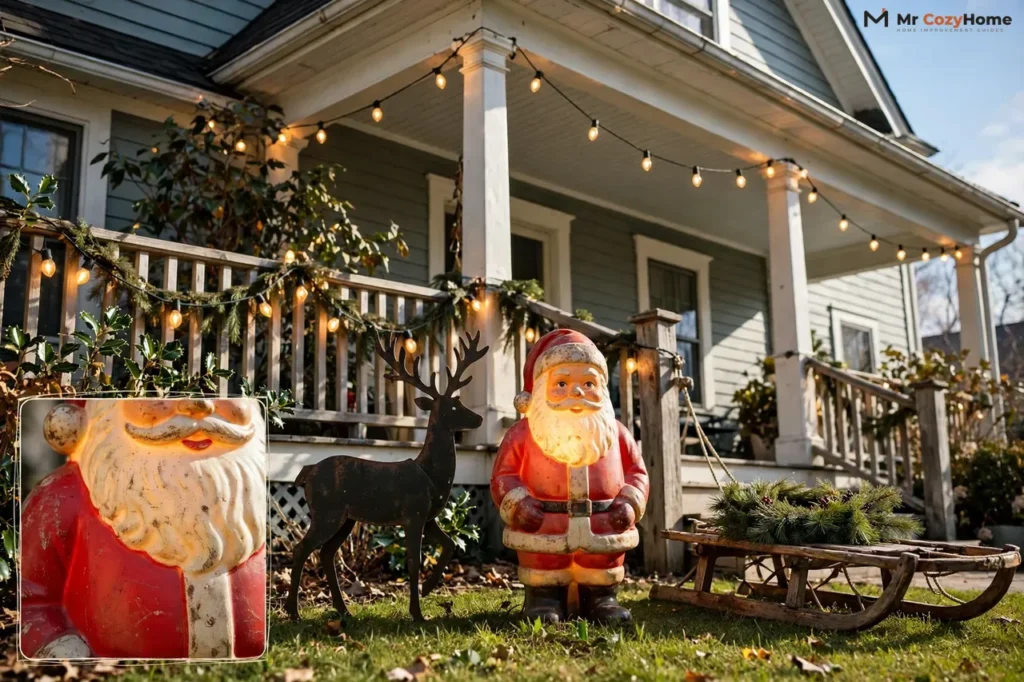
If you want antique outdoor Christmas decorations, here is the honest truth: most pieces you will find are not true antiques at all. A true antique is at least 100 years old, and very few outdoor pieces survive that long in rain, snow, and sun. Most of what sellers call “antique” is vintage decor from the 1950s through the 1980s, such as blow mold Santas, metal reindeer, wire-frame figures, and big C7 and C9 bulbs. Those vintage pieces can look wonderful in a yard, and this guide shows you how to spot real ones, judge their condition, protect them from the weather, and handle old lights safely. One rule comes first: never plug in a damaged vintage light string. Keep it display-only, or let a qualified electrician rewire it.
That single rule shapes this whole guide. Old outdoor pieces carry real charm, but they also carry real age. Plastic turns brittle, paint flakes, metal rusts, and wiring breaks down. You can still build a beautiful vintage display. You just need to know what you are buying, what you should leave alone, and when you should call a professional.
What Counts as Antique, Vintage, or Just Vintage-Style?
Sellers use these three words loosely, so learn what each one should mean before you spend money. The table below gives you the plain version.
| Label | What it usually means | What it means for your yard |
|---|---|---|
| Antique | At least 100 years old | Very rare outdoors; treat it as a fragile collectible, not everyday yard decor |
| Vintage | Old, but less than 100 years old, often from the 1950s through the 1980s | The sweet spot for most buyers: real age, real charm, and still usable with care |
| Vintage-style | Newly made to look old | Often the safest choice for lights and large displays, but it is not a collectible |
Most outdoor pieces from the mid-1900s fall in the vintage group. The Outdoor Nativity Store guide defines vintage Christmas decorations as pieces from the 1950s through the 1980s, the post–World War II years, in its guide to vintage Christmas decorations. Blow mold figures, for example, became a popular lawn decoration in the 1960s, and they stayed popular for decades. A 1960s blow mold Santa is a genuine vintage piece, even though it is not an antique by the 100-year rule.
Why Sellers Stretch the Word Antique
“Antique” sounds rare, and rare sounds valuable. Some sellers use it for anything old-looking, including brand-new reproductions. That is why you should always ask for proof of age, such as a maker mark, a date stamp, or clear photos of wear in the right places. If a seller cannot show you any of that, shop for the look you love and pay a vintage-style price, not an antique price.
Values for old pieces vary a great deal with condition, rarity, maker, and provenance. This guide gives no price for any antique piece, because a single number would mislead you. Two Santas from the same maker can differ hugely when one kept its original paint and the other did not.
The Classic Pieces You Will Actually Find Outdoors
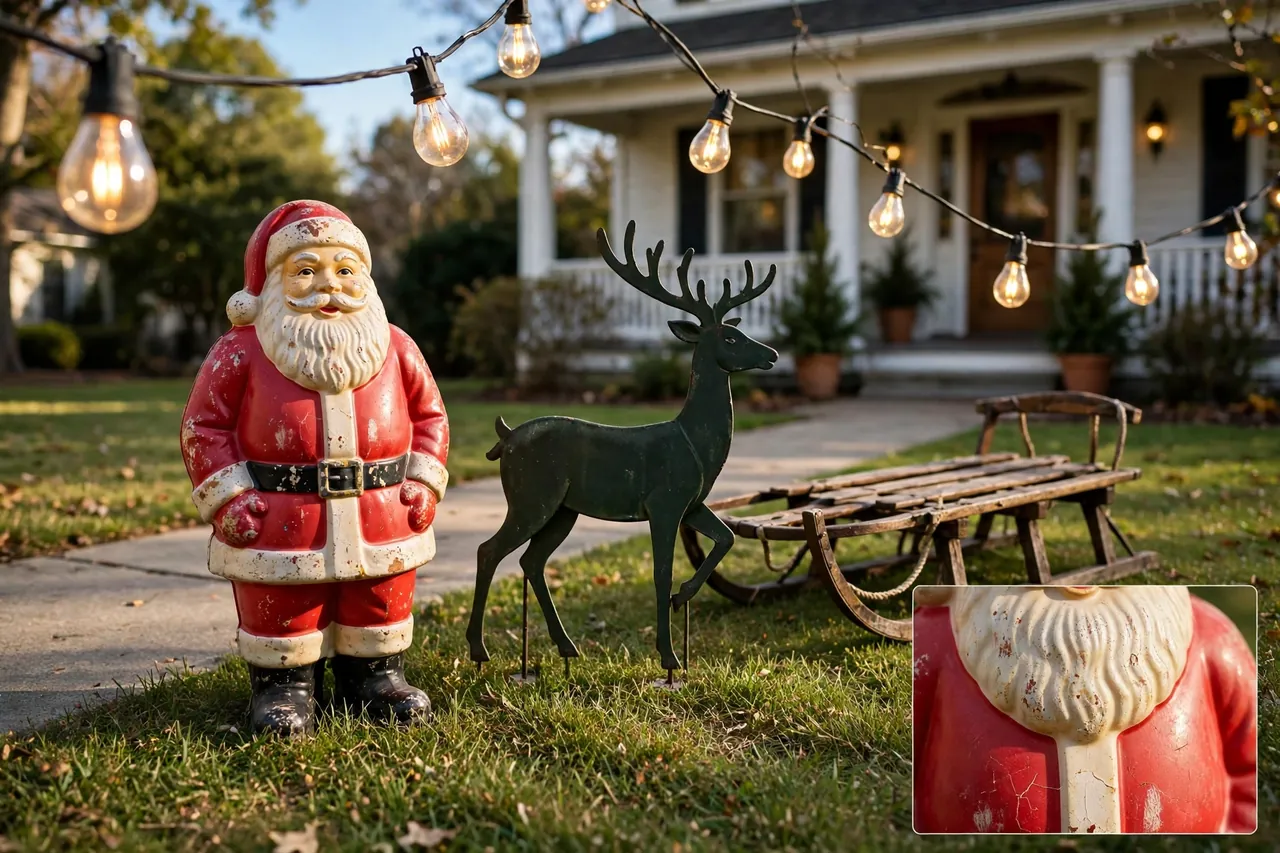
When people picture antique outdoor Christmas decorations, they usually picture a short list of classics. Each one has its own strengths and its own weak spots. Learn them before you buy, and you will spot trouble fast.
Blow Mold Figures
Blow molds are hollow plastic figures with a light bulb inside, and they ruled American lawns from the 1960s onward. Santas, snowmen, reindeer, candles, and nativity figures all came in this form. Makers such as Empire and Union Products made many of the pieces collectors still hunt for today.
Check the base and the back for a molded maker name, and look for thick, sturdy plastic with hand-painted detail. Newer reproductions often use thinner plastic and colors that look washed out or oddly bright. Christmas Central notes the same tells in its guide to the vintage charm of blow mold Christmas decorations: older pieces may carry a date stamped into the bottom, while barcode stickers mark a piece made after the 1970s. A little paint wear in high-touch spots is normal for a piece that spent years outside. Big cracks, deep fading, or missing parts are not.
Metal and Wooden Lawn Figures
Painted metal silhouettes and wooden cutouts gave yards their shape before plastic took over. Stars, trees, candy canes, reindeer, and carolers all appeared as flat lawn figures staked into the ground. Metal pieces rust at joints and edges first, so check those spots closely. Wooden pieces swell, split, and rot where water sits, so check the bottom edge and any spot where paint has peeled away.
These figures look best in groups of two or three, not in a crowd. A single reindeer pair beside a walkway reads as vintage charm. Ten figures crammed on a small lawn read as clutter.
Wire-Frame Figures and Silhouette Cutouts
Wire-frame snowmen and Santas, often dressed in flocking or fabric, date back to the 1930s and stayed popular for decades. Their charm comes from their simple outline, especially when light shines through them at night. Their weak spot is the frame itself: bent wire, broken welds, and rotted fabric all need repair before the piece goes back outside.
If you love the classic sleigh-team look, read our guide to Santa and reindeer outdoor decorations for scene ideas that suit these older figures.
Old C7 and C9 Light Strings
The big ceramic-style C7 and C9 bulbs are the glow most people remember from childhood Christmases. They throw a warm, soft light that tiny modern bulbs cannot quite copy. They also carry the biggest safety risk in this whole guide, because their cords age badly. Read the safety section below before you plug any old string in, and treat a damaged string as display-only.
For a calmer overview of modern light types, see our guide to lighted Christmas decorations. It helps you pair a vintage look with safe, current wiring.
Wooden Sleds and Nativity Sets
Old wooden sleds make lovely porch decor with a wreath or a pair of vintage ice skates on top. Outdoor nativity sets, often in blow mold plastic, anchor a quiet corner of a yard. Both types need shelter from standing water. A sled left flat on wet ground rots from the bottom up, and a nativity figure left in a puddle fades and cracks.
Our guide to outdoor sleigh decoration covers placement, lighting, and styling for sleds and sleighs of every age.
How to Tell a Real Old Piece From a Reproduction
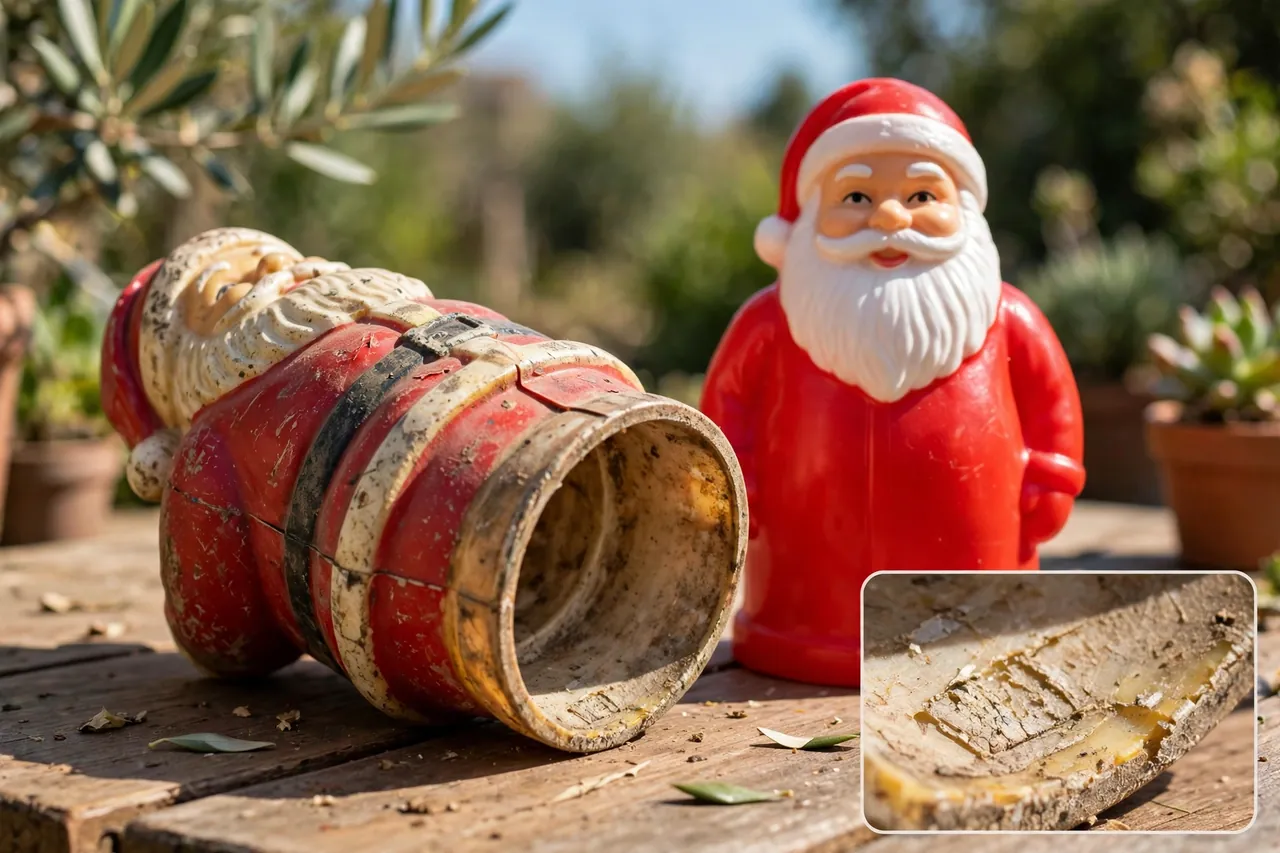
Reproductions are not bad. They just are not old, and you should not pay an old-piece price for one. Use these three checks together, because no single clue proves age on its own.
Look for Maker Marks and Real Age Clues
Turn the piece over and look at the base, the back, and the inside of any access hole. Older blow molds often carry a maker name molded into the plastic, and some carry a date stamp. A sticker with a barcode points to a much newer piece, since barcodes came into wide use after the 1970s. For metal and wooden pieces, look for old-style screws, hand-painted brush marks, and faded maker labels rather than crisp new printing.
Ask the seller for close-up photos of these marks before you buy online. A seller who refuses to show the base is a seller you should skip.
Feel the Materials and the Weight
Real vintage plastic feels thick and sturdy, while many reproductions feel thin and light. Real old paint feels slightly uneven, because workers painted many pieces by hand. New paint often looks too perfect, too even, or too bright. Metal pieces should feel solid at the joints, not wobbly or paper-thin. Wood should feel dry and firm, not soft or spongy.
Read the Wear Like a Story
Real age leaves wear in places that make sense. Paint fades on the sun-facing side. Edges rub bare where hands grabbed the piece each year. Bases scuff where they sat on concrete. Fake aging looks too even, as if someone distressed the whole piece at once. If every surface looks equally worn, trust your doubt and walk away.
💡 Practical Home Tip: Photograph the maker mark, the wear spots, and any damage before you buy or store a piece. Those photos protect you if you ever resell it, and they help you track how the piece ages from one season to the next.
Where to Find Antique Outdoor Christmas Decorations
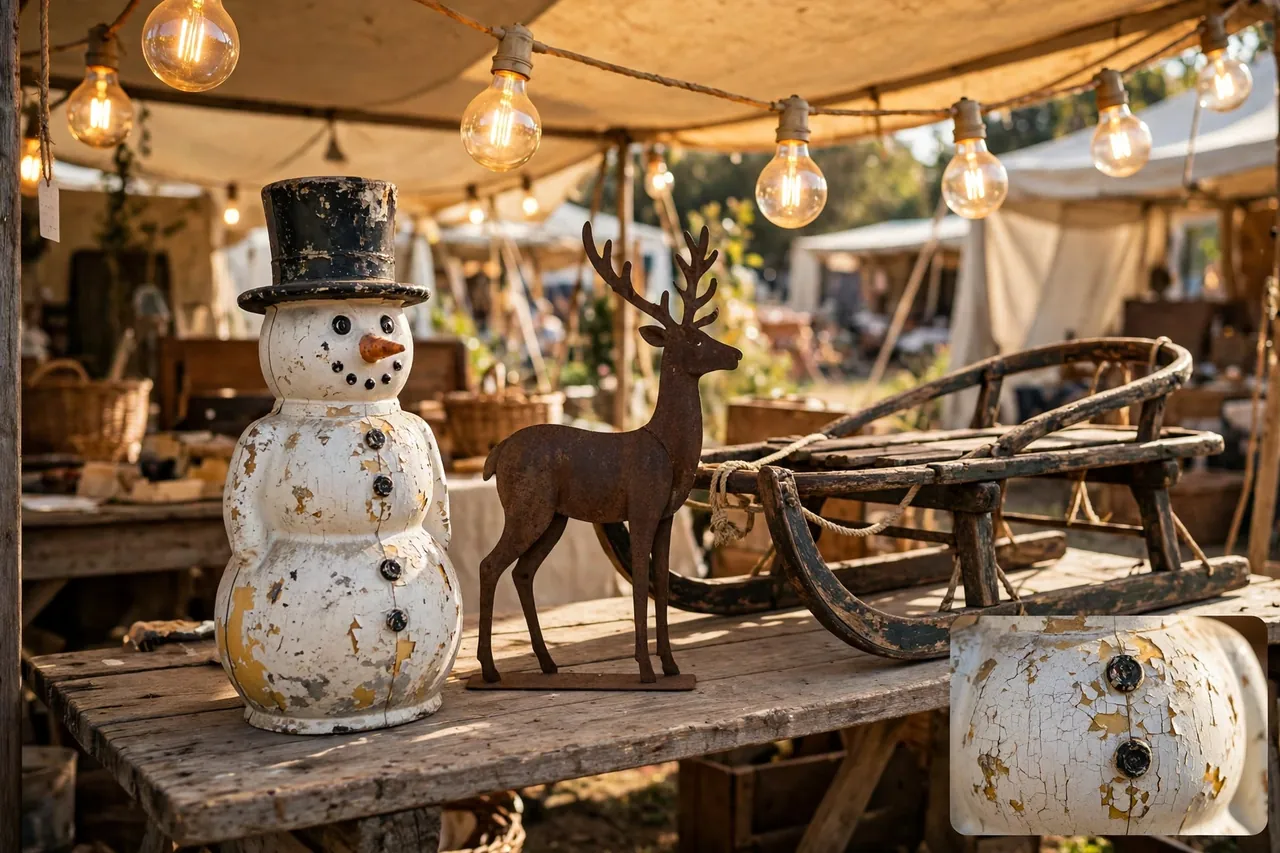
The best finds rarely sit in one place. Spread your search across a few sources, and give yourself time. The best pieces often appear in November, when estates and shops clear holiday stock.
- Antique malls and antique shops, where you can inspect a piece in person before you pay.
- Estate sales, especially for homes decorated in the 1960s through the 1980s.
- Flea markets and December holiday shows, where dealers bring out seasonal stock.
- Thrift shops and garage sales, where prices run lower but condition varies widely.
- Online marketplaces such as eBay and Etsy, where you should demand base photos and damage photos first.
- Your own attic or a family member’s garage, where the best piece may already wait for free.
Buy in person when you can. You can lift the piece, flex nothing that should not flex, and check the base in daylight. Online buying works too, but only with a seller who answers questions, shows flaws honestly, and accepts returns. Vague listings with one dark photo deserve a pass, no matter how pretty the piece looks.
If your budget runs tight, mix one real vintage star piece with affordable new decor around it. Our guide to Christmas decorations cheap DIY shows how to stretch a display without losing the vintage feel. You can also build simple yard pieces yourself with our guide to DIY Xmas decorations outdoors.
Judging Condition Before You Buy
Condition decides both beauty and safety. Run through this table on every piece, and do it in daylight. A porch light hides cracks that daylight reveals.
| Check | Good sign | Walk-away sign |
|---|---|---|
| Plastic body | Firm, with light scuffs and minor paint wear | Brittle, chalky, or cracked near light housings |
| Paint | Original paint with honest fading | Thick repaint that hides damage or maker marks |
| Metal frame | Surface rust you can brush off | Deep rust, bent wire, or broken welds |
| Wood | Dry, firm, and solid at the base | Soft, spongy, or split wood |
| Wiring | Flexible cord, intact sockets, fused plug | Frayed wire, cracked sockets, or bare copper |
| Stability | Stands firm with stakes or a weighted base | Wobbles, leans, or lacks its base |
Minor flaws are part of the deal with old decor. A small paint chip tells a true story, and you can live with it. Structural cracks, rot, and bad wiring tell a different story, and you should not pay full price for that story.
Restoring vs Preserving Patina
Patina means the soft wear, fading, and tone that age gives a piece. Collectors value it because it proves the piece lived a real life. Restoring means you clean, repair, or repaint it. Both choices can be right, but they serve different goals.
When You Should Leave the Patina Alone
Leave the patina alone when the piece has rare maker marks, original paint, or a family story. A gentle dusting with a soft brush or a soft cloth is enough. Harsh cleaners, wire brushes, and strong chemicals strip original paint and erase the very age that makes the piece special. If you plan to resell the piece one day, heavy restoration usually hurts its appeal to collectors.
Safe, Gentle Fixes You Can Do at Home
Start with mild soap and water on plastic, and dry the piece fully before you store it. Tighten loose screws, replace a missing stake, and touch up only tiny chips with matching paint if the piece is a yard decorator rather than a collectible. Keep any repair small, reversible, and honest. If a crack sits near a light housing or a metal support, stop and get professional help instead of gluing it and hoping for the best.
Weatherproofing Old Materials for Outdoor Life
Old materials were not built for today’s long, wet seasons. You can still display them outside, but you must give them shelter, drainage, and a way to dry out.
- Raise every piece off bare soil and out of puddles with a stand, a stone, or a porch board.
- Place fragile pieces under a porch roof or eave when wind and driving rain hit your yard.
- Anchor tall figures with stakes or weights so a winter gust cannot throw them across the lawn.
- Seal bare wood with an outdoor-safe clear finish, and recoat it when water stops beading on the surface.
- Brush rust off metal, treat it, and repaint only the damaged spots so the piece keeps its old look.
- Bring the most fragile pieces inside during storms, and never leave them out all winter.
Sun fades paint faster than any other force, so rotate a prized piece to a shadier spot every few weeks if you can. Small moves like that add years to an old figure’s life.
Old Christmas Lights: The Safety Rules That Matter Most
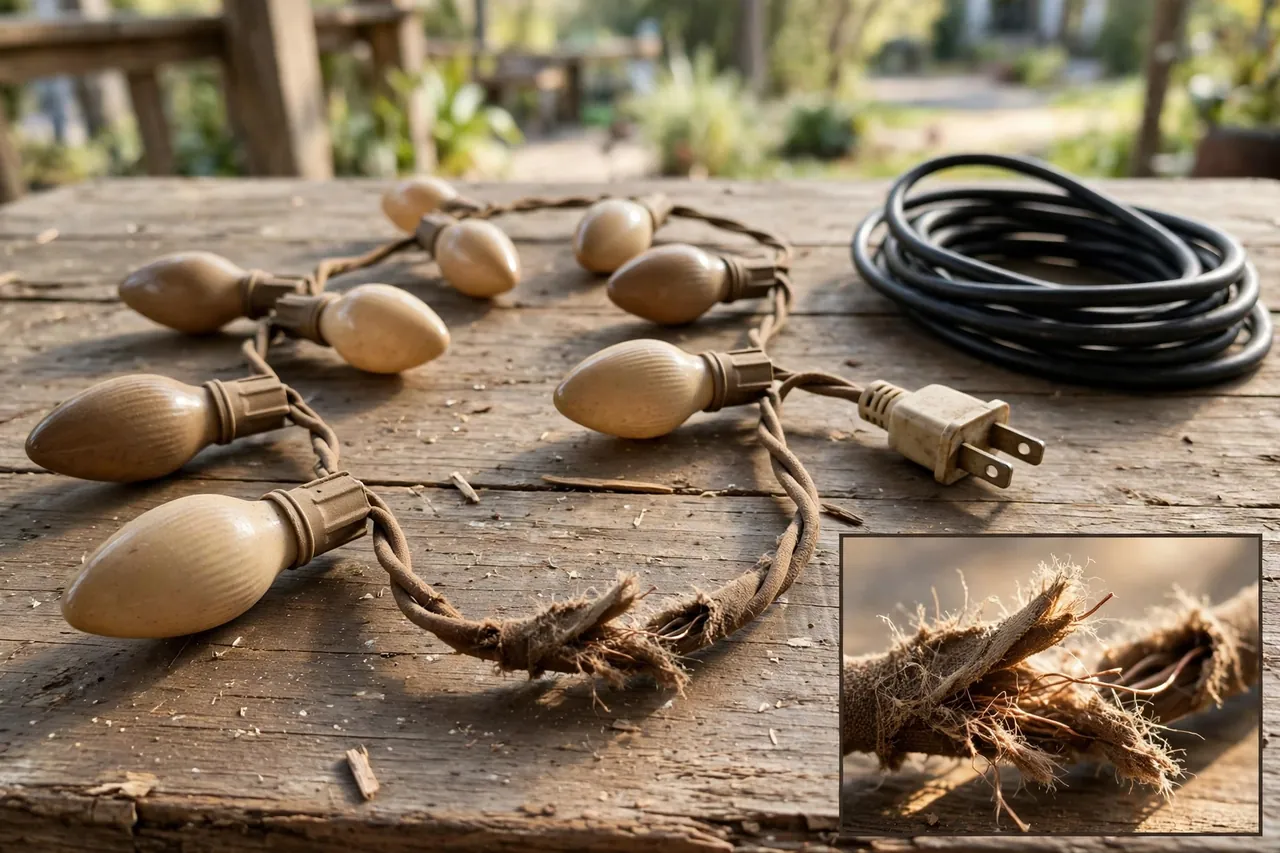
Old light strings deserve respect, not fear, and not blind trust either. Wiring insulation turns brittle with age, sockets crack, and early sets often lack the fuses and protections that modern sets carry. The U.S. Consumer Product Safety Commission (CPSC) advises buyers to use only lights tested for safety by a recognized testing laboratory, to check every set for broken or cracked sockets, frayed or bare wires, and loose connections, and to throw out damaged sets, in its holiday decorating safety guidance. That advice matters twice as much for strings made decades ago.
Safety caution: Do not plug in a vintage light string until you finish the full inspection below, and never test it while it hangs on a tree, a metal frame, or wet ground. Work on a dry, non-flammable surface, keep children and pets away, and unplug the string the moment you smell heat, see sparks, or feel warmth in the cord. A damaged vintage string must not go back into service on its old wiring.
- Unplug the string and inspect the whole cord in daylight. Look for frayed insulation, bare copper, cracked sockets, and loose connections.
- Flex the cord gently in a few spots. If it feels stiff, crackly, or crumbly, retire the string from electrical use.
- Check each socket for cracks and each bulb for a firm, clean fit. Replace a burned-out bulb only with the same wattage.
- Look for a fused plug and an outdoor rating on the tag. If the tag is gone or the set lacks a fuse, treat the string as display-only.
- Test the string briefly on a dry, non-flammable surface while you watch it. If any bulb fails, the cord warms up, or anything smells hot, unplug it and retire it.
- Connect no more than three standard-size sets per extension cord, and use only an extension cord rated for outdoor use.
Display-Only or Rewired: The Only Two Safe Choices for Damaged Strings
A damaged vintage string still has a future, just not on its old cord. Hang the unplugged bulbs as a daytime display, or place the string inside a glass-front cabinet where no one can plug it in by mistake. The second choice is professional rewiring: a qualified electrician can fit modern, safety-listed wiring and sockets while you keep the vintage bulbs and look. Do not rewire a string yourself unless you truly hold electrical skills, because a bad repair hides danger behind a pretty glow.
Swapping old bulbs for LEDs does not fix old wiring. The cord, the sockets, and the missing fuse stay just as old and just as risky. New bulbs on a bad cord still run through a bad cord.
Outdoor Power Rules That Protect You
Plug outdoor lights and decorations into circuits protected by ground-fault circuit interrupters (GFCIs), as the CPSC recommends in the same holiday decorating safety guidance. GFCIs cut power fast when current leaks, which is exactly the risk wet ground and old cords create. Keep every connection dry, use clips made for lights rather than nails or staples, and turn lights off when you leave the house or go to bed. For hands-on build ideas with safe modern wiring, see our guide to DIY Christmas lighting.
Styling a Vintage Outdoor Display Without Overdoing It
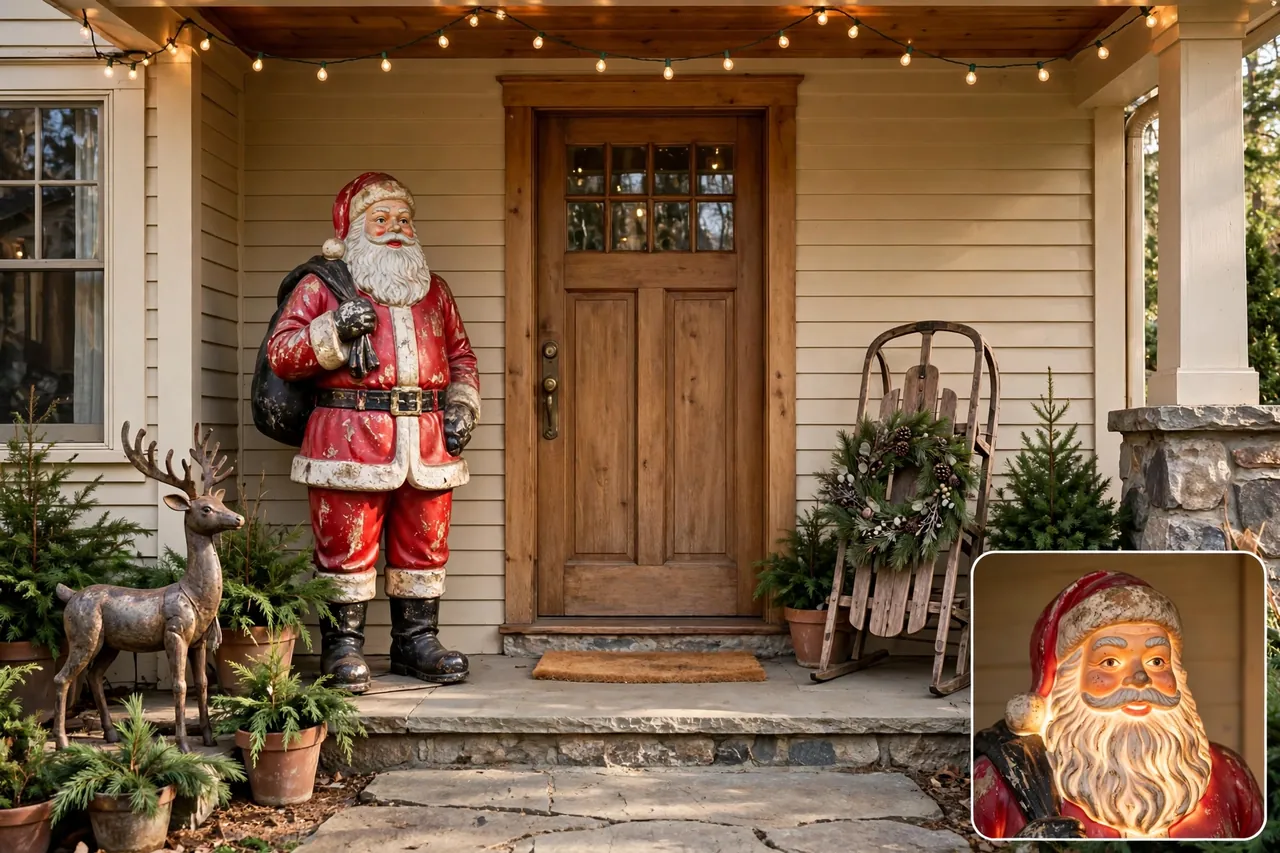
A vintage display works best when each piece gets room to shine. Pick one hero piece, such as a tall blow mold Santa or a wooden sled, and build around it with two or three smaller pieces. Repeat one color, such as warm red or soft white, so the yard reads as one scene rather than a cluttered sale table.
Place large figures where people naturally look: beside the front door, at the end of a walkway, or near a porch corner. Keep walkways clear and cords out of foot traffic. If you want a whole-house plan, our guide to decorating outside your house for Christmas walks through the full layout. For windows, pair your yard pieces with our ideas for outdoor Christmas window decorations, and for a cozy porch, see Christmas patio decorating ideas.
Mix old and new with care. A vintage figure beside a modern LED string looks fine when the colors match and the new lights stay soft. Harsh, flashing, color-changing lights beside a 1960s Santa fight the vintage mood, so keep new lights warm and steady near old pieces.
Storing Old Pieces So They Last Another Season
Storage decides whether a vintage piece survives to next Christmas. Attics bake plastic in summer and freeze it in winter, and damp basements grow mold on fabric and wood. Choose a cool, dry spot, and store each piece where nothing heavy sits on top of it.
- Clean each piece gently, dry it fully, and wrap it in soft cloth or tissue, not in sealed plastic that traps moisture.
- Label each box with the piece name and a note about any damage you already know about.
- Coil light strings loosely, never tightly, and keep unplugged vintage strings apart from working modern sets.
- Store paint, fabric, and paper pieces away from direct sun, even inside a garage.
- Check stored pieces once mid-year for damp, pests, or new cracks, and fix small problems early.
Quick-Reference: Your Vintage Yard Piece Checklist
Use this checklist as your one-page answer to the whole guide. If a piece fails any safety row, it stays unplugged.
| Step | What to do | Pass mark |
|---|---|---|
| 1. Identify | Find the maker mark and judge antique, vintage, or vintage-style | You know what age you actually bought |
| 2. Inspect | Check body, paint, frame, wood, wiring, and stability in daylight | No cracks, rot, deep rust, or wire damage |
| 3. Decide | Choose display, gentle repair, or professional help | Patina stays unless repair truly helps |
| 4. Weatherproof | Raise, anchor, shelter, and seal the piece | No standing water and no wind risk |
| 5. Power safely | Use GFCI outlets, outdoor-rated cords, and fused plugs only | Damaged strings stay display-only |
| 6. Store | Clean, dry, wrap, label, and store in a cool, dry spot | Nothing heavy sits on the piece |
Related Guides
Tall Christmas Decorations: How to Go Vertical Without Overwhelming Your Home · Christmas Floor Decorations: Warm Holiday Style That Starts at Ground Level · Christmas Decor for Chimney: A Safe, Beautiful Guide for Inside and Out
Frequently Asked Questions
How do I identify vintage blow mold decorations?
Look for a maker name such as Empire or Union Products molded into the base or back, thick sturdy plastic, and hand-painted detail with honest wear in high-touch spots. A date stamp points to an older piece, while a barcode sticker points to a newer one. Thin plastic and overly bright, even colors suggest a reproduction.
Can I safely use vintage electric lights if I replace the bulbs with LEDs?
No, not on the old cord. New bulbs draw less power, but they do not repair brittle insulation, corroded sockets, or a missing fuse. The wiring itself stays the hazard. Keep a damaged vintage string display-only, or ask a qualified electrician to rewire it with modern, safety-listed parts.
Can I repair old Christmas lights myself?
You can safely replace a single bulb with the same wattage and tighten a loose socket if you have basic skills. Do not splice wires, replace insulation, or rebuild a plug yourself, because a bad repair can hide a fire risk. Leave wiring work to a qualified electrician, and retire any string with frayed wire or cracked sockets.
Can I use a modern surge protector with vintage lights?
A surge protector does not make a damaged vintage string safe, and it never replaces a GFCI outlet outdoors. If you use any protector, choose one rated for the load and for outdoor use where needed, and keep connections dry. When in doubt, leave the vintage string unplugged and enjoy it as a display piece.
Where can you find blow mold decorations?
Check antique malls, estate sales, flea markets, thrift shops, and garage sales, and search online marketplaces such as eBay and Etsy with clear photo requests. December holiday shows often bring out seasonal dealer stock. Always ask for base photos and damage photos before you buy online.
Please Read This Before You Decorate
This guide shares general information only, not professional electrical, restoration, or appraisal advice. Old wiring, fragile materials, and outdoor weather can create real fire, shock, and injury risks, and every old piece differs. If a string, socket, or cord shows damage, do not plug it in. Ask a qualified electrician for wiring help, a qualified restorer for valuable pieces, and a qualified appraiser before you buy or sell anything you believe may hold real value. Your safety matters more than any display.
Start small this season. Pick one vintage piece you love, check it in daylight, and give it a safe, sheltered spot where it can shine. Add a second piece next year, and let your display grow the slow, honest way. That is how a yard gains the kind of warmth people remember long after the lights come down.


